


close
Choose Your Site
Global
Social Media

Discover the benefits of HPMC cellulose in tile adhesive, dry-mix mortar, wall putty, gypsum products, and personal care formulations. Learn how HPMC improves water retention, workability, viscosity, open time, stability, and product consistency, plus expert guidance on choosing the right grade.

This article explains the chemical composition, production process, key physical properties, and application-specific selection principles of Hydroxypropyl Methyl Cellulose. It also explores how HPMC structure influences construction mortar performance and daily-chemical product behavior.

This article compares HPMC and HEMC for surface tension reduction and wetting performance in construction and daily chemical applications. It explains the chemical differences between Hydroxypropyl Methyl Cellulose and Hydroxyethyl Methyl Cellulose, evaluates their effects on spreading, viscosity, water retention, workability, and adhesion, and provides practical guidance for selecting the right cellulose ether grade for tile adhesive, wall putty, cement render, skim coat, gypsum plaster, coatings, and personal-care formulations.

Compare Daily Chemical Grade HPMC vs CMC for acidic cosmetic formulas. Learn why CMC can lose viscosity, solubility, and stability at low pH, and how non-ionic HPMC supports more reliable rheology, texture, and formulation performance in skincare and personal care.

This article explains how Hydroxypropyl Methyl Cellulose (HPMC) improves dry-mix construction materials such as tile adhesive, wall putty, cement render, gypsum plaster and waterproofing mortar. It covers HPMC functions, application benefits, HPMC versus HEMC and HEC selection, common formulation challenges and a practical testing process for more stable mortar performance.

Learn how to select the right HPMC grade for tile adhesive, dry-mix mortar, wall putty, coatings, personal care, food, and pharmaceutical applications. This guide compares viscosity, substitution level, particle size, application performance, and formulation testing considerations.

Compare HEC vs HPMC for water-based paints, coatings, personal-care products, tile adhesive, wall putty, cement mortar, plaster, and skim coat. Learn their differences in thickening, rheology, water retention, workability, open time, applications, and selection criteria for industrial formulations.
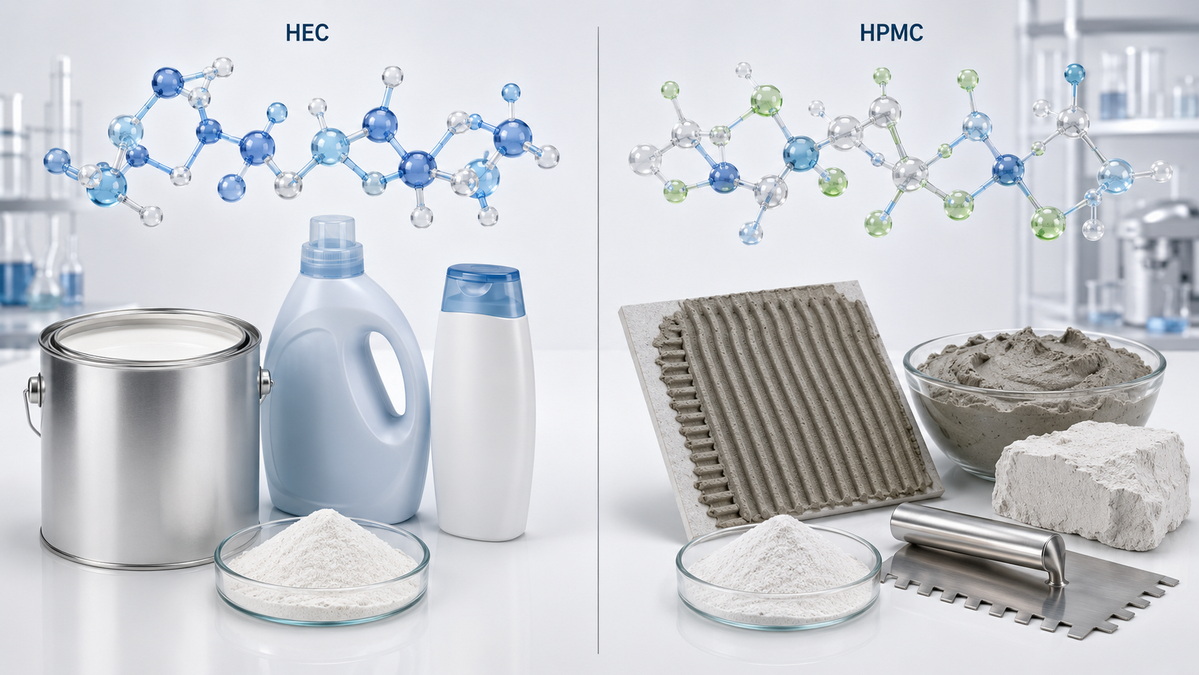
Compare HEC vs HPMC for water-based paint, personal care, tile adhesive, mortar, and dry-mix construction materials. Learn the differences in viscosity, water retention, rheology, solubility, application performance, and grade selection for reliable formulation results.

Shandong Shengda New Material is a China-based manufacturer of HPMC, HEMC, and HEC cellulose ethers for global construction-material and home-care formulators. This guide explains product functions, application-specific selection, surface treatment, testing, quality control, storage, and practical formulation considerations for stable product performance.


