


close
Choose Your Site
Global
Social Media
Views: 297 Author: Shengda Publish Time: 2026-08-27 Origin: Site


Content Menu
>> What Is Hydroxyethyl Cellulose (HEC)?
>> What Is Hydroxypropyl Methyl Cellulose (HPMC)?
● HEC vs HPMC: Key Differences at a Glance
● HEC vs HPMC in Water-Based Paints and Coatings
>> Why HEC Is Commonly Used in Paint
>> How to Evaluate HEC in a Paint Formula
● HEC vs HPMC in Construction Mortar
>> Why HPMC Is Important in Cement-Based Materials
>> The Balance Between Water Retention and Workability
>> Example: Choosing HPMC for Tile Adhesive
● Which Is Better: HEC or HPMC?
● How to Select the Right Cellulose Ether
>> Step 1: Identify Your Application Type
>> Step 2: Define the Primary Performance Goal
>> Step 3: Test the Complete Formula
>> Step 4: Confirm Consistency and Supply Reliability
● Common Mistakes When Choosing HEC or HPMC
>> Ignoring Climate and Substrate Conditions
>> Skipping Pilot-Scale Validation
● FAQ
>> 1. What is the main difference between HEC and HPMC?
>> 2. Is HEC better than HPMC for water-based paint?
>> 3. Is HPMC suitable for tile adhesive?
>> 4. Can HEC replace HPMC in cement mortar?
>> 5. Does a higher HPMC dosage always improve mortar performance?
>> 6. Can HEC and HPMC be used together?
>> 7. What information is needed to select the right HEC or HPMC grade?
Hydroxyethyl Cellulose (HEC) and Hydroxypropyl Methyl Cellulose (HPMC) are two widely used non-ionic cellulose ethers. Both can improve viscosity, water management, stability, and application performance. However, they are not interchangeable.
The right choice depends on the formulation system, the target performance, processing conditions, and the expectations of end users. In general, HEC is widely used in water-based coatings and daily chemical products, while HPMC is commonly selected for construction dry-mix materials that require strong water retention and workability.
For formulators, buyers, and product managers, understanding the practical difference between HEC and HPMC can reduce development time, avoid unnecessary reformulation, and improve finished-product consistency.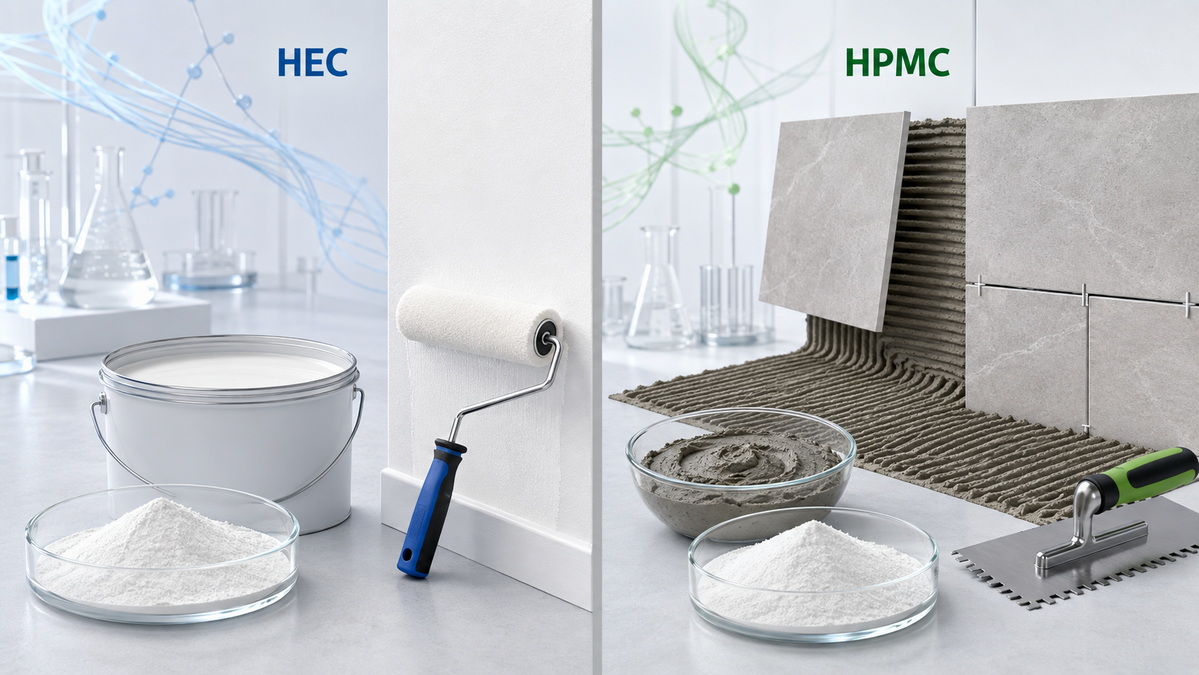
HEC and HPMC are cellulose ethers derived from natural cellulose. Cellulose is chemically modified to give it water-soluble or water-dispersible properties. These modifications allow cellulose ethers to perform valuable functions in coatings, construction materials, personal-care products, and other water-based formulations.
Both HEC and HPMC are non-ionic. This gives them good compatibility with many ingredients commonly used in industrial formulations.
However, their molecular structures are different. That difference affects hydration speed, thickening behavior, water retention, rheology, temperature response, and end-use performance.
Hydroxyethyl Cellulose is produced by introducing hydroxyethyl groups into the cellulose molecular chain. It is widely recognized as an effective thickener and rheology modifier for aqueous systems.
HEC is often used when a formulation needs controlled viscosity, good flow, pigment suspension, and stable application properties.
Common HEC applications include:
- Water-based architectural paints
- Latex paints
- Interior and exterior coatings
- Water-based inks
- Shampoos
- Body washes
- Hand soaps
- Household cleaning products
- Cosmetic gels
- Water-based industrial coatings
In many waterborne formulations, HEC helps create a balance between viscosity, flow, leveling, and anti-sag behavior.
Hydroxypropyl Methyl Cellulose is produced by adding methoxy and hydroxypropyl groups to the cellulose backbone. This creates a cellulose ether with strong water-retention and thickening properties.
HPMC is commonly used in cement-based, gypsum-based, and other dry-mix construction materials. It can improve water management during application and support a more stable, workable mixture.
Common HPMC applications include:
- Tile adhesives
- Cement-based mortar
- Wall putty
- Skim coat
- Cement render
- Gypsum plaster
- EIFS and ETICS systems
- Self-leveling compounds
- Masonry mortar
- Repair mortar
- Daily chemical products
- Pharmaceutical and food-related formulations where suitable grades are used
In construction materials, HPMC is especially valuable when water retention, open time, adhesion, and workability need to be controlled together.
| Property | HEC | HPMC | Practical Meaning |
|---|---|---|---|
| Full name | Hydroxyethyl Cellulose | Hydroxypropyl Methyl Cellulose | Both are non-ionic cellulose ethers |
| Main chemical group | Hydroxyethyl group | Methoxy and hydroxypropyl groups | Different substitution groups create different performance profiles |
| Primary function | Thickening and rheology control | Water retention, thickening, and workability improvement | Selection should follow the main formulation target |
| Typical application | Water-based paints and daily chemicals | Construction dry-mix mortar and specialty applications | Application environment is a major selection factor |
| Water retention in mortar | Usually not the first choice | Often a core performance function | HPMC is commonly preferred for cementitious systems |
| Coating flow and leveling | Often highly suitable | Can be used in selected systems | HEC is widely evaluated for waterborne coatings |
| Thermal behavior | Primarily used for aqueous thickening | Can exhibit thermal gelation behavior | Process temperature may affect grade selection |
| Common performance concern | Hydration quality and compatibility | Excessive stickiness or delayed setting at high dosage | Laboratory testing is essential |
| Typical decision point | Viscosity, leveling, suspension, anti-sag | Water retention, open time, trowelability, adhesion | Focus on the finished-product requirement |
HEC is frequently selected for water-based paints because it provides effective thickening and practical rheology control. It can help paint manufacturers adjust viscosity during production while maintaining suitable flow and leveling after application.
A well-selected HEC grade can support a range of performance requirements in architectural and industrial waterborne coatings.
HEC can contribute to:
- Stable viscosity during storage
- Improved pigment and filler suspension
- Better resistance to settling
- Suitable brush and roller application
- More controlled anti-sag performance
- Improved paint flow and leveling
- Better consistency during manufacturing
- Easier viscosity adjustment in water-based systems
Paint is exposed to different shear conditions during mixing, pumping, rolling, brushing, spraying, and leveling. Therefore, a single viscosity value is not enough to evaluate thickener performance.
A paint can look sufficiently thick in a container but still have poor roller feel, weak leveling, unstable pigment suspension, or unacceptable sag resistance on a vertical wall.
A practical paint evaluation should consider the following factors:
1. Low-shear viscosity for storage stability and pigment suspension
2. Mid-shear viscosity for brush and roller application
3. High-shear viscosity for pumping and spraying behavior
4. Flow and leveling after application
5. Sag resistance on vertical surfaces
6. Compatibility with pigments, binders, dispersants, defoamers, and surfactants
7. Viscosity stability during storage
8. Film appearance after drying
For many latex paints, HEC provides a practical starting point when efficient thickening and balanced coating rheology are the main goals.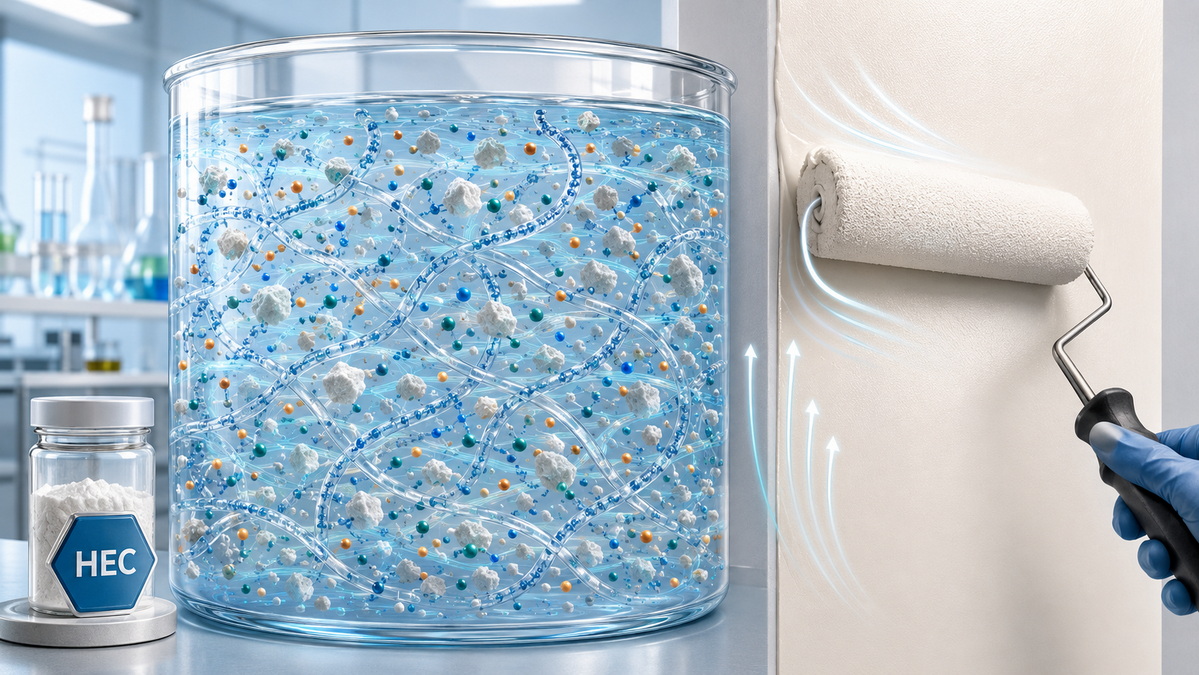
HPMC is widely used in dry-mix construction products because water retention is critical to fresh mortar performance. Cement-based materials need enough water for hydration, adhesion development, and workable application.
When mortar loses water too quickly, it can become difficult to spread and may not perform consistently on the substrate. This is especially important in warm climates, dry conditions, windy environments, and highly absorptive walls.
HPMC can help construction formulations achieve:
- Stronger water retention
- Better trowelability
- More stable workability
- Improved open time
- Better resistance to premature drying
- Improved consistency during application
- Better adhesion development
- More controlled slip resistance
- Improved handling for installers
HPMC can form a water-retaining network within fresh mortar. This helps slow the movement of water into porous substrates or into the surrounding environment.
For tile adhesive, wall putty, skim coat, plaster, and cement render, this effect can make the material easier to apply and more reliable under real jobsite conditions.
Higher HPMC dosage does not automatically create a better mortar. Too little HPMC may lead to poor water retention and dry application behavior. Too much HPMC may create excessive stickiness, reduce spreading efficiency, affect setting behavior, or increase overall formulation cost.
The goal is not to maximize one property. The goal is to create a balanced product.
A well-designed HPMC selection should consider:
- Water retention
- Open time
- Tensile adhesion
- Slip resistance
- Workability
- Mixing time
- Surface smoothness
- Setting profile
- Climate conditions
- Raw-material consistency
- Production cost
Consider a tile-adhesive producer developing a formula for large-format tiles applied on an absorptive cement substrate.
If the mortar loses water too quickly, the adhesive may have reduced open time. The installer may also experience poor spreading, rapid skin formation, or weaker final bonding performance.
A suitable HPMC grade can help retain water in the adhesive layer for longer. This supports a more workable mortar and gives the installer more time to position the tile.
However, the grade and dosage should be tested carefully. Excessive viscosity may make the tile adhesive feel too sticky or difficult to spread with a notched trowel.
In this application, HPMC is generally the more suitable cellulose ether to evaluate first because the main challenge is water control in a cementitious dry-mix system.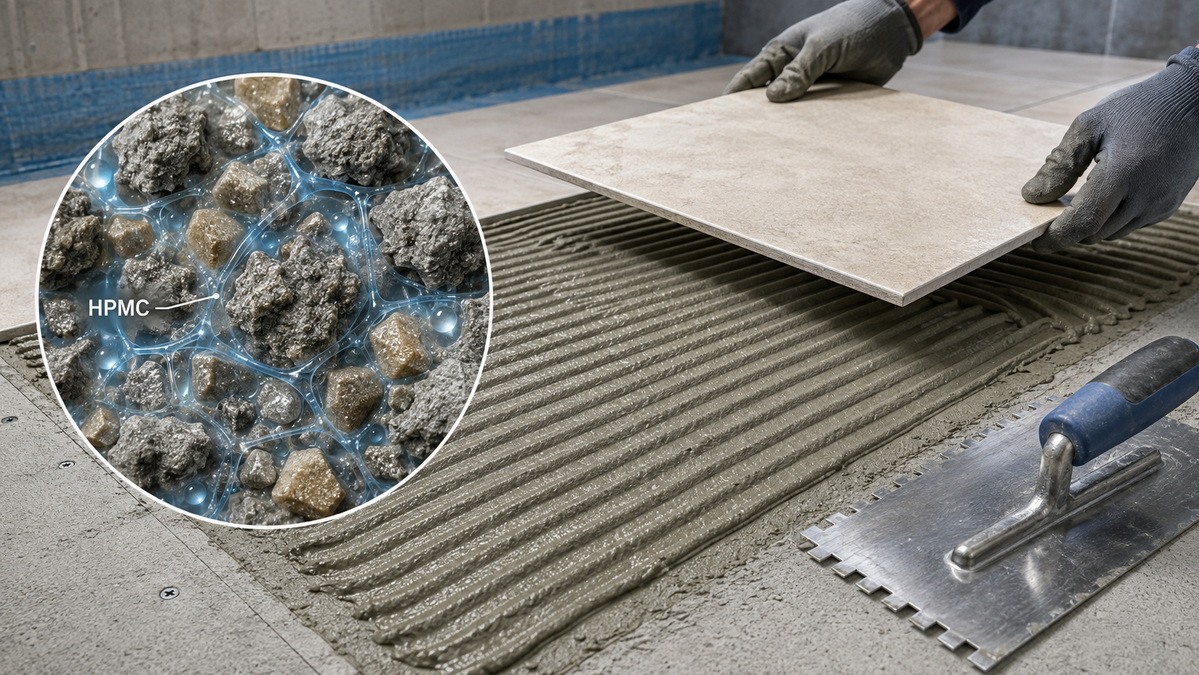
Neither HEC nor HPMC is universally better. The better option depends on what the final product must achieve.
| Formulation Requirement | More Relevant Starting Point |
|---|---|
| Water-based paint thickening | HEC |
| Latex paint rheology control | HEC |
| Better flow and leveling in coatings | HEC |
| Pigment and filler suspension | HEC |
| Shampoo or body wash thickening | HEC |
| Tile adhesive water retention | HPMC |
| Cement mortar workability | HPMC |
| Longer open time in dry-mix mortar | HPMC |
| Wall putty application performance | HPMC |
| Gypsum plaster water management | HPMC |
| Skim coat workability | HPMC |
This comparison provides a useful direction, but final selection should always be based on actual formulation testing.
Choosing the correct cellulose ether is a structured process. It should begin with the application system and end with real performance validation.
Start by defining the product category:
- Water-based paint
- Latex coating
- Industrial waterborne coating
- Shampoo or body wash
- Hand soap
- Tile adhesive
- Wall putty
- Cement plaster
- Gypsum plaster
- Skim coat
- Self-leveling mortar
- Repair mortar
For water-based coating and daily chemical products, HEC is often a logical starting material. For dry-mix construction materials, HPMC is usually the first cellulose ether to evaluate.
Clarify what the additive must improve.
For a coating, the priority may be:
- Viscosity
- Flow
- Leveling
- Sag resistance
- Suspension
- Storage stability
For a construction material, the priority may be:
- Water retention
- Open time
- Adhesion
- Workability
- Slip resistance
- Trowelability
- Setting behavior
The more clearly the target is defined, the easier it becomes to select an appropriate cellulose ether grade.
HEC and HPMC do not work alone. Their performance depends on other raw materials in the formula.
For coatings, performance can be affected by:
- Acrylic or vinyl-acrylic binder
- Pigments
- Fillers
- Dispersants
- Defoamers
- Surfactants
- Coalescents
- Preservatives
- pH adjustment agents
For dry-mix mortar, performance can be affected by:
- Cement type
- Sand gradation
- Calcium formate
- Redispersible polymer powder
- Starch ether
- Hydrophobic additives
- Mineral fillers
- Retarders or accelerators
- Mixing equipment
- Ambient temperature
A grade that performs well in one formula may not produce the same result in another.
For professional manufacturers, consistent quality is as important as initial laboratory performance.
Before finalizing a cellulose ether supplier, evaluate:
- Batch-to-batch viscosity stability
- Moisture control
- Particle-size consistency
- Packaging quality
- Storage stability
- Production capacity
- Documentation availability
- Technical communication quality
- Sampling process
- Lead-time reliability
A stable raw-material supply supports more consistent finished-product quality and reduces production risks.
HEC and HPMC should not be treated as interchangeable low-cost ingredients. A lower purchase price may lead to higher dosage, unstable production, weaker performance, customer complaints, or costly reformulation.
Viscosity is important, but it is not the only performance indicator.
For paint, formulators should evaluate flow, leveling, sag resistance, color acceptance, and storage stability.
For mortar, formulators should evaluate water retention, open time, trowelability, adhesion, slip resistance, and setting behavior.
In construction applications, temperature, humidity, wind, and substrate absorption can strongly affect mortar behavior.
A formula that performs well under controlled laboratory conditions may behave differently on a hot and dry jobsite. Testing should reflect the intended application environment whenever possible.
Laboratory testing is essential, but it should be followed by pilot-scale validation.
Production-scale mixing can change hydration behavior, dispersion quality, mixing time, and final product consistency. A well-planned pilot trial helps identify issues before commercial production begins.
The HEC vs HPMC decision should be based on the product system and the main performance target.
HEC is commonly selected for water-based paints, coatings, and daily chemical products because it offers effective thickening, rheology control, pigment suspension, flow, and leveling support.
HPMC is commonly selected for tile adhesive, wall putty, plaster, skim coat, and cement-based mortar because it can improve water retention, open time, workability, and application consistency.
The best cellulose ether is the one that performs reliably in your complete formula, under your production conditions, and in the end-use environment.
Shandong Shengda New Material Co., Ltd. provides construction-grade and daily-chemical-grade HPMC and HEC solutions for global customers. Product selection can be aligned with your target viscosity, application method, raw materials, processing conditions, climate requirements, and finished-product performance goals.
The main difference is their chemical structure and primary performance focus. HEC is widely used for aqueous thickening and rheology control, while HPMC is commonly used for water retention and workability improvement in dry-mix construction materials.
HEC is often a more suitable starting point for water-based paint because it is widely used to control viscosity, flow, leveling, pigment suspension, and anti-sag behavior. The final selection depends on the complete coating formulation.
Yes. HPMC is commonly used in tile adhesive because it can improve water retention, open time, consistency, trowelability, and overall application performance.
HEC cannot automatically replace HPMC in cement mortar. When water retention and open time are key performance requirements, HPMC is generally the more appropriate cellulose ether to evaluate.
No. Increasing HPMC dosage can improve water retention, but excessive dosage may increase stickiness, affect setting behavior, reduce spreading efficiency, or increase cost. A balanced dosage should be determined through formulation testing.
In selected applications, formulators may assess HEC and HPMC blends to balance rheology, water retention, and application behavior. Compatibility and final performance should be tested with the complete formulation.
Key information includes the application type, target viscosity, water-retention requirement, formulation ingredients, mixing method, climate conditions, substrate type, application method, and desired finished-product properties.
1. Chen, N., Wang, P., Zhao, L., & Zhang, G. "[Water Retention Mechanism of HPMC in Cement Mortar]." *Materials*, 13(13), 2918, 2020.
2. Ashland. "[Natrosol™ Performax Hydroxyethylcellulose]."
3. WOTAI Chemical. "[HEC vs HPMC: Picking the Perfect Cellulose for Success]."
4. U.S. Food and Drug Administration. "[Food Additive Status List]."


