


close
Choose Your Site
Global
Social Media
Views: 265 Author: Shengda Publish Time: 2026-08-28 Origin: Site


Content Menu
● Why HPMC Grade Selection Matters
● The Three Main Factors That Define HPMC Grades
>> Common Applications for Low-Viscosity HPMC
● Medium-Viscosity HPMC Grades
>> Common Applications for Medium-Viscosity HPMC
>> Common Applications for High-Viscosity HPMC
● How Chemical Substitution Affects HPMC Performance
>> HPMC With Higher Methoxy Content
>> HPMC With Higher Hydroxypropyl Content
● Fine vs. Coarse HPMC Particle Size
● How to Select HPMC for Tile Adhesive
>> A Practical Selection Process
● HPMC Selection for Wall Putty and Skim Coat
● HPMC in Personal Care and Home Care Products
>> Typical Personal-Care Applications
>> Typical Home-Care Applications
● Common HPMC Grade Selection Mistakes
>> Selecting Only by Viscosity
>> Comparing Different Test Methods
>> Increasing Dosage Without Testing Side Effects
>> Ignoring the Influence of Other Additives
>> Skipping Production-Scale Validation
● FAQ
>> What is the difference between HPMC, HEMC, and HEC?
>> Which HPMC viscosity grade is suitable for tile adhesive?
>> Does higher HPMC viscosity always mean better water retention?
>> Why does HPMC form lumps in water?
>> Can construction-grade HPMC be used in food or pharmaceutical products?
>> What information is needed to select an HPMC sample?
Hydroxypropyl Methyl Cellulose (HPMC), also known as hypromellose, is not a one-grade-fits-all additive. For formulators, distributors, and dry-mix mortar manufacturers, selecting an appropriate HPMC grade requires more than comparing a viscosity number.
The right choice depends on viscosity, chemical substitution, particle size, dissolution behavior, dosage, raw-material compatibility, and processing conditions. Each of these factors can influence the final product's workability, water retention, consistency, open time, adhesion, film formation, stability, and user experience.
Shandong Shengda New Material Co., Ltd. develops and supplies HPMC, Hydroxyethyl Methyl Cellulose (HEMC), and Hydroxyethyl Cellulose (HEC) products for global construction and daily-chemical markets. This guide explains how different HPMC grades work and how to make a more informed grade-selection decision.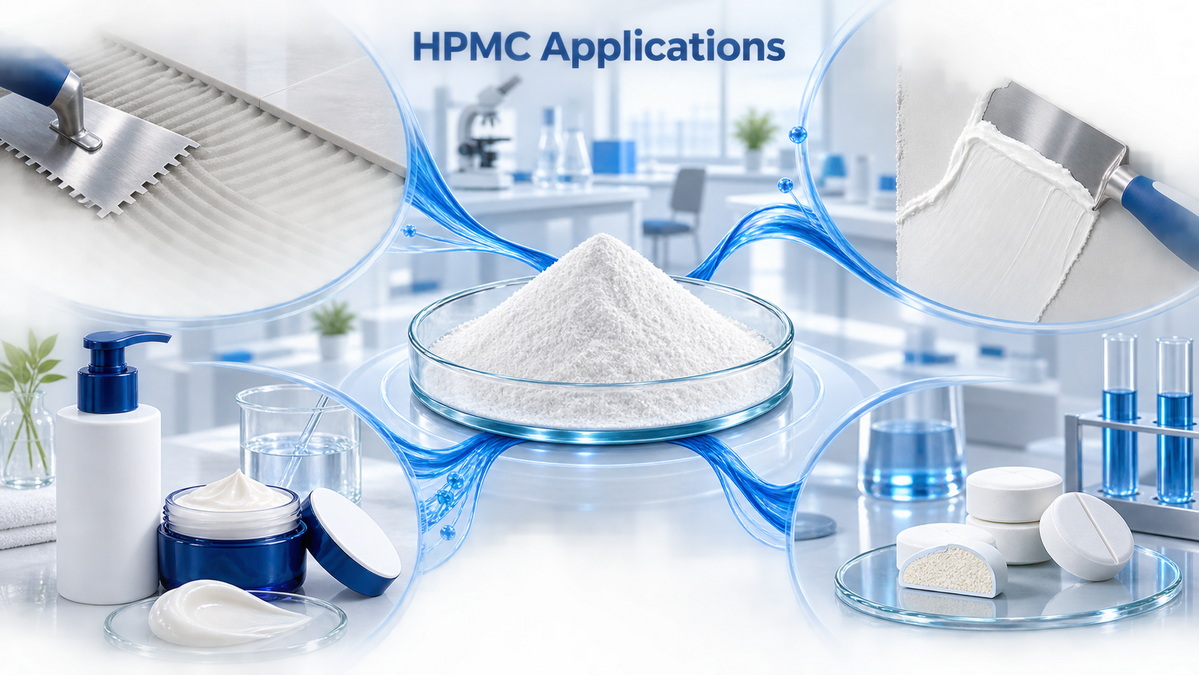
Hydroxypropyl Methyl Cellulose is a non-ionic cellulose ether derived from refined cellulose. Through a controlled modification process, cellulose receives methoxy and hydroxypropyl groups that provide valuable water-soluble and rheology-modifying properties.
When dispersed and hydrated correctly, HPMC can improve formulation behavior in several ways:
- Water retention
- Thickening and viscosity control
- Rheology modification
- Workability improvement
- Film formation
- Suspension stabilization
- Anti-sagging performance
- Open-time adjustment
- Thermal gelation
- Surface finish improvement
HPMC is widely used in cement-based and gypsum-based dry-mix products, as well as coatings, home-care liquids, personal-care products, food systems, and pharmaceutical formulations.
However, the performance of HPMC varies by grade. A grade that performs well in tile adhesive may not be suitable for self-leveling mortar. A cellulose ether selected for wall putty may not provide the desired clarity or skin feel in a personal-care formula.
The best HPMC grade is the one that delivers the required performance in the complete formulation.
In real production environments, formula performance depends on more than the cellulose ether itself. Cement type, gypsum quality, filler particle size, polymer powder, starch ether, accelerators, retarders, hydrophobic agents, water temperature, mixing time, humidity, and local raw-material variation can all affect results.
For this reason, material selection should begin with a clear performance objective rather than a single product parameter.
For example, a tile adhesive manufacturer may need:
- High water retention
- Stable open time
- Strong anti-slip performance
- Smooth trowelability
- Reliable tensile adhesion
- Consistent workability during application
A wall-putty manufacturer may focus more on:
- Easy mixing
- Smooth spreading
- Low drag during scraping
- Good anti-sagging behavior
- Fine surface finish
- Reduced cracking risk
A shampoo or lotion producer may instead prioritize:
- Controlled viscosity
- Uniform texture
- Suspension stability
- Clear appearance
- Smooth sensory properties
- Compatibility with surfactants or emulsifiers
These needs require different HPMC grades, dosage ranges, and evaluation methods.
Viscosity is the most frequently requested HPMC specification. It indicates the resistance of an HPMC solution to flow under defined test conditions.
In practical use, viscosity can influence:
- Thickening efficiency
- Water retention
- Flow behavior
- Sag resistance
- Workability
- Coating thickness
- Gel structure
- Suspension capability
A higher viscosity grade generally creates stronger thickening and structure. However, higher viscosity is not automatically better. It may reduce flowability, slow mixing, increase air entrainment, or negatively affect self-leveling performance.
Viscosity values should always be compared under the same testing conditions, including solution concentration, temperature, measurement method, and instrument setup.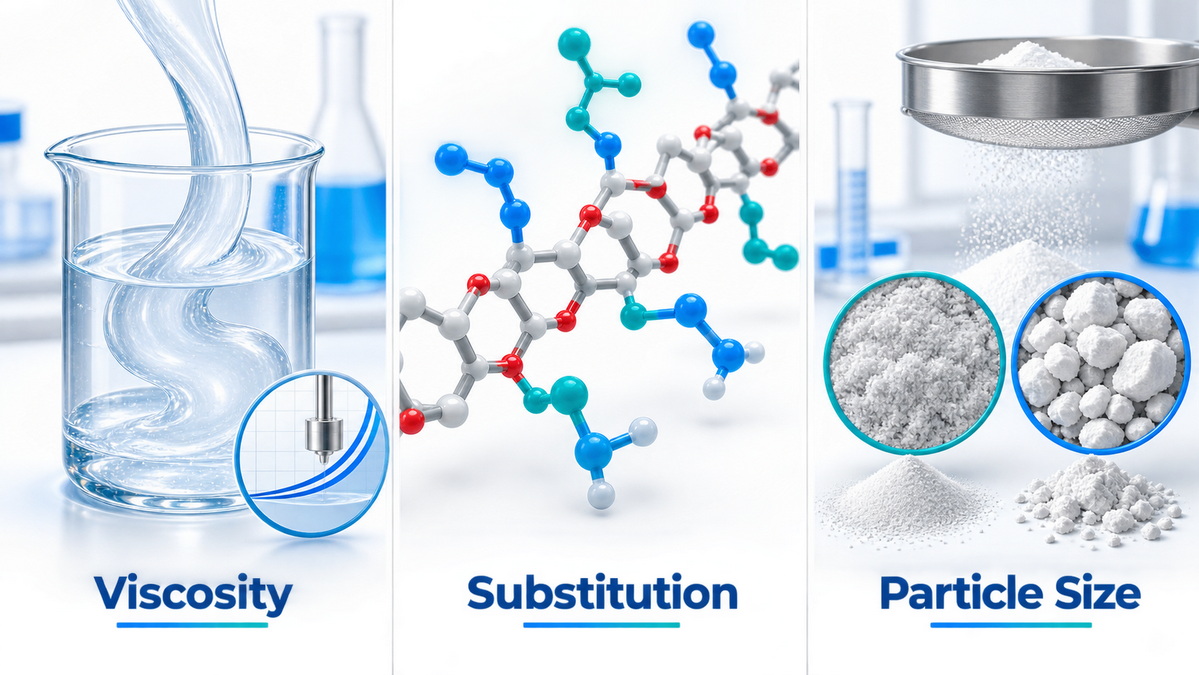
HPMC is characterized by methoxy and hydroxypropyl substitution. The balance between these groups affects solubility, hydration behavior, gelation temperature, flexibility, and film-forming characteristics.
Chemical substitution can influence:
- Cold-water solubility
- Hydration speed
- Thermal gelation behavior
- Compatibility with other ingredients
- Film flexibility
- Heat resistance
- Water retention
- Application performance
Two HPMC products with similar viscosity values may still perform differently if their substitution profiles differ. This is why viscosity alone cannot fully predict application results.
Particle size affects how quickly HPMC wets, disperses, and dissolves. It also influences powder flow, mixing behavior, storage handling, and the risk of lump formation.
Fine-particle HPMC tends to hydrate faster because it has a larger surface area. Coarser-particle HPMC typically hydrates more gradually and may offer better dry-powder flowability.
The right particle size depends on the mixing method, expected hydration speed, production equipment, and the final product requirements.
Low-viscosity HPMC grades are designed for systems that need moderate thickening while maintaining good fluidity and processing efficiency.
These grades are often selected where a formulation needs controlled viscosity without creating excessive resistance during pumping, spraying, coating, or mixing.
- Tablet and capsule film coatings
- Pharmaceutical binders
- Food texture modification
- Sauces and dressings
- Light personal-care emulsions
- Low-build coatings
- Printing inks
- Specialty industrial coatings
- Water-soluble film systems
In pharmaceutical and food-related uses, the specific grade must meet the relevant purity, regulatory, and application requirements. Construction-grade HPMC should not be assumed to be suitable for food, pharmaceutical, or personal-care uses.
Medium-viscosity HPMC provides a practical balance between thickening, water retention, workability, and processing behavior. This range is widely used in dry-mix mortar and daily-chemical formulations.
For many construction products, medium-viscosity HPMC can provide stable water retention without creating excessive drag or poor mixing behavior.
- Cement-based tile adhesive
- Wall putty
- Skim coat
- Cement plaster
- Gypsum plaster
- Repair mortar
- Masonry mortar
- Crack filler
- Shampoos
- Creams and lotions
- Household cleaners
- Liquid detergents
Medium-viscosity grades are often used as a starting point during formulation development. Their final dosage should be adjusted after evaluating water retention, workability, consistency, open time, anti-sagging behavior, and cost efficiency.
High-viscosity HPMC grades create stronger rheological structure and higher resistance to flow. They are useful when the formulation must retain water for longer, stay in place on vertical surfaces, or develop a more pronounced gel-like body.
These grades are commonly used in high-performance construction materials and structured formulations.
- High-performance tile adhesive
- EIFS and ETICS mortars
- Exterior insulation finishing systems
- Base coat mortar
- Wall putty
- Joint compounds
- Cement repair mortar
- Crack repair products
- Controlled-release pharmaceutical matrices
- High-body creams and gels
High-viscosity HPMC may increase water retention and anti-sagging performance, but it can also affect flow and mixing time. It should therefore be tested with the complete formula rather than evaluated in isolation.
HPMC grades with relatively higher methoxy substitution can show useful cold-water hydration and gelation behavior. These properties may support applications where controlled hydration, fast dissolution, or reliable water retention is required.
Potential applications include:
- Cement-based tile adhesive
- Cement render
- Wall putty
- Dry-mix mortar
- Tablet coating
- Water-based coatings
- Selected food systems
In construction products, water retention is essential because cement and gypsum need sufficient water to hydrate properly. If water evaporates or is absorbed too quickly by the substrate, mortar may lose workability and develop weaker adhesion.
HPMC grades with a higher hydroxypropyl contribution may offer different thermal behavior and film flexibility. They can be useful in formulations exposed to temperature changes or where flexible film formation is important.
Potential applications include:
- Flexible cementitious mortars
- Thermal-insulation mortar
- Coatings
- Pharmaceutical film coatings
- Personal-care emulsions
- Heat-processed formulations
- Specialty film-forming systems
The most appropriate substitution profile depends on the end-use product, target processing temperature, formula composition, and desired rheology.
Fine-particle HPMC has a larger surface area and usually hydrates faster than coarse material. It can be beneficial in formulations requiring rapid wetting, fast thickening, or a smooth finish.
Fine-particle grades may be suitable for:
- Wall putty
- Skim coat
- Paints and coatings
- Cosmetic creams
- Lotions
- Rapid-mixing dry-mix products
- Fine-surface finishing products
However, fast hydration may also increase the risk of lump formation when HPMC is added directly to water without proper agitation or dispersion control.
Coarse-particle HPMC usually hydrates more gradually and may offer better powder flow during dry mixing and packaging.
Coarse-particle grades may be suitable for:
- Large-scale dry-mix mortar production
- Cement plaster
- Gypsum plaster
- Tile adhesive
- EIFS mortar
- Self-leveling compound systems
- Products requiring controlled hydration
The best particle size should be selected according to the mixer type, mixing sequence, water addition method, manufacturing speed, and final application requirements.
Tile adhesive is one of the most demanding construction applications for cellulose ether. The selected HPMC grade must support reliable workability while helping the mortar retain enough water for proper cement hydration and adhesion development.
A suitable HPMC grade for tile adhesive should be evaluated for:
- Water retention
- Open time
- Extended open time
- Slip resistance
- Tensile adhesion
- Workability
- Trowelability
- Mixing time
- Air entrainment
- Consistency after storage
- Cost efficiency at the required dosage
1. Define the tile-adhesive category and required performance level.
2. Review the full formula, including cement, sand, fillers, redispersible polymer powder, starch ether, and additives.
3. Test several HPMC candidates at the same dosage.
4. Compare water retention, open time, anti-slip performance, and tensile adhesion.
5. Adjust the dosage only after comparing baseline results.
6. Confirm the final grade on factory-scale production equipment.
7. Monitor batch consistency and performance after raw-material changes.
A useful evaluation should focus on the total formula cost and finished-product performance. The lowest-cost HPMC per kilogram does not always produce the lowest cost per ton of finished mortar.
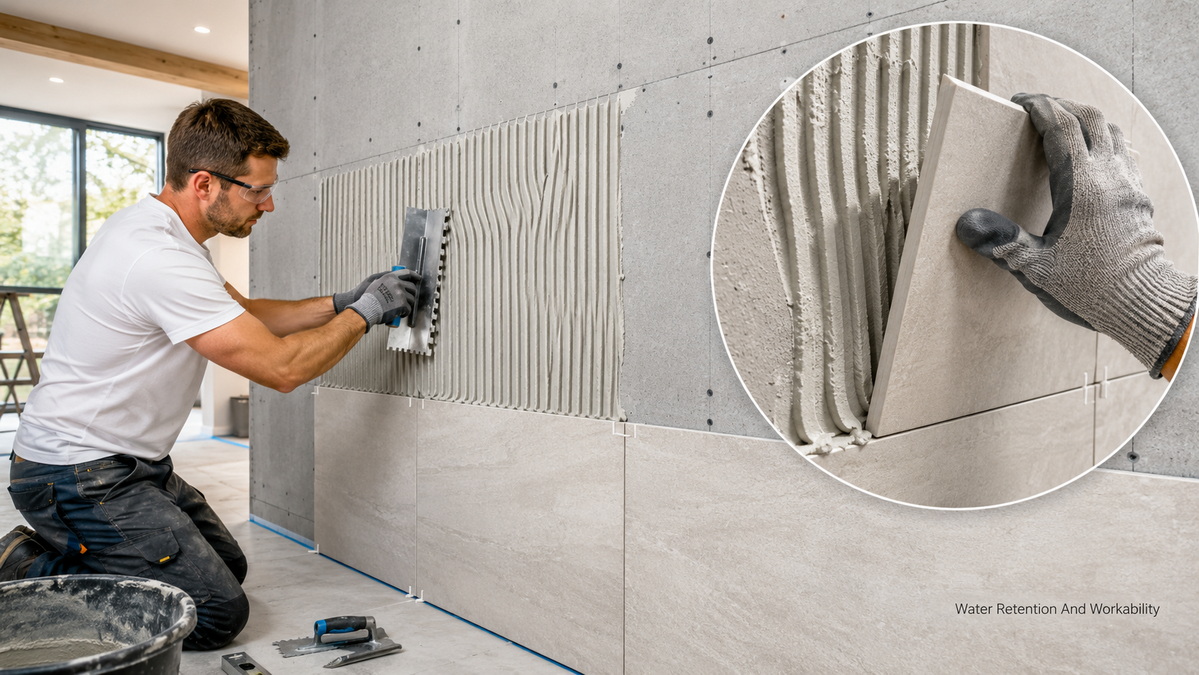
Wall putty and skim coat formulations often require a balance between water retention, spreadability, smoothness, anti-sagging behavior, and sanding performance.
A suitable HPMC grade can help improve:
- Wet-mix consistency
- Smooth application
- Scraping feel
- Adhesion to the substrate
- Surface fineness
- Resistance to sagging
- Reduced water loss
- Working time
When evaluating HPMC for wall putty, test the material on actual wall substrates. The water absorption of the substrate can significantly influence the perceived workability and drying speed.
For skim-coat products, avoid selecting an overly high-viscosity HPMC solely for stronger thickening. Excessively structured rheology can increase scraping resistance and reduce application comfort.
In personal-care and home-care formulations, HPMC can serve as a thickener, stabilizer, film former, and rheology modifier. It may contribute to product texture, suspension behavior, and application feel.
- Shampoo
- Body wash
- Facial cleanser
- Hand soap
- Lotion
- Cream
- Hair styling products
- Cosmetic emulsions
- Toothpaste
- Gel products
- Liquid detergents
- Surface cleaners
- Toilet cleaners
- Dishwashing liquids
- Laundry products
- Cleaning gels
The selected HPMC grade must be compatible with surfactants, salts, preservatives, fragrances, oils, emulsifiers, and other components. Stability testing should include storage at different temperatures and repeated freeze-thaw cycles where relevant.
Viscosity is important, but it does not tell the full performance story. Substitution, particle size, hydration behavior, production consistency, and formulation compatibility also matter.
A viscosity result has limited value unless the concentration, temperature, instrument, spindle, and testing method are known. Always compare like-for-like data.
Higher HPMC dosage can improve water retention or thickening, but it may also increase air entrainment, reduce flow, delay setting, affect adhesion, or raise total formula cost.
HPMC performance changes when combined with redispersible polymer powder, starch ether, defoamers, retarders, accelerators, hydrophobic agents, fillers, and different cement types.
Laboratory results may not perfectly match factory production. Differences in mixer intensity, humidity, water temperature, raw-material quality, and batch size can change the outcome.
A successful HPMC selection process should combine product knowledge with testing discipline. Start with the target application, define measurable requirements, compare multiple grades, and validate results under real production conditions.
For construction applications, focus on performance indicators such as water retention, open time, workability, slip resistance, tensile adhesion, and application feel. For personal-care and home-care applications, assess viscosity stability, clarity, sensory properties, suspension performance, and compatibility.
Shandong Shengda New Material Co., Ltd. provides HPMC, HEMC, and HEC cellulose ether solutions for manufacturers seeking dependable formulation performance across construction-grade and daily-chemical applications. Technical discussions based on the actual formula, raw materials, processing method, and target properties help create a more efficient path from sample evaluation to stable production.
HPMC contains methoxy and hydroxypropyl groups and is widely used in dry-mix mortar, coatings, food, pharmaceutical, and personal-care applications. HEMC contains methyl and hydroxyethyl groups and is commonly used for construction products requiring water retention and workability control. HEC contains hydroxyethyl groups and is widely used as a thickener and rheology modifier in water-based paints, detergents, coatings, and personal-care products.
There is no single grade suitable for every tile adhesive. Medium- and high-viscosity grades are commonly evaluated, but the final choice depends on cement type, polymer powder level, filler system, target open time, water retention, anti-slip requirements, and application standards.
Not always. Higher viscosity can contribute to improved water retention, but performance also depends on dosage, substitution profile, particle size, mortar composition, and environmental conditions. Excessively high viscosity may negatively affect flowability or mixing behavior.
HPMC can form lumps when the outer surface hydrates quickly and creates a gel layer around dry powder. To reduce this issue, add HPMC gradually under suitable agitation, pre-blend it with dry ingredients, or use an appropriate controlled-dispersion method.
No. Construction-grade HPMC should not be used in food, pharmaceutical, or personal-care applications unless it is specifically manufactured, tested, documented, and approved for the relevant use. Each application requires the appropriate quality standard and compliance documentation.
Helpful information includes the end-use application, current formulation, desired viscosity, HPMC dosage range, mixing method, production conditions, raw materials, performance targets, test standards, and the specific issue that needs improvement.
1. Zhang, G., et al. "Water Retention Mechanism of HPMC in Cement Mortar." *Materials*, 2020. https://pmc.ncbi.nlm.nih.gov/articles/PMC7372461/
2. Knapen, E., and Van Gemert, D. "Cellulose Ethers Influence on Water Retention and Consistency in Cement Mortars." *Cement and Concrete Research*. https://www.sciencedirect.com/science/article/abs/pii/S0008884610002085
3. Szymanowski, J., et al. "Effect of Cellulose Ether and Starch Ether on Hydration of Cement Mortar." *Materials*, 2022. https://www.mdpi.com/1996-1944/15/24/8764
4. U.S. Food and Drug Administration. "Hydroxypropyl Methylcellulose: Food Substances Listing." https://www.hfpappexternal.fda.gov/scripts/fdcc/index.cfm?set=FoodSubstances&id=HYDROXYPROPYLMETHYLCELLULOSE
5. U.S. Food and Drug Administration. "Inventory of Food Contact Substances Listed in 21 CFR: Hydroxypropyl Methylcellulose." https://www.hfpappexternal.fda.gov/scripts/fdcc/index.cfm?set=IndirectAdditives&id=HYDROXYPROPYLMETHYLCELLULOSE
6. LANDU. "Different HPMC Grades and Their Corresponding Applications." https://landu-china.com/en/different-hpmc-grades-and-their-corresponding-applications/


