


close
Choose Your Site
Global
Social Media
Views: 248 Author: Shengda Publish Time: 2026-09-02 Origin: Site


Content Menu
● What Is Daily Chemical Grade HPMC?
● What Is CMC in Cosmetic Formulation?
● Daily Chemical Grade HPMC vs. CMC: Key Differences
● Why CMC Can Fail in Low-pH Cosmetic Formulas
>> Acid Reduces the Ionic Charge of CMC
>> Final pH Adjustment Can Change the Formula Completely
>> Low-pH Actives Increase Formulation Stress
● Why Daily Chemical Grade HPMC Performs Better in Acidic Systems
>> Improved Appearance and Texture
>> Better Flexibility for Modern Cosmetic Concepts
● HPMC vs. CMC by Cosmetic Application
● How to Test HPMC and CMC in a Low-pH Formula
>> 1. Define the Finished Product Target
>> 2. Prepare Matched Formula Prototypes
>> 3. Adjust Both Samples to Final pH
>> 4. Measure Critical Stability Indicators
● Practical Processing Tips for Daily Chemical Grade HPMC
>> Use a Controlled Addition Method
>> Avoid Measuring Viscosity Too Early
>> Control the Order of Addition
● Formulation Considerations Beyond pH
>> Electrolytes
>> Surfactants
>> Temperature
● Selecting the Right Daily Chemical Grade HPMC
>> Is HPMC better than CMC for all cosmetic products?
>> Why does CMC lose viscosity in low-pH cosmetics?
>> Can Daily Chemical Grade HPMC be used in an acidic serum?
>> Can HPMC replace CMC at the same dosage?
>> Does HPMC improve the sensory feel of cosmetic products?
>> What types of products may benefit from HPMC instead of CMC?
>> What information is needed to select a suitable HPMC grade?
Daily Chemical Grade HPMC and CMC are both widely used cellulose-based rheology modifiers in personal-care formulations. However, their molecular structures respond differently to acidity. This article explains why CMC may lose viscosity, clarity, and stability in low-pH cosmetic formulas, and why non-ionic HPMC can provide a more reliable formulation option for acidic skincare, haircare, cleansing, and treatment products.
In modern cosmetic formulation, selecting a thickener is not only a question of viscosity or raw-material cost. It directly affects product appearance, skin feel, processing efficiency, storage stability, and consumer perception.
For acidic skincare and personal-care products, the difference between Daily Chemical Grade HPMC and CMC can be especially important. Both are cellulose-derived polymers. Both can thicken water-based systems, improve product texture, and support suspension stability. However, their chemical structures create very different responses when the formula pH becomes acidic.
Hydroxypropyl Methyl Cellulose (HPMC) is a non-ionic cellulose ether. Carboxymethyl Cellulose (CMC), usually used as sodium CMC in cosmetics, is an anionic cellulose ether. This distinction is critical for formulators developing low-pH facial serums, exfoliating gels, acidic cleansers, scalp-care products, vitamin C formulas, and treatment products.
CMC can perform well under suitable conditions. But in low-pH formulas, it may become less soluble, lose thickening efficiency, develop haze, or create unstable texture. Daily Chemical Grade HPMC often offers a more predictable alternative because its performance is less dependent on ionic charge.
Daily Chemical Grade HPMC is a water-soluble, non-ionic cellulose ether commonly used in skincare, haircare, and household personal-care applications.
It is produced by chemically modifying natural cellulose with methoxy and hydroxypropyl groups. These substitutions allow HPMC to hydrate in water and create viscosity, gel structure, suspension support, and film-forming performance.
In cosmetic formulas, HPMC can be used to improve:
- Viscosity and body
- Smooth gel texture
- Spreadability
- Suspension of insoluble particles
- Product flow control
- Film formation
- Water retention
- Consumer sensory experience
Depending on the selected grade, Daily Chemical Grade HPMC can create anything from a light serum texture to a rich gel structure.
For formulators, its main advantage is its non-ionic character. It does not rely on negatively charged groups to maintain hydration and thickening performance.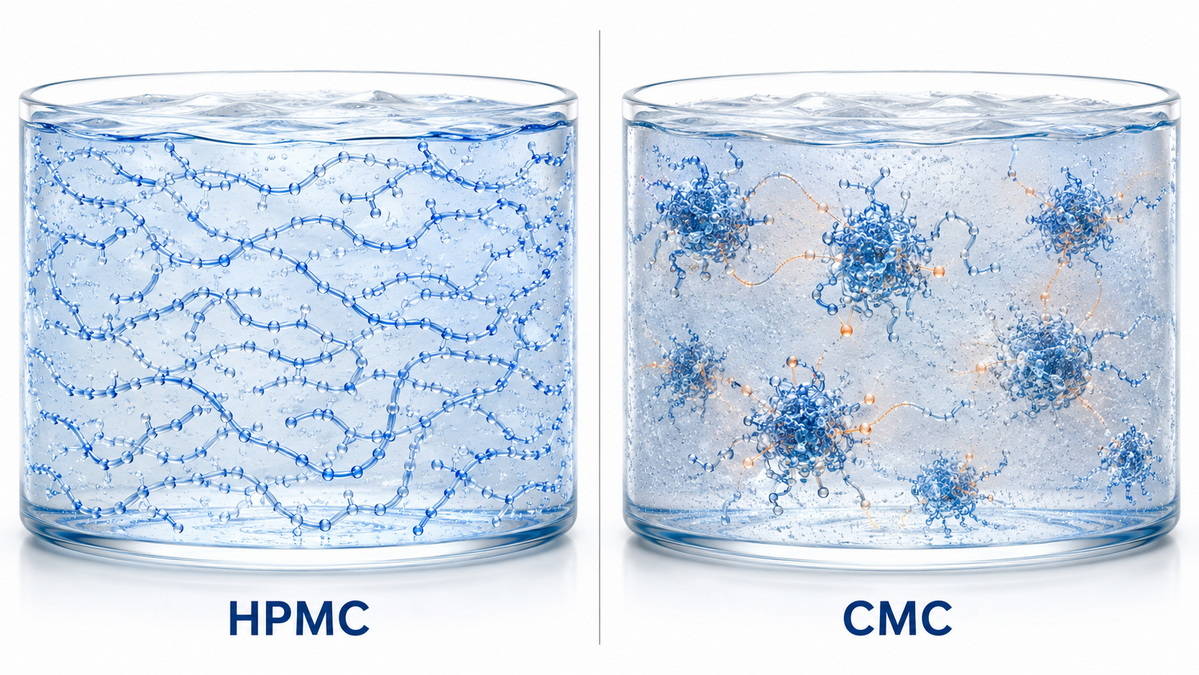
CMC, commonly supplied as sodium carboxymethyl cellulose, is another cellulose-derived polymer used as a thickener, stabilizer, binder, water-retention aid, and rheology modifier.
CMC contains carboxymethyl groups attached to the cellulose chain. In water, these groups often exist in an ionized form, creating negatively charged sites along the polymer backbone.
These negative charges help polymer chains repel each other. The chains remain more extended in water, allowing CMC to build viscosity and improve thickening performance.
CMC may be used in:
- Creams and lotions
- Haircare products
- Facial masks
- Toothpaste
- Cleansing products
- Water-based gels
- Household-care formulas
- Powder products after hydration
However, the same ionic properties that help CMC build viscosity can become a weakness in acidic systems.
| Property | Daily Chemical Grade HPMC | CMC / Sodium CMC |
|---|---|---|
| Polymer type | Non-ionic cellulose ether | Anionic cellulose ether |
| Functional groups | Methoxy and hydroxypropyl groups | Carboxymethyl groups |
| pH sensitivity | Generally less sensitive to moderate pH changes | More sensitive to acidic conditions |
| Low-pH formulation suitability | Often preferred for acidic cosmetic systems | May lose viscosity or solubility at lower pH |
| Electrolyte sensitivity | Usually more tolerant, depending on the system | Can be affected by salts and ionic ingredients |
| Appearance in water | Can provide clear or translucent gels | May become hazy or unstable in unsuitable conditions |
| Rheology behaviour | Often more predictable in acidic systems | Can vary strongly after pH adjustment |
| Common cosmetic role | Thickening, suspension, film formation, sensory improvement | Thickening, binding, water retention, stabilisation |
The most important difference is simple: HPMC is non-ionic, while CMC is anionic.
This molecular distinction affects how each polymer behaves when acids, salts, active ingredients, surfactants, preservatives, or botanical extracts are introduced into a formula.
CMC does not always fail in acidic cosmetic products. Its performance depends on the grade, concentration, degree of substitution, electrolyte load, surfactant system, process conditions, and final formula design.
However, as formula pH drops, CMC becomes more likely to show reduced performance.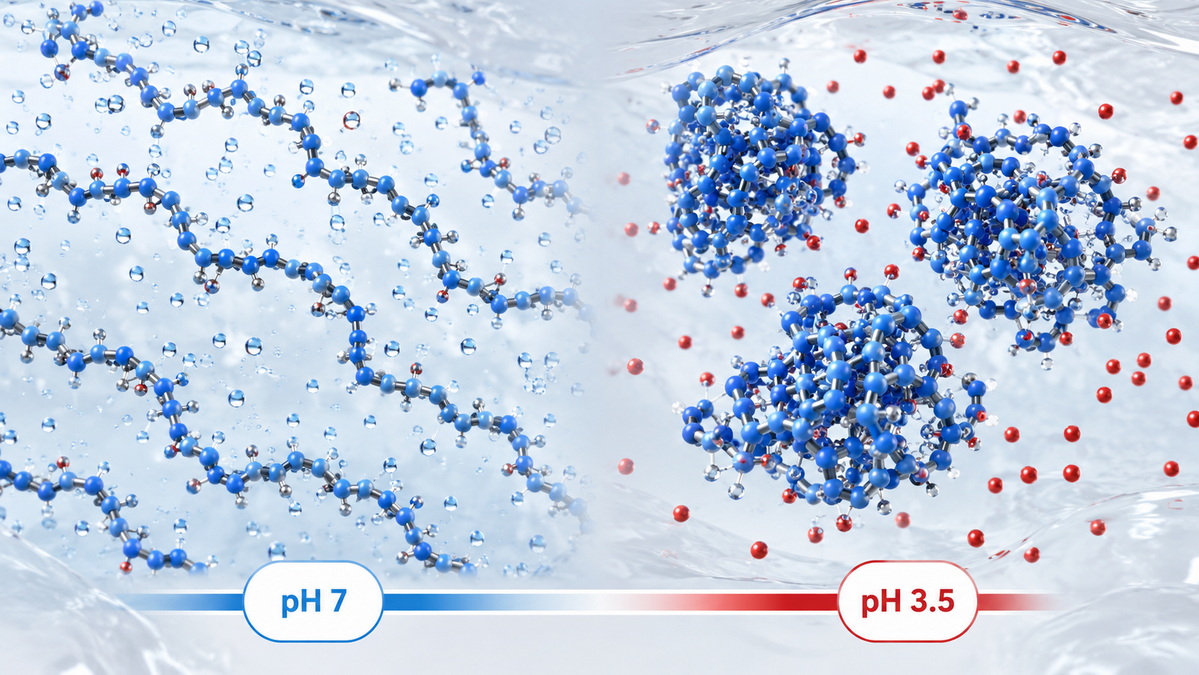
In neutral or mildly alkaline conditions, sodium CMC contains negatively charged carboxylate groups. These groups help polymer chains remain separated and hydrated in water.
When acid is added, the negatively charged groups can become protonated.
\[
\text{CMC–COO}^{-} + \text{H}^{+} \rightarrow \text{CMC–COOH}
\]
When this happens, the polymer chains lose part of their electrical repulsion. Instead of remaining extended and evenly dispersed in water, they may begin to coil, associate, or aggregate.
This can create several formulation problems:
- Lower viscosity
- Reduced thickening efficiency
- Poor hydration
- Hazy appearance
- Flocculation
- Gel particles
- Sedimentation
- Uneven product texture
- Reduced suspension performance
- Instability during storage
For a premium cosmetic product, even a small texture change can affect customer satisfaction and brand perception.
Many cosmetic formulations are built before final pH adjustment. The initial prototype may look smooth and stable at pH 6.0 or pH 7.0. However, after lactic acid, citric acid, glycolic acid, or another acidifier is added, the formula may behave very differently.
This is one of the most common risks when using CMC in acidic products.
A gel may look stable during the mixing stage but lose viscosity after 24 hours. A transparent formula may become cloudy after several days. A suspension product may begin to settle because the rheology system becomes weaker after acidification.
For example, a brand may develop an exfoliating gel using sodium CMC. The product initially has a pleasant, thick texture. After adjusting the formula to pH 3.8 with lactic acid, the gel becomes thinner and less uniform. During stability testing, the formula may show air bubbles, syneresis, particles, or a noticeable loss of body.
This is why polymer evaluation should always be performed after the formula reaches its final target pH.
Acidic cosmetic systems often contain more than one challenging ingredient. They may include exfoliating acids, vitamin C derivatives, mineral salts, preservatives, plant extracts, surfactants, or anti-acne ingredients.
These materials can increase the risk of instability in an ionic polymer system.
Common examples include:
- Alpha hydroxy acids
- Beta hydroxy acids
- Polyhydroxy acids
- Citric acid
- Lactic acid
- Glycolic acid
- Salicylic acid systems
- Vitamin C derivatives
- Zinc salts
- Mineral-rich botanical extracts
- Electrolyte-containing actives
- Acidic preservatives
- Surfactant blends
When CMC is exposed to both acidity and electrolytes, its thickening performance can become less reliable. The result may be a formula that changes over time, even if it initially appears acceptable.
Daily Chemical Grade HPMC does not rely on ionized carboxylate groups to hydrate and create viscosity. Its performance is primarily influenced by molecular weight, substitution type, concentration, hydration process, temperature, and interaction with other formula ingredients.
Because HPMC is non-ionic, it is generally less affected by the acid-driven charge reduction that can weaken CMC.
This gives formulators a more stable starting point when developing low-pH products.
In many acidic cosmetic systems, HPMC can provide more consistent viscosity after pH adjustment.
This can be useful for products such as:
- Facial serums
- Exfoliating gels
- Acid treatment gels
- Soothing gels
- Gel cleansers
- Scalp-care products
- Hair styling gels
- Acne-care products
- Lightweight moisturising gels
- After-sun gels
- Eye-care gels
- Body-care treatments
The objective is not simply to create a thicker formula. The goal is to maintain a controlled rheology profile throughout production, filling, transport, storage, and consumer use.
A well-selected HPMC grade can help create a smooth and uniform texture.
Depending on the formula, it may support:
- Clear or translucent gel systems
- Soft and smooth sensory feel
- Controlled flow
- Reduced dripping
- Improved spreadability
- Better suspension performance
- Reduced separation risk
- More stable product body
For leave-on products, consumer experience is particularly important. A serum that feels sticky, watery, uneven, or unstable may be perceived as lower quality even if the active ingredients are effective.
Modern cosmetic brands increasingly develop formulas with low pH, active ingredients, multifunctional claims, and lightweight sensory profiles.
HPMC can support these trends because it can be adapted for different texture requirements.
A lower-viscosity HPMC grade may be suitable for fluid serums, sprayable systems, and light essences. A higher-viscosity grade may help create more structured gels, masks, and treatment products.
The right grade selection depends on the final product concept.
| Cosmetic Application | Typical Formula Condition | Recommended Starting Point | Main Reason |
|---|---|---|---|
| AHA exfoliating gel | Acidic | Daily Chemical Grade HPMC | Better starting point for low-pH rheology |
| BHA treatment product | Acidic | HPMC with full compatibility testing | Reduced dependence on ionic polymer expansion |
| Vitamin C serum | Acidic to mildly acidic | HPMC | Can support a stable gel or serum texture |
| Facial toner | Mildly acidic | Low-viscosity HPMC | Adds light body and controlled flow |
| Gel cleanser | Mildly acidic with surfactants | HPMC, HEC, or tailored blend | Supports rheology and reduces dripping |
| Scalp-care serum | Mildly acidic | HPMC or HEC | Suitable for lightweight personal-care systems |
| Hair styling gel | Mildly acidic to neutral | HPMC or HEC | Supports texture and film-forming performance |
| Cream or lotion | Near neutral | HPMC or CMC | Selection depends on emulsion and sensory target |
| Powder mask | Variable after hydration | HPMC or CMC | Final pH and hydration conditions are decisive |
 How to Test HPMC and CMC in a Low-pH Formula
The most reliable way to select a cellulose ether is through a controlled formulation comparison.
Before selecting the polymer, identify the commercial and technical requirements.
Include:
- Final target pH
- Target viscosity
- Product appearance
- Transparency requirement
- Sensory profile
- Active ingredients
- Surfactant level
- Salt and electrolyte content
- Preservative system
- Packaging format
- Target shelf life
- Storage and transportation conditions
A polymer should be selected for the finished product, not only for the first bench sample.
Create two prototypes using the same formula base:
- One with Daily Chemical Grade HPMC
- One with CMC
Keep all other ingredients, processing temperatures, mixing conditions, and pH targets the same.
Do not assume that HPMC can replace CMC at the same dosage. Their thickening efficiency and rheology profiles can differ significantly.
A dosage screening study is more reliable than a one-to-one replacement approach.
This step is essential.
Evaluate the formula only after final pH adjustment. Allow sufficient time for the polymer to hydrate and the formula to stabilise before measuring viscosity.
The formula should be checked after:
- Initial preparation
- 24 hours
- 7 days
- Accelerated storage
- Freeze-thaw cycling
- Centrifuge testing, where appropriate
A complete evaluation should include:
- pH
- Viscosity
- Appearance
- Clarity
- Colour
- Odour
- Flow behaviour
- Suspension performance
- Syneresis
- Phase separation
- Sedimentation
- Freeze-thaw stability
- High-temperature stability
- Packaging compatibility
- Microbiological quality
The goal is to identify not only which polymer creates the desired initial viscosity, but also which one maintains product quality during the full product life cycle.
Correct processing can have a major influence on HPMC performance.
HPMC should be dispersed carefully to avoid lump formation.
Common processing approaches include:
- Adding HPMC slowly into well-agitated water
- Pre-dispersing HPMC in a compatible non-solvent phase
- Using a hot-water dispersion followed by cooling hydration
- Adding HPMC under controlled shear
- Allowing enough hydration time before final viscosity evaluation
The exact method depends on the selected HPMC grade and formula composition.
HPMC may require time to hydrate fully. A viscosity reading taken immediately after mixing may not represent the final performance of the formula.
Allow the system to equilibrate before making major adjustments.
The order of addition matters in acidic systems.
A practical approach is often:
1. Disperse and hydrate the HPMC correctly.
2. Add compatible humectants, solvents, and water-soluble ingredients.
3. Introduce active ingredients and other functional materials.
4. Adjust pH gradually near the final stage.
5. Recheck viscosity, appearance, and stability after equilibration.
Each formula should be tested individually because surfactants, solvents, salts, and active ingredients can alter the final result.
pH is important, but it is not the only factor that determines polymer performance.
High levels of salts, mineral extracts, or ionic actives can influence viscosity and hydration. Even a non-ionic polymer should be tested carefully in electrolyte-rich formulas.
Shampoos, body washes, facial cleansers, and hand washes contain surfactant systems that can affect rheology behaviour. The selected cellulose ether must be compatible with the surfactant blend and desired foam profile.
High processing temperatures and long exposure times can influence hydration and stability. Temperature cycling should also be included in product development testing.
Some preservation systems require a lower pH range. The rheology modifier should be selected based on the preservative system and final pH requirement.
Exfoliating acids, botanical extracts, vitamins, peptides, mineral salts, and other actives can all influence the final texture and stability of the product.
A successful HPMC selection depends on more than choosing a high-viscosity or low-viscosity grade.
The following factors should be considered:
- Desired final viscosity
- Formula pH
- Product transparency requirement
- Processing method
- Active ingredients
- Surfactant system
- Electrolyte content
- Product format
- Sensory target
- Packaging type
- Storage conditions
For example, a clear facial serum may require a different HPMC grade from a rich gel mask. A surfactant-based facial cleanser may require a different solution from a leave-on exfoliating gel.
A technical evaluation should focus on the finished consumer experience, not only the raw material's laboratory viscosity specification.
Daily Chemical Grade HPMC and CMC are both useful cellulose-based rheology modifiers. However, their performance in cosmetic formulations can be very different.
CMC is an anionic polymer. In low-pH cosmetic systems, acid can reduce its ionic charge, weaken chain expansion, reduce viscosity, and increase the risk of haze, aggregation, or instability.
Daily Chemical Grade HPMC is non-ionic. It is generally less dependent on ionic charge for hydration and thickening performance. This makes HPMC a valuable formulation option for many acidic skincare, haircare, cleansing, and treatment products.
For brands and manufacturers developing low-pH cosmetic products, the best approach is to compare HPMC and CMC under final formula conditions. Test the finished pH, active ingredients, surfactant system, electrolyte load, storage temperature, and packaging environment before making a commercial decision.
Shandong Shengda New Material Co., Ltd. provides HPMC, HEMC, and HEC cellulose ether solutions for global customers seeking reliable quality, technical consistency, and adaptable daily chemical formulation performance.
No. Both materials can be useful in cosmetic products. HPMC is often a stronger starting point for acidic formulas because it is non-ionic and generally less sensitive to acid-driven changes in polymer charge.
CMC contains carboxymethyl groups that can lose their negative charge as the formula becomes more acidic. This reduces chain repulsion and may cause the polymer to become less expanded and less effective as a thickener.
Yes, HPMC can be suitable for many acidic serum systems. However, the selected grade, concentration, active ingredients, preservative system, and final pH should all be tested before commercial production.
Not always. HPMC and CMC have different hydration rates, viscosity profiles, and thickening efficiency. A dosage screening study is recommended instead of direct one-to-one replacement.
Depending on the grade and formula, HPMC can support smooth texture, controlled flow, spreadability, gel structure, suspension performance, and film-forming properties.
Potential applications include acidic facial serums, exfoliating gels, gel cleansers, scalp-care products, vitamin C products, after-sun gels, hair styling gels, masks, and lightweight moisturising gels.
Useful information includes the product type, target pH, desired viscosity, active ingredients, surfactant content, salt level, processing conditions, clarity requirement, packaging, and storage requirements.
1. Vlad, R.-A., et al. "Hydroxypropyl Methylcellulose—A Key Excipient in Pharmaceutical Drug Delivery Systems." *Pharmaceutics*, 2025.
[https://pmc.ncbi.nlm.nih.gov/articles/PMC12196896/]
2. U.S. Food and Drug Administration. "Modernization of Cosmetics Regulation Act of 2022 (MoCRA)."
3. SpecialChem. "Hydroxypropyl Methylcellulose: Cosmetic Ingredient INCI."
[https://www.specialchem.com/cosmetics/inci-ingredients/hydroxypropyl-methylcellulose]
4. Ataman Chemical. "Sodium Carboxymethyl Cellulose CMC."
[https://www.atamanchemicals.com/sodium-carboxymethyl-cellulose-cmc_u35569/]
5. Kima Chemical. "Formulation Tips for Using CMC in Cosmetics."
[https://www.hpmcmanufacturer.com/formulation-tips-for-using-cmc-in-cosmetics/]


