


close
Choose Your Site
Global
Social Media
Views: 211 Author: Shengda Publish Time: 2026-07-01 Origin: Site


As a cellulose ether manufacturer serving global markets, we often get one question from formulators and procurement teams: Should I choose HEC or HPMC? The answer depends on your target performance, application system, process conditions, and cost structure. Both HEC (Hydroxyethyl Cellulose) and HPMC (Hydroxypropyl Methyl Cellulose) are widely used non-ionic cellulose ethers, but they behave differently in water, heat, and complex formulations. [celotech]
For construction-grade and daily chemical formulations, understanding those differences is not just technical knowledge; it is a commercial advantage. In this guide, we compare HEC and HPMC from an industry perspective and explain where each one works best, where they overlap, and how to choose the right grade for stable performance and better profitability. [yibangchemical]

HEC and HPMC are both cellulose ethers derived from natural cellulose and modified to improve water solubility, thickening, and rheology control. They are valued for their non-ionic nature, which gives them good compatibility with many raw materials used in coatings, mortars, detergents, and personal care products. [innonew-material]
HEC is widely recognized for its smooth thickening, excellent leveling, and broad pH compatibility, which makes it especially useful in water-based coatings and some personal care systems. HPMC is better known for strong water retention, workability improvement, and thermal behavior, which makes it a preferred choice in dry-mix construction materials such as tile adhesives and wall putty. [celotech]
| Property | HEC | HPMC |
|---|---|---|
| Main strength | Flow, leveling, smooth rheology | Water retention, workability, adhesion |
| Dissolution behavior | Cold-water soluble | Cold-water dispersible, temperature-sensitive behavior |
| Best-known applications | Latex paint, coatings, personal care | Tile adhesive, mortar, wall putty |
| Formulation feel | Smooth and balanced | Strong hold and longer open time |
| Key advantage | Better leveling and compatibility | Better moisture retention and construction performance |
This comparison is useful, but it does not tell the full story. In real production, the better choice depends on viscosity target, substrate absorbency, application temperature, and whether the system needs fast leveling or longer open time. [yibangchemical]
HEC thickens by hydrating in water and building viscosity through polymer chain interaction. Because it is non-ionic and stable across a wide range of pH conditions, it is often selected for systems that need predictable thickening and stable flow behavior. [yibangchemical]
In coatings, HEC is popular because it helps improve brushability, anti-sag performance, and film smoothness. In personal care, it is used where formulators want a clear, stable, and elegant texture without disrupting the rest of the formula. [innonew-material]
HPMC provides viscosity, water retention, and workability, especially in cement-based dry-mix products. Its thermal behavior and hydration profile make it especially valuable in construction systems that must remain workable for longer periods without losing water too quickly. [celotech]
In tile adhesives, renders, and mortars, HPMC helps reduce water loss, improve adhesion, and support consistent application. This is why it has become one of the most important cellulose ethers in building materials, particularly in formulations where open time and crack resistance matter. [databridgemarketresearch]
The technical differences between HEC and HPMC become clear when you look at real performance goals. HEC is usually stronger in flow and leveling, while HPMC is usually stronger in water retention and workability. [innonew-material]
Choose HEC when you need:
- Better leveling and smoother surface appearance.
- Strong performance in water-based latex paints.
- Good compatibility in pH-sensitive or formula-complex systems.
- A thickener that supports elegant flow rather than heavy body. [innonew-material]
Choose HPMC when you need:
- Better water retention in cementitious systems.
- Longer open time and improved construction workability.
- Strong adhesion support in dry-mix building materials.
- Stable performance in tile adhesive, mortar, and plaster applications. [celotech]
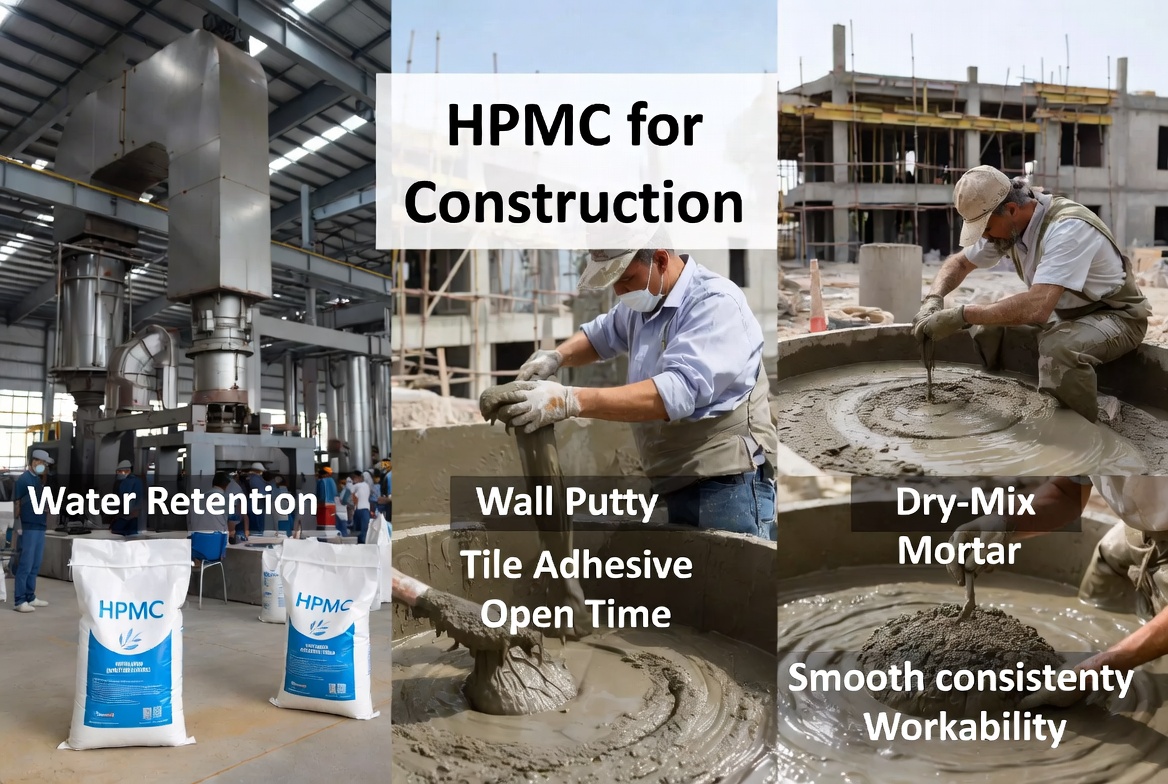
Construction is one of the biggest demand drivers for cellulose ethers, and it is also where HPMC is often the first choice. Industry reports continue to show growth in the broader cellulose ether market, supported by demand from building materials and sustainable formulation trends. [finance.yahoo]
In construction, HPMC is typically used in:
- Tile adhesives.
- Wall putty.
- Skim coats.
- Cement mortars.
- Self-leveling compounds. [yibangchemical]
HEC can also appear in some construction-related formulations, but it is usually selected when the product design emphasizes flow, application feel, or compatibility in a specific system. For most dry-mix mortar applications, HPMC remains the more common performance anchor. [celotech]
For water-based coatings and latex paints, HEC often has the advantage because it delivers smoother application, better leveling, and a more controlled rheology profile. This is especially important in decorative coatings, where finish quality is judged visually and touch performance matters. [innonew-material]
HPMC can be used in certain coating systems, but it is less often the first choice when the priority is high-end leveling. That said, formulation design is never one-size-fits-all; some cost-sensitive or hybrid systems may still benefit from blending cellulose ethers to balance cost and performance. [celotech]
HEC is also relevant in daily chemical products such as toothpaste, cleansers, and some cosmetic formulations. Its smooth thickening behavior and compatibility make it attractive for formulas that require stability, texture, and a pleasant consumer experience. [yibangchemical]
HPMC is used less broadly in classic daily chemical systems than in construction, but it can still play a role where film formation, water retention, or controlled viscosity is valuable. For manufacturers in this segment, the final choice should be based on sensory performance, processing method, and ingredient compatibility. [yibangchemical]
One practical advantage of working with a cellulose ether supplier is that the material choice can be made systematically instead of by trial and error. A good selection process reduces rework, lowers formulation cost, and shortens time to market. [innonew-material]
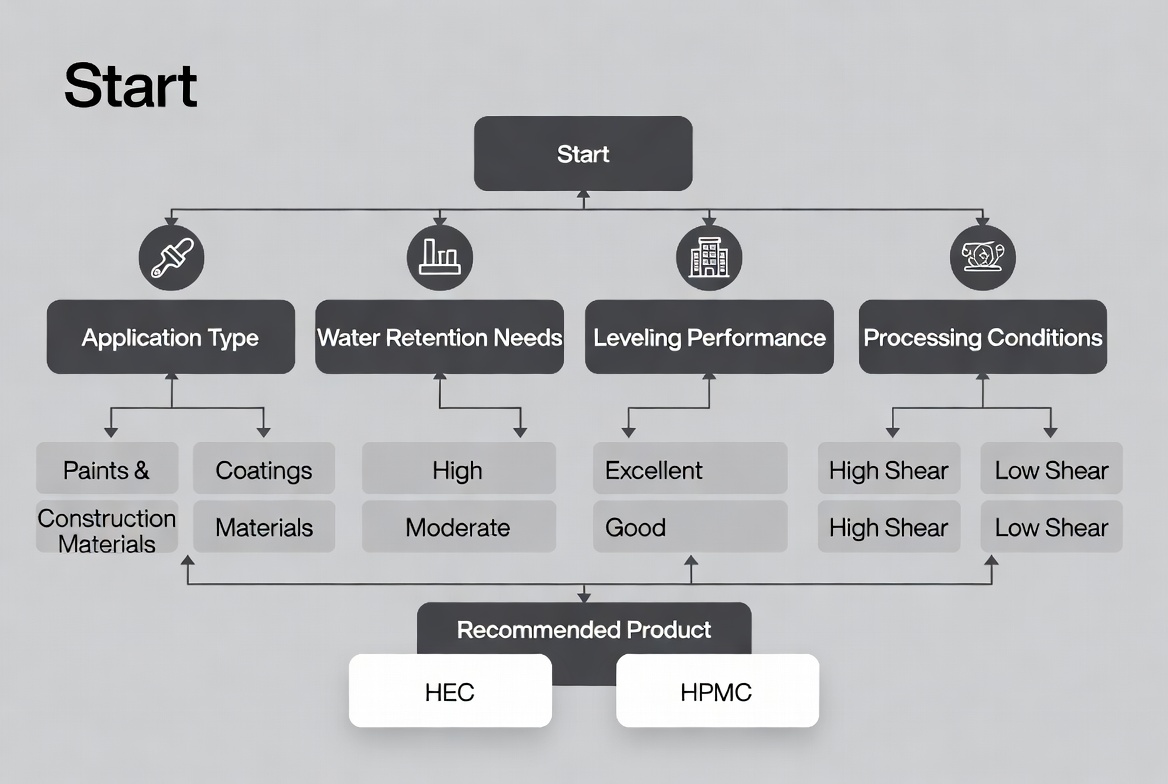
Use this simple workflow:
1. Define the application system. Is it coating, mortar, tile adhesive, personal care, or detergent?
2. Set the main performance goal. Do you need leveling, open time, water retention, suspension, or smoother feel?
3. Check processing conditions. Consider temperature, pH, shear, and mixing order.
4. Choose the primary ether. HEC for flow and leveling; HPMC for construction retention and open time.
5. Validate with lab and pilot trials. Confirm viscosity, sag resistance, open time, and end-use performance. [celotech]
This approach is especially useful for export buyers and OEM formulators, because the wrong grade can increase cost even when the chemistry looks similar on paper. [yibangchemical]
The cellulose ether market continues to benefit from construction demand and the broader move toward high-performance, bio-based functional ingredients. Public market research sources point to sustained growth in the sector over the next several years, which supports continued investment in both HEC and HPMC supply chains. [datamintelligence]
For manufacturers and buyers, this means three things:
- Supply consistency matters more than ever.
- Technical support is becoming a major differentiator.
- Buyers increasingly want sustainable, high-performance, and cost-efficient grades in one package. [360iresearch]
If you are buying cellulose ether for export, ask your supplier the right questions before placing an order. The label grade alone is not enough; the actual performance depends on molecular design, viscosity class, substitution pattern, particle behavior, and application-specific testing. [celotech]
Ask these questions:
- What is the recommended application window?
- What are the key viscosity and hydration characteristics?
- Is the grade optimized for hot climates or fast dispersion?
- Can the supplier provide pilot guidance and sample validation?
- How does the grade perform in your target system, not just in general tests? [innonew-material]
This is where a manufacturer with application expertise can create real value, because technical service often matters as much as product specification. [databridgemarketresearch]
If your main goal is surface quality, leveling, and flow, HEC is usually the better option. If your main goal is water retention, open time, and construction workability, HPMC is usually the better option. [innonew-material]
For mixed requirements, some formulators use blends to balance performance and cost. That strategy can be effective, but only if the ratio is tested carefully in the actual end-use system. [celotech]
Working with a specialized cellulose ether manufacturer gives you more than a product shipment. It gives you application guidance, consistency control, and the ability to match the right grade to the right system. [finance.yahoo]
For customers in construction and daily chemicals, this matters because small formulation differences can change viscosity, spreadability, stability, and final user experience. A strong supplier relationship can shorten development time and reduce costly production mistakes. [yibangchemical]
HEC and HPMC are both valuable cellulose ethers, but they solve different problems. HEC is often the better choice for coatings and flow-driven applications, while HPMC is often the better choice for construction products that need retention, adhesion, and longer workability. [innonew-material]
If you are developing a new formulation or optimizing an existing one, start with application needs rather than raw material names. Contact our technical team to request samples, compare grades, and receive a tailored recommendation for your target market and production process.
HEC is generally better for flow, leveling, and coating applications, while HPMC is generally better for water retention and construction performance. [yibangchemical]
HPMC is usually better for tile adhesive because it improves water retention, open time, and adhesion. [celotech]
Yes, HEC is often preferred in water-based latex paint because it supports better leveling, smoother flow, and a more refined finish. [innonew-material]
Yes, they can be blended in some systems, but the ratio should be validated in lab and pilot testing to avoid performance imbalance. [celotech]
They are derived from natural cellulose and are widely used as functional ingredients in formulations that aim to balance performance with sustainability. [databridgemarketresearch]
1. [Cellulose Ether Market Size & Share 2026-2032] — market growth estimate and industry outlook.
2. [HPMC vs HEC: Water-Based Coatings Comparison Guide] — application comparison, coating performance, and formulation guidance.
3. [Cellulose Ether Price Trend and Forecast] — pricing trend reference.
4. [Cellulose Ethers Market Size, Share, Growth Report 2024-2031] — market growth estimate.
5. [HEC vs HPMC in Coatings] — technical property comparison and selection notes.
6. [HEC vs. HPMC: What's the Difference and Which Should You Use?] — application and property comparison across industries.
7. [Cellulose Ether and Its Derivatives Market Size, Trends] — broader market size and forecast.
8. [Cellulose Ether Global Market Insights 2025] — global market coverage.
9. [Global Cellulose Ether and Derivatives Market to total US$ 22.6 billion by 2034] — long-term demand outlook and market drivers.


