


close
Choose Your Site
Global
Social Media
Views: 237 Author: Shengda Publish Time: 2026-10-17 Origin: Site


Content Menu
● HPMC Powder vs Granular: What Actually Changes?
>> Granulation and Surface Treatment Are Different
● HPMC Powder vs Granular: Side-by-Side Comparison
● Why HPMC Dust Matters in Automated Production
● Can Granular HPMC Solve the Dust Problem?
>> Measure Dust After Conveying
>> Avoid Unsupported Reduction Claims
● Does Granular HPMC Dissolve Faster Than Powder?
>> Measure Time to Usable Viscosity
● Choosing HPMC for Construction and Daily Chemical Production
>> Construction: Protect Distribution and End-Use Performance
>> Daily Chemicals: Protect the Hydration Sequence
● A Practical Five-Step Qualification Protocol
>> 1. Establish a Fair Material Comparison
>> 2. Record the Existing Process
>> 3. Test the Complete Handling Route
>> 4. Recalibrate and Verify the Feeder
>> 5. Define Acceptance Criteria Before Approval
● An Illustrative Cost Model: Compare the Whole Process
● Low-Dust HPMC Still Requires Dust-Safety Controls
● What to Request From an HPMC Manufacturer
● Conclusion: Select the Form Your Production Line Can Validate
>> Is granular HPMC completely dust-free?
>> Can granular HPMC replace powder at the same dosage?
>> Is surface-treated HPMC the same as granular HPMC?
>> Which HPMC form is better for automated dosing?
>> Will granular HPMC reduce mixing time?
>> Should dust extraction remain after switching to granules?
HPMC powder vs granular HPMC is more than a particle-size comparison. In automated production, the choice can influence dust generation, feeder consistency, mixing efficiency, and housekeeping requirements. However, granular HPMC is not automatically dust-free, and fine powder is not automatically unsuitable for automation. The right choice depends on the polymer grade, particle characteristics, equipment, and finished-product requirements.
At Shandong Shengda New Material Co., Ltd., our focus is on cellulose ether solutions for construction and daily chemical applications. Our approach to material selection starts with one principle: performance must be verified across the entire production process, not judged from a sample's appearance.
This guide explains where each form fits, how to evaluate low-dust HPMC, and what to test before changing an established formulation.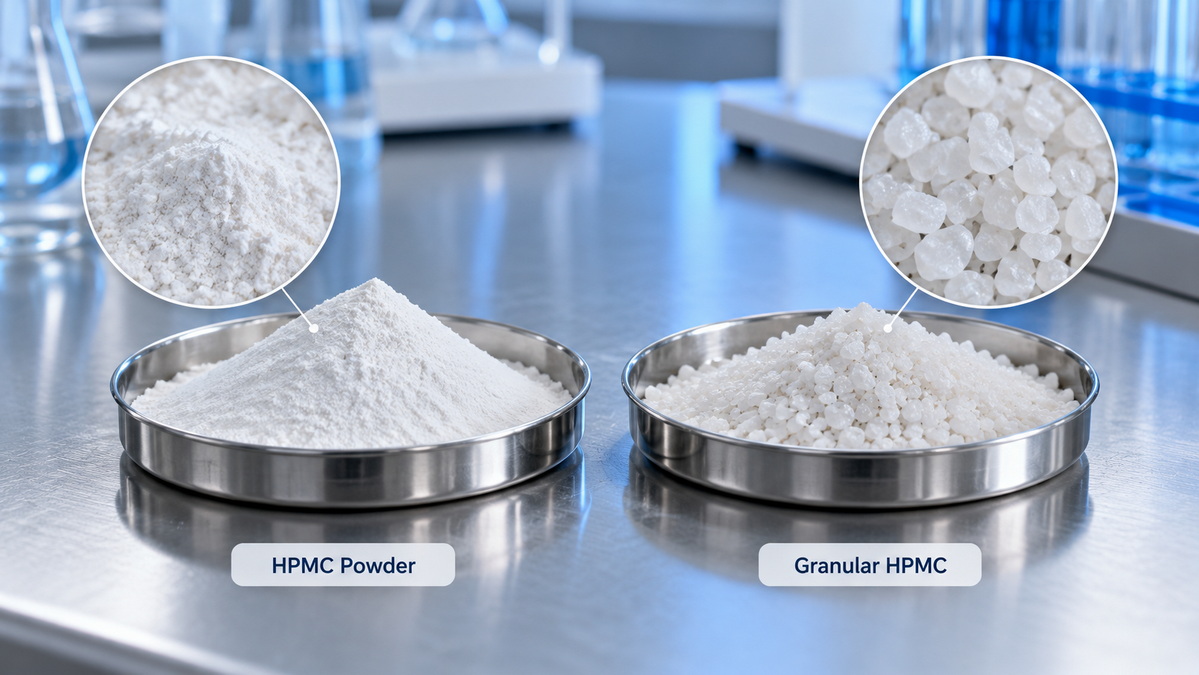
Hydroxypropyl methylcellulose is a nonionic cellulose ether used for thickening, water retention, binding, and rheology control.
Powder and granular forms can share similar polymer chemistry. Their main difference may be physical structure, but commercial grades can also differ in viscosity, substitution, surface treatment, and additives.
Consequently, switching physical form does not guarantee an equivalent formulation.
HPMC powder consists of relatively fine particles. In construction applications, it is commonly incorporated into dry blends containing cement, gypsum, mineral fillers, and other additives.
Fine particles can distribute effectively through a properly designed premix. However, exposed handling can release airborne fines, particularly during bag emptying and transfer.
Untreated powder also requires an appropriate dispersion method when added to water. If particles hydrate before separating, lumps can form.
Granular HPMC has a coarser particle structure. Depending on the supplier, this may reflect controlled particle sizing, agglomeration, or another manufacturing approach.
Certain engineered granular cellulose ethers offer lower dust formation and improved dry flow. Nevertheless, "granular" is not a universal specification.
Buyers should establish:
- How the granules are manufactured.
- Their particle-size distribution and fines content.
- Whether they contain additional processing ingredients.
- Whether they are surface-treated.
- How they withstand conveying and mixing.
Granulation concerns particle structure. Surface treatment concerns initial wetting and hydration behavior.
A surface-treated powder may disperse easily in water while still generating dust during handling. A granular product may reduce dust without providing the hydration delay needed for a particular liquid process.
Specify these properties separately rather than treating "granular," "instant," and "easy-dispersing" as interchangeable terms.
The following describes potential tendencies, not guaranteed specifications.
| Evaluation factor | HPMC powder | Granular HPMC |
|---|---|---|
| Dust during open handling | Fine particles can become airborne | Lower dust potential when fines are controlled |
| Hopper discharge | May require assistance if cohesive | May improve, depending on particle structure |
| Automated dosing | Suitable with correctly selected equipment | Can improve feeding, but requires recalibration |
| Dry-blend distribution | Useful for low-dose incorporation when mixing is validated | Must be checked for segregation |
| Water incorporation | Untreated grades need controlled dispersion | Some engineered grades permit easier incorporation |
| Hydration speed | Depends on chemistry, size, treatment, and conditions | Also depends on porosity and granule breakdown |
| Conveying durability | Already contains fine particles | Breakage may regenerate fines |
| Purchase economics | Compare actual quotations | Any premium must be justified by process savings |
The practical question is not which form wins every category. It is which form creates the lowest production cost while maintaining the required product quality.
Automation does not eliminate dust. It can move the problem from an operator's bag-opening station into enclosed transfer equipment.
Common release points include:
- Bag discharge connections.
- Hopper filling ports.
- Screw feeder outlets.
- Conveyor discharge points.
- Mixer charging connections.
- Filter maintenance areas.
Airborne material can increase cleaning requirements and create opportunities for contamination between batches. Product captured by extraction equipment may also represent a material loss, depending on whether recovery is permitted and validated.
Fine powders may behave inconsistently if they bridge, aerate, compact, or adhere to equipment surfaces.
However, poor dosing is not necessarily a particle-size problem. Hopper geometry, screw design, refill timing, vibration, and pressure differences can all affect delivery.
My first recommendation is to separate two questions:
1. Is dust escaping from the system?
2. Is the feeder delivering the correct mass?
A material change may help both, but each problem needs its own measurement.
It can reduce dust generation when the product is engineered for low dust and survives the actual handling route.
Larger, mechanically stable particles generally offer fewer opportunities for fine material to become airborne. Yet initial particle size alone does not establish dust performance.
A granular sample that looks clean at receipt may break down during transport, pneumatic conveying, or aggressive mixing.
A useful qualification method compares the material at three stages:
1. As received.
2. After the normal transfer route.
3. At the final charging point.
Measure particle-size distribution and dustiness using consistent methods. Where worker exposure is relevant, arrange appropriate workplace air sampling.
This distinction matters because bulk dustiness testing and occupational exposure monitoring answer different questions. Neither a photograph nor a clean-looking floor establishes exposure compliance.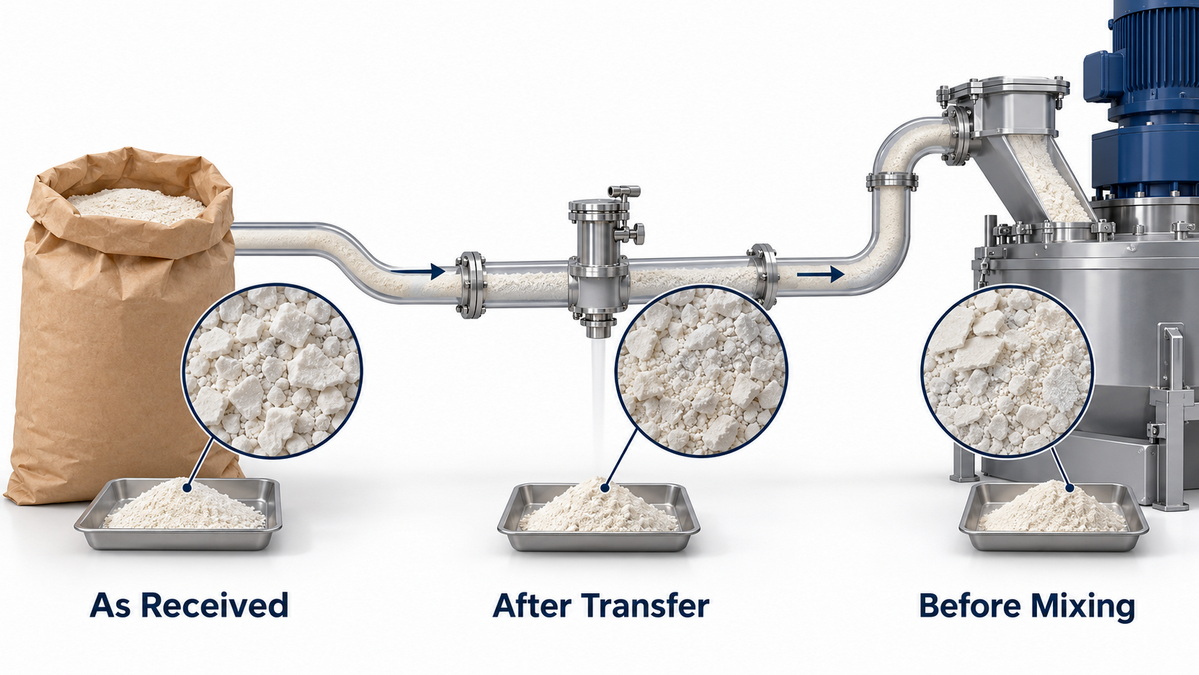
Claims such as "90% less dust" require a defined reference material, test method, operating conditions, and repeatable results.
Without that information, the percentage has limited purchasing value.
Ask suppliers for comparative evidence, then confirm the result on your equipment. There is no defensible universal dust-reduction percentage for every granular HPMC grade.
Not necessarily.
Dispersion means distributing particles through the liquid. Dissolution and hydration produce the developed polymer solution and its viscosity.
These stages are related, but they are not identical.
Fine untreated powder can develop a hydrated outer layer before the particles separate. The resulting lumps may contain dry material inside.
Some engineered granular or surface-treated grades improve incorporation by allowing better initial distribution. However, coarse, dense particles may take longer to hydrate than smaller particles under other conditions.
For liquid production, record:
- Time required to add the material.
- Time until visible lumps disappear.
- Time to a defined viscosity endpoint.
- Final viscosity after complete hydration.
- Undissolved residue.
- Batch-to-batch consistency.
Keep concentration, temperature, water quality, agitation, and measurement conditions consistent.
Follow the grade-specific preparation instructions. Do not apply a generic alkaline hydration trigger to every HPMC grade or formulation.
For tile adhesives, wall putty, and gypsum products, HPMC must distribute throughout the dry blend and function correctly after water addition.
Fine powder may remain the practical choice where low-dose distribution is already reliable.
Granular HPMC deserves evaluation where charging dust or feeder instability is a genuine bottleneck. However, differences in particle size and density can create segregation risks.
A construction trial should therefore assess both production behavior and application properties, including:
- Water retention and workability.
- Open time where relevant.
- Sag resistance.
- Surface finish.
- Adhesion or other specified performance criteria.
A cleaner factory does not justify an inferior finished mortar.
In cleaners, detergents, and selected personal care formulations, incorporation behavior can be especially important.
A lower-dust grade may simplify charging, but it must remain compatible with the formulation's pH, surfactants, salts, temperature, and addition sequence.
Test the complete formulation, not only an HPMC solution in clean water. Confirm appearance, viscosity development, stability, and any application-specific quality requirements.
Also verify that the proposed grade meets the intended product category's quality and documentation requirements.
A controlled comparison is more valuable than a short demonstration under ideal conditions.
Match viscosity grade, substitution characteristics, moisture basis, and treatment status as closely as possible.
If the candidate differs chemically, document that difference. Otherwise, a performance change may be incorrectly attributed to granulation.
Document throughput, dust release points, cleaning time, dosing deviation, mixing time, and rejected batches.
Include both normal production and known difficult conditions, such as low hopper levels or refill events.
Use representative packaging, transfer distances, bends, feeder settings, and charging rates.
Check whether granules break down or whether powder becomes excessively aerated.
Changes in bulk density and flow behavior can alter volumetric output.
Even gravimetric feeders require performance verification across the intended operating range. Test startup, steady operation, refill, and shutdown rather than accepting one stable reading.
Agree on allowable dosing variation, dust performance, hydration time, finished-product properties, and cost.
Repeat the comparison across representative batches. A single successful run is not sufficient evidence of production reliability.
The following example is a purchasing calculation, not a customer case study or measured Shengda result.
Assume annual HPMC consumption is 100,000 kg and the proposed granular grade costs $0.12/kg more.
The additional annual material cost is $12,000.
Suppose a validated plant trial supports these annual savings:
| Potential saving | Illustrative annual value |
|---|---|
| Reduced cleaning labor | $6,000 |
| Reduced unrecoverable material loss | $3,000 |
| Reduced filter-related maintenance | $2,000 |
| Avoided production downtime | $5,000 |
| Total | $16,000 |
The illustrative net benefit is $4,000 annually before equipment changes, qualification costs, and other implementation expenses.
Avoid double-counting downtime and labor savings. Use actual lost contribution or documented operating costs rather than automatically valuing recovered hours at full sales revenue.
Environmental claims need similar discipline. Less waste may be beneficial, but a lower overall footprint requires evidence that also considers granulation energy, packaging, transport, and process changes.
Cellulose ether dust can present a combustible-dust hazard under suitable conditions. Granulation does not remove the need for a site-specific assessment.
Review the current safety data sheet and involve qualified personnel when evaluating fire, explosion, exposure, and equipment-protection requirements.
A sound control strategy may include:
- Enclosed transfer and sealed connections.
- Local extraction close to release points.
- Dust collection designed for the assessed hazard.
- Ignition-source control and appropriate bonding and grounding.
- Suitable housekeeping equipment and procedures.
- Required fire and explosion protection.
- Training and exposure-based personal protection.
Do not clean combustible dust with compressed air or assume that an ordinary vacuum is suitable.
A useful supplier comparison should go beyond a viscosity number and a photograph.
Request:
- A technical data sheet and current safety data sheet.
- A certificate of analysis with defined test methods.
- Particle-size distribution and a specified fines limit.
- Loose and tapped bulk density.
- Comparative dustiness data.
- Conveying or attrition information where available.
- Hydration instructions and treatment details.
- Disclosure of relevant additives.
- Packaging, storage, and shelf-life guidance.
- Representative samples for production trials.
For overseas sourcing, agree on specifications and acceptance methods before ordering. Descriptions such as "low dust" and "good flow" are not substitutes for measurable purchasing requirements.
Granular HPMC can help reduce dust and improve handling, but it is not a universal replacement for powder. HPMC powder remains a viable option when enclosed handling, feeder design, and mixing controls deliver reliable results.
The strongest decision combines material characterization, full-route handling trials, finished-product testing, and total-cost analysis.
Contact Shandong Shengda New Material Co., Ltd. with your application, current HPMC specification, dosing equipment, and dust-control challenges. Request a discussion of suitable grades and sample availability, then qualify the proposed material under your own production conditions before making a commercial change.
No. It may contain residual fines or generate them through abrasion. Validate dust performance after the normal conveying route.
Possibly, if polymer chemistry, active content, viscosity grade, and application performance are equivalent. Confirm this through formulation trials rather than assuming direct interchangeability.
No. Surface treatment primarily affects initial hydration behavior. Granulation concerns particle structure. A product may have either feature, both, or neither.
Neither is universally better. Evaluate hopper discharge, feeder accuracy, refill behavior, bulk density, and performance across the required dosing range.
It may improve incorporation, but total mixing time depends on hydration, formulation chemistry, agitation, and the required endpoint. Measure time to usable viscosity or acceptable blend uniformity.
Do not remove it solely because the material looks cleaner. Any change should follow a documented risk assessment and verification of exposure and dust-hazard controls.
1. [Roquette / ChemPoint — METHOCEL™ Industrial Cellulose Ethers]. Technical information on cellulose ether functions, viscosity, water solubility, solution preparation, and distinctions between untreated, surface-treated, and granular products. Product-specific statements should not be generalized to every HPMC grade. [industrialcellulosics]
2. [The Dow Chemical Company — METHOCEL Cellulose Ethers: Technical Handbook]. Historical manufacturer handbook, hosted by Brigham Young University. Relevant sections include aqueous solution preparation, powder properties, construction and household applications, handling considerations, and granular cellulose ethers with controlled granulometry. Used for technical principles, not current product availability or regulatory requirements. [uolab.groups.et.byu]
3. [Occupational Safety and Health Administration — Hazard Communication Guidance for Combustible Dusts]. Guidance supporting dust containment, housekeeping, ignition control, hazard communication, and appropriately designed handling equipment. [osha]
4. [Occupational Safety and Health Administration — Protecting Workers from Combustible Dust Explosion Hazards]. Worker-protection guidance addressing dust capture, containment, cleaning, and precautions against flash fires and explosions. [osha]
5. [Canadian Centre for Occupational Health and Safety — Combustible Dust]. Guidance on hazard assessment, dust generation during handling, extraction, ignition control, bonding and grounding, and safe cleaning methods. [ccohs]


