


close
Choose Your Site
Global
Social Media
Views: 254 Author: Shengda Publish Time: 2026-10-19 Origin: Site


Content Menu
● What Does HPMC Do in a Formulation?
● Choose the Right HPMC Grade Before Mixing
>> Match the Grade to the Application
>> Compare Viscosity Under Matching Test Conditions
● Understand Dispersion Versus Hydration
● How to Use HPMC in Construction Dry Mixes
>> Step-by-Step Dry-Blending Procedure
>> Test More Than Initial Consistency
● How to Dissolve HPMC in Water Without Lumps
>> Method 1: Hot Dispersion Followed by Cooling
>> Method 2: Cold-Water Dispersion of Surface-Treated Grades
>> Method 3: Compatible Nonsolvent Slurry
● How Much HPMC Should You Use?
>> Define the Percentage Basis First
>> Use a Controlled Dosage Ladder
● Using HPMC in Detergents and Personal-Care Products
>> A Practical Development Sequence
● HPMC Troubleshooting: Diagnose Before Adding More
● Build a Repeatable HPMC Validation Plan
>> Record the Variables That Matter
● Handle HPMC Carefully and Assess Sustainability Realistically
● Conclusion: Start With the Grade, Then Validate the Process
>> Can HPMC Dissolve in Cold Water?
>> Should HPMC Be Added Before or After Cement?
>> Does Higher HPMC Viscosity Always Improve Performance?
>> How Long Does HPMC Take to Hydrate?
>> Can Construction-Grade HPMC Be Used in Personal Care?
Knowing how to use hydroxypropyl methylcellulose (HPMC) starts with three decisions: selecting the right grade, dispersing the powder correctly, and measuring performance in your actual formulation. Whether you manufacture tile adhesive, wall putty, or liquid hand soap, these decisions matter more than choosing the highest viscosity available.
At Shandong Shengda New Material Co., Ltd., our focus is construction-grade and daily-chemical cellulose ethers. This guide explains practical HPMC mixing methods, dosage calculations, and troubleshooting steps to help manufacturers build a repeatable process rather than rely on trial and error.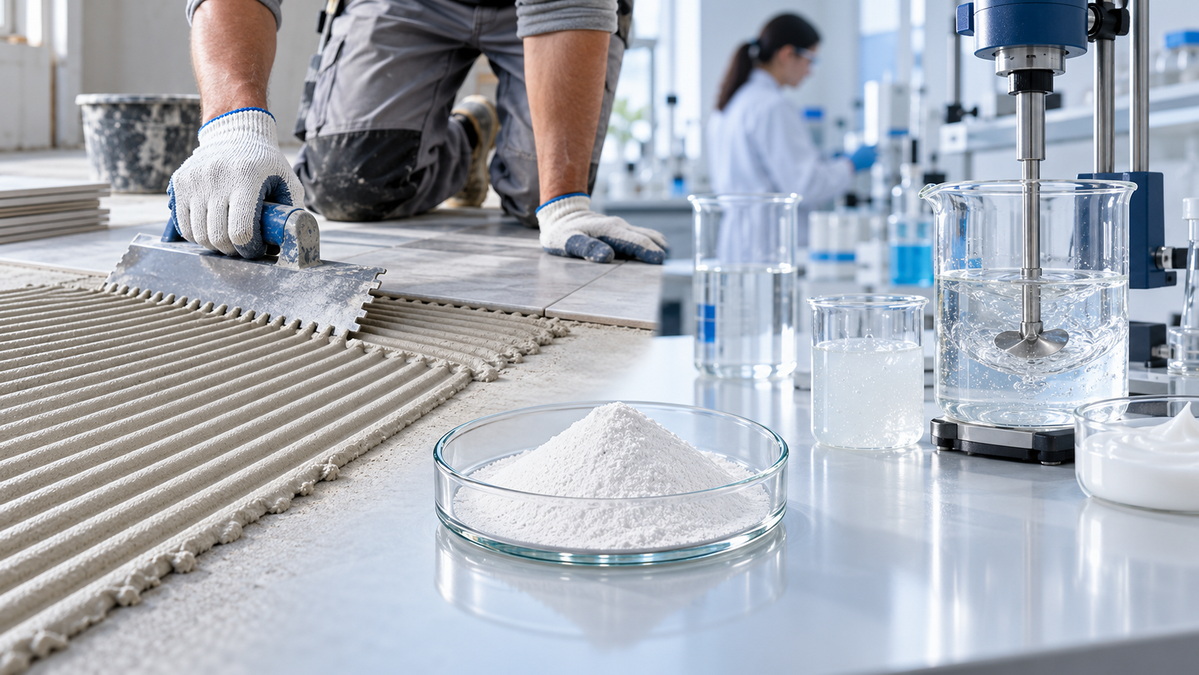
HPMC is a nonionic, water-soluble cellulose ether. Depending on its grade and application, it provides thickening, water retention, film formation, and formulation stabilization.
In construction materials, it helps control how mortar spreads, holds water, and remains workable. In personal-care and household formulations, suitable grades can modify flow, support foam stability, and improve texture.
However, these benefits are formulation-dependent. HPMC does not automatically make mortar waterproof, prevent every crack, or stabilize every detergent.
A useful formulation principle is simple: select HPMC for the performance you need, then verify that performance under realistic conditions.
Construction and daily-chemical products place different demands on cellulose ethers.
| Application | Main requirement | What to evaluate |
|---|---|---|
| Cement-based tile adhesive | Water retention and workable consistency | Open time, slip, wetting, and adhesion |
| Wall putty and skim coat | Smooth spreading and moisture control | Trowel feel, surface finish, and working time |
| Gypsum plaster | Consistent application behavior | Water retention, setting behavior, and workability |
| Self-leveling compound | Stability without excessive thickening | Flow, leveling, air release, and segregation |
| Liquid cleanser or hand soap | Suitable texture and compatibility | Viscosity, clarity, foam, and storage stability |
Do not assume a construction-grade product is suitable for skin-contact applications. Request documentation appropriate to the intended product and destination market.
An HPMC viscosity number is incomplete without its measurement conditions.
Before comparing suppliers, check:
- Polymer concentration in the test solution.
- Measurement temperature.
- Instrument, spindle, and rotational speed.
- Hydration procedure and conditioning time.
- Whether results are reported on the same moisture basis.
Two products carrying similar viscosity labels may behave differently when their test methods or chemical modifications differ.
Higher viscosity is not always better. A grade suitable for vertical tile adhesive may restrict the flow required in a self-leveling compound.
Dispersion separates and distributes powder particles. Hydration allows those particles to absorb water and develop viscosity.
Confusing these stages causes many mixing problems.
When untreated HPMC is dumped directly into cold water, the outer surfaces can hydrate quickly. A gel layer then surrounds dry material, creating lumps commonly called "fish eyes."
Increasing mixing speed afterward may introduce air without fully removing the trapped powder.
The better approach is to separate particles before rapid hydration begins. Depending on the grade, this can involve dry blending, hot-water dispersion followed by cooling, or delayed-hydration technology.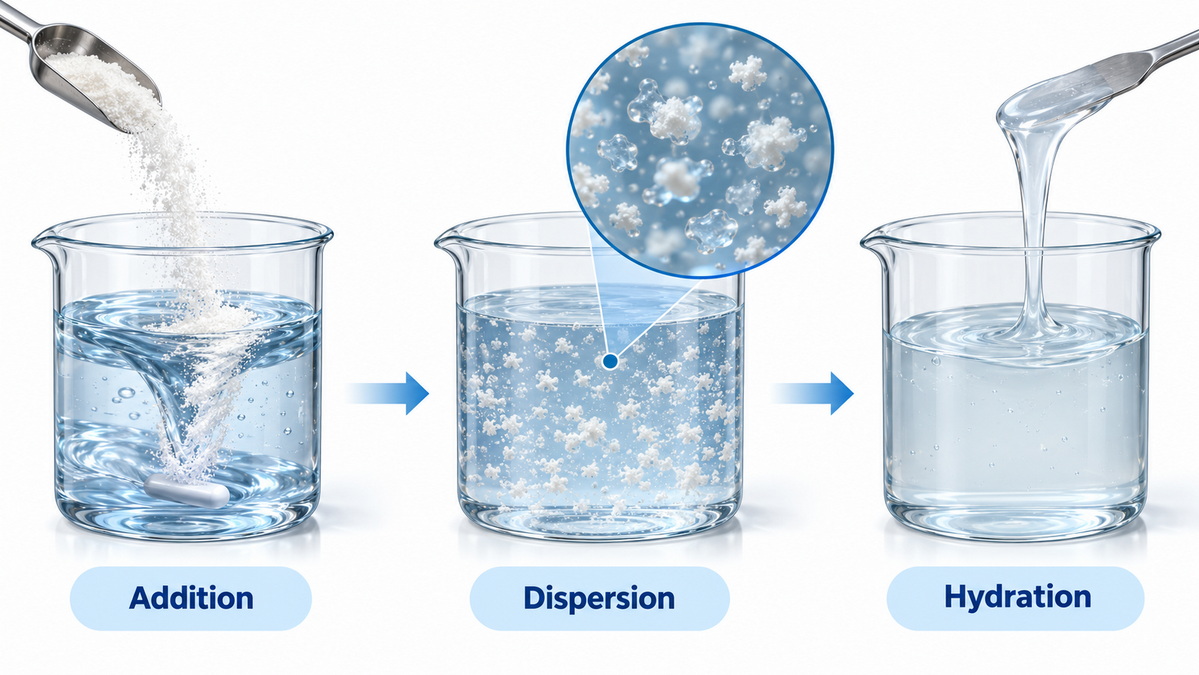
For factory-produced dry-mix mortar, HPMC is generally incorporated into the dry powder blend before water is added during preparation.
1. Weigh HPMC accurately using calibrated equipment.
2. Where necessary, preblend it with a portion of a compatible dry ingredient.
3. Add the preblend to the main mixer with the remaining dry components.
4. Mix using a validated loading sequence and mixing cycle.
5. Check uniformity through representative sampling.
6. During wet preparation, follow the specified water addition and mixing procedure.
7. Allow any required resting period, then remix before testing or application.
Dry blending distributes HPMC particles throughout the formulation, reducing localized concentrations when water enters the mix.
There is no universal mixing time. Mixer geometry, batch size, fill level, and particle-size distribution all affect uniformity.
A mortar that feels smooth immediately after mixing may still lose workability too quickly or perform poorly after application.
Evaluate the properties relevant to the finished product:
- Water retention and working time.
- Tile wetting, slip, and open time.
- Setting behavior and hardened adhesion.
- Air content, density, and application finish.
HPMC can support adhesion through water management and application behavior, but it does not replace the binder system or guarantee a particular strength classification.
For suitable untreated grades, the hot/cold method uses hot water to disperse the powder before cooling allows hydration.
1. Charge the specified portion of water into the vessel.
2. Heat it to the grade supplier's recommended dispersion temperature.
3. Add HPMC gradually under controlled agitation.
4. Continue until the particles are evenly wetted and distributed.
5. Add the remaining cold water, or use controlled cooling.
6. Mix until hydration is complete and viscosity becomes consistent.
Do not confuse hot dispersion with hot-water dissolution. HPMC typically develops its aqueous solution as the dispersion cools sufficiently.
Published METHOCEL guidance describes using approximately one-fifth to one-third of the total water above 90°C for its hot/cold technique. Treat this as product-specific guidance, not a universal instruction for every HPMC grade.
Certain surface-treated grades delay hydration, allowing particles to disperse before substantial thickening occurs.
Add the powder gradually to water under agitation. Once dispersion is complete, follow the supplier's instructions for hydration.
Some grades hydrate faster after an alkaline pH adjustment. However, the appropriate trigger depends on the product.
Adding a delayed-hydration powder directly into an already alkaline liquid can eliminate the useful dispersion window. Confirm the addition sequence before scaling up.
Where the formulation permits, HPMC can first be dispersed in a compatible nonsolvent, such as glycerin or propylene glycol, before incorporation into water.
The carrier separates particles and reduces immediate surface hydration.
Confirm compatibility, carrier quantity, and effects on the finished formulation. A slurry method suitable for one cleanser may be inappropriate for another product.
There is no single correct HPMC dosage for every mortar or cleanser.
The required amount depends on grade, binder chemistry, solids content, water demand, other additives, and the target performance.
For dry-mix mortar, specify whether dosage refers to total dry formulation mass or binder mass. For liquid products, state whether it refers to the final batch or a stock solution.
For example:
- A 1,000 kg dry formulation containing 3 kg HPMC has a dosage of 0.30% by total dry mass.
- A 100 kg finished liquid containing 0.5 kg HPMC has a final concentration of 0.50%.
These are calculation examples, not recommended recipes.
If you use a stock solution, calculate the actual polymer content rather than treating the whole solution as HPMC.
Begin with the supplier's application-specific recommendation. Then compare lower, middle, and higher levels while controlling other variables.
For context, published Benecel personal-care guidance lists 0.2–0.5% for certain applications using E10M and 0.5–1.0% for selected E4M and K100M applications.
Those ranges apply to the named products and uses. They should not be transferred directly to construction grades or another supplier's material.
Suitable HPMC grades can thicken surfactant systems and contribute to foam quality. Their nonionic character supports compatibility with many commonly used surfactants.
Nevertheless, compatibility must be demonstrated in the complete formulation.
1. Prepare the water phase using a validated dispersion method.
2. Hydrate HPMC sufficiently before additions that could interfere with hydration.
3. Incorporate surfactants with controlled agitation.
4. Add fragrance, salts, preservatives, and other ingredients in the validated order.
5. Adjust final pH as required.
6. Check viscosity, appearance, foam, and storage stability.
Do not assume salt will affect an HPMC-containing cleanser exactly as it affects a conventional surfactant-thickened system.
Also, viscosity does not establish preservation adequacy. Microbiological protection requires a separate assessment appropriate to the finished product.
| Problem | Possible cause | First check |
|---|---|---|
| Gel-coated lumps | Rapid surface hydration before dispersion | Addition speed and mixing method |
| Low initial viscosity | Incomplete hydration or incorrect concentration | Hydration conditions and weighing records |
| Batch-to-batch variation | Inconsistent raw materials or test conditions | Water quality, temperature, and measurement method |
| Excessive air | Strong vortexing or unsuitable mixing conditions | Agitator position, speed, and defoaming approach |
| Mortar feels too sticky | Unsuitable grade or formulation balance | Grade selection and water demand |
| Poor leveling | Excessive thickening or incompatible additives | Flow at controlled water content |
| Liquid becomes cloudy | Compatibility issue or incomplete hydration | Ingredient sequence and individual additions |
Change one variable at a time. Increasing dosage before identifying the cause can raise cost while leaving the underlying problem unresolved.
A structured comparison provides more useful evidence than a single successful demonstration.
For each trial, document:
- HPMC grade, batch number, and dosage.
- Raw-material batches and water quality.
- Mixing equipment, sequence, speed, and duration.
- Temperature, pH where relevant, and conditioning time.
- Test method, observations, and acceptance criteria.
Compare candidates at equal dosage first. Where appropriate, conduct another comparison at matched application consistency.
This distinguishes a material's thickening efficiency from its practical performance. Two mortars can feel equally thick yet differ in wetting or working time.
Repeat promising trials, then run a pilot batch on production equipment. Laboratory success does not establish that a larger mixer will deliver identical dispersion, hydration, or air incorporation.
For purchasing decisions, compare cost per acceptable finished batch—not simply price per kilogram of HPMC.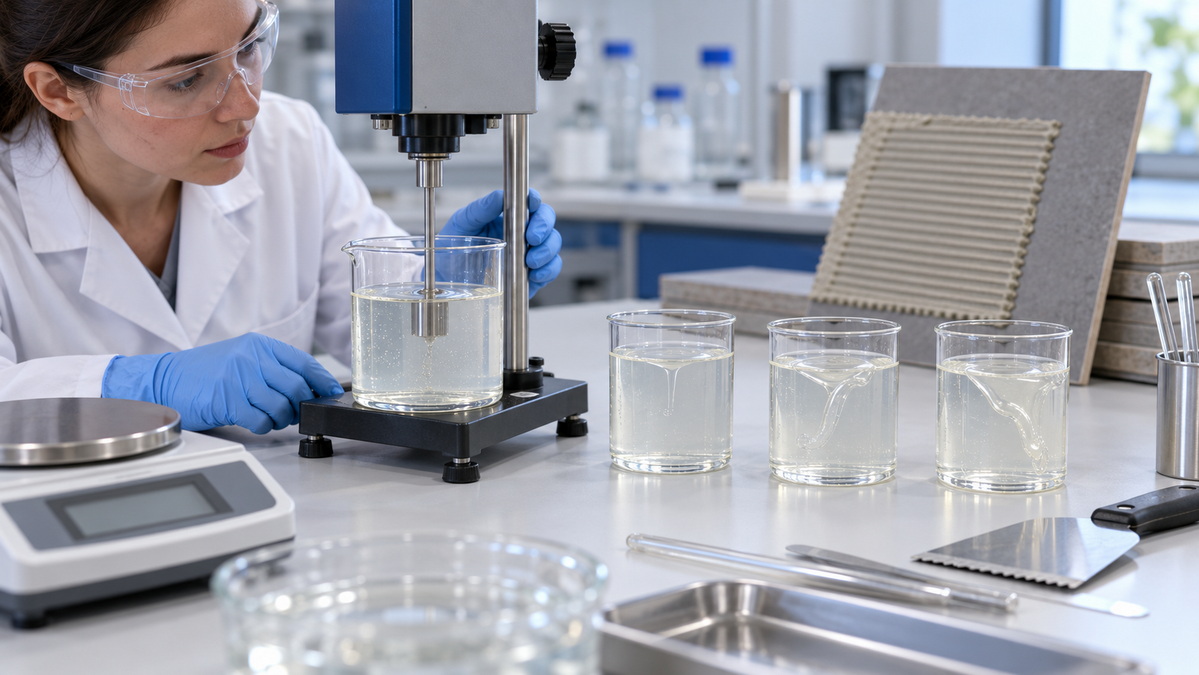
Keep packaging closed and protect the powder from moisture and contamination. Follow the product's safety data sheet for dust control, protective equipment, spill cleanup, and storage requirements.
For sustainability comparisons, cellulose origin alone is not enough. Request evidence relevant to sourcing, manufacturing, packaging, transport, and performance at the required dosage.
Cold-water processing may reduce heating demand where suitable grades and equipment allow it. However, any claimed saving should be checked against actual mixing time, cooling requirements, and rejected-batch rates.
Reliable HPMC use depends on matching grade, dosage, dispersion method, and testing conditions. A controlled process helps manufacturers identify the real cause of variation instead of compensating with unnecessary additions.
Shandong Shengda New Material Co., Ltd. focuses on developing, manufacturing, and supplying cellulose ethers for construction and daily-chemical applications.
Send us your application, formulation constraints, current mixing method, and target performance. Request a suitable HPMC grade, technical documentation, and a sample for comparison in your own formulation before committing to production quantities.
Yes. Suitable HPMC grades dissolve in cold water, but untreated powder must first be dispersed effectively to prevent gel-coated lumps.
The particle surfaces hydrate before the powder separates. This traps dry material inside a gel layer. Controlled addition and the correct dispersion method help prevent it.
For factory-produced dry-mix mortar, HPMC is normally distributed within the dry blend before wet preparation. Validate the exact loading sequence for your mixer.
No. Higher viscosity can increase thickening but may restrict flow or alter application feel. Select the grade against the finished product's requirements.
Hydration time depends on grade, surface treatment, temperature, pH, concentration, and mixing conditions. Use a defined hydration endpoint rather than an arbitrary universal time.
Not without confirming suitability. Personal-care applications require appropriate quality specifications, documentation, and a finished-product safety assessment.
1. [Kima Chemical — "How to use Hydroxypropyl Methylcellulose HPMC."]
Original article reviewed for reconstruction. It outlines applications and handling but does not provide detailed mixing procedures, dosage calculations, or a validation framework. No customer comments were visible in the retrieved article; no testimonials or customer results have been invented. [kimacellulose]
2. [Industrial Cellulosics by Roquette / ChemPoint — "METHOCEL™."]
Technical information supporting cold-water solubility, particle dispersion, nonsolvent slurry preparation, thermal gelation, viscosity measurement conditions, and general functional properties. Product-specific information is not presented as a specification for Shengda materials. [industrialcellulosics]
3. [Dow — "METHOCEL Cellulose Ethers: Technical Handbook," hosted by Brigham Young University.]
Technical basis for distinguishing dispersion from hydration, the hot/cold preparation technique, and alkaline acceleration of hydration in certain surface-treated grades. [uolab.groups.et.byu]
4. [SE Tylose — "Tylose® for Building Materials," July 2025.]
Manufacturer guidance covering water retention, consistency, construction applications, viscosity nomenclature, and delayed-solubility grades. The document addresses multiple cellulose-ether chemistries, not exclusively HPMC. [setylose]
5. [Ashland — "Benecel™ Hydroxypropyl Methylcellulose."]
Source for personal-care functions, surfactant compatibility, and the specifically attributed E4M, E10M, and K100M dosage examples. These examples are not Shengda product recommendations. [ashland]
6. Company positioning is based on the background supplied by Shandong Shengda New Material Co., Ltd. The calculation examples, troubleshooting framework, and validation sequence are editorial synthesis, not reported customer trials or independently verified company performance data.


