


close
Choose Your Site
Global
Social Media
Views: 248 Author: Shengda Publish Time: 2026-10-21 Origin: Site


Content Menu
● What Is Hydroxyethylcellulose?
● What Does Hydroxyethylcellulose Do in Cosmetics?
>> Thickening and Texture Control
>> Support for Physical Stability
>> Improved Slip and Application Feel
● Common Uses of Hydroxyethylcellulose in Cosmetics
● How to Choose the Right HEC Grade
>> Compare Viscosity Under Matching Conditions
>> Check Hydration Characteristics
>> Match Quality Documentation to the Application
● How to Dissolve Hydroxyethylcellulose Without Lumps
>> 1. Prepare a Controlled Water Phase
>> 2. Disperse Before Full Hydration
>> 3. Consider a Compatible Prewetting Method
>> 4. Allow Hydration to Finish
>> 5. Complete and Recheck the Formula
● A Practical Validation Plan Before Scale-Up
>> Screen Grades and Concentrations
>> Evaluate More Than Thickness
>> Confirm Microbiological Protection
● Troubleshooting Common HEC Formulation Problems
● Is Hydroxyethylcellulose Safe for Skin?
● Responsible Sourcing and Supplier Evaluation
● Develop Your Cellulose Ether Specification With Shandong Shengda
>> Is Hydroxyethylcellulose the Same as HPMC?
>> Is Hydroxyethylcellulose Natural?
>> Can HEC Replace an Emulsifier?
>> Does HEC Need Neutralization?
>> How Much HEC Should a Cosmetic Formula Contain?
>> Can HEC Keep Exfoliating Particles Suspended?
Hydroxyethylcellulose in cosmetics is a water-soluble, cellulose-derived polymer used to thicken products, improve flow, and support formulation stability. Commonly called HEC, it helps give facial cleansers, shampoos, lotions, and gels their desired consistency without serving as the main cleansing or moisturizing ingredient.
For formulators and purchasing teams, however, understanding its basic function is only the beginning. Choosing the right grade, hydrating it correctly, and evaluating the finished formula determine whether HEC delivers a smooth, repeatable product.
This guide explains how hydroxyethylcellulose works, where it adds value, and what manufacturers should verify before moving from laboratory samples to commercial production.
Hydroxyethylcellulose is a chemically modified derivative of cellulose, the structural polymer found in plant cell walls. Hydroxyethyl groups are introduced onto the cellulose backbone to improve its interaction with water.
Its cosmetic ingredient name is Hydroxyethylcellulose.
HEC is nonionic, meaning its polymer chains do not carry the permanent positive or negative charges associated with ionic thickeners. This characteristic contributes to its compatibility with many surfactants and other cosmetic ingredients.
When properly hydrated, suitable grades form smooth aqueous solutions with viscosity determined by polymer characteristics, concentration, temperature, and the surrounding formulation.
Although HEC begins with plant-derived cellulose, it is not unmodified cellulose. Claims such as "natural," "biodegradable," or "sustainably sourced" require supporting documentation for the specific material being purchased.
HEC increases the viscosity of the water phase, helping manufacturers create anything from a lightly bodied cleanser to a richer gel.
The objective is not simply maximum thickness. A successful product must also pour, pump, spread, and rinse as intended.
Excessive viscosity may make a formula difficult to process or dispense. Grade selection should therefore begin with the desired product experience, not the highest available viscosity number.
HEC solutions can exhibit shear-thinning behavior: their apparent viscosity decreases when shear increases.
This helps explain why a product can feel substantial in its container yet spread more easily during application.
Shear thinning is not the same as thixotropy. Thixotropy involves time-dependent structural breakdown and recovery, which must be demonstrated through suitable testing rather than assumed from an ingredient description.
By thickening the continuous water phase, HEC can slow the movement of dispersed droplets or particles.
However, it is not a universal emulsifier. A lotion still needs an appropriate emulsification system, and a thick appearance does not prove long-term stability.
Likewise, suspending visible particles requires more than a high viscosity reading. Particle size, density, and the formulation's low-shear behavior all matter.
Suitable HEC grades can contribute lubricity and smoother spreading in skin and hair products.
Its contribution is primarily structural and sensory. HEC should not be presented as a substitute for proven moisturizing ingredients or as evidence that a finished product repairs the skin barrier.
Any hydration or conditioning claim should be supported by testing of the complete formula.
| Product category | Main purpose of HEC | Important evaluation point |
|---|---|---|
| Facial cleansers | Build body and improve dispensing | Clarity, foam, rinsing, and surfactant compatibility |
| Shampoos and body washes | Adjust viscosity and support lather texture | Fragrance, electrolyte, and temperature effects |
| Serums and aqueous gels | Create controlled flow and spreadability | Tack, stringiness, clarity, and pump performance |
| Creams and lotions | Thicken the aqueous phase | Compatibility with the emulsifier system |
| Shaving products | Improve slip and product body | Lubricity, foam behavior, and residue |
These applications require different performance profiles. A grade that works well in a rinse-off wash may not produce the preferred feel in a leave-on serum.
For buyers, "HEC for cosmetics" is therefore a starting category, not a complete specification.
Viscosity values are meaningful only when the measurement conditions are known.
Before comparing suppliers, request:
- Polymer concentration used in the test.
- Water quality and sample preparation procedure.
- Measurement temperature.
- Instrument, spindle, and rotational speed.
- Hydration and equilibration time.
Two products with similar numerical viscosity values may behave differently if those values were measured using different methods.
The practical priority is reproducibility in your formula.
Some HEC grades are surface-treated to delay hydration, allowing the powder to disperse before viscosity develops.
This can simplify processing, but the activation conditions depend on the grade. A procedure developed for one product should not automatically be transferred to another.
Ask whether the supplied material is untreated or delayed-hydration, and obtain written preparation instructions.
Do not assume that construction-grade cellulose ether is interchangeable with material intended for personal care.
Request the technical data sheet, safety data sheet, batch certificate of analysis, and relevant impurity and microbiological specifications.
Also confirm traceability, storage requirements, shelf life, and the supplier's process for notifying customers about specification changes.
Use water of consistent quality and a clean mixing vessel.
Record water temperature, batch size, mixing equipment, and addition sequence. These details help explain differences between laboratory batches and production runs.
Follow the supplier's instructions for the selected grade rather than applying one universal temperature or pH rule.
Add the powder gradually into a well-circulated water phase.
Avoid dumping it onto the surface. Rapid hydration around a dry powder cluster can create a gelled shell that traps an unhydrated center.
Adequate circulation matters more than creating an unnecessarily deep vortex, which can introduce excessive air.
Where appropriate, prewetting HEC in glycerin or another compatible water-miscible liquid can help separate particles before they contact water.
This is a dispersion technique, not proof that HEC dissolves in that liquid.
The carrier must fit the final formulation, and its proportion should follow a validated procedure.
Do not judge viscosity immediately after powder addition.
Allow sufficient hydration time, then inspect for lumps and measure viscosity under defined conditions. For delayed-hydration grades, follow the prescribed activation procedure.
Introduce the remaining ingredients according to the validated manufacturing sequence.
After surfactants, fragrance, salts, actives, preservatives, and final pH adjustments are incorporated, recheck appearance and viscosity.
An attractive HEC solution in water is not evidence that the finished cosmetic will remain stable.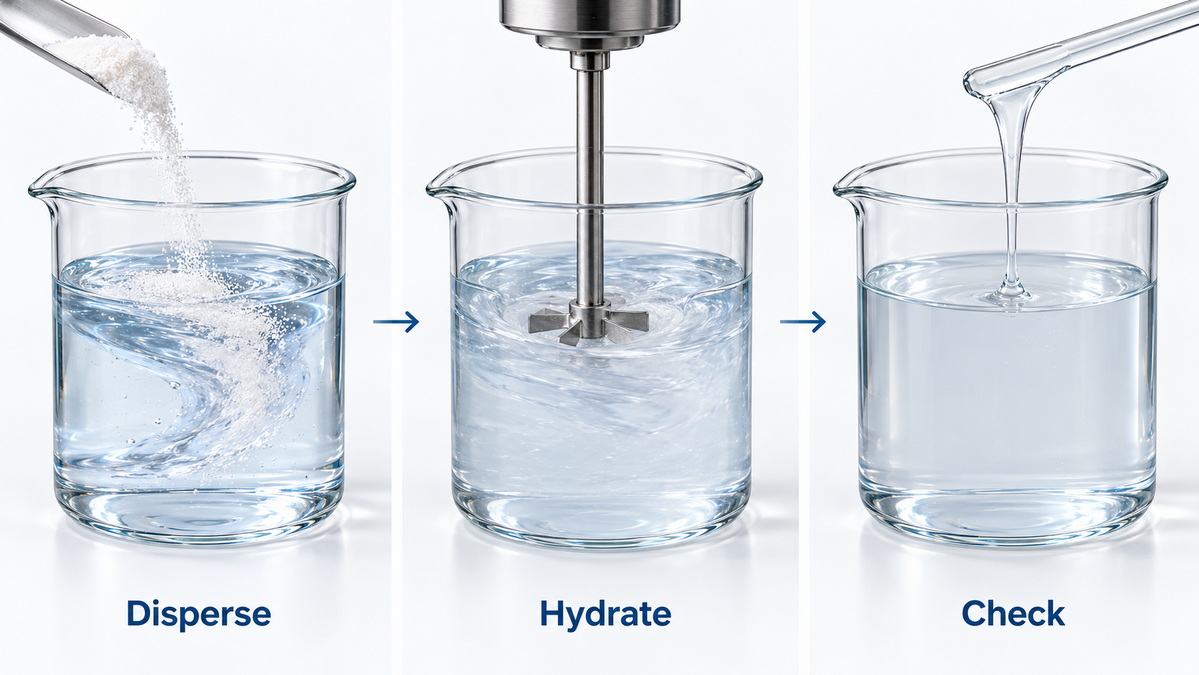
A useful development approach separates polymer selection from finished-product approval.
Compare a small set of suitable grades at several supplier-recommended concentrations.
Keep the base formula, water quality, equipment, and preparation conditions consistent. Change one major variable at a time so that results remain interpretable.
This is a proposed evaluation method, not a claim about factory testing or customer results.
Record:
1. Hydration time and visible lump formation.
2. Viscosity under a defined measurement method.
3. Clarity, color, and entrained air.
4. Spreading, tack, stringiness, and rinsing.
5. Pumping or dispensing through the intended package.
6. Changes during an appropriate stability program.
Where particle suspension matters, include low-shear rheological evaluation rather than relying on a single rotational viscosity reading.
HEC is a thickener, not a preservative.
Water-containing cosmetics need an appropriate microbiological risk assessment and preservation strategy. Where applicable, preservative efficacy testing can follow ISO 11930.
Physical stability and microbiological protection are separate requirements. A smooth gel may still need preservation changes before commercial release.
| Problem | Possible explanation | Practical next step |
|---|---|---|
| Persistent lumps | Powder added too quickly or insufficiently dispersed | Slow addition and review circulation or prewetting |
| Lower-than-expected viscosity | Incomplete hydration or mismatched test conditions | Verify preparation, concentration, temperature, and method |
| Excessive stringiness | Grade or concentration unsuitable for the desired texture | Screen alternatives using sensory and dispensing tests |
| Haze after fragrance addition | Solubility or compatibility problem in the complete formula | Review fragrance solubilization and ingredient interactions |
| Particles settle despite thickness | Insufficient low-shear structure | Evaluate suspension behavior and complementary modifiers |
| Viscosity changes during storage | Several possible chemical, physical, or microbial causes | Investigate systematically rather than adding more thickener |
Troubleshooting should begin with batch records. Changing polymer concentration before identifying the cause can conceal the problem and create new processing difficulties.
Safety assessments have reviewed HEC within the broader group of cellulose-derived cosmetic ingredients and support its use under the assessed conditions.
That does not mean every HEC-containing product suits every person or application.
Finished-product safety depends on ingredient quality, concentration, impurities, preservation, exposure, and the complete formulation.
Manufacturers should avoid unsupported claims such as "allergy-free," "safe at any concentration," or "suitable for every sensitive skin type."
Consumers who experience irritation should stop using the product and seek appropriate professional advice if symptoms persist. An ingredient's established cosmetic use does not replace evaluation of the product in which it appears.
Plant-derived feedstock can support a sourcing discussion, but it does not establish the environmental performance of every HEC grade.
Ask suppliers which claims they can document:
- Feedstock origin and traceability.
- Relevant sourcing certifications.
- Grade-specific biodegradability evidence.
- Manufacturing and transport information.
- Batch consistency and manufacturing yield.
- Packaging and waste-management options.
Distinguish technical properties reported for a named commercial product from guarantees about all HEC materials.
From a purchasing perspective, consistency can matter as much as price. A lower purchase cost offers limited value if variable hydration or viscosity repeatedly disrupts production.
Shandong Shengda New Material Co., Ltd. focuses on cellulose ether research, development, production, and sales for construction and daily chemical applications.
For a productive technical discussion, share your product type, target viscosity and test method, formulation pH, main surfactants, processing conditions, and intended market.
Request confirmation of grade suitability, available documentation, and sample options before approving a material.
The objective is a cellulose ether specification that supports your actual manufacturing process—not simply a familiar product name or an attractive viscosity number.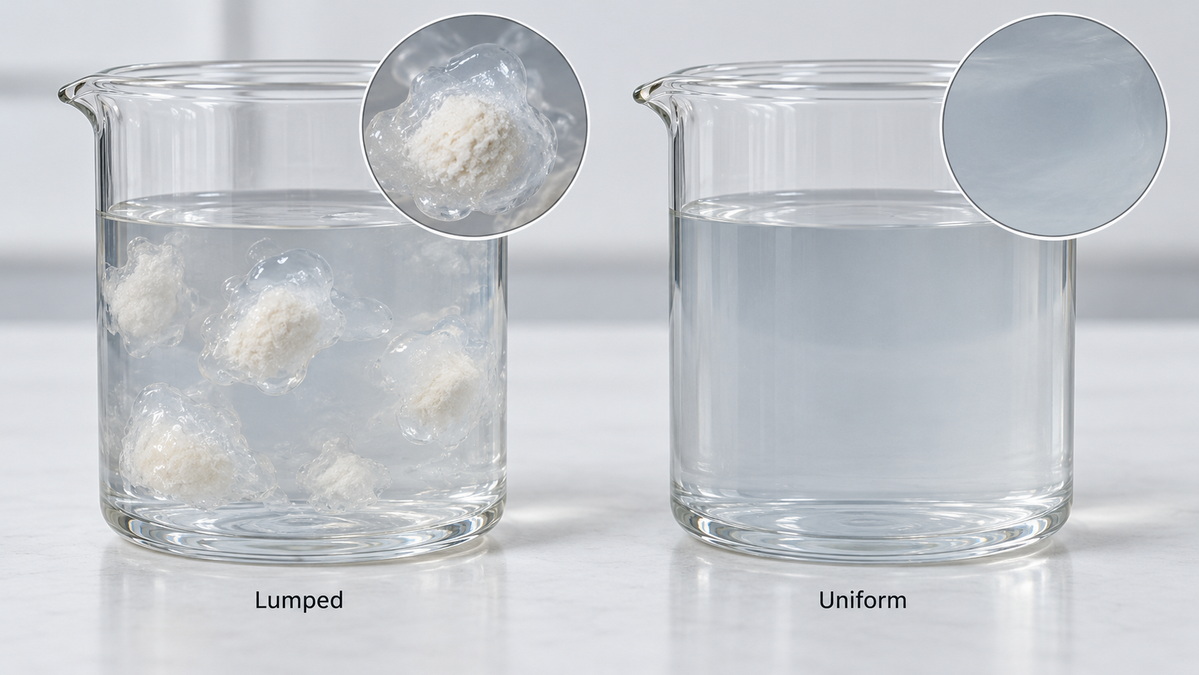
No. HEC is hydroxyethylcellulose; HPMC is hydroxypropyl methylcellulose. Their substitution chemistry differs, so hydration, thermal behavior, and formulation performance should not be assumed equivalent. Substitution requires testing.
It is derived from natural cellulose but chemically modified. Whether a particular natural-origin claim is appropriate depends on the applicable definition, calculation method, and supplier documentation.
Generally, it should not be treated as the primary replacement for an emulsifier. It can thicken an emulsion's aqueous phase, but the formula still requires a suitable emulsification system.
HEC does not generally need neutralization to develop viscosity in the same way as conventional carbomer systems. However, some delayed-hydration grades require specific activation conditions, so follow the supplier's instructions.
There is no universal concentration. Begin with the selected grade's recommended range, then optimize against viscosity, sensory properties, dispensing, and stability. Concentration is a formulation decision, not a standalone safety limit.
It may help, but reliable suspension depends on particle characteristics and the complete rheological profile. A high viscosity value alone does not guarantee that particles will remain evenly distributed.
The outside of a powder cluster can hydrate before water reaches its center. Controlled addition, adequate circulation, and an appropriate dispersion method help prevent this problem.
1. [Kima Chemical — "What Is Hydroxyethylcellulose in Cosmetics"]. Original article reviewed for topic coverage and restructuring. Its explanation of shear-thinning behavior has been corrected in the rewritten article. [kimacellulose]
2. [Ashland — "Natrosol™ HEC: Skin and Sun Care"]. Manufacturer information supporting nonionic character, thickening, surfactant compatibility, electrolyte tolerance, lubricity, and personal care applications. Product-specific environmental claims should not be generalized to other suppliers. [ashland]
3. [Ashland — "Natrosol™ Hydroxyethylcellulose: Oral Care"]. Supports the description of HEC as a water-soluble polymer producing shear-thinning solutions and its use in personal care formulations. [ashland]
4. [Ashland — "Natrosol™ 250 Hydroxyethylcellulose: Formulating Elegant Liquid and Semisolid Drug Products"]. Technical background for hydration, dispersion, prewetting, and solution behavior. This pharmaceutical-grade document does not establish equivalent purity or compliance for another supplier's material. [ashland]
5. [Ashland — "Natrosol™ 250 LR Hydroxyethylcellulose"]. Supports the explanation that certain surface-treated grades have delayed hydration. It is not a recommendation to use this specific industrial grade in cosmetics. [ashland]
6. [ISO — ISO 11930:2019, "Cosmetics — Microbiology — Evaluation of the Antimicrobial Protection of a Cosmetic Product"]. Authoritative basis for discussing preservation efficacy testing and microbiological risk assessment separately from physical stability. [iso]
7. ["Final Report of the Cosmetic Ingredient Review Expert Panel" — Cellulose and Modified Cellulose Polymers, bibliographic record]. Supports the qualified discussion of safety assessments for cellulose-derived cosmetic ingredients; it does not establish unrestricted safety for every finished formulation. [semanticscholar]


