


close
Choose Your Site
Global
Social Media
Views: 286 Author: Shengda Publish Time: 2026-10-09 Origin: Site


Content Menu
● What Are Cellulose Ethers in Paint Formulations?
>> Common Cellulose Ethers Used in Coatings
● Why High-Pigment Paints Need Strong Rheology Control
>> Common Problems in High-Pigment Paints
● Why HEC Is Preferred for High-Pigment Paints
>> HEC Supports Pigment and Filler Suspension
>> HEC Provides High Low-Shear Viscosity
>> HEC Offers Shear-Thinning Behavior
>> HEC Is Nonionic and Compatible With Many Water-Based Systems
>> HEC Helps Improve Application Properties
● HEC vs. Other Cellulose Ethers in High-Pigment Coatings
>> HEC vs. HPMC, MHEC, and HEMC
>> HEC vs. CMC
>> HEC vs. EHEC
● How HEC Works in High-PVC Latex Paint
>> Supporting Uniform Color and Hiding
● Practical Formulation Factors When Selecting HEC
>> Pigment Volume Concentration
>> Storage and Transportation Conditions
● Recommended Tests for High-Pigment HEC Paints
● Best Practices for Adding HEC to Water-Based Paint
>> Basic HEC Addition Procedure
>> Common HEC Processing Problems
● A Practical HEC Selection Strategy
● When HEC Should Be Used With Other Rheology Modifiers
● Why HEC Remains a Practical Choice for High-Pigment Paints
>> What is the difference between HEC and cellulose ethers?
>> Why is HEC used in high-pigment paints?
>> Is HEC suitable for high-PVC latex paint?
>> Can HEC reduce paint sedimentation?
>> Does HEC improve brush and roller application?
>> Can HEC be combined with other thickeners?
>> What factors should be considered when choosing an HEC grade?
High-pigment paints require more than high-quality pigments and fillers. They also need a well-designed rheology system that keeps particles uniformly suspended, maintains workable viscosity, and supports consistent application performance from manufacturing through end use.
Hydroxyethyl Cellulose (HEC) is widely used in water-based architectural coatings because it can provide effective thickening, pigment suspension, anti-settling performance, and application control. While HEC belongs to the broader cellulose ether family, it often offers specific advantages for high-pigment and high-PVC paint formulations.
In this comparison, HEC is evaluated against other common cellulose ethers used in coatings, including HPMC, MHEC/HEMC, CMC, and EHEC. The goal is to explain why HEC is frequently selected for high-pigment latex paints, interior wall coatings, primers, matte finishes, and other water-based coating systems.
Key point: HEC is a cellulose ether, but its nonionic chemistry and rheological behavior make it especially suitable for many high-pigment water-based paint formulations.
Cellulose ethers are modified cellulose polymers used to control viscosity, water retention, flow behavior, particle suspension, and application properties in a variety of water-based systems.
Cellulose is a naturally occurring polymer. Through controlled chemical modification, manufacturers create cellulose derivatives with different solubility, thickening, and compatibility properties. These derivatives are used in construction materials, personal care products, pharmaceuticals, food applications, detergents, and paints.
In water-based paint formulations, cellulose ethers are commonly used as:
- Thickeners to adjust viscosity
- Rheology modifiers to control flow under different shear conditions
- Pigment suspension aids to reduce settling
- Anti-sag additives for vertical application
- Water-retention agents during coating application
- Stabilizers for selected latex and pigment systems
- Application modifiers for brush, roller, and spray performance
Not every cellulose ether produces the same result. Chemical structure, substitution type, molecular weight, particle size, dissolution rate, and viscosity grade can all influence paint performance.
| Cellulose Ether Type | Typical Chemistry | Common Role in Paints | Consideration for High-Pigment Paints |
|---|---|---|---|
| Hydroxyethyl Cellulose (HEC) | Nonionic hydroxyethyl-modified cellulose | Thickening, suspension, viscosity control | Often preferred for high-pigment water-based paints |
| Hydroxypropyl Methylcellulose (HPMC) | Nonionic methyl and hydroxypropyl-modified cellulose | Thickening, workability, water retention | Can be suitable, depending on paint type and grade |
| Methyl Hydroxyethyl Cellulose (MHEC/HEMC) | Nonionic methyl and hydroxyethyl-modified cellulose | Viscosity adjustment and water retention | Useful in selected coating and construction systems |
| Carboxymethyl Cellulose (CMC) | Anionic carboxymethyl-modified cellulose | Thickening and stabilization | Requires careful compatibility testing in electrolyte-rich formulas |
| Ethyl Hydroxyethyl Cellulose (EHEC) | Ethyl and hydroxyethyl-modified cellulose | Rheology and application control | Can be selected for specialized flow requirements |
For high-pigment architectural coatings, the choice of cellulose ether should depend on practical formulation targets rather than on chemical classification alone.
High-pigment paints contain substantial quantities of pigments and fillers. These materials provide hiding power, color, texture, mattness, cost efficiency, and film structure. However, they also create formulation challenges.
The relationship between pigments, fillers, and binder is commonly described by pigment volume concentration, often shortened to PVC.
As pigment volume concentration increases, the paint typically becomes more difficult to stabilize. The formulation contains more solid particles that can settle, agglomerate, interfere with flow, or affect viscosity stability.
High-pigment coating systems may include:
- Titanium dioxide for opacity and brightness
- Calcium carbonate for cost control and matte appearance
- Kaolin clay for coverage and film structure
- Talc for texture and barrier performance
- Silica for specialized rheology or surface effects
- Iron oxide pigments for earthy and durable colors
- Organic pigments for bright decorative shades
- Carbon black for deep bases and dark coatings
Without a suitable rheology modifier, high-pigment paint may develop problems during production, storage, transport, or application.
- Pigment settling at the bottom of the container
- Hard sediment formation that cannot be easily re-dispersed
- Color separation between the top and bottom of the paint can
- Inconsistent hiding power after application
- Poor brush drag and difficult roller application
- Sagging on vertical surfaces
- Weak leveling after brushing or rolling
- Viscosity drift during storage
- Uneven sheen after film formation
- Reduced shelf stability under changing temperatures
The formulator must create a balanced system. The paint needs enough viscosity at rest to hold pigments and fillers in suspension. At the same time, it needs sufficient flow under mixing, pumping, brushing, rolling, and spraying.
This balance is one of the main reasons HEC is frequently selected for high-pigment latex paints.
HEC provides several properties that make it valuable in heavily filled water-based coatings. It can improve low-shear viscosity, help suspend pigments and fillers, support in-can stability, and contribute to practical application behavior.
One of the most important benefits of HEC is its ability to thicken the aqueous phase of a water-based paint system.
When HEC hydrates in water, its polymer chains expand and interact with the surrounding water molecules. This increases the viscosity of the continuous phase. As a result, pigment and filler particles move more slowly under gravity.
For high-pigment paints, this can help reduce:
- Pigment sedimentation
- Filler settling
- Hard-packed deposits
- Color inconsistency
- Separation during storage
- Viscosity loss over time
Dense inorganic materials such as titanium dioxide, calcium carbonate, barite, talc, and iron oxide pigments can create strong settling pressure inside the paint container. A suitable HEC grade helps the formulation resist this movement and maintain a more uniform particle distribution.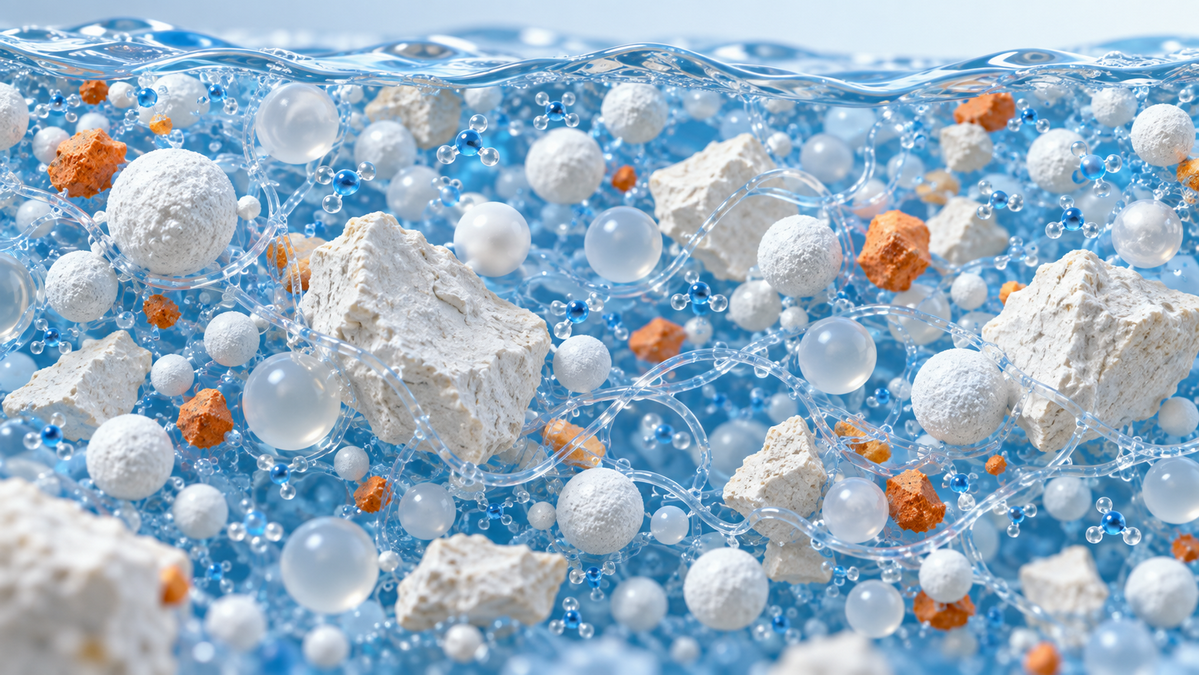
Paint experiences different shear conditions at different stages.
At rest inside a container, the coating is exposed to very low shear. During mixing, pumping, rolling, brushing, or spraying, the coating experiences higher shear.
HEC is often valued because it can provide relatively strong viscosity at low shear. This is beneficial for paint storage because low-shear viscosity plays an important role in resisting sedimentation.
A high-pigment coating with insufficient low-shear viscosity may initially look stable after production. However, over time, heavy particles can migrate downward and form a dense sediment layer.
HEC helps reduce this risk by supporting the paint structure while it remains in storage.
HEC-containing paint systems often show shear-thinning behavior. This means that viscosity decreases when the paint is exposed to higher shear forces.
This behavior is useful because the coating can remain stable in the can while becoming easier to apply during use.
A properly designed HEC rheology profile can provide:
- Stable viscosity during storage
- Reduced pigment settling
- Better pumpability
- Improved roller loading
- Smoother brushing
- More controlled spray behavior
- Improved paint spreadability
The objective is not to create the highest possible viscosity. Excessive thickening can make paint difficult to process and apply. The objective is to achieve the right balance between stability and flow.
HEC is generally considered a nonionic cellulose ether. This characteristic is important because water-based paints often contain many ingredients that can influence viscosity and stability.
These ingredients may include:
- Dispersants
- Wetting agents
- Defoamers
- Preservatives
- Surfactants
- Coalescents
- pH adjusters
- Mineral fillers
- Colored pigments
- Latex binders
- Salts and trace electrolytes
Anionic materials can sometimes show stronger sensitivity to ions or formulation changes. Because HEC is nonionic, it can offer more predictable performance in many conventional water-based latex paint systems.
Compatibility still needs to be tested. Every formulation behaves differently. However, HEC is often a dependable starting point for coatings containing complex combinations of pigments, fillers, and additives.
End users judge paint by how it performs during application. Even if a formulation remains stable in the can, it may fail commercially if it is difficult to brush, roll, or spray.
HEC can support several application-related properties:
- Brush body
- Roller feel
- Anti-sag behavior
- Spatter control
- Film uniformity
- Color consistency
- Open-time management
- Reduced pigment streaking
In decorative wall coatings, paint should spread smoothly without excessive resistance. It should not drip excessively from the brush or roller. It should also level after application so that brush marks and roller patterns become less visible.
The correct HEC grade can help create this balance.
HEC is not the only cellulose ether used in paint formulations. However, it is often selected when high pigment loading, anti-settling performance, and water-based compatibility are major priorities.
| Performance Factor | HEC | HPMC / MHEC / HEMC | CMC | EHEC |
|---|---|---|---|---|
| Low-shear viscosity development | Strong | Moderate to strong, depending on grade | Can be strong | Moderate to strong |
| Pigment suspension support | Strong | Suitable in selected systems | Depends strongly on formulation compatibility | Suitable in selected systems |
| High-PVC paint suitability | Frequently preferred | Requires grade-specific evaluation | Requires careful electrolyte management | Often used in specialty systems |
| Nonionic character | Yes | Yes | No, generally anionic | Yes |
| Sensitivity to salts and electrolytes | Generally lower | Generally lower | Can be higher | Generally lower |
| Anti-settling contribution | Strong | Can be effective | Variable | Can be effective |
| Architectural latex paint use | Very common | Common in selected formulas | More limited in many conventional systems | Used in specific rheology packages |
| Typical formulation function | Primary cellulosic thickener and suspension aid | Thickener, workability modifier, water-retention agent | Thickener and stabilizer | Rheology and application modifier |
HPMC, MHEC, and HEMC are nonionic cellulose ethers that can offer useful thickening and water-retention properties. They are widely used in dry-mix mortars, tile adhesives, skim coats, gypsum products, and selected coating applications.
In water-based paints, these materials may be suitable when formulators need specific hydration behavior, water retention, or application characteristics. However, their performance can vary significantly depending on substitution level, molecular weight, and grade design.
For high-pigment latex paints, HEC is often preferred because it has a long history of use as a water-phase thickener and pigment suspension aid. It can provide strong low-shear viscosity while maintaining useful shear-thinning properties.
CMC is an anionic cellulose ether. It can increase viscosity and provide stabilization in appropriate systems. However, because of its ionic nature, CMC may require more careful compatibility control when a formulation contains salts, multivalent ions, electrolyte-rich pigments, or other charged additives.
High-pigment paints can be chemically complex. Mineral fillers and pigment dispersions may introduce ions that affect thickener performance. For this reason, nonionic HEC is often considered a more robust option in conventional water-based architectural coatings.
EHEC can also be used for rheology and viscosity control in coatings. It may be selected for certain specialized formulations where a different balance of flow, thickening, and application performance is required.
However, for many high-pigment architectural paint systems, HEC remains a highly practical option due to its strong aqueous thickening performance, established application history, and ability to support pigment suspension.
High-PVC latex paints often contain a large quantity of extenders and fillers relative to binder solids. These coatings may be designed for interior walls, ceilings, primers, economical decorative paints, or matte finishes.
In these systems, HEC contributes to performance through several connected mechanisms.
HEC thickens the continuous water phase of the coating. This creates resistance to the movement of pigment and filler particles.
When particles move more slowly, the paint has a better chance of maintaining uniformity during storage and transport.
Pigments and fillers tend to settle because of gravity. The risk becomes greater when particles are dense, large, poorly dispersed, or present at high loading levels.
HEC helps slow down this settling process by increasing low-shear viscosity and supporting a more stable rheological structure.
Pigments must remain evenly distributed to produce consistent color and hiding power.
If pigment settles or separates, the paint may show shade differences between the top and bottom of the container. This can lead to inconsistent tint strength, uneven opacity, and customer dissatisfaction.
HEC supports a more consistent pigment distribution, which can help improve visual uniformity after application.
A high-pigment paint must remain manageable during manufacturing. It needs to move through pumps, mixers, filters, filling lines, and packaging equipment without creating processing problems.
A correctly selected HEC grade can support:
- Controlled viscosity build
- More stable batch-to-batch processing
- Reduced risk of separation
- Improved handling during filling
- More reliable final viscosity adjustment
The exact result depends on the full formulation and manufacturing process. HEC should therefore be evaluated alongside the pigment package, dispersant, binder, and other rheology modifiers.
Selecting HEC only by viscosity specification can lead to disappointing results. Paint performance depends on more than the viscosity of a cellulose ether solution.
A successful high-pigment paint formulation should consider the following factors.
Higher pigment volume concentration generally increases the demand for suspension stability. Paints with high levels of calcium carbonate, talc, kaolin, titanium dioxide, or other fillers may require stronger low-shear viscosity control.
Dense inorganic materials create greater settling pressure. Titanium dioxide, barite, iron oxide, and certain mineral fillers may need stronger anti-settling support than lighter pigment systems.
Different binders interact differently with the overall rheology package. Acrylic, styrene-acrylic, vinyl-acrylic, and pure acrylic binders can produce different flow, viscosity, and film-forming behavior.
The application method influences the ideal viscosity profile.
- Brush paints need good body and leveling
- Roller paints need controlled spatter and smooth loading
- Spray paints need suitable atomization behavior
- Primer paints need penetration and coverage
- Ceiling paints often require strong anti-sag and anti-spatter performance
Paint may be stored for weeks or months before use. It may also experience temperature changes during warehouse storage and international shipping.
High-pigment formulations should be evaluated for:
- Long-term sedimentation resistance
- Viscosity stability
- Freeze-thaw behavior where relevant
- Heat stability
- Re-dispersibility after storage
- Separation resistance
- Package appearance after transport
Laboratory testing helps identify whether the selected HEC grade provides the correct balance of stability and application behavior.
| Test | Main Purpose | What It Can Reveal |
|---|---|---|
| Stormer viscosity | Evaluates practical low- to medium-shear viscosity | General paint consistency and in-can body |
| ICI viscosity | Evaluates high-shear viscosity | Brush, roller, and spray response |
| Storage stability test | Evaluates aging behavior | Settling, separation, skinning, or viscosity drift |
| Freeze-thaw test | Evaluates low-temperature durability | Damage caused by repeated freezing and thawing |
| Sag resistance test | Evaluates vertical flow control | Ability to resist downward movement after application |
| Leveling test | Evaluates surface smoothness | Reduction of brush marks and roller texture |
| Drawdown test | Evaluates film appearance | Color consistency, hiding, and surface defects |
| Re-dispersion test | Evaluates sediment behavior | Whether settled material can be mixed back easily |
| Spatter resistance test | Evaluates roller application | Paint splashing during rolling |
| pH stability test | Evaluates formulation tolerance | Viscosity changes caused by pH shifts |
Best Practices for Adding HEC to Water-Based Paint
Even the right HEC grade can perform poorly if the hydration process is not well controlled. Incomplete wetting, clumping, insufficient mixing, and premature viscosity adjustment can all create processing difficulties.
The final addition procedure should be adjusted according to the selected HEC grade, equipment type, water temperature, formulation sequence, and desired production speed.
1. Charge the required amount of clean process water into the premix tank.
2. Begin controlled agitation and create a stable vortex without excessive foam formation.
3. Slowly sift HEC powder into the vortex.
4. Maintain mixing until the powder is evenly wetted and no dry clumps remain.
5. Allow adequate hydration time before making final viscosity adjustments.
6. Add wetting agents, dispersants, defoamers, preservatives, and other compatible liquid additives according to the formulation sequence.
7. Disperse pigments and fillers under suitable shear conditions.
8. Add latex binder and remaining formulation ingredients.
9. Adjust viscosity only after the HEC has hydrated sufficiently and the batch has reached a stable condition.
10. Perform final quality-control testing before filling.
| Problem | Possible Cause | Practical Prevention |
|---|---|---|
| Gel particles or lumps | HEC added too quickly | Add powder slowly into a stable vortex |
| Incomplete viscosity development | Insufficient hydration time | Allow full hydration before final adjustment |
| Excessive foam | High agitation or unsuitable defoamer balance | Control mixing speed and optimize defoamer |
| Viscosity variation between batches | Inconsistent addition sequence or water quality | Standardize process order and monitor raw materials |
| Poor anti-settling performance | HEC grade or dosage is insufficient | Evaluate low-shear rheology and optimize thickener package |
| Poor leveling | Excessive low-shear viscosity | Balance HEC with other rheology modifiers |
| Heavy brush drag | Over-thickening | Adjust dosage and evaluate high-shear viscosity |
| Difficult re-dispersion | Dense sediment formed during storage | Improve suspension system and particle dispersion |
For a new high-pigment paint project, it is useful to evaluate several HEC grades rather than relying on one grade from a previous formula.
A practical development sequence may include the following steps:
1. Define the target paint type, including interior wall paint, primer, ceiling paint, matte coating, or exterior latex coating.
2. Identify the pigment and filler package, including titanium dioxide level, calcium carbonate loading, clay content, and colored pigment requirements.
3. Set target viscosity values for low, medium, and high shear.
4. Prepare small-scale batches using different HEC grades or dosage levels.
5. Compare pigment suspension, storage stability, leveling, anti-sag performance, brushability, roller feel, and color uniformity.
6. Evaluate whether HEC should be used alone or combined with an associative thickener or another rheology modifier.
7. Conduct accelerated storage testing before commercial scale-up.
8. Confirm that the selected HEC grade can be consistently processed under plant production conditions.
This method helps reduce the risk of selecting a grade based only on initial viscosity. A paint that looks acceptable on the day of production may still fail after storage, transport, or application testing.
HEC can provide excellent low-shear viscosity and suspension performance. However, some coatings need a broader rheology profile than one additive can provide.
For example, a paint may require:
- Higher high-shear viscosity for improved roller application
- Better leveling in semi-gloss or satin coatings
- Enhanced spatter resistance
- Controlled spray atomization
- Improved flow in high-gloss systems
- Stronger sag resistance on vertical surfaces
- Better balance between brush drag and film smoothness
In these cases, HEC may be used as part of a combined rheology package.
A typical strategy is to use HEC as the primary cellulosic thickener for low-shear viscosity and pigment suspension, then add another rheology modifier to fine-tune high-shear behavior or application feel.
This approach allows formulators to improve performance without relying on excessive HEC dosage.
High-pigment paint formulation requires careful control of particle suspension, viscosity, color consistency, storage stability, and application behavior.
HEC remains a practical cellulose ether choice because it can offer:
- Effective thickening of the aqueous phase
- Strong low-shear viscosity development
- Improved pigment and filler suspension
- Reduced risk of hard settling
- Good compatibility with many water-based latex systems
- Useful shear-thinning behavior
- Improved brush, roller, and application performance
- More stable color and hiding consistency
- Suitability for high-PVC architectural coatings
- Flexible use in blended rheology systems
For high-pigment latex paints, HEC can help bridge the gap between in-can stability and real-world usability. It supports the properties that matter throughout the coating lifecycle: manufacturing, storage, transportation, application, drying, and final appearance.
HEC is a cellulose ether, but it is often preferred over other cellulose ether options in high-pigment water-based paints because of its nonionic structure, strong water-phase thickening ability, pigment suspension support, and practical rheological performance.
In high-PVC architectural coatings, HEC can help reduce pigment settling, improve storage stability, support uniform color, and maintain manageable application behavior. It is particularly valuable in formulations containing high levels of titanium dioxide, calcium carbonate, kaolin, talc, iron oxide, and other dense pigment or filler materials.
The best HEC grade depends on the entire paint system. Pigment loading, binder type, application method, target viscosity, storage requirements, and other additives should all be evaluated through structured formulation testing.
Shandong Shengda New Material Co., Ltd. provides cellulose ether solutions, including Hydroxyethyl Cellulose for water-based coatings, construction materials, and daily chemical applications. The right HEC grade can help paint manufacturers improve stability, efficiency, and product consistency in demanding high-pigment coating systems.
Cellulose ethers are a broad group of modified cellulose polymers. HEC is one specific type of cellulose ether. Other common cellulose ethers include HPMC, MHEC, HEMC, CMC, and EHEC.
HEC increases viscosity in the water phase and helps reduce the settling of pigments and fillers. This can improve paint stability, color consistency, re-dispersibility, and storage performance.
Yes. HEC is commonly used in high-PVC water-based architectural coatings because it can provide strong low-shear viscosity and help maintain pigment and filler suspension.
HEC can help reduce sedimentation by increasing low-shear viscosity and slowing the movement of dense pigment and filler particles during storage.
HEC can improve brush body, roller loading, sag resistance, and application control. The final effect depends on dosage, viscosity grade, latex type, and the complete rheology package.
Yes. HEC is often combined with associative thickeners, polyurethane thickeners, alkali-swellable emulsions, or inorganic rheology modifiers to optimize both low-shear and high-shear paint behavior.
Key factors include pigment volume concentration, pigment and filler density, binder type, desired paint viscosity, application method, storage requirements, production equipment, and the compatibility of other additives.
1. Safic-Alcan. "Rheology Modifiers for Waterborne Systems."
[https://www.safic-alcan.com/en-fr/industry-articles/rheology-modifiers-waterborne-systems/]
2. Celotech. "Application Method of Hydroxyethyl Cellulose in Latex Paint."
[https://www.celotech.com/technology/application-method-of-hydroxyethyl-cellulose-in-latex-paint/]
3. Shandong Shengda New Material Co., Ltd. "How Is Hydroxyethyl Cellulose HEC Used in Water Based Paint: A Complete Formulation Guide."
4. UL Prospector. "Pigment Volume Concentration – Part 1."
[https://www.ulprospector.com/knowledge/10288/pc-pigment-volume-concentration-part-1/]
5. CelluloseEther.com. "Hydroxyethyl Cellulose in Water-Based Paints."
[https://celluloseether.com/application-hec-water-based-paints/]
6. Landercoll. "Paint Grade Cellulose Ethers."
[https://landercoll.com/en/products/product-by-grade/paint-grade/]
7. Google Patents. "Paint Formulations Comprising Cellulose Ether/Network Building Polymer Combinations."


