


close
Choose Your Site
Global
Social Media
Views: 276 Author: Shengda Publish Time: 2026-08-12 Origin: Site


Content Menu
● Main Types of Cellulose Ether
● HPMC in Construction Materials
● HEMC for Better Heat Resistance
● HEC in Coatings and Daily Chemicals
● Key Differences Between HPMC, HEMC, and HEC
● How to Choose the Right Grade
● Practical Applications Across Industries
● Industry Trends and Market Direction
● Purchasing Considerations for Buyers
● FAQ
>> 1. What is cellulose ether used for?
>> 2. What is the difference between HPMC and HEMC?
>> 3. Why is HEC used in coatings?
>> 4. Which cellulose ether is best for tile adhesive?
>> 5. How do I choose the right cellulose ether?
Cellulose ether is one of the most widely used functional materials in modern industry. It plays an important role in construction materials, coatings, personal care products, detergents, and other formulated systems.
Among the most important types are HPMC, HEMC, and HEC. These three cellulose ethers are similar in origin but differ in performance, application focus, and suitability for different environments. Understanding these differences helps manufacturers, distributors, and formulators choose the right grade for each product.
Cellulose ether is a group of water-soluble derivatives made from natural cellulose through chemical modification. This process gives cellulose better solubility and functional performance in industrial formulations.
Because of their versatile properties, cellulose ethers are used as thickening agents, water-retention agents, binders, stabilizers, and film-forming materials. They are valued for being efficient at low dosage and adaptable to many product systems.
In many industries, product performance depends on stability, workability, and consistency. Cellulose ether helps improve all three.
In construction, it can improve mortar workability, extend open time, and reduce water loss. In daily chemical products, it can enhance texture, suspension, and flow behavior. In coatings, it can improve application feel and finish quality.
This combination of performance and flexibility explains why cellulose ether continues to be a core raw material in many industrial formulations.
The most common types used in construction and daily chemical products are HPMC, HEMC, and HEC.
| Type | Full Name | Main Features | Common Applications |
|---|---|---|---|
| HPMC | Hydroxypropyl Methyl Cellulose | Water retention, thickening, workability, film formation | Tile adhesive, mortar, wall putty, pharmaceuticals, food |
| HEMC | Hydroxyethyl Methyl Cellulose | Strong water retention, better heat stability, good workability | Tile adhesive, mortar, exterior wall systems, coatings |
| HEC | Hydroxyethyl Cellulose | Excellent thickening, film formation, compatibility | Paint, coatings, adhesives, shampoo, detergent |
Each type has a slightly different balance of properties. The right choice depends on how the product will be used and what performance is most important.
HPMC is one of the most widely used cellulose ethers in the construction industry. It is especially popular in dry-mix mortar systems such as tile adhesive, plaster, wall putty, and self-leveling compounds.
Its main function is to improve water retention and workability. This allows the mortar to stay usable for a longer period during application, while also helping the cement system hydrate properly.
HPMC is also helpful in reducing sagging and improving application consistency. For many building material formulations, it is the standard choice because of its balanced performance.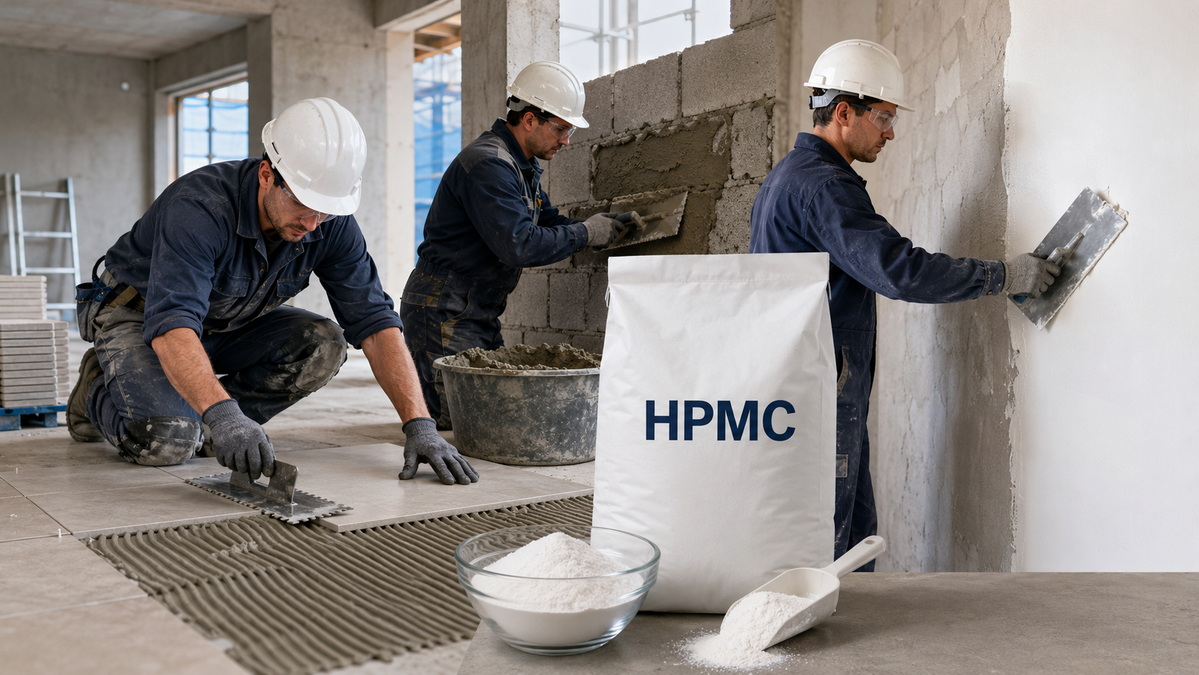
HEMC is closely related to HPMC but often performs better in hotter conditions. This makes it particularly useful in regions with high temperatures or in construction projects exposed to rapid drying.
One of the key advantages of HEMC is its higher gel temperature. This helps the material maintain water retention and workability when the environment becomes warmer.
As a result, HEMC is often selected for tile adhesives, plaster systems, and exterior wall products where temperature stability is important. It is a strong option when a formulation must remain reliable under more demanding conditions.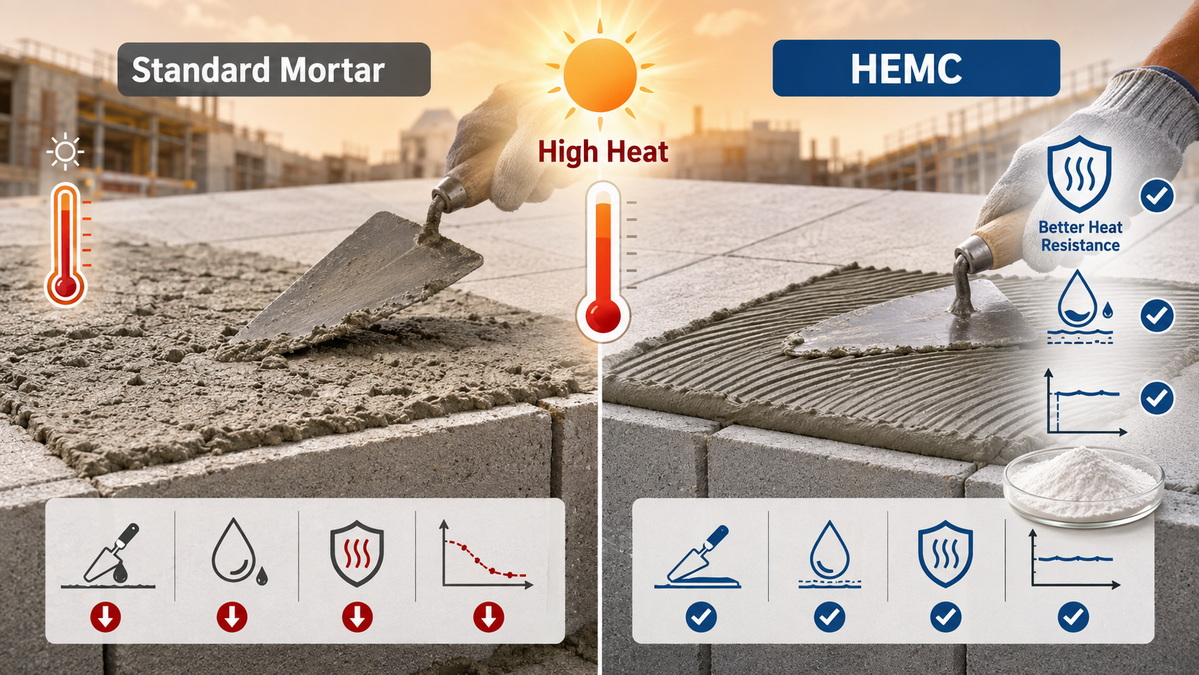
HEC is often used in coatings, detergents, and personal care products. It provides excellent thickening and compatibility, which makes it useful in systems that require smooth flow, stable texture, and good visual appearance.
In coatings, HEC helps improve viscosity control and application behavior. In personal care products such as shampoo and shower gel, it helps create a more pleasant texture and stable product consistency.
Compared with HPMC and HEMC, HEC is usually more associated with liquid and semi-liquid formulations. Its film-forming and rheology control properties make it valuable in many non-construction applications.
Although these three materials belong to the same cellulose ether family, their performance is not identical.
HPMC and HEMC are both strong water-retention agents in construction formulations. HEMC often performs better in hot environments, while HPMC is suitable for a wide range of standard applications.
HEC is less commonly chosen for dry-mix mortars, but it performs well in coatings and liquid systems where thickening is more important than cement hydration support.
HEMC has an advantage in high-temperature environments. Its higher gel temperature gives it better stability when exposed to heat during construction or drying.
HPMC also performs well, but its working range is generally better suited to standard conditions. HEC is usually selected more for rheology and film performance than for heat resistance in cement-based systems.
HEC is especially well known for film-forming performance. This is one reason it is widely used in coatings and daily chemical products.
HPMC also has film-forming ability, but it is more often chosen for building materials because of its water retention and workability balance. HEMC is similar to HPMC but is generally better when temperature stability is needed.
HPMC is mainly used in construction and some regulated industries. HEMC is also focused on construction but is often preferred in warmer climates. HEC is more commonly used in coatings, adhesives, and daily chemical formulations.
This difference in application focus is one of the easiest ways to understand how to choose among them.
Choosing the correct cellulose ether grade starts with the end application.
If the product is a dry-mix construction material, HPMC or HEMC is usually the first choice. If the application is in a hotter climate or requires stronger temperature stability, HEMC may be the better option.
If the formulation is for paint, shampoo, detergent, or other liquid systems, HEC is often a better fit because of its thickening and film-forming performance.
Other factors also matter, including viscosity, particle size, water-retention level, open time, and compatibility with other raw materials. A well-matched grade can improve both production efficiency and final product quality.
Cellulose ether is not limited to a single industry. Its versatility makes it useful in many different product categories.
- In construction, it supports tile adhesives, wall putty, plaster, mortar, and insulation systems.
- In coatings, it helps control viscosity, improve brushability, and stabilize the system.
- In personal care, it improves texture, consistency, and consumer feel.
- In household products, it supports stable thickening and better suspension.
- In pharmaceutical and food applications, certain grades are used for binding, thickening, and controlled performance.
This wide range of uses is one reason cellulose ether remains an important industrial additive.
The demand for cellulose ether continues to rise as construction, personal care, and other downstream sectors grow. Buyers are paying more attention to consistency, technical support, and product stability.
At the same time, manufacturers are looking for materials that can support better efficiency, lower waste, and more sustainable production systems. This is increasing interest in cellulose ether grades that combine performance with environmental compatibility.
For global buyers, this means supplier selection is no longer based on price alone. Technical reliability and long-term product consistency are becoming just as important.
When sourcing cellulose ether, it is important to evaluate more than one specification. Product grade, application fit, and supplier capability all matter.
Before purchase, buyers should confirm:
- The intended end use.
- The required viscosity range.
- The needed water-retention performance.
- The target working conditions, including climate and temperature.
- Compatibility with other ingredients.
- Whether technical support is available for sample testing and adjustment.
These points help reduce formulation risk and improve the chance of successful product development.
HPMC, HEMC, and HEC are three of the most important cellulose ethers used in modern industry. Although they share a similar base material, their properties are different enough to make each one suitable for specific applications.
HPMC is a strong all-round choice for construction materials. HEMC is often preferred when better heat resistance is needed. HEC is especially useful in coatings and daily chemical products.
The best result comes from matching the cellulose ether grade to the application, climate, and performance target. When that match is right, the material can improve product stability, application experience, and overall formulation efficiency.
If you are developing construction-grade or daily chemical products, choosing the correct cellulose ether grade is a key step toward better performance and more consistent results.
Cellulose ether is used as a thickener, water-retention agent, binder, stabilizer, and film-forming material in construction, coatings, personal care, and other industries.
HPMC and HEMC are both used in construction materials, but HEMC usually performs better in hot conditions because of its higher gel temperature.
HEC is used in coatings because it provides good thickening, stable viscosity, and strong film-forming performance.
HPMC and HEMC are both widely used in tile adhesive. HEMC is often preferred in warm climates, while HPMC is a common general-purpose option.
The right choice depends on the application, temperature conditions, required viscosity, water retention, and compatibility with other ingredients.
1. [GlobalGrowthInsights – Powdered Cellulose Ether Market Size]
2. [Google Developers – Creating Helpful, Reliable, People-First Content]
3. [Semrush – Google E-E-A-T: What it is & how it affects SEO]
4. [WEVENTURE – E-E-A-T for Google]
6. [WotaiChem – 7 Key Differences of HPMC and HEMC]
7. [KDOChem – Differences Between HPMC and HEC]
8. [Vitchem – China Cellulose Ether Industry Development Outlook and Analysis Report]
9. [Shandong HeDa / Shanghai Securities Research Report Excerpt]


