


close
Choose Your Site
Global
Social Media
Views: 216 Author: Shengda Publish Time: 2026-08-16 Origin: Site


Content Menu
● Reliable Cellulose Ether Solutions Start with Application Knowledge
● HPMC for Dry-Mix Construction Materials
>> How HPMC Supports Mortar Performance
● HEMC for Controlled Workability and Water Retention
>> A Better Starting Point for HEMC Selection
● HEC for Personal Care and Water-Based Formulations
>> What HEC Can Contribute to a Formula
● How to Select the Right Cellulose Ether Grade
>> Step 1: Define the Application
>> Step 2: Set Performance Targets
>> Step 3: Review the Formula Context
>> Step 4: Select Suitable Samples
>> Step 5: Validate at Laboratory and Pilot Scale
● Quality Documents and Batch Consistency
>> Recommended Documents to Review
● Storage, Handling, and Mixing Guidance
>> Practical Handling Recommendations
● Partner with Shandong Shengda New Material
● FAQ
>> What is the difference between HPMC, HEMC, and HEC?
>> How do I choose HPMC for tile adhesive?
>> Can HPMC improve mortar water retention?
>> Is HEC suitable for shampoo and body wash?
>> Why does cellulose ether form lumps in water?
>> What documents should I request from a cellulose ether supplier?
>> Can I request samples before a bulk order?
Selecting a cellulose ether is not simply a matter of choosing a powder with a certain viscosity value. For dry-mix mortar producers, tile adhesive brands, paint manufacturers, and personal care formulators, the selected grade can influence processing stability, application performance, product consistency, and end-user satisfaction.
Shandong Shengda New Material Co., Ltd. focuses on the research, development, production, and supply of Hydroxypropyl Methyl Cellulose (HPMC),Hydroxyethyl Methyl Cellulose ( HEMC) and Hydroxyethyl Cellulose (HEC).
We provide construction-grade and personal-care-grade cellulose ether solutions for global manufacturers seeking dependable quality, stable supply, and formulation-oriented technical support.
Our objective is to help customers solve practical formulation challenges, including:
- Selecting a suitable cellulose ether for a specific application.
- Improving water retention and workability in dry-mix mortar.
- Controlling viscosity and texture in water-based formulations.
- Reducing variation between production batches.
- Establishing a more efficient laboratory testing process.
- Preparing technical documents for international procurement.
Cellulose ethers are modified cellulose-based polymers. Through controlled chemical modification, they can provide thickening, water retention, film formation, rheology control, stabilization, and workability improvement in a broad range of applications.
However, viscosity alone does not define the performance of a cellulose ether.
Important factors may include substitution type, particle size, moisture content, dissolution behavior, surface treatment, dosage, mixing procedure, raw-material compatibility, and the overall formulation system. A suitable grade should therefore be selected through practical testing rather than a single specification value.
Hydroxypropyl Methyl Cellulose, commonly known as HPMC, is widely used in cement-based and gypsum-based dry-mix formulations.
In construction materials, HPMC can help retain water in the fresh mortar, improve consistency, extend workable time, and support a smoother application experience. These benefits are particularly important when mortar is applied to absorbent substrates or used under changing temperature and humidity conditions.
For manufacturers of dry-mix products, the goal is not simply to use more HPMC. The goal is to select a grade that creates the desired balance between water retention, workability, open time, anti-sag performance, and cost efficiency.
HPMC can be used in a variety of construction material systems, including:
- Ceramic tile adhesives.
- Wall putty and skim coat.
- Cement render and plaster.
- Gypsum plaster.
- Masonry mortar.
- Self-leveling compounds.
- External insulation and finishing systems.
- Joint fillers.
- Repair mortars.
- Decorative cement-based coatings.
A well-selected HPMC grade can contribute to several critical fresh-mortar properties.
| Performance Area | Practical Value for Manufacturers and Applicators |
|---|---|
| Water retention | Helps reduce excessively rapid water loss from fresh mortar. |
| Workability | Supports smoother spreading, mixing, and troweling behavior. |
| Open time | Allows more time for tile adjustment, finishing, or application. |
| Anti-sag performance | Helps vertical applications remain stable after placement. |
| Cohesion | Supports a more uniform and less crumbly mortar texture. |
| Surface finish | Can improve the feel and appearance of the applied material. |
| Pumpability | May support more consistent flow in suitable pumped mortar systems. |
The result depends on the complete formula. Cement type, filler content, particle-size distribution, polymer powder, starch ether, defoamer, retarder, accelerator, and ambient conditions can all influence the final performance.
A high-viscosity product is not necessarily the most appropriate choice. In some formulations, excessive viscosity can create unwanted drag, slower mixing, unsuitable flow behavior, or application difficulty. The correct grade is the one that meets the product's full performance target at a practical dosage level.
Hydroxyethyl Methyl Cellulose, known as HEMC, is another important non-ionic cellulose ether used in dry-mix construction materials.
HEMC can be evaluated for formulations requiring a specific balance of water retention, thickening behavior, rheology control, and application performance. It is often considered for cementitious and gypsum-based products where formulators need stable handling properties during mixing and application.
Like HPMC, HEMC performance should be assessed in the final formulation. Two grades with similar viscosity labels may behave differently because of their substitution characteristics, manufacturing process, moisture level, particle distribution, and interaction with other formulation ingredients.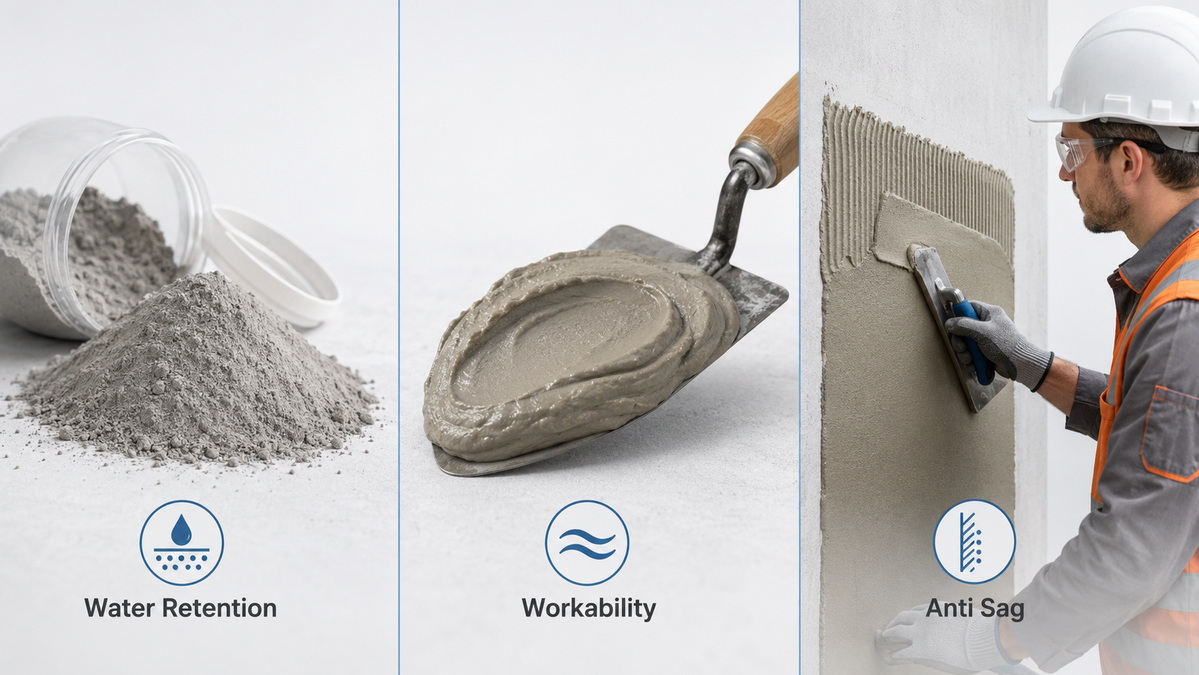
HEMC may be an appropriate option when a formulation requires:
- Stable workability during application.
- Improved trowel feel.
- Better resistance to rapid moisture loss.
- Controlled water demand.
- Reliable thickening performance.
- Smoother plastering or rendering behavior.
- A customized balance between viscosity and flow.
For example, a wall putty producer may need a product that spreads smoothly without feeling too heavy during application. A render manufacturer may focus more strongly on water retention, cohesion, and resistance to sagging. These are different formulation targets, and they may require different cellulose ether grades.
Instead of requesting only a "high-viscosity HEMC," share practical product information with the supplier:
- Your final application.
- Main binder type.
- Filler system.
- Target consistency.
- Required working time.
- Current dosage of additives.
- Local climate conditions.
- Existing product challenges.
This information helps narrow the initial sample selection and can reduce unnecessary laboratory trials.
Hydroxyethyl Cellulose, or HEC, is commonly used in water-based formulations as a thickener and rheology modifier.
In personal care applications, HEC can help create a stable and appealing product texture. It may contribute to viscosity development, suspension support, improved body, and a more consistent sensory experience.
Personal care manufacturers often require more than a thick product. They need a formulation that remains stable during mixing, filling, transportation, storage, and everyday consumer use.

HEC can be considered for products such as:
- Shampoo.
- Body wash.
- Facial cleanser.
- Shower gel.
- Hand wash.
- Hair styling gel.
- Skin-care gel.
- Lotion and cream systems.
- Water-based cosmetic formulations.
- Water-based coatings and industrial liquid systems.
A properly selected HEC grade may help support:
- Smooth viscosity development.
- Improved formulation body.
- Stable visual appearance.
- Better suspension of selected insoluble ingredients.
- Improved texture and flow behavior.
- More consistent product performance.
- Better processing control in water-based systems.
The final result depends on the full formula and manufacturing procedure. Surfactants, electrolyte concentration, pH, fragrance, active ingredients, preservatives, processing temperature, and mixing speed can all affect final viscosity and appearance.
For this reason, HEC should be tested under production-relevant conditions. A laboratory formula that performs well at a small scale should also be evaluated through pilot-scale mixing and stability observation before commercial production.
The most efficient selection process starts with measurable performance requirements.
Rather than choosing a product based only on a viscosity number, manufacturers should review the complete application environment. This includes raw materials, processing equipment, target product behavior, application conditions, and customer expectations.
First, identify the final product clearly.
Examples include:
- Tile adhesive.
- Skim coat.
- Wall putty.
- Cement plaster.
- Gypsum plaster.
- Self-leveling mortar.
- Masonry mortar.
- Shampoo.
- Facial cleanser.
- Body wash.
- Water-based coating.
Each application has different performance priorities.
Define what the finished product must achieve.
For construction applications, relevant targets may include:
- Water retention.
- Open time.
- Slip resistance.
- Workability.
- Adhesion-related performance.
- Sag resistance.
- Pumpability.
- Surface smoothness.
For personal care applications, relevant targets may include:
- Final viscosity.
- Transparency.
- Texture.
- Product stability.
- Suspension behavior.
- Sensory feel.
- pH compatibility.
- Processing time.
The cellulose ether must work with the rest of the formulation.
For dry-mix mortar, relevant ingredients may include cement, gypsum, calcium carbonate, silica sand, redispersible polymer powder, starch ether, accelerator, retarder, and defoamer.
For personal care products, relevant ingredients may include water, surfactants, salts, humectants, fragrance, preservatives, active ingredients, and pH-adjustment agents.
A short list of relevant grades is usually more useful than testing many unrelated products.
Each sample should be identified clearly by grade, batch, recommended dosage range, and testing conditions.
Initial laboratory results are important, but they should not be the only basis for approval.
Evaluate the selected grade through:
- Initial appearance and mixing behavior.
- Viscosity development.
- Workability or sensory evaluation.
- Stability observation.
- Repeated test batches.
- Pilot-scale production.
- Packaging and storage evaluation.
A structured validation process can reduce production risk and improve confidence before commercial purchasing.
For international buyers, quality is not just a statement on a product page. It should be supported by documentation, defined specifications, batch traceability, and clear communication.
Before placing a commercial order, buyers should request relevant technical documents for the selected grade.
- Technical Data Sheet.
- Safety Data Sheet.
- Certificate of Analysis.
- Product specification sheet.
- Packaging specification.
- Storage and handling guidance.
- Test method information.
- Sample identification details.
- Batch traceability information.
The Certificate of Analysis should help the customer verify important batch-level properties based on the supplier's defined test methods and specifications.
A reliable supply relationship also requires transparent communication. If a customer experiences a formulation issue, the supplier should be able to review application details, testing conditions, dosage, and batch information before recommending next steps.
Cellulose ethers are typically supplied in powder form and should be protected from moisture during storage and transportation.
Store unopened bags in a clean, dry, and well-ventilated area. Avoid direct exposure to water, excessive humidity, and unsuitable storage conditions. Follow the product-specific handling guidance and local workplace requirements.
- Keep packaging sealed until use.
- Avoid direct contact with moisture.
- Use clean and dry production equipment.
- Follow a controlled addition sequence.
- Maintain consistent mixing speed and time.
- Record batch numbers during testing and production.
- Retain approved reference samples when possible.
In water-based systems, adding cellulose ether too quickly can create lumps. The outer surface of the powder may hydrate first, trapping dry material inside. A controlled dispersion process and suitable mixing procedure can reduce agglomeration and improve hydration efficiency.
In dry-mix mortar production, uniform blending is equally important. Uneven dispersion can lead to inconsistent workability and performance across different bags or production batches.
Shandong Shengda New Material Co., Ltd. provides HPMC, HEMC, and HEC cellulose ether solutions for manufacturers serving construction, coatings, personal care, and other water-based formulation markets.
We understand that product selection requires more than a specification sheet. Manufacturers need stable material quality, practical technical communication, clear documentation, and a supplier that understands the relationship between raw materials and final-product performance.
Whether you are developing tile adhesive, wall putty, gypsum plaster, shampoo, body wash, facial cleanser, or another water-based product, our team can support the early stages of grade selection and product evaluation.
Share your application, target performance, estimated volume, and destination market with us. We will help identify a practical starting point for sampling and formulation assessment.
HPMC, HEMC, and HEC are versatile cellulose ethers used across construction materials and water-based formulations. HPMC and HEMC can support water retention, workability, cohesion, and application performance in dry-mix mortar systems. HEC can help provide viscosity control, texture, and formulation stability in personal care and other liquid products.
The best cellulose ether grade depends on the complete formulation, processing method, target performance, and local application conditions. Structured sample evaluation, technical documentation, and batch-level consistency are essential for dependable long-term supply.
HPMC, HEMC, and HEC are cellulose ethers with different chemical structures and performance characteristics. HPMC and HEMC are commonly used in dry-mix construction materials, while HEC is frequently used in water-based coatings and personal care formulations. The final choice depends on the application and formulation requirements.
Start by identifying the tile adhesive type, cement level, filler system, polymer powder content, open-time target, and anti-slip requirement. Then test suitable HPMC samples at controlled dosage levels. Avoid choosing a grade based only on viscosity.
HPMC is commonly used to support water retention in cement-based mortar. The actual result depends on the selected grade, dosage, cement type, filler system, environmental conditions, and testing method.
HEC can be used in shampoo, body wash, cleanser, and other water-based personal care products as a thickening and rheology-modifying ingredient. It should be tested with the complete surfactant system, salt level, pH, fragrance, and active ingredients.
Lumps may form when cellulose ether powder is added too quickly or without suitable agitation. The powder surface hydrates first and may trap dry powder inside. A controlled dispersion and hydration process can reduce this issue.
Request a Technical Data Sheet, Safety Data Sheet, Certificate of Analysis, packaging details, storage guidance, and product test-method information. For international purchasing, also discuss destination-market requirements before confirming an order.
Yes. Sampling is an important stage before commercial purchasing. Customers should confirm the grade, batch identification, intended application, testing conditions, and acceptance criteria before moving to bulk supply.
1. LANDU. "[HPMC Factory | Premium Hydroxypropyl Methyl Cellulose]." Used for industry-page structure benchmarking. [landu-china]
2. Vlad, R. A., et al. "[Hydroxypropyl Methylcellulose—A Key Excipient in Pharmaceutical Formulations]." *Pharmaceutics*, 2025. [pmc.ncbi.nlm.nih]
3. Zhang, et al. "[Water Retention Mechanism of HPMC in Cement Mortar]." *Materials*, 2020. [pmc.ncbi.nlm.nih]
4. SpecialChem. "[Hydroxyethylcellulose: INCI Ingredient Profile]." [specialchem]
5. Cosmetic Ingredient Review. "[Final Report on the Safety Assessment of Selected Cellulose Polymers Used in Cosmetics]." [semanticscholar]


