


close
Choose Your Site
Global
Social Media
Views: 239 Author: Shengda Publish Time: 2026-09-15 Origin: Site


Content Menu
● What Is Hydroxyethyl Cellulose?
● Why Hydroxyethyl Cellulose Is Important in Formulations
● Hydroxyethyl Cellulose in Water-Based Paints and Coatings
>> Key Benefits of HEC in Paint
>> HEC Applications in Different Coating Systems
>> Practical Considerations for Paint Formulators
● Hydroxyethyl Cellulose in Cosmetics and Personal Care Products
>> Main Functions of HEC in Personal Care
>> Typical Personal-Care Applications
>> Formulation Factors That Affect HEC Performance
● Hydroxyethyl Cellulose in Construction Materials
>> Construction-Related Benefits of HEC
>> Why Consistency Matters in Construction Products
● Hydroxyethyl Cellulose in Detergents and Cleaning Products
>> Benefits of HEC in Cleaning Formulations
● Hydroxyethyl Cellulose in Pharmaceutical and Ophthalmic Systems
● How Does Hydroxyethyl Cellulose Work as a Thickener?
● How to Add HEC to Water Without Lumps
>> Recommended HEC Addition Process
>> Common HEC Processing Problems
● How to Choose the Right HEC Grade
>> Key Questions Before Choosing HEC
>> HEC Grade Selection by Application
● Quality Factors That Matter When Buying HEC
>> What is Hydroxyethyl Cellulose used for?
>> Why does HEC form lumps in water?
>> Can Hydroxyethyl Cellulose be used in cosmetics?
>> Can HEC improve anti-sag performance in paint?
>> How do I choose the right HEC viscosity grade?
>> Is HEC suitable for liquid detergent?
>> How should Hydroxyethyl Cellulose be stored?
Hydroxyethyl Cellulose (HEC) is a nonionic, water-soluble cellulose ether used to control viscosity, retain water, stabilize formulations, suspend particles, and improve application performance. It is widely used in water-based paints, coatings, construction products, shampoos, skin-care gels, liquid detergents, and selected pharmaceutical formulations.
For formulators, distributors, and product manufacturers, HEC does far more than make a liquid thicker. The right Hydroxyethyl Cellulose grade can improve product flow, storage stability, anti-sag behavior, texture, pigment suspension, spreadability, and consistency from one production batch to the next.
Shandong Shengda New Material Co., Ltd. develops, produces, and supplies construction-grade and personal-care-grade cellulose ethers for customers worldwide. Our goal is to help manufacturers select reliable HEC solutions based on their specific formulation requirements, processing conditions, and performance targets.
Hydroxyethyl Cellulose, commonly known as HEC, is a modified cellulose polymer. It is produced from cellulose, a plant-derived natural polymer, through a chemical modification process that introduces hydroxyethyl groups into the cellulose chain.
This modification makes HEC suitable for use in water-based systems. When dispersed and hydrated correctly, it can form a clear or slightly hazy viscous solution, depending on the grade, concentration, formula composition, and processing conditions.
HEC is widely valued for its multifunctional performance. In many formulations, one material can contribute to several important characteristics at the same time.
The main functions of Hydroxyethyl Cellulose include:
- Thickening water-based liquids and gels
- Controlling viscosity during production and use
- Improving water retention in coatings and construction materials
- Stabilizing emulsions and dispersed systems
- Suspending pigments, fillers, and particles
- Improving flow and application behavior
- Supporting anti-sag performance on vertical surfaces
- Enhancing texture and sensory feel in personal-care products
- Improving product consistency during storage and transportation
Because HEC is nonionic, it can offer useful compatibility in many water-based formulas. However, performance always depends on the complete formulation, including pH, surfactants, salts, pigments, fillers, temperature, mixing method, and other additives.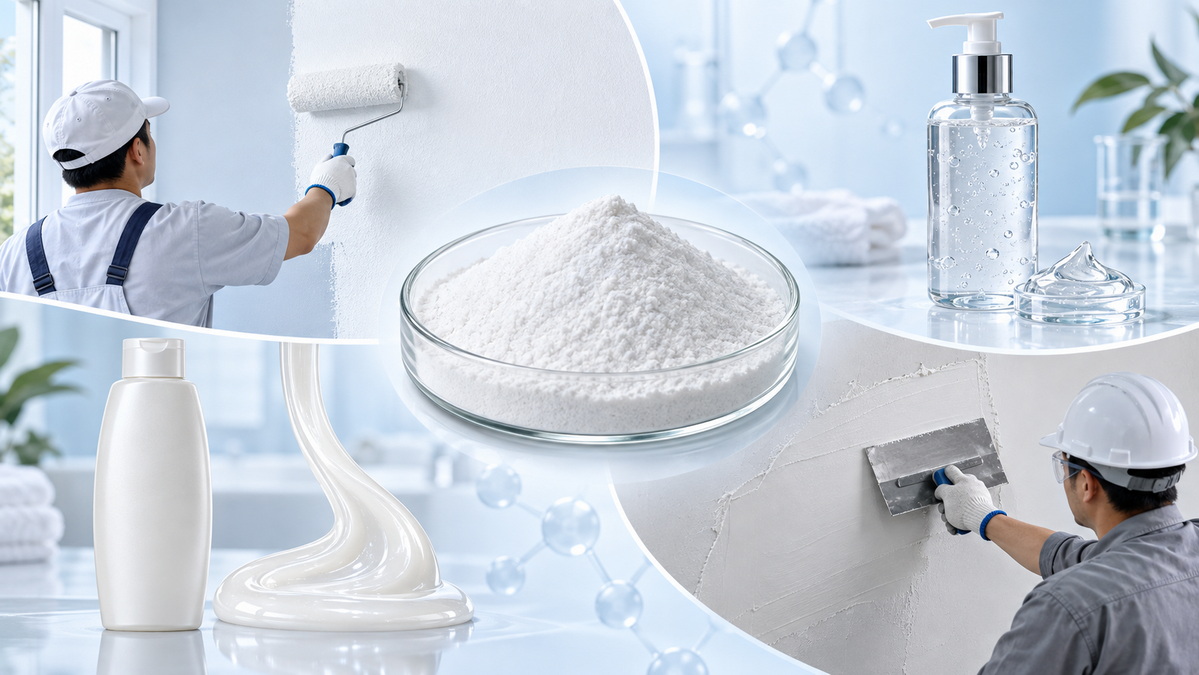
A formulation must perform well at several different stages. It must be easy to manufacture, stable during storage, convenient to package, simple to apply, and consistent for the final user.
For example, a paint should remain stable in the container, spread smoothly under a roller, resist splashing, and avoid running down the wall after application. A shampoo should flow easily from a bottle but should not feel watery in the consumer's hand. A cosmetic gel should remain uniform, smooth, and visually appealing throughout its shelf life.
Hydroxyethyl Cellulose helps balance these competing requirements.
| Formulation Requirement | How HEC Can Help |
|---|---|
| Product is too thin | Builds viscosity and improves body |
| Pigments settle during storage | Supports particle suspension |
| Coating sags on a vertical wall | Improves rheology and vertical hold |
| Cosmetic gel feels watery | Creates a fuller, smoother texture |
| Detergent separates or looks uneven | Supports stability and visual consistency |
| Formula is difficult to spread | Helps optimize flow and application feel |
| Construction material dries too quickly | Supports water retention and workability |
The most effective HEC grade is selected according to the end product rather than by viscosity alone. A high-viscosity grade may be useful for anti-sag coatings or thick gels, while a lower-viscosity grade may be more suitable where easier flow or processability is needed.
One of the most important applications of Hydroxyethyl Cellulose is in water-based paints and coatings. It is commonly used in latex paint, emulsion paint, architectural coatings, primers, textured finishes, and other aqueous coating systems.
In these products, HEC works as a thickener and rheology modifier. It helps control how paint behaves in the container, during mixing, while being applied, and after application to a surface.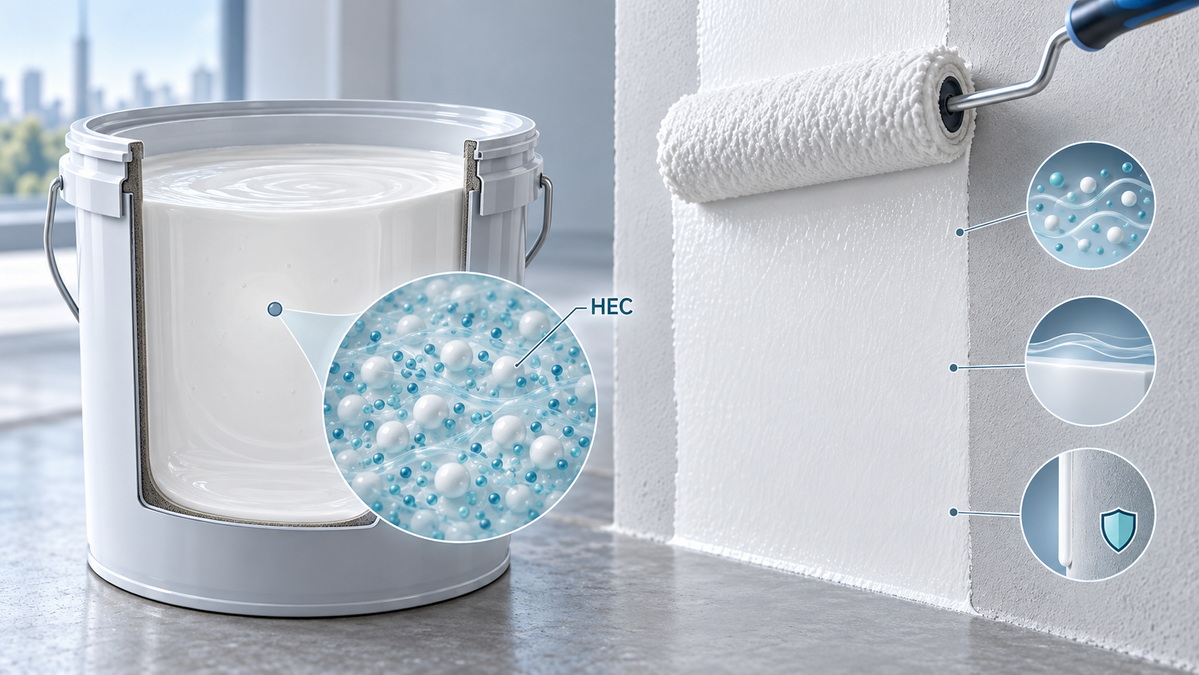
Hydroxyethyl Cellulose can provide several important advantages in water-based paint formulations:
- Improves in-can viscosity for a more consistent product body
- Helps suspend pigments and fillers during storage
- Reduces pigment settling and separation
- Supports smooth brush and roller application
- Improves anti-sag performance on walls and vertical surfaces
- Helps control spatter during roller application
- Supports a balanced leveling profile
- Improves consistency between production batches
- Contributes to a more professional application experience
Paint needs different rheological behavior at different moments. It should have enough body at rest to prevent settling. It should flow under mixing or brushing. It should then recover enough structure after application to reduce drips and sagging.
This balance is especially important in decorative coatings, where the final appearance of the wall can influence customer satisfaction.
| Coating Type | Typical Role of HEC | Main Performance Priority |
|---|---|---|
| Interior wall paint | Thickening and pigment suspension | Smooth application and balanced leveling |
| Exterior emulsion paint | Rheology control and water retention | Stability and anti-sag performance |
| Primer | Viscosity adjustment | Easy brushing and even coverage |
| Textured coating | High-build structure | Strong vertical hold |
| Waterproof coating | Viscosity and material suspension | Uniform film formation |
| Low-VOC architectural paint | Water-phase rheology control | Stable, user-friendly application |
HEC should not be selected only by a nominal viscosity value. The same viscosity grade may perform differently depending on the formulation.
Important factors include:
- Pigment volume concentration
- Type and amount of filler
- Binder chemistry
- pH range
- Dispersant and surfactant package
- Co-thickener selection
- Water quality
- Mixing speed and equipment
- Storage temperature
- Required leveling and anti-sag balance
For premium coating systems, it is often useful to test more than one HEC grade. A laboratory evaluation can compare viscosity build, pigment stability, roller feel, leveling, spatter resistance, and vertical application behavior.
Hydroxyethyl Cellulose is also widely used in cosmetics and personal-care formulations. It can be found in shampoo, body wash, facial cleanser, shower gel, skin-care gel, hair styling products, lotions, creams, masks, and other water-based products.
In personal care, product texture matters. Consumers often judge a product before they experience its functional benefits. A smooth gel, stable shampoo, or well-dispersed cleanser can create a stronger impression of quality and reliability.
HEC can help improve the physical characteristics of a cosmetic or personal-care product by providing:
- Viscosity control
- Gel formation
- Texture enhancement
- Improved spreadability
- Better visual uniformity
- Suspension of particles or selected ingredients
- Support for formula stability
- More controlled dispensing from pumps, tubes, and bottles
- Improved consumer sensory experience
A transparent facial gel, for example, may require a smooth and stable texture without excessive cloudiness or air bubbles. A body wash may need enough body to feel rich while still dispensing easily from a bottle. A shampoo may require a carefully balanced viscosity to support a premium appearance without negatively affecting foam or cleansing performance.
| Product Type | Possible HEC Function |
|---|---|
| Shampoo | Viscosity adjustment and texture improvement |
| Body wash | Thickening and product-body enhancement |
| Facial cleanser | Gel structure and controlled flow |
| Hair styling gel | Film formation and gel consistency |
| Skin-care gel | Smooth texture and ingredient suspension |
| Lotion and cream | Viscosity support and emulsion stabilization |
| Facial mask | Improved spreadability and uniform appearance |
| Hand soap | Viscosity control and dispensing performance |
The behavior of HEC in personal-care products can be influenced by many formulation variables. A grade that performs well in pure water may respond differently when surfactants, salts, preservatives, fragrances, botanical extracts, oils, humectants, colorants, and active ingredients are added.
Before commercial production, manufacturers should assess:
- Appearance and clarity
- Viscosity after full hydration
- Viscosity after aging
- Stability at low and high storage temperatures
- Compatibility with surfactants
- Compatibility with electrolytes
- Foam performance, where relevant
- Pumpability and dispensing behavior
- Sensory feel during application
- Preservative-system compatibility
Construction-grade cellulose ethers are important performance additives in many building material systems. Hydroxyethyl Cellulose can be used in selected water-based construction coatings, wall putty formulations, repair materials, and other specialty building products.
In these applications, water management and workability are especially important. A material that loses water too quickly may become difficult to apply. A coating or putty with poor rheology may slump, separate, or produce an uneven surface.
HEC may support the following performance targets:
- Improved water retention
- More consistent workability
- Better spreading behavior
- Reduced material separation
- Improved viscosity and body
- Enhanced anti-sag performance
- More stable storage properties
- Improved vertical adhesion
- Better application consistency
For wall coatings and water-based putties, HEC can contribute to a smoother application process and more uniform product behavior. The final result depends on the total material system, including cement, gypsum, latex binder, mineral filler, redispersible polymer powder, dispersant, defoamer, and other performance additives.
A small raw-material variation can create visible differences in the finished product. Changes in viscosity, moisture content, dissolution rate, particle size, or impurity level may affect mixing time, application feel, water demand, storage stability, and final surface appearance.
For this reason, manufacturers should consider more than the purchase price of cellulose ether. A dependable material should deliver consistent performance across repeated production batches.
Hydroxyethyl Cellulose can be used in liquid detergents, dishwashing liquids, hand soaps, cleaning gels, household cleaners, and selected industrial cleaning products.
In these formulations, HEC often helps improve viscosity, visual quality, dispensing control, and suspension stability. A cleaning product that is too thin may appear weak or low quality. A product that is too thick may be difficult to pour, pump, or process.
- Builds and adjusts viscosity
- Improves product appearance
- Helps create a stable gel structure
- Supports ingredient suspension
- Improves dispensing from packaging
- Enhances the perceived richness of the formulation
- Contributes to more uniform storage behavior
Cleaning products often contain surfactants, salts, solvents, fragrance materials, preservatives, dyes, and other functional ingredients. These materials may affect HEC hydration and final viscosity. Therefore, the correct grade and dosage should be determined through laboratory testing using the complete formula.
Hydroxyethyl Cellulose has been used in selected pharmaceutical and ophthalmic applications as a viscosity-enhancing, stabilizing, and film-forming material.
In ophthalmic systems, a viscosity-enhancing polymer can help increase the residence time of a liquid on the ocular surface. In topical or gel-based products, HEC may contribute to texture, spreadability, and controlled flow.
However, pharmaceutical and ophthalmic applications require a higher level of evaluation. Product manufacturers must ensure that the selected grade, purity level, technical documentation, safety data, regulatory status, and quality requirements are appropriate for the intended use and target market.
Construction-grade or cosmetic-grade HEC should not be assumed to be suitable for pharmaceutical applications. Each grade must be evaluated according to the relevant formulation, manufacturing, quality, and regulatory requirements.
Hydroxyethyl Cellulose develops viscosity after it is properly dispersed and hydrated in water. The polymer chains absorb water and expand, creating a network that increases resistance to flow.
The final viscosity depends on several variables:
- HEC grade and molecular weight
- Product concentration
- Water temperature
- Mixing procedure
- Hydration time
- pH
- Salt concentration
- Surfactant content
- Pigment and filler loading
- Other polymers or rheology modifiers
- Storage conditions
In many systems, HEC provides shear-dependent flow behavior. This means the product may become easier to move when force is applied through mixing, pumping, brushing, rolling, or pouring. At rest, the formula can retain enough structure to support stability and reduce settling or sagging.
This behavior is useful in products that need to be easy to process but also stable during storage and application.
Proper addition is essential for achieving stable HEC performance. If HEC powder is added too quickly, the outer surface of the particles may hydrate immediately. This can trap dry powder inside and create lumps commonly called "fish eyes."
A controlled mixing procedure can reduce this risk.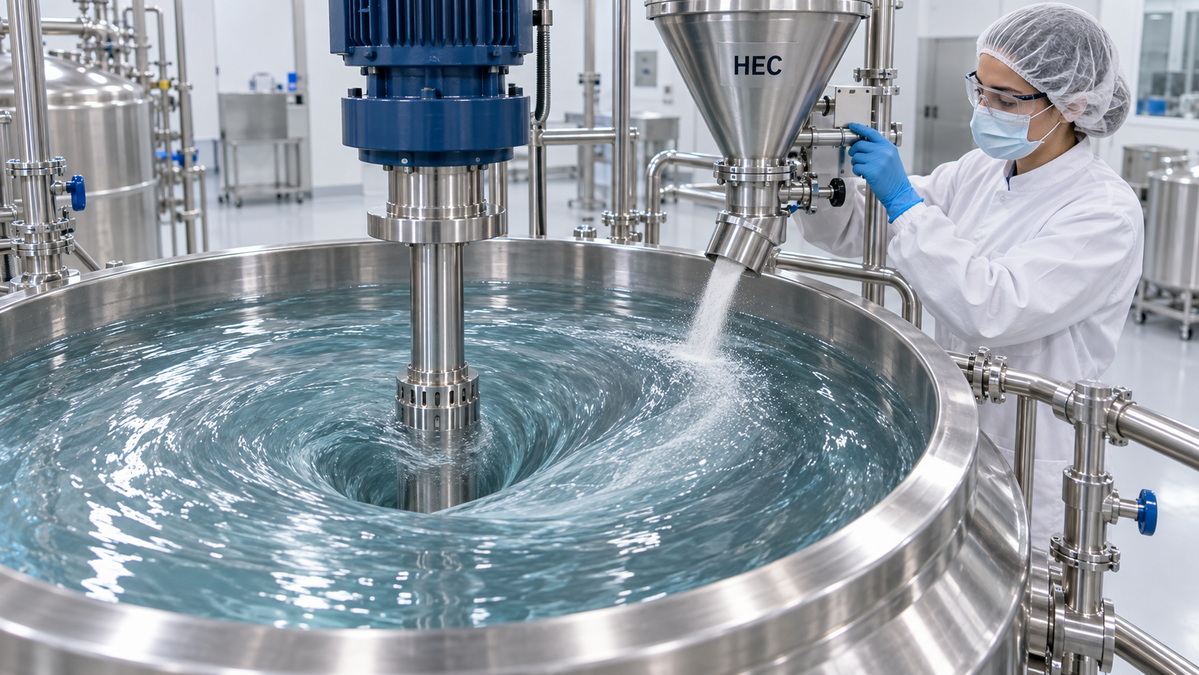
1. Prepare clean water in the mixing vessel.
2. Start moderate agitation and create a stable vortex.
3. Add Hydroxyethyl Cellulose powder slowly and evenly into the vortex.
4. Avoid dumping a large quantity of powder into the water at one time.
5. Continue mixing until the HEC is fully dispersed.
6. Allow sufficient time for complete hydration and viscosity development.
7. Add the remaining formulation ingredients according to the established process sequence.
8. Check final viscosity after the complete formula has stabilized.
| Problem | Possible Cause | Recommended Solution |
|---|---|---|
| Fish eyes or lumps | Powder added too quickly | Sift HEC slowly into a controlled vortex |
| Low viscosity | Incomplete hydration | Extend mixing and hydration time |
| Unstable viscosity | Incompatibility with other ingredients | Review pH, salts, surfactants, and additives |
| Excessive foam | Mixing speed is too high | Reduce shear and optimize agitation |
| Uneven batch quality | Inconsistent process sequence | Standardize addition order and processing time |
| Poor dispersion | Insufficient agitation | Improve mixing efficiency without excessive aeration |
A well-controlled process is often as important as the HEC grade itself. Even a high-quality raw material can underperform if it is added incorrectly or not given enough time to hydrate.
The best Hydroxyethyl Cellulose grade depends on the desired performance of the final product.
Before selecting HEC, manufacturers should define their technical requirements clearly.
- What is the final application?
- Is the product a paint, coating, shampoo, gel, detergent, putty, or another water-based system?
- What viscosity range is required?
- Does the formula need fast hydration?
- Is high anti-sag performance important?
- Does the product contain a high level of surfactants or salts?
- Is product clarity a key requirement?
- What mixing equipment is available?
- What storage conditions will the finished product experience?
- Which quality documents are required for the target market?
- Does the formulation require customized technical support?
| Application | Typical Performance Focus |
|---|---|
| Interior wall paint | Good thickening, leveling, and pigment suspension |
| Exterior coating | Rheology control, anti-sag behavior, and stability |
| Texture coating | High-build structure and vertical hold |
| Shampoo | Controlled viscosity and consumer-friendly texture |
| Shower gel | Smooth flow and stable appearance |
| Facial gel | Clarity, smoothness, and ingredient compatibility |
| Liquid detergent | Thickening and easy dispensing |
| Water-based putty | Workability, water retention, and application consistency |
The most reliable way to select an HEC grade is to test it in the actual formulation. Laboratory sample evaluation helps identify whether the product can meet viscosity, stability, processing, application, and final-use expectations.
For global buyers, the quality of Hydroxyethyl Cellulose should be assessed through both product performance and supplier capability.
A dependable HEC manufacturer should be able to provide consistent product quality, clear technical information, responsive communication, and practical support for application testing.
Important purchasing considerations include:
- Stable viscosity from batch to batch
- Consistent moisture control
- Reliable dissolution and hydration behavior
- Suitable particle size for processing needs
- Clear technical data sheet
- Current safety data sheet
- Application-based grade recommendations
- Professional sample support
- Stable export packaging
- Dependable production and supply capability
Shandong Shengda New Material Co., Ltd. supplies cellulose ether solutions for customers seeking construction-grade and personal-care-grade Hydroxyethyl Cellulose. We understand that a cellulose ether is not simply a commodity powder. It is a functional ingredient that must perform reliably in a specific formula, production process, and end-use environment.
Hydroxyethyl Cellulose is a versatile cellulose ether with important uses in water-based paints, coatings, personal-care products, detergents, construction materials, and selected pharmaceutical systems. Its primary roles include thickening, viscosity control, rheology modification, water retention, particle suspension, stabilization, and texture improvement.
The right HEC grade can help manufacturers create products that are easier to produce, more stable during storage, smoother to apply, and more consistent for the end user. The best results come from combining the appropriate HEC grade with a controlled addition process and formulation-specific testing.
For manufacturers looking to improve the performance of paints, coatings, shampoos, gels, detergents, or construction materials, Hydroxyethyl Cellulose can be an effective and flexible solution when selected and used correctly.
Hydroxyethyl Cellulose is used as a thickener, rheology modifier, water-retention aid, stabilizer, suspending agent, and film-forming polymer. It is commonly used in water-based paints, coatings, shampoo, body wash, cosmetic gels, detergents, and selected pharmaceutical products.
No. HEC and Hydroxypropyl Methylcellulose, also known as HPMC, are both cellulose ethers, but they have different chemical structures and performance profiles. Their water solubility, temperature behavior, rheological properties, and suitability for different applications may vary.
HEC can form lumps when it is added too quickly to water. The outside of each powder particle hydrates first and can create a barrier around dry powder inside. Slow addition under controlled agitation helps reduce lump formation.
Yes. Hydroxyethyl Cellulose is used in many cosmetic and personal-care products, including shampoo, body wash, facial cleanser, gel, lotion, cream, and hair styling products. It helps control viscosity, improve texture, and support formula stability.
Yes. In water-based paints and coatings, HEC can help improve viscosity and rheology. This can support better vertical hold and reduce the tendency of a coating to run or sag after application.
The correct grade depends on the end-use application, target viscosity, formulation ingredients, mixing process, storage conditions, and required performance. Sample testing in the actual formula is the most reliable way to confirm a suitable grade.
HEC can be used in certain liquid detergent and cleaning-product formulations to improve viscosity, product body, stability, and dispensing behavior. Compatibility should be tested because surfactants, salts, solvents, and other ingredients can affect final performance.
HEC should be stored in a cool, dry, and well-ventilated area. Containers should remain tightly closed to prevent moisture absorption. Dry powder should be handled carefully to minimize dust generation.
1. Kima Chemical. [What Is the Use of Hydroxyethyl Cellulose HEC?]
2. National Center for Biotechnology Information, PubChem. [Hydroxyethyl Cellulose]
3. Uematsu, Y., et al. [Conformation and Structure of Hydroxyethyl Cellulose Ether with a High Molar Substitution Number in Aqueous Solution]. *Polymers*, 2022.
4. Uematsu, Y., et al. [Hydration/Dehydration Behavior of Hydroxyethyl Cellulose Ether in Aqueous Solution]. *Polymers*, 2020.
5. Cosmetic Ingredient Review. [Hydroxyethylcellulose]
6. U.S. Food and Drug Administration. [Inactive Ingredients in Approved Drug Products: Frequently Asked Questions]
7. Unionchem. [HEC in Paints and Coatings: Rheology Modifier Selection Guide]
8. PubMed. [Corneal Toxicity Studies in Rabbits and Dogs with Hydroxyethyl Cellulose and Benzalkonium Chloride]
9. TCI Chemicals. [Safety Data Sheet: Hydroxyethyl Cellulose]
10. ChemPoint. [Safety Data Sheet: Hydroxyethyl Cellulose]


