


close
Choose Your Site
Global
Social Media
Views: 235 Author: Shengda Publish Time: 2026-11-19 Origin: Site


Content Menu
● Why Flexible RDP and HEMC Improve Tile Adhesive Performance
>> Flexible RDP Supports Adhesion and Stress Accommodation
>> HEMC Controls the Fresh Mortar Environment
● Define "Good Adhesion" Before Adjusting the Formulation
>> Separate Installer Feedback From Laboratory Results
>> Translate Performance Claims Into Measurable Targets
● How to Select Flexible RDP for Tile Adhesives
>> Match Polymer Performance to Service Conditions
>> Avoid Selecting RDP by Softness Alone
● How to Select HEMC for Tile Adhesive Formulations
>> Compare More Than Nominal Viscosity
>> Balance Water Retention With Tile Bedding
● Optimize RDP and HEMC With a Controlled Trial Matrix
>> Step 1: Establish a Repeatable Baseline
>> Step 2: Screen Three Levels of Each Additive
>> Step 3: Compare Fixed-Water and Comparable-Consistency Results
>> Step 4: Test Fresh and Hardened Properties Together
● Diagnose Adhesion Failures Before Increasing Additive Dosage
>> Examine Where the Bond Failed
>> Check Coverage and Ridge Collapse
>> Track Air Alongside Workability
● Validate Open Time Under Realistic Application Conditions
>> Run Delayed-Placement Trials
● Build Batch Consistency and Cost Efficiency Into Development
>> Create an Application-Based Supplier Approval Process
>> Evaluate Cost per Compliant Result
● Develop a Better-Balanced Tile Adhesive With Shandong Shengda
>> 1. Can HEMC replace flexible RDP in tile adhesive?
>> 2. Does higher-viscosity HEMC always improve adhesion?
>> 3. What is the best RDP-to-HEMC ratio?
>> 4. Why is dry adhesion good but wet adhesion poor?
>> 5. Can flexible RDP guarantee an S1 tile adhesive?
>> 6. How should buyers verify a claim of "good adhesion"?
Flexible RDP and HEMC work together to improve adhesion in tile adhesive formulations, but they solve different problems. Redispersible polymer powder strengthens the polymer-modified bond and contributes flexibility. Hydroxyethyl Methyl Cellulose helps control water retention, consistency, and application behavior, creating conditions for effective cement hydration and tile contact.
For a mortar manufacturer, the objective is not simply a thicker mixture or a softer polymer. It is reliable adhesion after installation, water exposure, temperature changes, and realistic application delays.
At Shandong Shengda New Material Co., Ltd., our focus on cellulose ether research, development, production, and sales informs a practical formulation perspective: evaluate HEMC as part of the complete adhesive system, rather than as an isolated viscosity specification.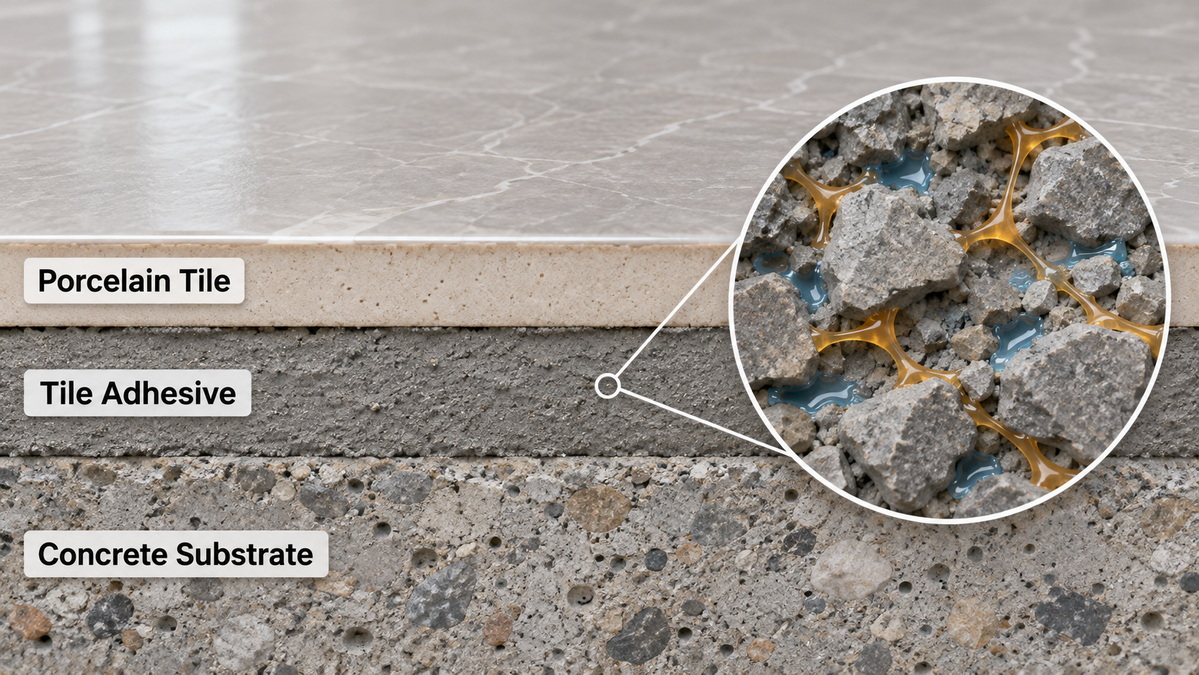
A successful cementitious tile adhesive must perform in two stages. While fresh, it must spread, wet the tile, resist slipping, and remain usable. After hardening, it must maintain adhesion under its intended service conditions.
Flexible RDP redistributes polymer particles in the mortar when mixed with water. As the system develops and dries under suitable conditions, the polymer contributes to a modified binder structure.
Depending on its chemistry and grade, RDP can improve:
- Adhesion to mineral substrates and low-absorption tiles.
- Flexibility of the hardened mortar.
- Resistance to stresses associated with temperature changes.
- Adhesion after water immersion or heat aging.
However, "flexible" does not automatically mean strong wet adhesion. Polymer chemistry, dosage, film-formation conditions, and the surrounding cementitious formulation all matter.
HEMC is a nonionic cellulose ether used to modify water retention and rheology—the way mortar flows and resists movement.
Its contribution is especially important when absorbent substrates or drying conditions remove water from the adhesive.
Properly selected HEMC can help:
- Reduce premature water loss.
- Maintain workable consistency.
- Support cement hydration.
- Improve application stability.
- Preserve an effective tile-placement window.
HEMC does not replace RDP as a polymer binder. Its value lies in helping the adhesive establish adequate contact and develop its intended properties.
Customer feedback such as "good adhesion" is encouraging, but it is not a complete performance specification.
Does the customer mean strong initial grab, easy bedding, resistance to sliding, or measured tensile adhesion after curing? These observations describe different behaviors.
Ask customers to identify:
1. Tile material and dimensions.
2. Substrate type and preparation.
3. Application temperature and drying conditions.
4. Time between spreading and tile placement.
5. Whether the observation concerns fresh or hardened adhesive.
6. Any failure after water exposure or heating.
This converts a general compliment into useful development information.
Common cementitious tile adhesive classifications distinguish adhesion, open time, slip, and deformability.
| Performance designation | Typical requirement | Formulation implication |
|---|---|---|
| C2 improved adhesion | At least 1.0 N/mm² under the specified adhesion conditioning regimes | Evaluate more than initial dry strength |
| E extended open time | At least 0.5 N/mm² after a minimum 30-minute placement delay | Assess delayed tile placement |
| T reduced slip | No more than 0.5 mm | Balance stability with easy bedding |
| S1 deformability | At least 2.5 mm but less than 5 mm transverse deformation | Verify hardened-system deformation |
These are separate characteristics. A flexible RDP label does not establish S1 classification, and high fresh-mortar tack does not demonstrate C2 compliance. Use the applicable standard edition and complete testing requirements for the intended market.
Start with the application rather than a generic "high-flexibility" request.
For porcelain tile, prioritize adhesion to low-absorption surfaces. For heated floors, consider movement accommodation alongside bond strength. For wet environments, examine adhesion after water immersion.
Request grade-specific information covering:
- Recommended applications.
- Polymer chemistry.
- Minimum film-forming temperature.
- Adhesion after relevant conditioning.
- Compatibility with cementitious drymix systems.
Minimum film-forming temperature is useful, but it is not the same as the adhesive's minimum installation temperature. The complete formulation still requires validation.
A more flexible polymer is not necessarily the best solution for every tile adhesive.
The formulation must balance adhesion, deformation, wet performance, application properties, and cost. Compare candidate powders in the same mortar base before drawing conclusions from their individual technical data sheets.
A viscosity number is meaningful only when its measurement conditions are known.
Ask the supplier to specify solution concentration, temperature, instrument, and measurement procedure. Two products with similar reported viscosities may behave differently in mortar.
Relevant selection factors include:
- Dissolution behavior.
- Water retention.
- Mortar consistency.
- Troweling resistance.
- Tile-back wetting.
- Air entrainment.
- Open-time performance.
The most useful purchasing specification connects material properties with application results.
Increasing cellulose ether dosage can alter water demand, consistency, air content, and setting behavior. More is not automatically better.
An overly resistant mortar may hold its ridges well but fail to collapse sufficiently beneath the tile. The result can be poor contact despite an apparently strong, creamy consistency.
Our formulation recommendation is straightforward: select HEMC for effective water management and usable rheology, not for maximum thickness.
Changing several ingredients at once makes troubleshooting difficult. A small, controlled experiment produces more useful evidence.
Keep the following consistent:
- Cement source and batch.
- Aggregate grading.
- Filler content.
- Mixing equipment and sequence.
- Mixing and maturation times.
- Tile and substrate.
- Application thickness.
- Curing conditions.
Record the actual water addition. Unrecorded water adjustments can obscure the effects of both RDP and HEMC.
Use a nine-formulation matrix:
| HEMC level | Lower RDP | Reference RDP | Higher RDP |
|---|---|---|---|
| Lower HEMC | Trial 1 | Trial 2 | Trial 3 |
| Reference HEMC | Trial 4 | Trial 5 | Trial 6 |
| Higher HEMC | Trial 7 | Trial 8 | Trial 9 |
Define these levels around supplier recommendations and an established baseline. They are experimental settings, not universal dosage recommendations.
Keep total dry mass constant and document which balancing component changes.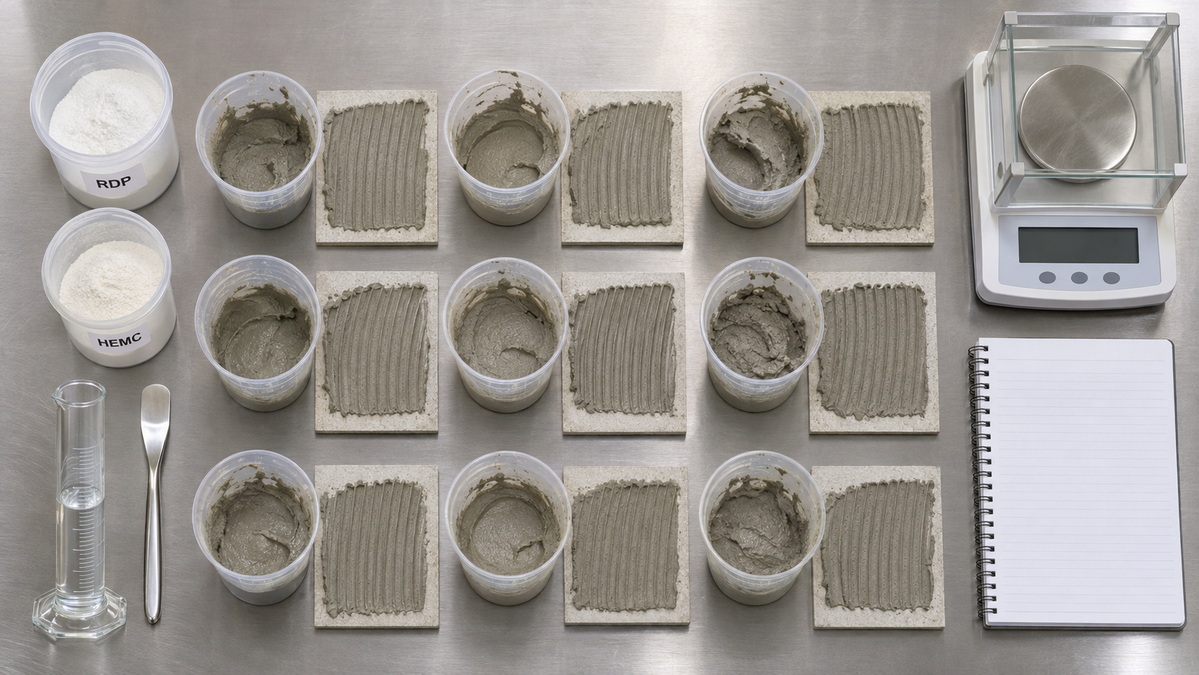
A fixed-water comparison helps reveal the direct effects of changing additives. However, some mixtures may become impractical to apply.
Follow with comparable-consistency trials, recording the water needed to reach the selected workability target. Report both comparisons separately.
This distinction helps prevent a higher-water mixture from appearing equivalent simply because it spreads more easily.
Measure workability, slip, delayed-placement adhesion, fresh density, and relevant hardened adhesion results.
Repeat promising formulations. One strong result is not sufficient evidence of a robust manufacturing formula.
Failure analysis often provides a more efficient route than immediately adding more RDP.
Record whether failure occurred:
- At the tile–adhesive interface.
- At the substrate–adhesive interface.
- Within the adhesive.
- Within the substrate.
- Through a combination of locations.
Interface failure should prompt investigation of contamination, skin formation, inadequate contact, and material compatibility.
Failure within a weak substrate may indicate that substrate preparation—not polymer content—is the controlling issue.
These observations guide investigation; they do not replace standardized strength measurements.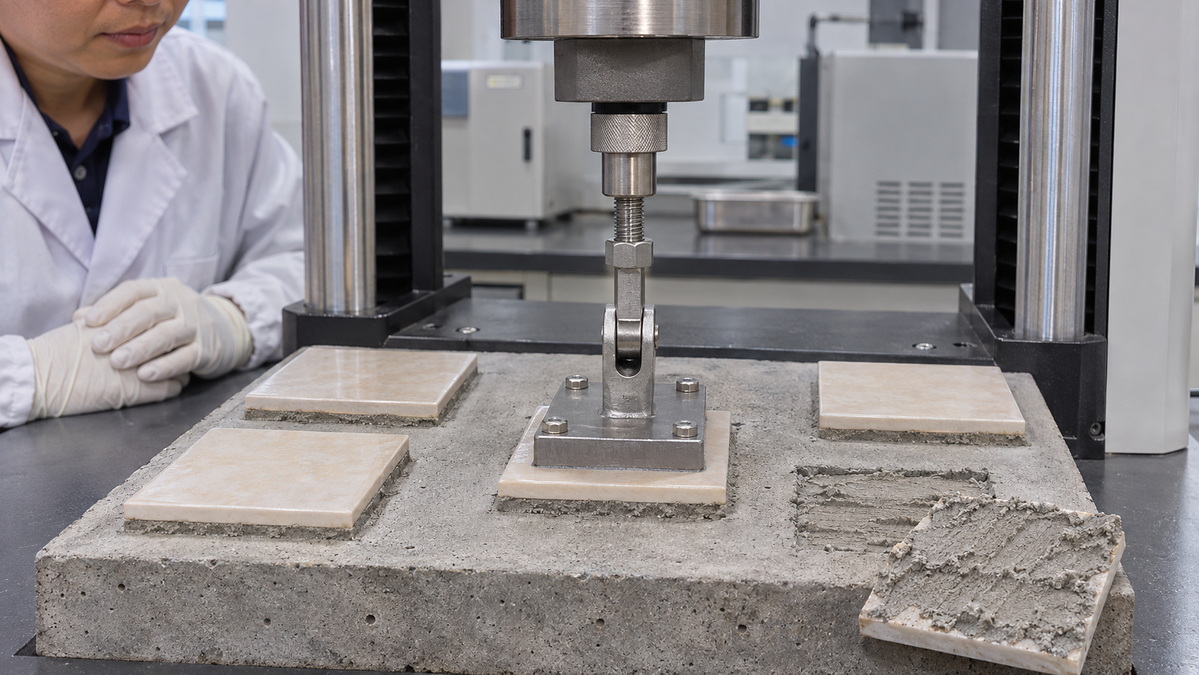
Lift a freshly embedded tile during application trials and inspect adhesive transfer.
Persistent ridges or large uncontacted areas can indicate inadequate bedding, unsuitable consistency, or placement after surface drying.
Control trowel selection, embedding pressure, tile movement, and back-buttering practices where required. Good laboratory mortar cannot compensate for poor installation contact.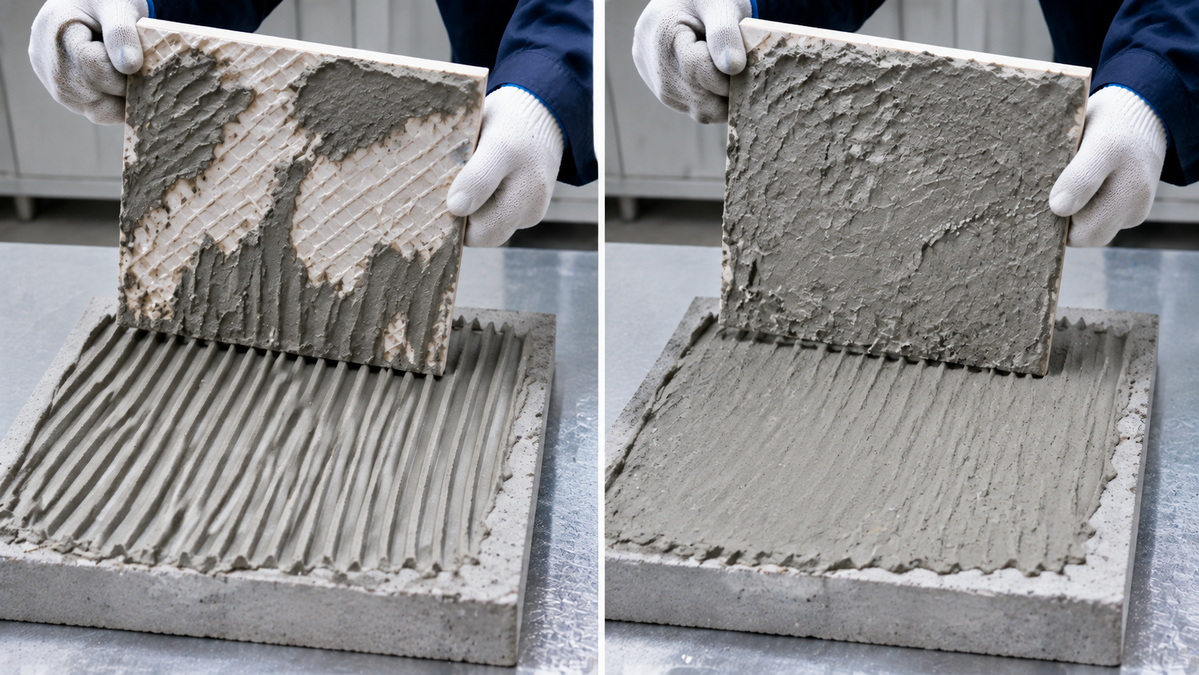
Cellulose ethers can influence air stabilization. Some air can improve handling, but excessive air may compromise mechanical performance.
Fresh density is a useful comparative indicator when composition and mixing are controlled. It is not a substitute for a dedicated air-content measurement.
If a mixture feels smoother but develops lower adhesion, investigate air, water addition, and contact before changing polymer chemistry.
Laboratory open time and site working conditions are not interchangeable.
Hot substrates, airflow, low humidity, and absorbent backgrounds can accelerate water loss. A formulation that performs well under controlled conditions may offer a shorter practical placement window on site.
Spread the adhesive and place tiles at defined intervals. Keep embedding procedures consistent and test adhesion after the specified curing period.
Also record:
- Air and substrate temperature.
- Relative humidity.
- Air movement.
- Substrate absorption.
- Visible surface drying.
- Tile-back transfer.
Distinguish open time from pot life. Open time concerns adhesive already spread on the substrate. Pot life concerns mixed material remaining in the container.
A mortar can remain workable in the bucket while its spread surface has become unsuitable for bonding.
The best formulation is not necessarily the one with the highest individual laboratory result. It is the one that repeatedly meets requirements with acceptable application behavior and manufacturing cost.
For HEMC procurement, request:
- A technical data sheet with defined test methods.
- A certificate of analysis.
- Batch identification and traceability.
- Storage and shelf-life guidance.
- Relevant safety documentation.
- Application testing against an agreed reference.
Where practical, approve more than one production batch before commercial adoption.
Lower additive cost has limited value if the adhesive requires excessive water, loses open time, or fails after immersion.
Similarly, unnecessary overdosing increases material consumption without guaranteeing better performance.
A balanced RDP–HEMC system can support resource efficiency by avoiding excess formulation cost and reducing the risk of installation rework. Quantified environmental claims, however, require product-specific evidence.
Reliable adhesion comes from coordinated polymer selection, cellulose ether performance, water control, substrate preparation, and installation practice.
Shandong Shengda New Material Co., Ltd. focuses on cellulose ether solutions for construction and daily chemical applications. For tile adhesive development, the useful starting point is your actual formulation challenge—not viscosity alone.
Share your target classification, cement type, tile and substrate details, current HEMC and RDP levels, water addition, and test results. Contact Shandong Shengda to discuss suitable construction-grade HEMC candidates and arrange sample evaluation against your existing formulation.
No. HEMC primarily controls water retention and fresh-mortar behavior. RDP contributes polymer modification, adhesion, and flexibility. Removing RDP requires reassessing the complete adhesive's performance rather than increasing HEMC to compensate.
No. Higher viscosity may improve consistency but can also increase application resistance. Adhesion depends on water management, wetting, coverage, cement hydration, and polymer performance—not viscosity alone.
There is no universal ratio. The appropriate balance depends on cement, aggregate grading, polymer grade, cellulose ether characteristics, water demand, and the target classification. A controlled trial matrix is more reliable than copying another formulation.
Possible causes include unsuitable polymer selection, inadequate polymer content, excessive water, incomplete strength development, or interface problems. Compare conditioned test results and failure locations before deciding which ingredient to change.
No. S1 is a measured deformability classification for the complete hardened adhesive. Polymer flexibility can support development, but only the specified deformation test establishes whether the formulation meets the requirement.
Request results identifying the formulation, test method, conditioning, tile and substrate, and failure mode. Combine laboratory evidence with application trials. A customer comment is useful feedback, but it is not independent proof of a performance classification.
1. WACKER. ["Simply VINNAPAS®: General Benefits for Tile Adhesives."] Explains polymer modification, adhesion to modern tiles, and flexibility under mechanical and temperature-related stresses. [wacker]
2. WACKER. ["Product Overview: VINNAPAS® Polymer Powders."] Provides grade-specific polymer information, minimum film-forming temperatures, and comparative application attributes, including adhesion after water immersion and heat aging. [wacker]
3. Nouryon. ["Bermocoll® Cellulose Ethers."] Supports the discussion of cellulose ether water retention, consistency, workability, air stabilization, and tile adhesive application properties. The brochure covers cellulose ether grades with different substitution chemistries; it does not establish identical performance for every HEMC grade. [nouryon]
4. LATICRETE. ["EN 12004 Classifications — TDS 137EN."] Provides industry guidance on adhesive classifications, extended open time, and S1/S2 deformability. Consult the applicable standards for complete testing and conformity requirements. [cdn-global.laticrete]
5. WACKER. ["Improving Adhesion and Flexibility in Facade Tile Adhesives."] Explains how dispersible polymer powders improve adhesion and flexibility to help accommodate shear stresses. [wacker]
6. The Tile Association. ["Bedding Adhesives for Stones and Tiles," hosted by Stone Superstore.] Includes a classification reference table covering C2 adhesion, reduced slip, extended open time, and deformability thresholds. [stonesuperstore.co]


