


close
Choose Your Site
Global
Social Media
Views: 254 Author: Shengda Publish Time: 2026-11-20 Origin: Site


Content Menu
● What Is Cellulose Ether Made From?
>> Is Cellulose Ether Natural or Synthetic?
● Main Types of Cellulose Ether: HPMC, HEMC, HEC, and CMC
>> HPMC for Construction and Daily Chemical Products
>> HEMC and HEC: Similar Names, Different Choices
● How Does Cellulose Ether Work?
>> Stabilization and Thermal Behavior
● Cellulose Ether Uses in Construction Materials
>> Wall Putty, Skim Coats, and Renders
● Cellulose Ether Uses in Household and Personal Care Products
● How to Choose the Right Cellulose Ether Grade
>> Start With the Finished Product
>> Compare Viscosity on the Same Basis
>> Check Hydration and Grade Modification
● A Practical Five-Step Cellulose Ether Trial
● Troubleshooting Common Cellulose Ether Problems
● Procurement Checks: Quality, Consistency, and Sustainability
● Find the Right Cellulose Ether for Your Formulation
>> 1. Is HPMC the same as cellulose ether?
>> 2. Can two HPMC grades with identical viscosity perform differently?
>> 3. Can construction-grade HPMC be used in shampoo or skincare?
>> 4. Does higher HPMC dosage always improve tile adhesive?
>> 5. How can buyers verify consistent supplier quality?
>> 6. What information helps a manufacturer recommend a grade?
Cellulose ether is a family of cellulose-derived polymers used to control water retention, viscosity, and application performance. For manufacturers of tile adhesives, wall putty, mortars, and household care products, choosing the right cellulose ether can make the difference between a workable formulation and an inconsistent product.
At Shandong Shengda New Material Co., Ltd., our focus is the research, development, production, and supply of HPMC and other cellulose ethers for construction and daily chemical applications.
Our approach to selection starts with a practical question: what must the finished product do? A viscosity number alone cannot answer that. Polymer chemistry, hydration behavior, formulation compatibility, and processing conditions also matter.
This guide explains how cellulose ethers work, where different types fit, and how to evaluate a grade before committing to commercial production.
Cellulose is a structural component of plant cell walls. Industrial cellulose ethers are produced by chemically modifying purified cellulose, commonly obtained from wood pulp or cotton linters.
During this modification, some hydroxyl groups on the cellulose backbone are replaced with ether-containing groups. The type and extent of substitution influence water solubility, hydration, thermal behavior, and compatibility.
The result is not one universal ingredient. It is a family of materials with different performance profiles.
Many commercially important grades dissolve in water to form viscous solutions. However, dissolution conditions vary. A powder that disperses readily does not necessarily dissolve immediately, and a method suitable for one grade may cause problems with another.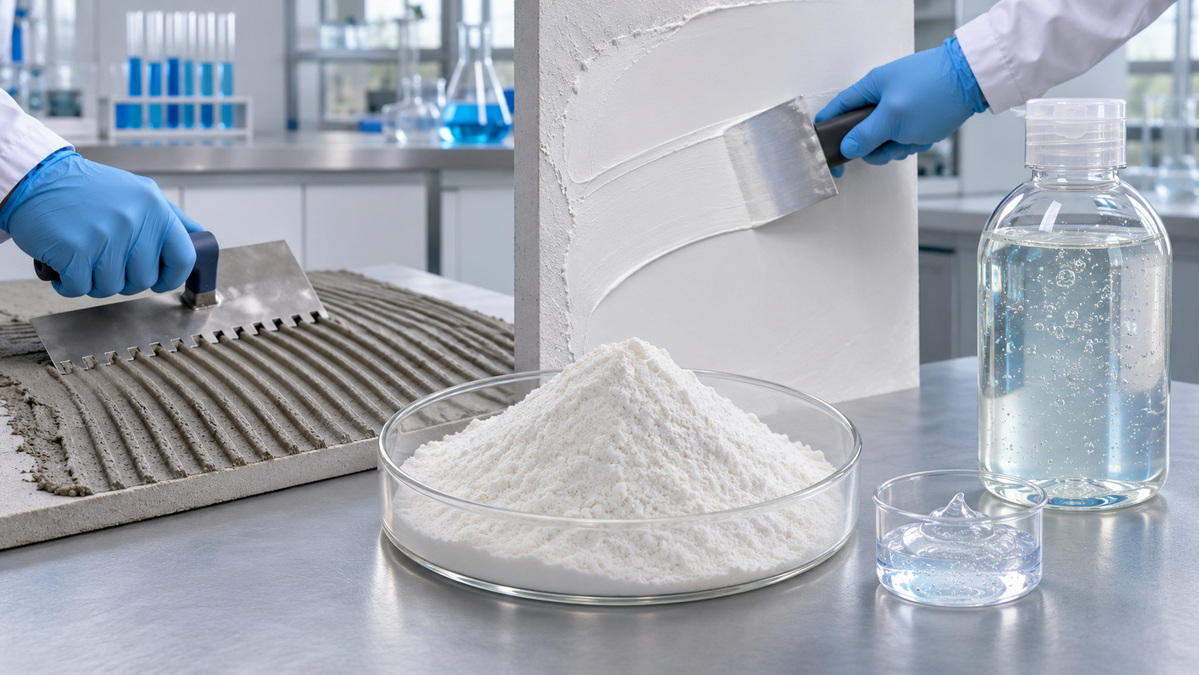
Cellulose ethers are best described as chemically modified, cellulose-derived polymers.
Their plant-based starting material does not make every grade fully natural, readily biodegradable, or suitable for every application. Environmental and regulatory claims require evidence for the specific product.
Likewise, construction-grade material must not be treated as interchangeable with food, pharmaceutical, or personal care grades.
The first selection decision is the polymer family. The table below provides a starting point rather than a substitution guide.
| Type | Full name | Ionic character | Typical application focus |
|---|---|---|---|
| HPMC | Hydroxypropyl methylcellulose | Nonionic | Dry-mix mortars, tile adhesives, wall putty, selected care formulations |
| HEMC / MHEC | Hydroxyethyl methylcellulose / methyl hydroxyethyl cellulose | Nonionic | Cement-based adhesives, renders, and related building materials |
| HEC | Hydroxyethyl cellulose | Nonionic | Water-based coatings, cleaners, and selected personal care products |
| CMC | Carboxymethyl cellulose, commonly supplied as its sodium salt | Anionic | Selected detergent, industrial, and other application-specific systems |

HPMC provides thickening, water retention, binding, and film-forming functions. Construction grades help formulators adjust fresh mortar consistency and application behavior.
Selected grades also serve as rheology modifiers in care formulations. However, suitability depends on purity, hydration characteristics, appearance requirements, and compatibility with the complete formula.
HEMC, also called MHEC, combines methyl and hydroxyethyl substitution. It is widely used in construction formulations requiring water retention and controlled workability.
HEC is a different cellulose ether used in many aqueous systems, including coatings and cleaning products.
Do not select between them by abbreviation alone. Ask for the intended application, technical data, and a suitable evaluation sample.
Cellulose ethers influence the aqueous phase of a formulation. Their hydrated polymer chains modify flow and help manage the movement and availability of water.
In cement-based materials, water may be lost through evaporation or absorbed by porous substrates. Excessively rapid loss can interfere with application and hydration.
Cellulose ether helps retain water within the fresh material. Its contribution depends on grade, dosage, substrate, temperature, and the rest of the formulation.
Water retention supports performance; it does not replace correct curing or compensate for an unsuitable binder system.
Thickening changes how a product behaves during mixing, pumping, spreading, or application.
The target is not necessarily maximum viscosity. A mortar must spread under a trowel while maintaining an appropriate profile afterward. A cleaner must pour or dispense without feeling excessively stringy.
These requirements involve more than a single viscosity measurement.
Appropriate cellulose ether grades can support suspension stability and help control separation.
Some methyl-containing cellulose ethers, including HPMC, also exhibit reversible thermal gelation in aqueous systems. The behavior depends on substitution, concentration, and formulation composition.
A temperature reported for one grade should not be treated as a universal specification.
In cement-based tile adhesives, cellulose ether helps balance water retention, consistency, open time, and resistance to tile movement.
These properties interact. Increasing thickening may change spreading, wetting, air content, or application feel.
Evaluate the complete adhesive rather than assuming that a higher-viscosity HPMC automatically produces stronger bonding. Cellulose ether and redispersible polymer powder perform different, complementary roles.
For wall putty and skim coats, application quality includes spreadability, blade drag, edge behavior, and consistency on absorbent substrates.
A candidate grade should provide useful water retention without making application unnecessarily sticky.
In renders and plastering mortars, practical assessment should include vertical stability and finishing behavior. Record both instrument results and structured applicator observations.
Gypsum systems require separate evaluation because their setting chemistry differs from cement-based materials.
Check water demand, workability, setting behavior, and compatibility with retarders and other additives. A grade that performs well in a cementitious adhesive is not automatically the best choice for gypsum plaster.
Cellulose ethers can adjust viscosity, texture, and stability in suitable cleaning and care formulations.
HEC is used in aqueous cleaning systems, while selected HPMC and HEC grades also appear in personal care applications.
For these products, evaluate:
- Surfactant and electrolyte compatibility.
- Clarity or opacity requirements.
- Flow, dispensing, and sensory properties.
- Hydration time and mixing sequence.
- Viscosity stability during storage.
- Microbiological quality and preservation requirements.
Nonionic character can be useful, but it does not guarantee compatibility with every formula.
For strongly acidic, alkaline, oxidizing, or otherwise demanding systems, obtain application-specific guidance and verify stability experimentally.
Define the application before reviewing viscosity options.
For tile adhesive, priorities may include open time, slip resistance, and spreading. For wall putty, they may include application smoothness and water retention. For liquid detergent, they may include clarity, pourability, and storage stability.
Translate these priorities into measurable acceptance criteria.
Viscosity values are comparable only when the test conditions are understood.
Request:
- Polymer concentration and preparation procedure.
- Measurement temperature.
- Instrument and measurement method.
- Spindle and speed, where applicable.
- Hydration and conditioning time.
For example, a value measured in a 1% solution cannot be directly equated with one measured in a 2% solution.
Even matching values do not prove equivalent application performance.
Surface treatment and other modifications can alter dispersion, hydration timing, and application behavior.
Distinguish between powder wetting, particle dispersion, and polymer dissolution. Confusing these stages can lead to premature testing or avoidable lumps.
The best grade must work within the production process—not only in an ideal laboratory preparation.
A controlled comparison produces more useful information than repeatedly changing several ingredients at once.
1. Establish a reference formula. Record raw materials, water quality, mixing equipment, and processing conditions.
2. Compare candidates consistently. Initially hold dosage, water addition, and preparation conditions constant.
3. Measure application performance. Assess relevant properties such as spreading, water retention, sag, or dispensing.
4. Check downstream results. Evaluate cured properties for construction products and storage stability for liquids.
5. Optimize the strongest candidate. Adjust dosage and water demand, then confirm performance in a larger trial.
Record temperature, humidity, mixing time, and conditioning time throughout.
This sequence separates grade screening from formulation optimization and makes results easier to reproduce.
The following checks are diagnostic starting points, not confirmed explanations for every failure.
| Problem | Possible contributors | First checks |
|---|---|---|
| Lumps during preparation | Rapid surface hydration, poor dispersion, unsuitable addition sequence | Confirm grade-specific mixing instructions |
| Lower-than-expected viscosity | Incomplete hydration, different test conditions, formulation incompatibility | Recheck preparation, temperature, and measurement method |
| Mortar feels too sticky | Excessive thickening, unsuitable grade, water or formulation imbalance | Review dosage and application requirements |
| Short working window | Rapid water loss, absorbent substrate, hot conditions, formulation limitations | Test under representative site conditions |
| Liquid changes during storage | Compatibility issues, incomplete hydration, microbial contamination, temperature effects | Review stability results and preservation strategy |
For untreated HPMC, a supplier-approved hot-dispersion and cooling method may be appropriate. Surface-treated grades may follow a different hydration sequence.
Never apply one dissolution procedure indiscriminately across all cellulose ethers.
A reliable purchasing decision considers more than price per kilogram.
Request a technical data sheet, safety data sheet, agreed specifications, and a batch-specific certificate of analysis. Establish which properties are release specifications and which are typical values.
For critical applications, ask how batches are identified, retained, and compared.
Packaging and storage also matter. Follow supplier instructions, protect material from moisture, and preserve batch traceability after opening.
Sustainability claims deserve the same discipline. Ask for product-specific evidence covering feedstock or environmental performance. Renewable cellulose content alone does not establish the footprint of the finished product.
Compare cost in use as well as purchase price, including dosage, processing efficiency, and rejected material.
The right cellulose ether is the grade that delivers reproducible results in your product and production process.
At Shandong Shengda New Material Co., Ltd., we focus on cellulose ether solutions for construction and daily chemical applications.
Send our team your application, formulation challenges, target viscosity method, and required performance. Request a grade recommendation, supporting technical documentation, and a sample for controlled evaluation before commercial approval.
No. HPMC is one member of the cellulose ether family. Other members include HEMC, HEC, and CMC, which differ in chemistry and application behavior.
Yes. Substitution, particle size, hydration behavior, and modification can influence performance. First confirm identical measurement conditions, then compare the grades in the intended formulation.
Do not assume so. Request an appropriately documented grade and evaluate purity, microbiological quality, formulation compatibility, and applicable requirements for the intended market.
No. Increasing dosage can change viscosity, stickiness, water demand, and other properties. Select dosage through controlled formulation trials and finished-product testing.
Agree on specifications and test methods, review batch-specific certificates, retain samples, and compare multiple production batches. A single successful sample does not establish long-term consistency.
Provide the application, formulation outline, current additive, dosage, processing conditions, target performance, and observed problems. Include test methods so results can be interpreted correctly.
1. [MATECEL — "What Is Cellulose Ether?"], published November 14, 2023. Original article reviewed for its definition, application coverage, and content gaps. The page identifies a different company; its corporate details and promotional claims have not been attributed to Shandong Shengda New Material Co., Ltd. [hpmc]
2. [Dow — WALOCEL™ J75M S Cellulose Ether: Technical Data Sheet]. Technical basis for grade-specific surface treatment, delayed hydration, dispersibility, application uses, and the importance of defined viscosity measurement conditions. Product-specific properties are not presented as Shengda specifications. [dow]
3. [Dow — WALOCEL™ M 04-25 Cellulose Ether]. Supports the discussion of HEMC in cement-based tile adhesives, including water retention, workability, open time, and rheology. [dow]
4. [SE Tylose — Methylhydroxyethyl Cellulose (MHEC)]. Supports MHEC terminology and its description as a water-soluble, nonionic cellulose ether. [setylose]
5. [SE Tylose — METOLOSE®: Product Properties and Dissolution Guidance]. Supports the explanation of HPMC's nonionic character, aqueous behavior, lump formation, and grade-dependent hot-dispersion and cooling procedures. This healthcare source does not establish the suitability of construction grades for regulated applications. [setylose]
6. [SE Tylose — TYLOPUR® and METOLOSE® Technical Brochure]. Supports the explanation of substitution chemistry, reversible thermal gelation, and formulation-dependent thermal behavior. Food-grade examples are used only to explain polymer behavior, not to claim food approval for Shengda products. [setylose]
7. [Dow — Surface Care Formulation Solutions]. Supports the use of HEC as a viscosity and texture modifier in household surface-cleaning formulations. [dow]
8. [SE Tylose — Tylose® for Personal Care, January 2023]. Supports the description of selected HEC and HPMC grades as nonionic, water-soluble polymeric thickeners for personal care applications. [setylose]


