


close
Choose Your Site
Global
Social Media
Views: 269 Author: Shengda Publish Time: 2026-09-04 Origin: Site


Content Menu
● What Is Hydroxyethyl Cellulose?
>> Water-Based Paints and Coatings
>> Dry-Mix Construction Materials
● Leading Hydroxyethyl Cellulose Manufacturers
>> Dow
>> Ashland
>> Nouryon
>> Shandong Shengda New Material Co., Ltd.
● How to Compare Hydroxyethyl Cellulose Suppliers
>> Compare Product Specifications Carefully
>> Review Application Performance
>> Evaluate Supply Reliability
● HEC, HPMC, and HEMC: Key Differences
● Practical Steps for Testing a New HEC Grade
>> Step 2: Conduct a Laboratory Trial
>> Step 3: Run a Pilot Production Trial
>> Step 4: Confirm Production Performance
● Expert Insight: Higher Viscosity Is Not Always Better
>> What is hydroxyethyl cellulose mainly used for?
>> Why does HEC form lumps during mixing?
>> How do I compare HEC grades from different suppliers?
>> Can HEC be used in water-based paint?
>> What should I request from an HEC manufacturer?
>> How can I test a new HEC supplier?
Hydroxyethyl cellulose is a nonionic, water-soluble cellulose ether. It is commonly used as a thickener, rheology modifier, stabilizer, suspension aid, and water-retention additive.
HEC is produced by chemically modifying cellulose, a naturally occurring polymer derived from plant-based raw materials. The modification gives cellulose improved water solubility and enables formulators to build viscosity, control flow, and stabilize water-based products.
In practical formulation work, HEC can help manufacturers manage:
- Viscosity development
- Flow and leveling
- Pigment suspension
- Sag resistance
- Water retention
- Product consistency
- Storage stability
- Application feel
- Dispersion behavior
Because HEC is nonionic, it is widely used in systems that require compatibility with many surfactants, pigments, salts, binders, and other water-based ingredients.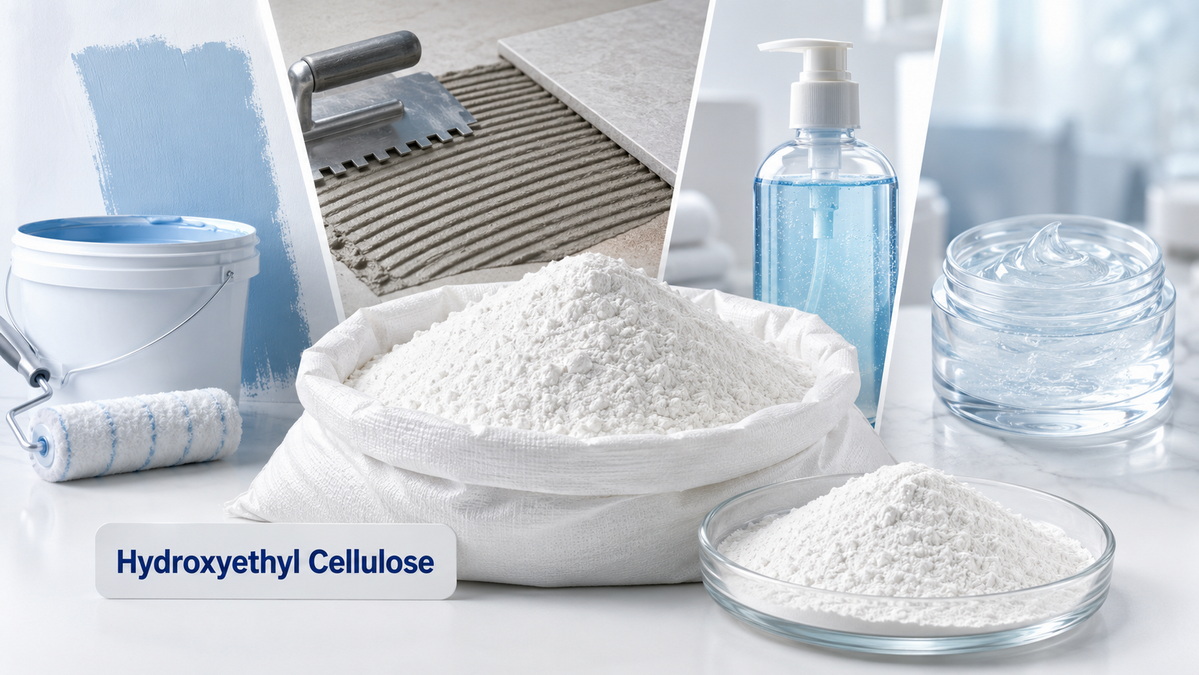
Hydroxyethyl cellulose is used across a range of industries. The required grade depends on molecular weight, viscosity, particle size, hydration behavior, substitution level, and formulation requirements.
In architectural paints, latex coatings, primers, and specialty waterborne systems, HEC can help control viscosity and application behavior.
Typical benefits include:
- Improved thickening efficiency
- Better anti-sag performance
- More stable pigment suspension
- Improved brush and roller feel
- Better flow and leveling balance
- Increased storage stability
- Reduced settling during storage
A well-selected HEC grade can improve the balance between thickening and application. If the grade is too low in viscosity, the paint may appear thin and unstable. If it is too high in viscosity, it may become difficult to mix, pump, spray, roll, or level smoothly.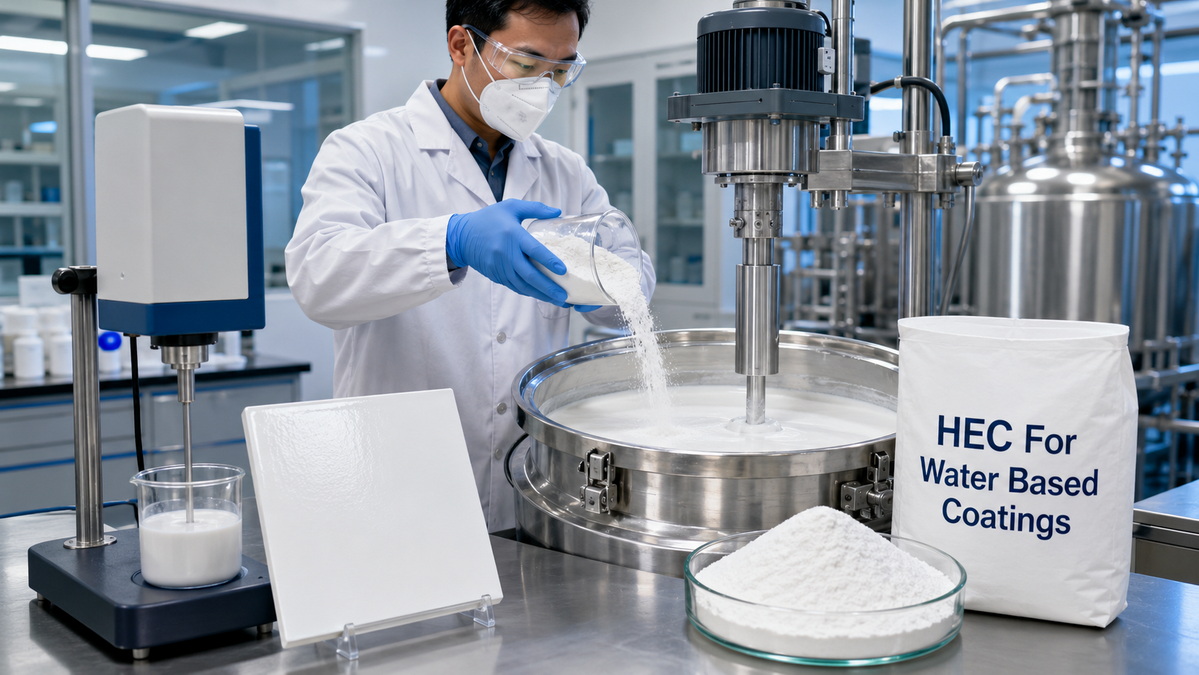
Although HPMC and HEMC are more commonly selected for cement-based dry-mix formulations, HEC may also be relevant in selected construction applications.
Cellulose ethers are widely used in:
- Tile adhesives
- Wall putty
- Skim coats
- Cement renders
- Gypsum plasters
- Repair mortars
- EIFS and ETICS systems
- Self-leveling compounds
- Joint fillers
In these formulations, cellulose ethers may improve water retention, consistency, workability, open time, and application performance.
HEC is also used in liquid detergents, cleaning products, hand-wash liquids, and household-care formulations. It can create a more stable and visually appealing product by improving thickness and suspension.
In detergent formulations, buyers often evaluate:
- Salt tolerance
- Surfactant compatibility
- Thickening efficiency
- Clarity
- Long-term viscosity stability
- Fragrance compatibility
- Ease of processing
Personal-care formulators may use HEC in shampoos, body washes, creams, lotions, gels, and selected cosmetic products.
Its functions may include:
- Thickening
- Texture improvement
- Suspension support
- Formula stabilization
- Improved sensory feel
- Better product appearance
The final performance depends on the specific formulation. A grade that works well in a paint system may not be suitable for a shampoo, gel, or facial-care product.
The global cellulose ether market includes multinational specialty chemical companies and experienced regional manufacturers. Each supplier has different strengths in product technology, application support, product range, supply flexibility, and commercial structure.
The following manufacturers are widely recognized in the cellulose ether industry.
Dow is a major global materials company with a broad portfolio of cellulose-based products. Its CELLOSIZE™ hydroxyethyl cellulose grades are used in several water-based industrial applications.
Dow's HEC products are associated with applications such as:
- Latex paints
- Architectural coatings
- Oilfield fluids
- Household products
- Personal care
- Construction-related formulations
- Industrial water-based systems
For paint manufacturers, Dow offers grades designed for thickening, pigment suspension, rheology control, and flow adjustment. Buyers with demanding technical requirements may consider Dow when they need established product technology and application experience.
Dow is often considered by companies that prioritize global product availability, technical documentation, and established industrial product lines.
Ashland is known for its specialty additives and cellulose-ether technologies. Its Natrosol™ range is widely used in water-based coatings, home care, and personal-care applications.
Ashland's HEC technologies are often selected for:
- Architectural paint thickening
- Waterborne coatings
- Low-shear dispersion
- Home-care formulations
- Personal-care products
- High-quality rheology control
For coating manufacturers, the key value of specialized HEC technology is often process efficiency. A grade that disperses smoothly and hydrates predictably can reduce mixing time, lower the risk of lump formation, and improve production consistency.
Ashland may be a suitable choice for formulators seeking high-performance coating additives or specialty grades for water-based consumer products.
Nouryon supplies cellulose ethers under the Bermocoll® brand. Its portfolio includes cellulose ether products for paints, coatings, dry-mix construction materials, and industrial water-based systems.
Nouryon's cellulose-ether range includes products designed to support:
- Water retention
- Viscosity control
- Paint stability
- Rheology adjustment
- Enzyme resistance
- Color stability
- Dry-mix mortar consistency
The company's offerings include not only standard HEC-related solutions but also other modified cellulose ethers. This is important because a buyer should select a product based on required performance, rather than choosing materials only by chemical name.
For example, paint manufacturers may need stronger anti-sag properties, while dry-mix mortar producers may focus more on water retention, open time, slip resistance, and workability.
Shin-Etsu Chemical is a major specialty chemical producer with broad experience in cellulose derivatives and advanced materials. It is often associated with high-value and technically demanding applications.
For buyers, Shin-Etsu can be relevant when product consistency, specialized technical requirements, and detailed quality documentation are important. It may be especially suitable for companies operating in higher-specification sectors or for projects where strict formulation performance is required.
However, large-company reputation should not replace product testing. Buyers should always confirm the exact grade, test method, viscosity range, application suitability, and compliance status before selecting any material.
Shandong Shengda New Material Co., Ltd. is a China-based manufacturer focused on the research, development, production, and sale of cellulose ethers, including:
- Hydroxypropyl methyl cellulose, or HPMC
- Hydroxyethyl methyl cellulose, or HEMC
- Hydroxyethyl cellulose, or HEC
The company serves customers in construction materials, water-based coatings, detergents, and other daily-chemical applications.
For international buyers, a China-based cellulose ether manufacturer can offer important sourcing benefits, including product customization, flexible commercial support, broad product selection, and efficient supply for bulk-volume requirements.
Shandong Shengda's product range allows buyers to source multiple cellulose ether types from one manufacturer. This can simplify supplier management for businesses producing several product categories, such as tile adhesive, wall putty, emulsion paint, liquid detergent, and home-care products.
Customer feedback published by the company indicates that customers value product performance in water-based coatings, stable product quality, reasonable commercial terms, on-time delivery, and responsive service. As with all supplier-provided customer feedback, buyers should validate performance through their own testing and trial-order process.
Selecting an HEC supplier requires more than comparing quotations. A lower purchase price may lead to higher total cost if the product causes poor dispersion, unstable viscosity, application defects, increased dosage, or production downtime.
A professional evaluation should include product performance, documentation, communication, supply stability, and long-term service capability.
Do not compare only a viscosity number. Two products with the same stated viscosity may perform very differently because testing conditions may vary.
Ask the supplier to provide detailed information on:
| Technical Item | Why It Matters |
|---|---|
| Viscosity range | Indicates the thickening profile of the product |
| Test method | Ensures specifications can be compared fairly |
| Solution concentration | Affects reported viscosity values |
| Temperature | Changes viscosity readings |
| Moisture content | Influences active content and powder handling |
| Particle size | Affects dispersion and hydration speed |
| pH value | Influences compatibility with the formula |
| Insoluble residue | Can affect clarity and appearance |
| Hydration time | Influences production efficiency |
| Batch consistency | Supports stable long-term formulation performance |
A technical data sheet should clearly explain how viscosity was measured. For example, buyers should ask about concentration, temperature, equipment, spindle, rotational speed, and solution preparation method.
The best HEC grade should be tested in the customer's actual formulation.
For water-based paint, compare:
- KU viscosity
- ICI viscosity
- Sag resistance
- Leveling
- Spatter resistance
- Pigment suspension
- Storage stability
- Freeze-thaw stability
- Brush and roller feel
- Color development
For dry-mix mortar, compare:
- Water retention
- Open time
- Workability
- Slip resistance
- Anti-sag behavior
- Mortar consistency
- Compatibility with redispersible polymer powder
- Adhesion performance
For detergent and home-care products, compare:
- Viscosity build
- Clarity
- Salt response
- Surfactant compatibility
- Storage stability
- Fragrance compatibility
- Product appearance
A good HEC manufacturer should provide stable and predictable supply. This matters especially for high-volume coating producers, mortar factories, and detergent brands that need continuous production.
Important questions include:
- Can the supplier support repeat bulk orders?
- Is the production capacity sufficient for future growth?
- Are standard grades regularly available?
- Can the manufacturer support customized grades?
- What is the normal production lead time?
- What packaging options are available?
- Can the supplier provide export documents?
- Does the supplier have experience with international shipping?
Supply reliability is especially important when a manufacturer is producing products for distributors, contractors, retailers, or export markets. A delayed cellulose ether shipment can delay the entire production schedule.
Cellulose ethers are functional additives. When a formula changes, technical support becomes highly valuable.
A capable supplier should be able to help customers understand:
- Which grade is suitable for the intended application
- How to reduce lump formation during mixing
- How to improve water retention or viscosity stability
- How to balance sag resistance and leveling
- How to adjust dosage
- How to improve compatibility with other additives
- How to solve viscosity variation during production
For many buyers, technical responsiveness is as important as the product itself.
HEC, HPMC, and HEMC belong to the cellulose ether family, but they are not interchangeable.
| Material | Main Functional Benefits | Common Applications |
|---|---|---|
| HEC | Thickening, rheology control, suspension, stabilization | Water-based paints, detergents, personal care, oilfield fluids |
| HPMC | Water retention, workability, thickening, film formation | Tile adhesives, wall putty, gypsum products, detergents |
| HEMC | Water retention, consistency, open time, workability | Cement mortars, renders, tile adhesives, wall putty |
HEC is often selected for water-based liquid formulations, especially coatings, detergents, and personal-care products.
HPMC and HEMC are commonly used in dry-mix construction materials because they can improve water retention, workability, and application performance in cement- or gypsum-based systems.
The final choice should always be based on formulation testing. A buyer should not switch from HEC to HPMC or HEMC solely because the products are all called cellulose ethers.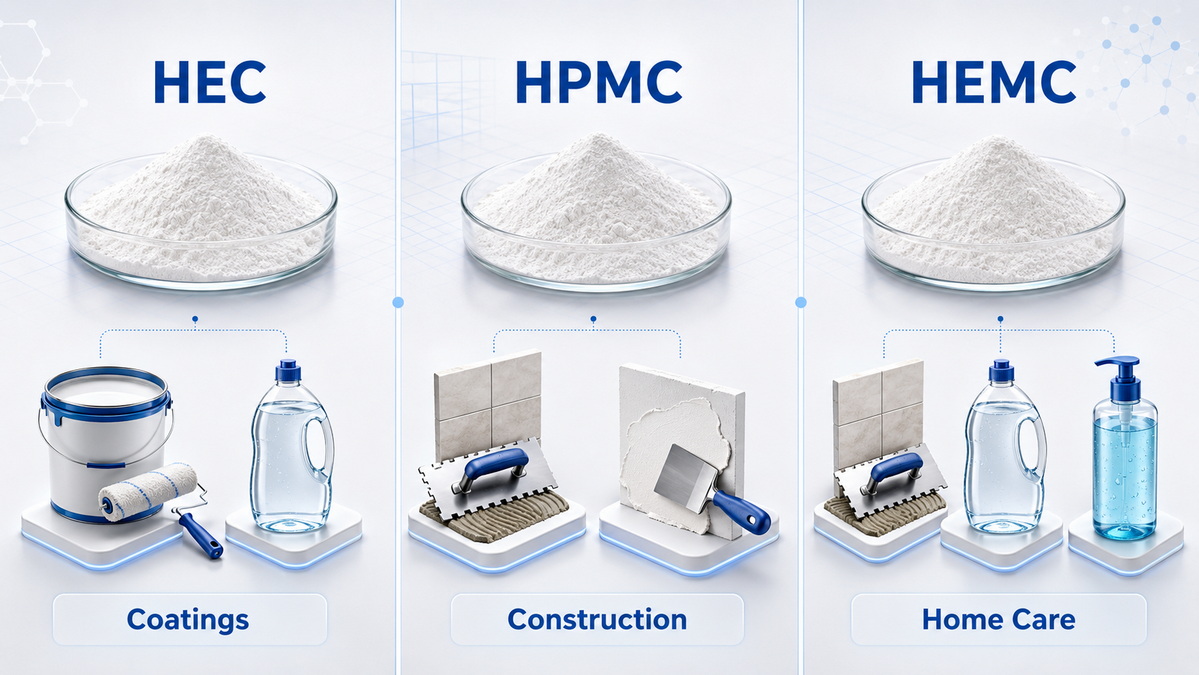
A structured sample test can reduce purchasing risk and help buyers identify the most suitable grade.
Before testing, request:
- Technical data sheet
- Safety data sheet
- Certificate of analysis
- Product specification
- Packaging information
- Shelf-life information
- Application recommendation
Review whether the supplier's product information matches the needs of the intended formula.
Use the new HEC sample in the existing formula or a controlled benchmark formula.
Check:
- Hydration speed
- Lump formation
- Viscosity development
- Appearance
- pH
- Compatibility
- Dosage efficiency
- Stability after standing
Use the same mixing procedure, raw materials, temperature, and test conditions when comparing multiple samples.
If laboratory results are positive, test the grade in a larger pilot batch.
Evaluate:
- Mixing time
- Powder addition behavior
- Process stability
- Pumping behavior
- Product appearance
- Application performance
- Batch-to-batch consistency
Before placing a large-volume order, conduct a production-scale validation. Where possible, test more than one batch to confirm that the supplier can deliver consistent quality.
A common mistake is to assume that the highest-viscosity HEC grade will always create the best product. In reality, excessively high viscosity can create processing difficulties and reduce application performance.
For example, a high-viscosity grade may improve anti-settling performance in a water-based paint. However, it may also reduce leveling, make pumping more difficult, increase roller resistance, or extend mixing time.
The target should be balanced performance, including:
- Sufficient viscosity for stability
- Good flow and leveling
- Appropriate sag resistance
- Predictable processing behavior
- Stable viscosity during storage
- Reasonable dosage efficiency
The most suitable product is the grade that delivers the desired final performance at the right dosage and with efficient production handling.
Selecting a hydroxyethyl cellulose manufacturer requires a balanced review of product performance, consistency, technical support, supply reliability, and commercial suitability.
Global suppliers such as Dow, Ashland, Nouryon, and Shin-Etsu offer established cellulose-ether technologies for demanding applications. At the same time, experienced Chinese manufacturers such as Shandong Shengda New Material provide an important sourcing option for buyers looking for HPMC, HEMC, and HEC products for construction materials, coatings, detergents, and daily-chemical applications.
The strongest purchasing decision comes from real formulation data. Start with technical documents, compare samples under controlled conditions, conduct pilot trials, and confirm performance across multiple batches before establishing a long-term supply relationship.
For manufacturers and distributors seeking stable cellulose ether solutions, the right partner should provide more than powder products. It should provide reliable quality, useful application knowledge, clear communication, and a practical understanding of the final product requirements.
Hydroxyethyl cellulose is mainly used as a thickener, rheology modifier, stabilizer, suspension aid, and water-retention additive. It is widely used in water-based paints, coatings, detergents, personal-care products, and selected industrial applications.
No. HEC, HPMC, and HEMC are different types of cellulose ethers. HEC is commonly used in water-based liquid systems, while HPMC and HEMC are widely used in dry-mix construction products such as tile adhesives, wall putty, and cement mortars.
HEC can form lumps when powder particles become wet too quickly on the outside. A gel layer can form around the particle and prevent water from reaching the center. Controlled addition, proper agitation, suitable dispersing methods, and the right grade selection can reduce this issue.
Compare the complete technical specification, not only the viscosity number. Confirm the solution concentration, test temperature, measurement equipment, particle size, moisture, pH, hydration time, and batch consistency.
Yes. HEC is commonly used in water-based paint to provide thickening, improve pigment suspension, adjust flow, enhance anti-sag performance, and support storage stability.
Request a technical data sheet, safety data sheet, certificate of analysis, product specification, packaging details, shelf life, application recommendation, and relevant quality or compliance documents for the intended market.
Start with a laboratory sample test, then conduct a pilot-scale trial, and finally complete a production-scale validation. Compare the material against the current benchmark grade under consistent processing and testing conditions.
1. [Top 5 Hydroxyethyl Cellulose Manufacturers in the World]
2. [Dow: Cellulosics]
3. [Dow: CELLOSIZE™ QP-15000H Hydroxyethyl Cellulose]
4. [Ashland: Natrosol™ Performax Hydroxyethylcellulose]
5. [Ashland: Natrosol™ 250 HHR PC Hydroxyethylcellulose]
6. [Nouryon: Bermocoll® Cellulose Ethers]
7. [Nouryon: Bermocoll® Prime 2530 Ethyl Hydroxyethyl Cellulose]
8. [Shandong Shengda New Material Co., Ltd.]
9. [Shandong Shengda New Material: Product and Company News]


