


close
Choose Your Site
Global
Social Media
Views: 270 Author: Shengda Publish Time: 2026-08-07 Origin: Site


Content Menu
● Why HPMC Dissolution Matters
● 3. Stirring Method and Shear
● 5. Water Quality and Dissolution Medium
● Other Factors Worth Watching
>> Substitution level and molecular structure
>> Moisture content and storage conditions
● Why Dissolution Quality Affects Construction Performance
● FAQ
>> 1. What is the best water temperature for HPMC dissolution?
>> 2. Why does HPMC sometimes form lumps?
>> 3. Does higher HPMC concentration always mean better performance?
>> 4. Can HPMC be dissolved in boiling water?
>> 5. What is the difference between surface-treated and non-surface-treated HPMC?
>> 6. Why is HPMC dissolution important in construction materials?
If you work with Hydroxypropyl Methyl Cellulose (HPMC) in construction materials or daily chemical products, you already know that dissolution behavior directly affects performance. When HPMC disperses poorly, it may cause clumping, delayed viscosity development, uneven water retention, and unstable application results.
In practical production, HPMC is not simply a thickener. It is a functional polymer that influences workability, adhesion, open time, sag resistance, texture, and formulation stability. That is why controlling its dissolution process is essential for consistent product quality.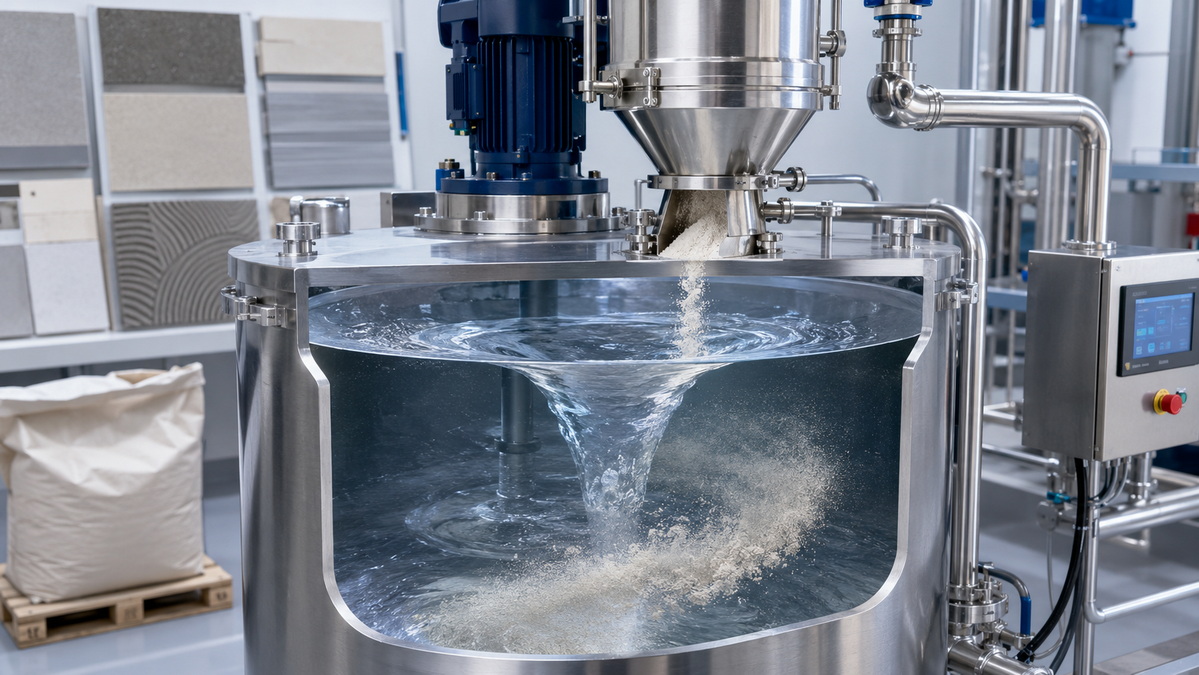
HPMC is widely used in tile adhesives, wall putty, plaster, skim coat, self-leveling compounds, detergents, and personal care formulations. In these systems, its hydration behavior determines how quickly the formula becomes uniform and how well it performs during mixing and application.
A small dissolution issue can create a large downstream problem. A product may look acceptable in the tank, but still perform poorly on the job site or during storage. For manufacturers, controlling HPMC dissolution is a critical part of quality consistency.
The first major factor is whether the HPMC is surface-treated or non-surface-treated. These two grades behave differently in water and should not be handled with the same process.
Surface-treated HPMC is designed for easier dispersion in cold water. It spreads quickly and helps reduce immediate lumping. This makes it suitable for liquid systems and processes where fast wet-out is needed.
Non-surface-treated HPMC behaves differently. It may clump in cold water, but it can disperse well in hot-water or two-step dissolution methods. This grade is often preferred when the process allows controlled hydration and gradual viscosity build-up.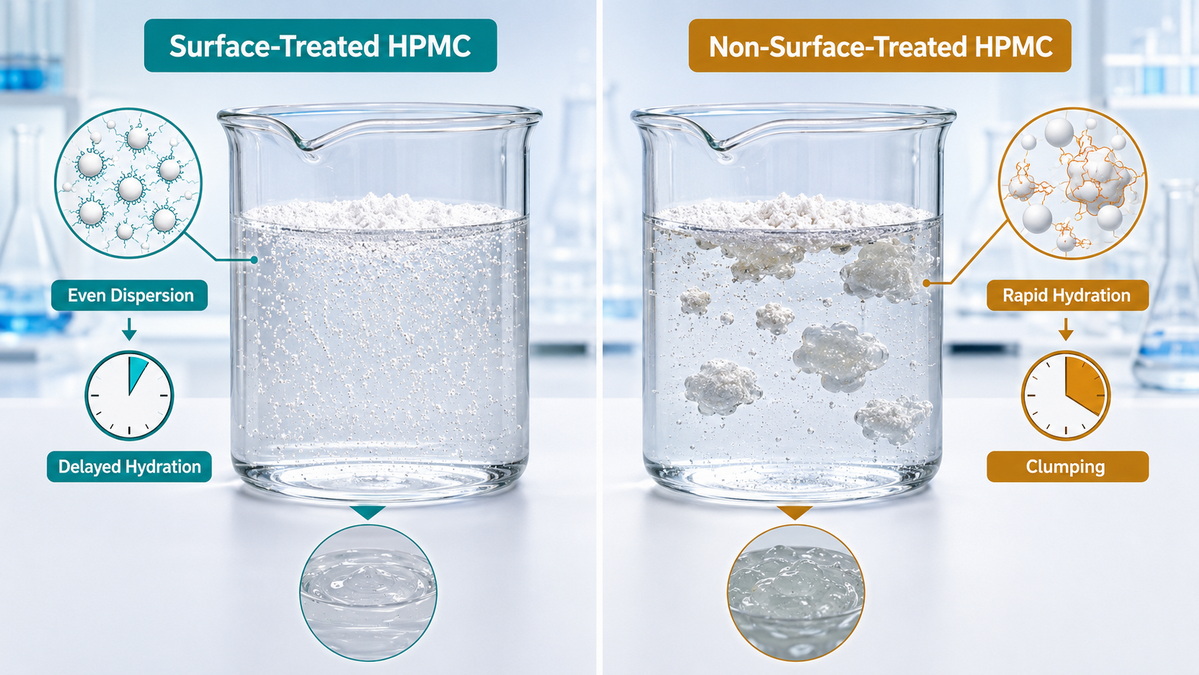
- Use surface-treated HPMC when cold-water dispersion is needed.
- Use non-surface-treated HPMC when your process supports hot-water or staged dissolution.
- Do not use the same method for both grades.
Water temperature has a direct impact on HPMC hydration and dispersion. HPMC does not dissolve like salt or sugar. Depending on the grade and process, it may disperse first, then swell, and finally build viscosity as the system stabilizes.
For many applications, a two-step method works well. One common approach is to disperse HPMC in hot water first, then add cold water while stirring so the system cools and hydration continues. This helps reduce clumping and improve uniformity.
For surface-treated grades, cold-water dispersion is usually easier. For non-surface-treated grades, warm or hot water is often more effective for initial dispersion. However, very high heat should be avoided because it may cause processing problems instead of improving performance.
| Water condition | Typical effect on HPMC |
|---|---|
| Cold water | Good dispersion for surface-treated grades |
| Warm water | Useful for controlled hydration |
| Hot water | Helpful in two-step or hot-dispersion methods |
| Boiling water | Not recommended for normal processing |
Even the right grade and water temperature will not guarantee success if the mixing method is poor. Stirring speed, mixing time, and equipment type all affect how well HPMC disperses and hydrates.
HPMC should be added slowly and evenly, not dumped in all at once. Fast agitation may help break up powder clusters at the start, but excessive shear for too long may introduce air, create foam, or make the system harder to control.
A practical production method usually includes three stages:
1. Initial dispersion under sufficient agitation.
2. Controlled stirring during hydration.
3. Cooling and stabilization until viscosity fully develops.
- Adding powder too quickly.
- Using weak stirring.
- Stopping mixing too early.
- Overmixing and entraining too much air.
The concentration of HPMC also affects dissolution behavior. In general, the higher the dosage, the longer the hydration time. This happens because the polymer network becomes denser and the system gradually becomes more viscous.
This is especially important in construction formulations. Even small changes in dosage can strongly influence water retention, workability, open time, and final consistency.
At higher loading levels, users may notice slower wet-out, stronger viscosity growth, and a greater risk of local agglomeration. For that reason, increasing dosage alone is not always the best solution.
If you need higher viscosity, optimize the following first:
- Viscosity grade.
- Particle size.
- Addition method.
- Mixing time.
This often works better than simply adding more HPMC.
Water quality is often overlooked, but it can influence dispersion and final stability. Hardness, salts, impurities, and pH may all affect hydration behavior in real formulations.
For laboratory testing, purified or deionized water is usually preferred. In production, it is better to test under the actual plant water conditions, because hard water or fluctuating water quality can change how HPMC behaves.
This is especially important in construction-grade applications, where stable water retention and viscosity are critical to reliable batch performance.
- Use purified water for initial testing when possible.
- Validate results with real production water.
- Check pH and mineral content if hydration is inconsistent.
Besides the five main factors, several material-level variables can also change HPMC performance.
Finer and more uniform particles often disperse more consistently. If the particle size distribution is too broad, hydration may become uneven.
The methoxy and hydroxypropyl substitution pattern affects solubility, gel temperature, and viscosity development. This is why different HPMC grades can behave differently even if they look similar.
If HPMC absorbs moisture during storage, flowability and dispersion can be affected. Proper packaging and dry storage help keep performance stable.
For more stable results in production, follow this sequence:
1. Identify the HPMC grade.
2. Confirm whether it is surface-treated or non-surface-treated.
3. Select the proper water temperature.
4. Add the powder slowly under controlled stirring.
5. Allow enough time for hydration.
6. Check viscosity after stabilization.
7. Test under real application conditions.
This workflow is useful for tile adhesives, wall putty, skim coat, self-leveling compounds, detergents, and cosmetic formulations.
In construction systems, HPMC does more than thicken a formula. It helps control water retention, adhesion, sag resistance, and open time. These properties directly affect application quality and finished surface performance.
If dissolution is uneven, some parts of the mix may retain too much water while others dry too quickly. The mortar may feel inconsistent, and bonding performance may fluctuate from batch to batch. That is why HPMC dissolution should be treated as a critical process step.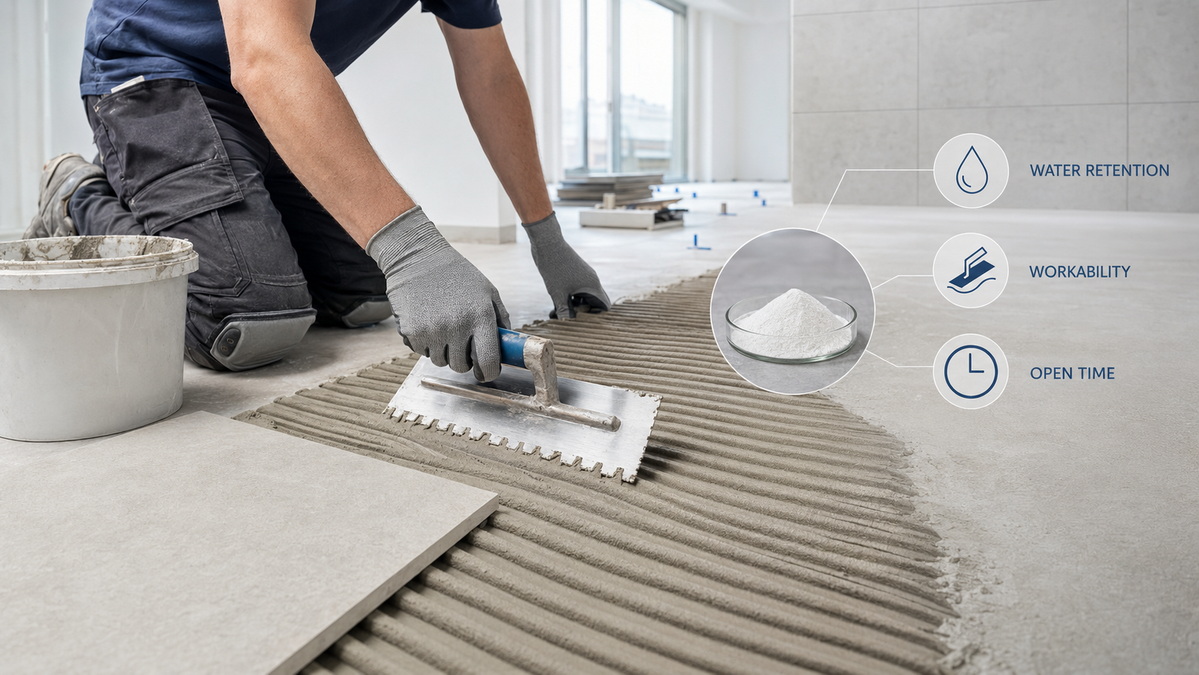
The dissolution behavior of HPMC depends on surface treatment, water temperature, stirring method, concentration, and water quality. When these five factors are controlled properly, you can improve dispersion, reduce clumping, and achieve more stable performance in both construction and daily chemical systems.
For manufacturers, the goal is not only to dissolve HPMC, but to make sure it hydrates in a way that supports the final product's viscosity, water retention, and application performance.
The best temperature depends on the grade. Surface-treated HPMC usually disperses well in cold water, while non-surface-treated HPMC often works better with hot-water or two-step methods.
Lumps usually appear when the powder is added too quickly, mixing is insufficient, or the wrong grade is used for the chosen water temperature.
No. Higher concentration may increase viscosity, but it also makes hydration slower and processing more difficult. The best result comes from balancing grade, dosage, and mixing method.
Boiling water is not recommended for normal processing. Excessive heat may create processing problems and reduce final dispersion quality.
Surface-treated HPMC disperses more easily in cold water and helps prevent immediate lumping. Non-surface-treated HPMC often needs hot-water or controlled hydration methods.
Because dissolution quality affects water retention, workability, open time, and adhesion. Poor dissolution can lead to unstable mortar performance and inconsistent application results.
1. LANDU – [5 Key Factors Affecting HPMC Dissolution]
2. LANDU – [How to Dissolving HPMC Powder? | Step-by-Step Guide]
3. LANDU – [HPMC Types, Dissolution Methods, and Applications]
4. LANDU – [Understand the Three Dissolution Methods of HPMC]
5. LANDU – [Hydroxypropyl Methylcellulose (HPMC) Dissolution Method]
6. LANDU – [HPMC for Water Retention Properties of Dry Mix Mortar]
7. LANDU – [Application of HPMC in Building Materials]
8. PMC – [Hydroxypropyl Methylcellulose—A Key Excipient in ...]


