


close
Choose Your Site
Global
Social Media
Views: 245 Author: Shengda Publish Time: 2026-08-18 Origin: Site


Content Menu
● Understanding HPMC Viscosity Grades
● Why Viscosity Is Not the Only Selection Factor
>> Hydration and Dissolution Behavior
● How to Choose HPMC for Construction Mortar
● A Practical HPMC Selection Process
>> 2. Identify the Main Problem
>> 3. Request Comparable Technical Data
>> 4. Test Multiple Dosage Levels
>> 5. Confirm Performance in Real Conditions
● Information to Request From an HPMC Supplier
● Example: Solving an Over-Thickened Tile Adhesive Formula
● FAQ
>> What is the main difference between HPMC grades?
>> Does higher HPMC viscosity always provide better water retention?
>> Which HPMC grade is suitable for tile adhesive?
>> What is the difference between HPMC and HEMC in dry mix mortar?
>> Can HPMC be used in daily chemical products?
>> Why can two HPMC products with the same viscosity perform differently?
>> What information should be provided when requesting an HPMC sample?
Hydroxypropyl Methylcellulose, commonly known as HPMC, is a nonionic cellulose ether used in construction materials, coatings, daily chemical products, food, pharmaceuticals, and other industrial applications.
HPMC is produced by modifying natural cellulose with methoxy and hydroxypropoxy groups. This modification gives the material useful properties, including water solubility, thickening, water retention, film formation, surface activity, and thermal gelation.
When manufacturers refer to different HPMC grades, they usually mean products with different combinations of:
- Viscosity range
- Methoxy content
- Hydroxypropoxy content
- Particle size
- Hydration and dissolution speed
- Moisture content
- Ash content
- pH value
- Surface treatment
- Application suitability
A grade should therefore be understood as a performance profile, not just a single number on a specification sheet.
For example, two HPMC products may both be described as 100,000 mPa·s. However, they may still perform differently in a tile adhesive or wall putty formula because their substitution level, particle size, hydration speed, molecular structure, and test methods are different.
Viscosity is one of the most important indicators used to classify HPMC grades. It describes the resistance of an HPMC solution to flow.
In practical formulations, viscosity can influence:
- Thickening performance
- Water retention
- Workability
- Open time
- Anti-sag performance
- Suspension stability
- Flow behavior
- Film-forming properties
- Product texture
Higher-viscosity HPMC does not automatically mean better performance. The best viscosity level depends on the application, formula design, climate, processing method, and target user experience.
| HPMC Viscosity Category | General Characteristics | Typical Applications |
|---|---|---|
| Low viscosity | Lower thickening, easier flow, relatively fast processing | Tablet coating, binders, specialty coatings, some liquid systems |
| Medium viscosity | Balanced thickening and workability | Wall putty, gypsum plaster, detergents, personal-care products |
| High viscosity | Strong thickening and improved water management | Tile adhesive, cement render, skim coat, EIFS mortar |
| Ultra-high viscosity | Strong rheology modification and high body | Specialized dry mix mortar and high-performance adhesive systems |
When comparing viscosity data, buyers should confirm the full testing conditions. A viscosity value should include the solution concentration, temperature, testing instrument, spindle, and rotational speed.
Without this information, comparing one supplier's viscosity result with another supplier's result can be misleading.
A common mistake is selecting an HPMC grade based only on its reported viscosity. This may lead to problems such as poor mixing, insufficient water retention, excessive stickiness, weak workability, low open time, or inconsistent batch performance.
A suitable HPMC grade must balance several properties.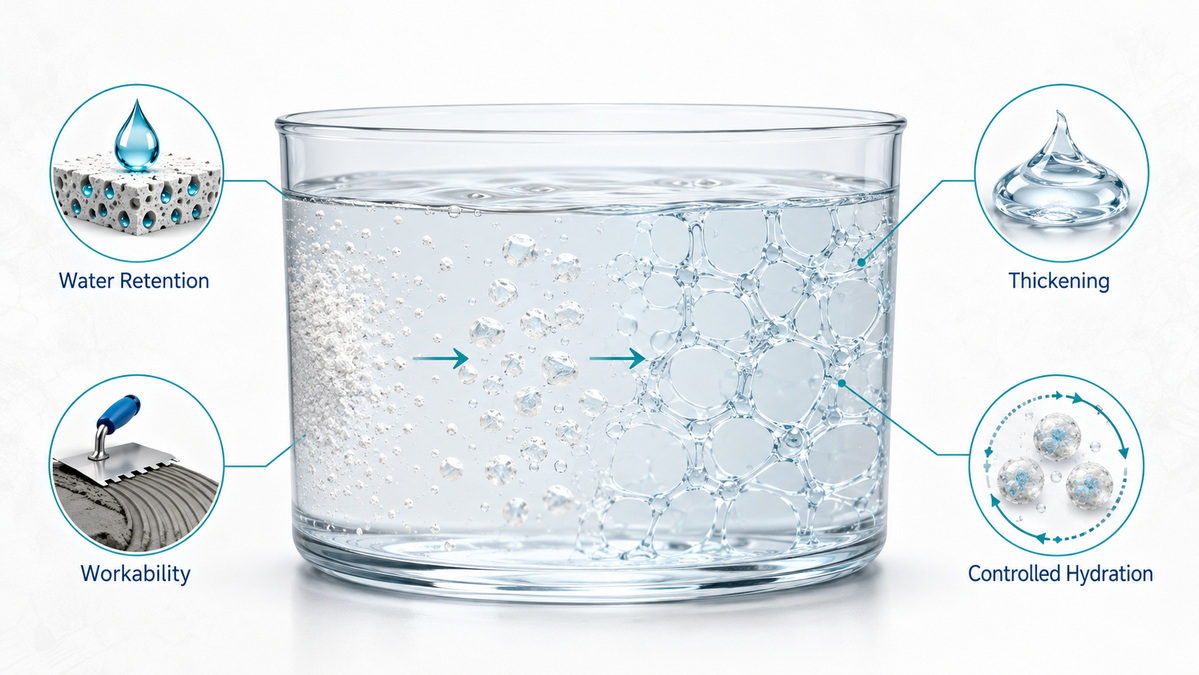
Water retention is especially important in cement-based and gypsum-based dry mix products. HPMC helps hold water in the mortar system, allowing cement or gypsum to hydrate more effectively and giving workers more time for application.
Good water retention can support:
- Better mortar workability
- More stable consistency
- Reduced premature drying
- Improved adhesion potential
- Better troweling performance
- Longer open time
- More uniform curing behavior
However, water retention does not depend on HPMC alone. The final result can also be influenced by cement type, filler ratio, sand gradation, polymer powder, starch ether, dosage, water ratio, temperature, humidity, and mixing conditions.
HPMC must disperse and hydrate properly to deliver consistent performance.
In dry mix mortar, rapid hydration during mixing can create lumps or fish eyes. In liquid detergent or personal-care systems, poor addition procedures may cause incomplete dissolution, uneven viscosity, or visible particles.
The appropriate grade depends on the customer's production process, including:
- Water temperature
- Mixing sequence
- Stirring speed
- Shear level
- Mixing time
- Salt concentration
- Surfactant system
- Other formulation additives
Some applications may benefit from surface-treated HPMC grades designed for controlled dispersion. These materials can help reduce lumping risk and improve handling during production.
The methoxy and hydroxypropoxy groups attached to cellulose influence how HPMC behaves in water and under heat.
These structural characteristics affect:
- Solubility
- Swelling behavior
- Hydration speed
- Surface activity
- Thermal gelation
- Water retention
- Compatibility with other materials
It is not accurate to judge performance based on methoxy content or hydroxypropoxy content alone. The final behavior depends on the complete molecular profile of the material and the formulation in which it is used.
For this reason, application testing is more reliable than making a purchase decision based only on a generic description of substitution level.
Construction-grade HPMC is widely used in dry mix mortar products. It can improve water retention, workability, lubrication, consistency, anti-sag performance, and application feel.
The correct HPMC grade should be selected according to the intended final product.
| Application | Main Performance Requirements | Selection Focus |
|---|---|---|
| Tile adhesive | Water retention, open time, slip resistance, trowelability | Medium-to-high viscosity, stable hydration, polymer compatibility |
| Wall putty | Smooth spreading, creamy feel, water retention, sanding balance | Balanced viscosity and workability |
| Skim coat | Easy application, smooth finish, low drag, reduced cracking risk | Water retention and controlled thickening |
| Cement render | Workability, pumpability, stable consistency | Water management and rheology balance |
| Gypsum plaster | Open time, smooth application, stable texture | Hydration profile and compatibility with retarders |
| EIFS adhesive | Cohesion, anti-sag performance, workability | Strong water retention and rheology control |
| Self-leveling mortar | Flow, leveling, surface quality | Low interference with flow behavior |

Tile adhesive requires a carefully balanced HPMC grade. The material should provide adequate water retention without making the mortar too sticky or difficult to spread.
Important selection factors include:
- Open time
- Slip resistance
- Troweling feel
- Water retention
- Tensile adhesion
- Compatibility with redispersible polymer powder
- Behavior under hot and dry conditions
A grade that appears suitable in a laboratory test may still need adjustment after field application trials.
For wall putty and skim coat, users often expect a smooth, creamy, easy-to-spread material. Excessive viscosity may produce drag during application, while insufficient water retention may reduce workability.
A suitable grade should provide:
- Smooth spreading
- Stable consistency
- Good water retention
- Reduced cracking tendency
- Acceptable sanding performance
- Controlled stickiness
The ideal balance depends on the filler system, cement ratio, gypsum content, and local construction conditions.
Gypsum plaster systems require a different approach from cement-based mortars. HPMC can improve workability and water management, but its interaction with retarders and other additives must be evaluated.
When selecting HPMC for gypsum products, consider:
- Initial setting time
- Final setting time
- Water demand
- Application smoothness
- Surface finish
- Retarder compatibility
- Pumping behavior
A grade that performs well in cement mortar may not automatically be appropriate for gypsum plaster.
Selecting an HPMC grade should involve a structured evaluation process.
Start by clearly identifying the final product.
Examples include:
- Ceramic tile adhesive
- Cement render
- Wall putty
- Gypsum plaster
- Exterior insulation mortar
- Paint
- Detergent
- Shampoo
- Hand sanitizer gel
- Personal-care cream
Each system requires a different balance of viscosity, hydration, rheology, and compatibility.
Many formulation projects begin with a performance issue. Typical concerns include:
- Poor water retention
- Short open time
- Weak anti-sag performance
- Excessive stickiness
- Difficult mixing
- Lumps during dissolution
- Low viscosity stability
- Poor surface smoothness
- Weak suspension
- Insufficient flow
Identifying the actual problem helps determine whether to adjust HPMC viscosity, dosage, particle size, substitution profile, or another part of the formulation.
When evaluating HPMC from different suppliers, request the same information for each sample.
Important data includes:
- Viscosity range
- Viscosity test method
- Solution concentration
- Testing temperature
- Moisture content
- Ash content
- pH value
- Particle size
- Recommended dosage
- Storage conditions
- Shelf life
The viscosity test method is especially important. A value measured under different conditions should not be used as a direct comparison.
Do not test only one dosage level. A practical evaluation should compare low, medium, and high dosage levels.
For dry mix mortar, evaluate:
- Water retention
- Mortar consistency
- Workability
- Open time
- Slip
- Adhesion
- Anti-sag behavior
- Surface finish
For daily chemical products, evaluate:
- Dissolution time
- Clarity
- Viscosity development
- Texture
- Foam behavior
- Storage stability
- Compatibility with salts and surfactants
Laboratory results are important, but practical application trials are equally valuable.
Construction materials should be tested under realistic temperature and humidity conditions. Daily chemical products should be evaluated after storage, transport simulation, and repeated temperature changes where relevant.
A consistent material should provide reliable performance not only in one test batch, but also across multiple production batches.
HPMC, Hydroxyethyl Methyl Cellulose (HEMC), and Hydroxyethyl Cellulose (HEC) are all cellulose ethers. However, they are not interchangeable in every formulation.
| Material | Main Characteristics | Common Application Areas |
|---|---|---|
| HPMC | Water retention, thickening, workability, thermal gelation | Dry mix mortar, tile adhesive, gypsum, coatings, personal care |
| HEMC | Strong water retention and rheology control | Cement-based mortar, tile adhesive, EIFS, render |
| HEC | Water-soluble thickening, smooth flow, clear aqueous systems | Paints, coatings, detergents, shampoos, oral care |

HPMC is a versatile option for both construction and daily chemical applications. It is commonly used where water retention, thickening, workability, and film-forming properties are required.
For construction products, HPMC is often selected for tile adhesive, wall putty, skim coat, gypsum plaster, and cement render.
For daily chemical systems, suitable HPMC grades may be used in personal-care and household products that require thickening, stabilization, or rheology control.
HEMC is commonly evaluated in demanding cement-based dry mix applications. It may be selected when strong water retention and rheology performance are required.
The final choice between HPMC and HEMC should be based on formula testing rather than assumptions. Factors such as local raw materials, polymer powder, climate, mortar consistency, application method, and cost-performance requirements should be considered.
HEC is widely used in water-based liquid systems, particularly coatings, paints, detergents, shampoos, and personal-care formulations.
It can provide smooth thickening and shear-thinning behavior. In some applications, it is preferred when transparency, flow, suspension, and sensory texture are important.
A reliable supplier should provide more than a price quotation. Buyers should be able to understand the product's performance profile, testing standards, and batch consistency.
Before approving a grade, request:
- Technical data sheet
- Certificate of analysis
- Viscosity testing method
- Moisture specification
- Ash specification
- pH specification
- Particle-size information
- Recommended dosage range
- Safety data sheet
- Storage guidance
- Shelf-life information
- Batch traceability details
- Application sample for testing
For regulated applications, customers should also confirm that the selected product and supporting documentation meet the requirements of the destination market and intended end use.
A tile adhesive manufacturer changes cellulose ether suppliers and finds that the new mortar feels heavier during mixing and more difficult to spread.
The first conclusion may be that the new HPMC viscosity is too high. However, several other factors may be responsible.
Possible causes include:
- Different viscosity test methods
- Faster HPMC hydration
- Higher water retention
- Higher actual dosage
- Different polymer powder interaction
- Different starch ether balance
- Changes in sand moisture
- Changes in filler particle size
A better approach is to compare the original HPMC and the new HPMC under the same test conditions.
The evaluation should include:
- Water demand
- Mortar consistency
- Water retention
- Open time
- Slip resistance
- Tensile adhesion
- Troweling performance
- Surface finish
This process helps determine whether the issue comes from viscosity, dosage, hydration rate, formula compatibility, or raw-material variation.
The right HPMC grade is not necessarily the highest-viscosity product or the lowest-cost option. It is the grade that delivers stable performance in the final formulation, production process, climate conditions, and target application.
For construction-grade HPMC, focus on water retention, hydration behavior, workability, anti-sag performance, open time, and compatibility with other dry mix additives. For daily chemical applications, focus on dissolution, clarity, rheology, sensory feel, viscosity stability, and compatibility with surfactants or salts.
Shandong Shengda New Material Co., Ltd. supplies HPMC, HEMC, and HEC products for global construction and daily chemical customers. Customers can share their application requirements, current formulation challenges, and target performance parameters to identify a suitable cellulose ether solution.
The main differences are viscosity, substitution level, particle size, hydration speed, moisture, ash content, and intended application. Products with similar viscosity values may still perform differently in the same formulation.
Not always. Higher viscosity can support water retention, but final performance also depends on dosage, substitution, cement type, fillers, polymers, water ratio, temperature, and mixing conditions.
Tile adhesive typically requires an HPMC grade that provides reliable water retention, acceptable open time, good trowelability, and controlled slip resistance. The best grade should be confirmed through laboratory and application testing.
Both are nonionic cellulose ethers used to improve mortar performance. HPMC is broadly used in many dry mix systems, while HEMC is also widely used in cement-based mortar applications that require robust water retention and rheology control.
Yes. Suitable HPMC grades can be used as thickeners, stabilizers, film formers, and rheology modifiers in certain personal-care and household formulations. Compatibility and storage stability should be tested in the final product.
The products may have different substitution levels, particle sizes, hydration rates, molecular structures, moisture levels, or viscosity testing methods. Performance should be compared using the same formula and identical testing conditions.
Provide the application type, formula details, current cellulose ether grade, target performance, dosage, mixing method, water temperature, climate conditions, and any issue such as poor water retention, short open time, lumping, or excessive stickiness.
1. Shandong Shengda New Material Co., Ltd. [What Are the Differences Between Different Grades of HPMC?]
2. Li, M. et al. [Water Retention Mechanism of HPMC in Cement Mortar]. *Polymers*, 2020. [pmc.ncbi.nlm.nih]
3. Oprea, E. et al. [Hydroxypropyl Methylcellulose—A Key Excipient in Pharmaceutical Formulations]. *Pharmaceutics*, 2025. [pmc.ncbi.nlm.nih]
4. U.S. Food and Drug Administration. [Hydroxypropyl Methylcellulose: Food Substance Listing].
5. European Commission. [Commission Regulation (EU) 2025/666 on Specifications for Cellulose Food Additives].
6. Ashland. [Natrosol™ Hydroxyethylcellulose]. [ashland]
7. Colorcon. [Using Hypromellose (HPMC) in Matrix Tablets for Controlled Release].


