


close
Choose Your Site
Global
Social Media
Views: 275 Author: Shengda Publish Time: 2026-11-06 Origin: Site


Content Menu
● HEMC vs HPMC: What Builders Need to Know
>> Water Retention and Open Time
>> Temperature Resistance and Thermal Gelation
● 2026 Cellulose Ether Market Trends Affecting Builders
>> Renovation Supports Performance-Oriented Mortar Demand
>> Regional Prices Are Moving Differently
>> Sustainability Claims Need Product-Level Evidence
● HEMC and HPMC Pricing in 2026: What the Data Actually Shows
>> Why HEMC vs HPMC Price Comparisons Can Mislead
● Late-2026 Pricing Forecast: Use Scenarios, Not False Precision
>> Build a Budget Sensitivity Around Your Own Quote
● Cost-in-Use Case: When a Higher-Priced Grade Costs Less
● A Five-Step Qualification Plan for HEMC and HPMC
>> 2. Align Supplier Documentation
>> 3. Run Controlled Laboratory Comparisons
>> 4. Validate Realistic Application Conditions
>> 5. Approve Consistency, Not Just One Sample
● Which Cellulose Ether Should Builders Choose?
>> Is HEMC always better than HPMC for hot climates?
>> Is HPMC always cheaper than HEMC in 2026?
>> Can I replace HPMC with HEMC at the same dosage?
>> What is the best cellulose ether for tile adhesive?
>> Can a general cellulose ether price index predict my purchase price?
>> What should I send a cellulose ether manufacturer before requesting samples?
HEMC vs HPMC in 2026 is not simply a comparison between two cellulose ether prices. For builders, dry-mix mortar manufacturers, and construction-material distributors, the real question is which grade delivers reliable application performance at the lowest cost-in-use.
Hydroxyethyl Methyl Cellulose (HEMC) and Hydroxypropyl Methyl Cellulose (HPMC) both support water retention, consistency, and workability in construction formulations. However, their performance depends on substitution chemistry, viscosity, modification, dosage, and the surrounding formulation—not just the product name.
At Shandong Shengda New Material Co., Ltd., our approach to this comparison is application-led: establish the required mortar performance, qualify suitable grades, and then compare purchasing economics. This article separates published market observations from practical recommendations and illustrative pricing scenarios.
HEMC contains methyl and hydroxyethyl substituents on a cellulose backbone. HPMC contains methyl and hydroxypropyl substituents. HEMC is also commonly called MHEC.
Both are nonionic cellulose ethers used in cementitious construction materials. They help control how fresh mortar holds water, spreads, and responds to application forces.
Neither is automatically the superior choice.
| Comparison factor | HEMC | HPMC |
|---|---|---|
| Main chemical distinction | Hydroxyethyl and methyl substitution | Hydroxypropyl and methyl substitution |
| Construction applications | Tile adhesives, renders, and other mortars | Tile adhesives, renders, insulation-system mortars, and other formulations |
| Water retention | Depends on grade, dosage, and formulation | Depends on grade, dosage, and formulation |
| Thermal behavior | Often considered for higher-temperature applications | Varies substantially with substitution and modification |
| Workability | Must be assessed in the finished mortar | Must be assessed in the finished mortar |
| Purchasing decision | Justify any premium through measured performance | Confirm that a lower quote also delivers acceptable performance |
A useful comparison therefore matches two application-specific grades, rather than comparing generic HEMC with generic HPMC.
Water retention helps limit premature water loss from fresh mortar, particularly when absorbent substrates draw water away.
Open time describes the usable interval after adhesive application during which tiles can still achieve the required bond performance.
These properties are related, but they are not interchangeable. A mortar can appear workable while its exposed surface has already developed a skin.
Evaluate water retention alongside open-time adhesion, substrate absorption, and actual installation conditions.
HEMC is frequently considered when hot-weather performance is important because many grades have higher thermal gelation temperatures than conventional HPMC grades.
However, there is no universal gelation temperature for either category. Substitution chemistry and product design matter.
A polymer solution's gelation temperature is also not the maximum safe application temperature of a finished mortar. Wind, humidity, substrate temperature, and evaporation can affect installation well before that threshold.
For hot-climate projects, request comparative mortar results rather than selecting from a gel-temperature figure alone.
Higher viscosity does not automatically mean better construction performance.
Excessive thickening can increase mixing resistance and make mortar harder to spread. Conversely, insufficient structure may compromise handling or vertical application.
Compare viscosity only when solution concentration, temperature, instrument, and measurement conditions match. Identical numbers on two datasheets may not represent equivalent products.
The construction-grade cellulose ether market operates within a wider industry serving pharmaceuticals, food, coatings, and personal care.
This distinction matters: a broad cellulose ether market forecast does not directly describe demand or pricing for construction-grade HEMC and HPMC.
Buildings account for around 30% of global energy demand. Improving insulation and renovating existing buildings remain important priorities, especially in advanced economies with substantial older building stock.
These priorities provide a demand rationale for insulation-system adhesives, reinforcing mortars, and renovation products that use performance additives.
However, an energy-efficiency policy does not translate automatically into immediate cellulose ether orders. Project financing, construction activity, and local implementation still determine purchasing volumes.
For suppliers, the practical opportunity is to support qualified formulations—not merely promise growth.
Published second-quarter 2026 cellulose ether observations show that regional markets did not move in one direction.
Some regions experienced firmer prices, while China and India showed downward pressure associated with improved availability and competition.
For international buyers, this means a general statement such as "cellulose ether prices are rising" is insufficient.
The relevant questions are:
- Which product category and grade?
- Which delivery location?
- Which reporting period?
- Which currency and commercial terms?
- Which order quantity and qualification requirements?
Plant-derived cellulose provides the starting material for these additives. Nevertheless, renewable feedstock alone does not establish a finished product's environmental footprint.
Manufacturing energy, chemical inputs, transport, packaging, and dosage also matter.
Request product-specific environmental information where available. Do not assume that one supplier's published carbon reduction applies to another manufacturer or to every HEMC and HPMC grade.
A public cellulose ether pricing report lists the following June 2026 observations:
| Market | Reported price, USD per metric ton |
|---|---|
| United States | 3,928 |
| China | 4,339 |
| Germany | 3,270 |
| India | 1,969 |
| Brazil | 4,260 |
These figures provide broad market context, not a construction-grade HPMC or HEMC quotation.
The publicly accessible information does not establish a fully comparable specification, grade mix, and delivery basis for every figure. Consequently, the table should not be used to rank countries by procurement competitiveness.
It also does not establish a universal HEMC premium over HPMC.
A meaningful comparison must normalize:
1. Product specification and modification.
2. Viscosity measurement method.
3. Moisture content and quality tolerances.
4. Packaging and order volume.
5. Delivery terms and destination.
6. Payment terms and quotation validity.
7. Dosage needed to achieve the same mortar performance.
An inexpensive additive can become expensive if it requires higher dosage or creates application problems.
Equally, a higher-priced grade offers poor value when its additional performance is unnecessary.
As of October 30, 2026, much of the year has already passed. A useful forecast should therefore distinguish observed data from expectations for the remaining purchasing period.
The outlook below is a planning framework, not a statistically validated price forecast or a Shengda quotation.
| Scenario | Conditions to monitor | Potential purchasing effect |
|---|---|---|
| Balanced market | Adequate supply and broadly stable operating costs | Competitive negotiations and relatively stable offers |
| Cost-pressure scenario | Higher energy, feedstock, freight, or financing costs | Upward pressure on replacement orders |
| Supply-abundant scenario | Ample availability and cautious downstream buying | Greater discounting pressure on standard grades |
| Specification-constrained scenario | Limited availability of an already approved grade | Premiums or longer lead times despite broader market softness |
Our planning view is that buyers should avoid assuming a uniform year-end price movement across both products.
Instead, obtain current quotes for approved grades and monitor quote validity, production lead times, freight, and exchange rates. Revisit the outlook when these inputs change.
Suppose an approved grade is quoted at USD 2.50/kg. A purchasing team could test a planning band of minus 10% to plus 10%, equivalent to USD 2.25–2.75/kg.
This is an illustrative stress test, not an observed market range or forecast probability.
Applying that band to expected consumption shows the budget exposure more clearly than relying on a generic industry prediction.
Consider two hypothetical formulations that achieve equivalent required performance.
| Item | Formulation A: HPMC | Formulation B: HEMC |
|---|---|---|
| Illustrative additive price | USD 2.20/kg | USD 2.60/kg |
| Dosage per metric ton of dry mortar | 3.0 kg | 2.5 kg |
| Cellulose ether cost per metric ton | USD 6.60 | USD 6.50 |
Although the HEMC price is higher per kilogram, its lower assumed dosage produces a slightly lower additive cost per ton.
These figures are illustrative, not market quotations or Shengda trial results. HEMC does not inherently require less material than HPMC.
The lesson is methodological: determine the dosage needed to meet the same acceptance criteria before calculating savings.
Include rejected batches, complaints, and rework where reliable operating data exists. Avoid assigning speculative savings to benefits that have not been demonstrated.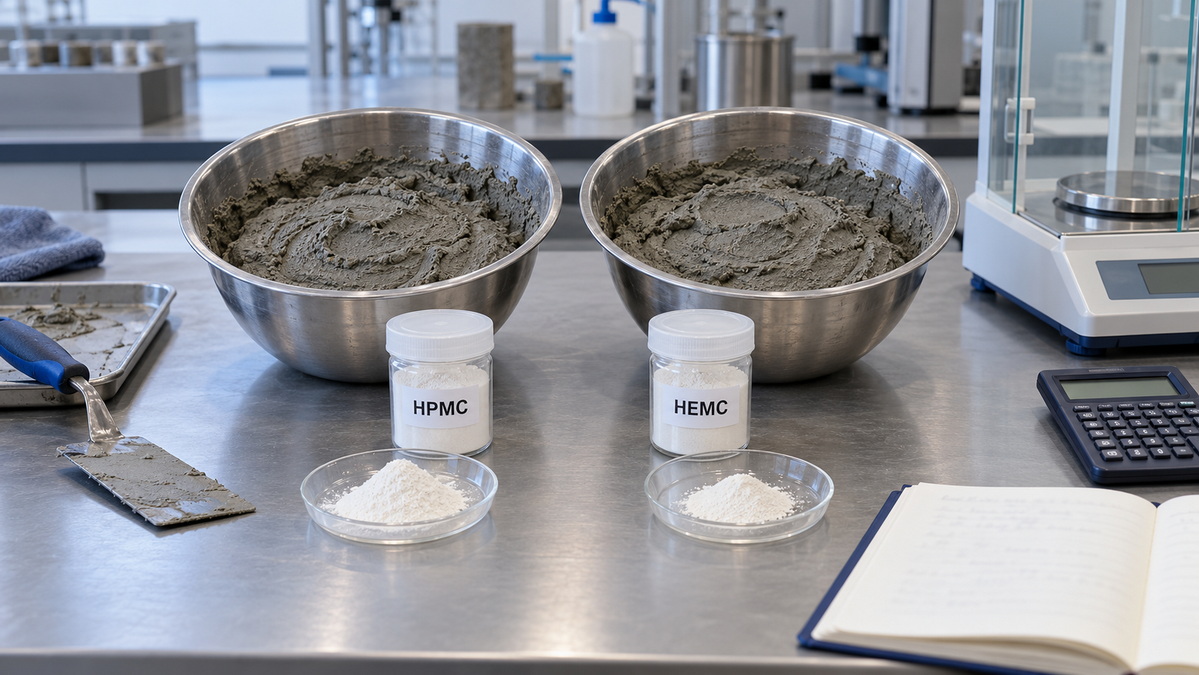
Specify the binder system, aggregate grading, water demand, substrate, installation temperature, and required performance.
Tile adhesive, gypsum plaster, and cement render should not share one generic acceptance checklist.
Request technical and safety datasheets, a representative certificate of analysis, viscosity test conditions, storage guidance, and relevant application recommendations.
For international procurement, confirm packaging, batch identification, and shipping documentation before commercial approval.
Start with the same base formulation and mixing procedure. Compare candidate grades at a common dosage, then optimize each separately.
Record:
- Water demand and consistency.
- Water retention.
- Spreading and troweling behavior.
- Slip or sag where relevant.
- Setting behavior.
- Open-time adhesion and final bond performance.
An equal-dosage screen and an optimized-formulation comparison answer different questions; both can be useful.
Repeat critical tests under representative temperature, humidity, and substrate conditions.
For hot-weather projects, assess the mortar on heated or absorbent substrates where appropriate. Do not rely exclusively on a room-temperature solution test.
Follow applicable test methods and project requirements when determining acceptance.
A successful laboratory sample is the beginning of qualification.
Check subsequent batches against agreed tolerances and retain samples for investigation. Where feasible, qualify an alternative grade before a supply interruption occurs.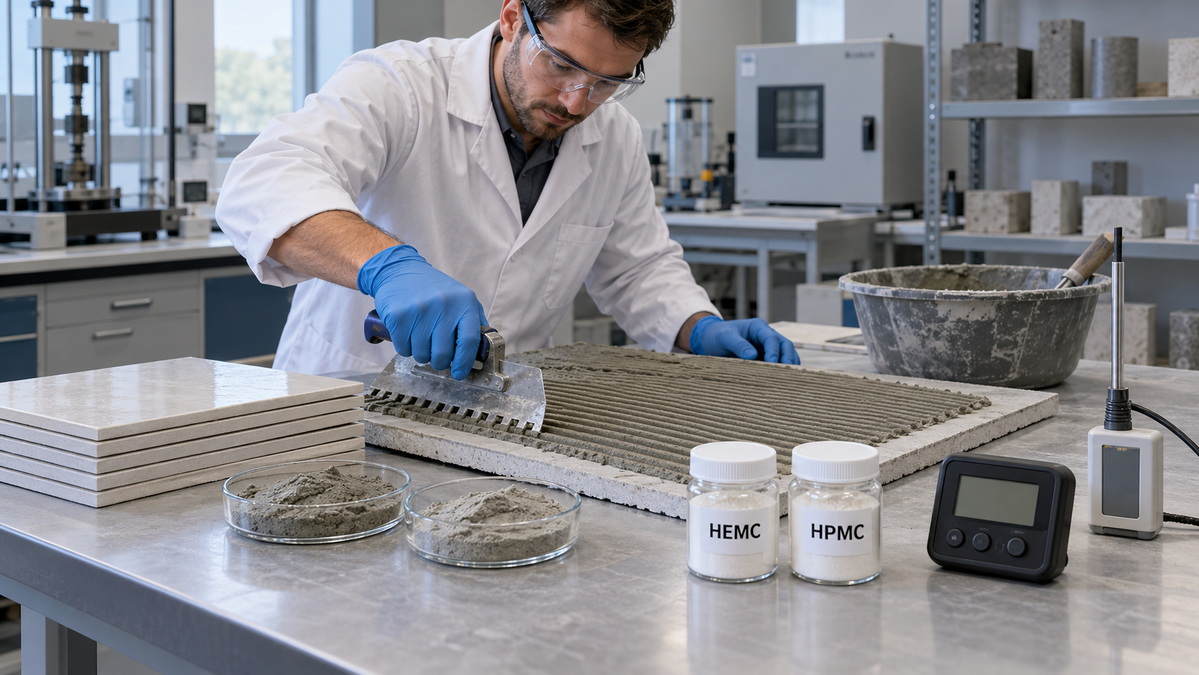
HPMC is a strong candidate when an application-specific grade meets performance requirements at an attractive delivered cost.
HEMC deserves consideration when its thermal behavior or formulation response provides a measurable advantage.
For either product, the decision should follow this sequence:
1. Meet the required performance.
2. Confirm repeatability.
3. Establish the appropriate dosage.
4. Compare delivered cost-in-use.
5. Assess supply reliability.
For Shandong Shengda New Material Co., Ltd., the most useful starting point is your formulation and operating environment—not a request for the "highest viscosity" or "cheapest powder."
Send our team your application, target performance, current dosage, expected order volume, and destination. Request a suitable HEMC or HPMC grade recommendation, supporting documentation, samples, and a quotation on clearly defined delivery terms.
No. Many HEMC grades warrant evaluation for higher-temperature applications, but suitably designed HPMC grades may also perform well. Compare finished-mortar results under representative conditions.
No universal price relationship can be established from the public data reviewed. Grade, modification, volume, delivery terms, and supplier conditions influence the actual quotation.
Use equal dosage as an initial screening condition, not an approval rule. Recheck water demand, workability, setting, open time, and adhesion before commercial substitution.
The best grade meets the adhesive's application and classification requirements at an acceptable cost. Polymer identity alone does not establish open-time adhesion, slip resistance, or overall performance.
Only as broad context. Your purchase price depends on the precise specification, commercial terms, destination, and timing. Obtain a current quotation for the approved grade.
Provide the application, binder system, current formulation or key constraints, target viscosity method, dosage, operating climate, performance requirements, and destination market.
1. Dow. [WALOCEL™ M 120-01 Cellulose Ether]. Manufacturer information supporting the use of modified HEMC in cement-based tile adhesives and mortars, including water retention, workability, and open time. [dow]
2. Dow. [WALOCEL™ M 10-40 Cellulose Ether]. Manufacturer information supporting modified HPMC applications in tile adhesives and external thermal insulation systems. Product-specific environmental claims are not generalized to Shengda products. [dow]
3. IMARC Group. [Cellulose Ether Prices, Trend, Chart, Demand, Market Analysis, News, Historical and Forecast Data Report, 2026 Edition]. Updated July 20, 2026. Source of the June 2026 regional price observations and associated market commentary. These are broad cellulose ether figures, not matched construction-grade HEMC/HPMC quotations. [imarcgroup]
4. International Energy Agency. [Buildings—Energy Efficiency 2025]. Source for buildings' approximate share of global energy demand and the relevance of insulation, efficient new construction, and retrofits. [iea]
5. Celotech. [The Difference of Physical and Chemical Properties and Application of HPMC and HEMC in the Construction Industry]. August 15, 2024. Supplier technical commentary on substitution chemistry and thermal behavior; indicative category differences should be verified against individual grade documentation. [celotech]
6. Shandong Shengda New Material Co., Ltd. [HPMC, HEMC and HEC Manufacturer in China for Construction and Personal Care Applications]. Company background and product-scope information. No proprietary performance results, production-capacity figures, or certifications are asserted in this article. [shengdahpmc]


