


close
Choose Your Site
Global
Social Media
Views: 265 Author: Shengda Publish Time: 2026-11-08 Origin: Site


Content Menu
>> Hydroxypropyl Methyl Cellulose: HPMC
>> Hydroxyethyl Methyl Cellulose: HEMC
● HPMC vs HEMC for Cement-Based Wall Putty: Comparison Table
● How HPMC and HEMC Affect Water Retention
>> How HPMC Supports Moisture Control
>> How HEMC Supports Moisture Control
● Workability, Sag Resistance, and Surface Finish
● Temperature, Working Time, and Cement Hydration
>> Working Time Is Not the Same as Setting Time
● What Published Research Actually Tells Formulators
>> Insight 1: More Cellulose Ether Can Produce Diminishing Returns
>> Insight 2: Dosage Can Outweigh the Viscosity Label
>> Insight 3: Molecular Structure Matters Beyond the Product Name
● A Practical Trial Plan for Selecting HPMC or HEMC
>> Step 1: Define Acceptance Criteria
>> Step 2: Check Whether Viscosity Values Are Comparable
>> Step 3: Run Two Separate Comparisons
>> Step 4: Control Mixing and Dissolution
>> Step 5: Test Realistic Application Conditions
● Troubleshooting Before Switching Cellulose Ether Types
● Cost, Procurement, and Sustainability
● Discuss Your Wall-Putty Requirements with Shengda
>> 1. Is HEMC always better than HPMC for cement-based wall putty?
>> 2. Can HPMC replace HEMC at the same dosage?
>> 3. Does higher viscosity always improve water retention?
>> 4. Which cellulose ether is better for hot weather?
>> 5. Do HPMC and HEMC make wall putty waterproof?
>> 6. What is the correct cellulose ether dosage?
Choosing between hydroxypropyl methyl cellulose and hydroxyethyl methyl cellulose for cement-based wall putty requires more than comparing viscosity numbers. Both additives improve water retention and application consistency. However, their performance depends on the specific grade, dosage, cement chemistry, substrate, and working conditions.
The practical answer is straightforward: neither HPMC nor HEMC is universally superior. Performance in your actual formulation should determine the choice.
At Shandong Shengda New Material Co., Ltd., our business focuses on developing, manufacturing, and supplying cellulose ethers for construction and daily chemical applications. From a manufacturer's perspective, we recommend evaluating HPMC and HEMC as formulation tools—not interchangeable powders with different names.
This comparison explains their differences and provides a practical framework for selecting cellulose ether for cement-based wall putty.
Hydroxypropyl methyl cellulose is a nonionic cellulose ether containing methoxy and hydroxypropyl substituents attached to a cellulose backbone.
In cement-based wall putty, HPMC primarily helps control:
- Water retention.
- Paste consistency and cohesion.
- Trowel application and spreading.
- Working time.
- Resistance to rapid moisture loss into absorbent substrates.
HPMC is also called hypromellose. Construction-grade products should be selected according to application requirements rather than specifications intended for pharmaceutical or other unrelated uses.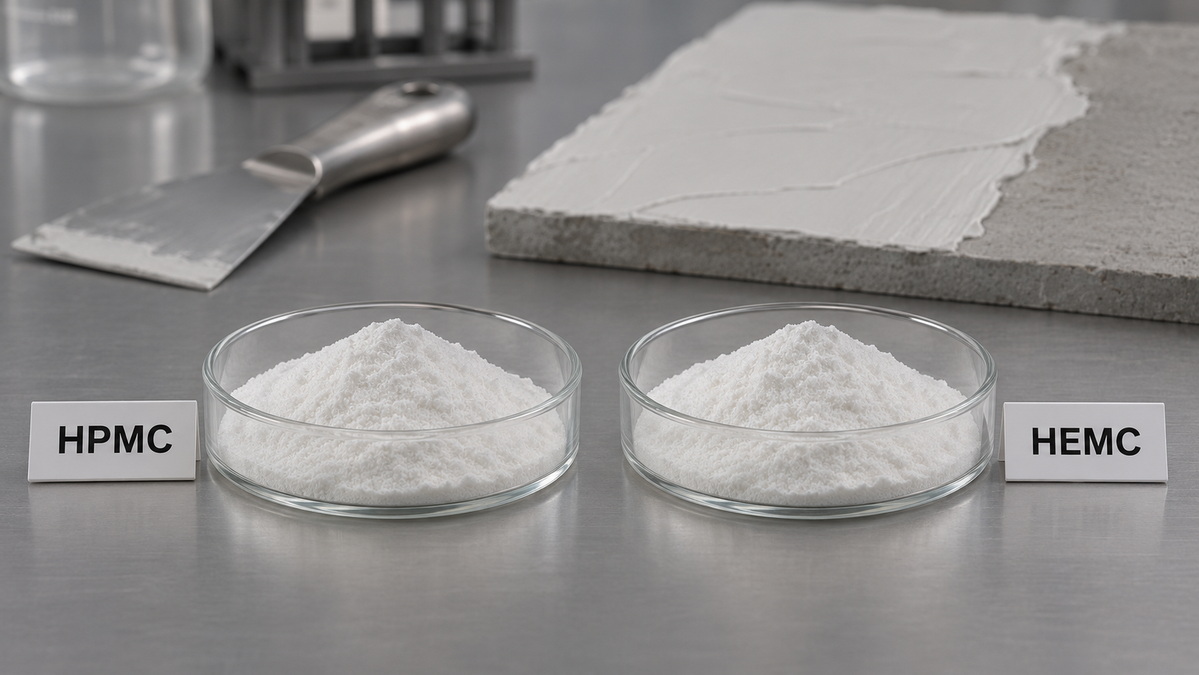
Hydroxyethyl methyl cellulose contains methoxy and hydroxyethyl substituents. It is also commonly called methyl hydroxyethyl cellulose, or MHEC.
Like HPMC, HEMC acts as a water-retaining and rheology-modifying additive in cementitious materials.
Its different substitution chemistry influences its interaction with water and cement. However, the acronym alone does not establish its water retention, application feel, or setting behavior.
HEMC should not be confused with hydroxyethyl cellulose, or HEC, which has a different substitution structure.
| Selection factor | HPMC | HEMC |
|---|---|---|
| Main substituents | Methoxy and hydroxypropyl | Methoxy and hydroxyethyl |
| Primary functions | Water retention and rheology control | Water retention and rheology control |
| Water-retention potential | Strong with an appropriate grade and dosage | Strong with an appropriate grade and dosage |
| Application consistency | Depends on molecular structure, modification, and formulation | Depends on molecular structure, modification, and formulation |
| Hot-weather suitability | Must be verified for the selected grade | Must be verified for the selected grade |
| Cement hydration | Can delay early hydration | Can delay early hydration |
| Surface finish | Depends on the complete formulation and application | Depends on the complete formulation and application |
| Purchasing decision | Compare validated performance and total use cost | Compare validated performance and total use cost |
The most important limitation is that equal stated viscosity does not mean equal wall-putty performance.
Water retention matters because a thin putty layer can lose moisture before adequate cement hydration occurs.
Porous substrates draw water from the paste. Meanwhile, temperature, humidity, and airflow influence evaporation. Together, these processes can shorten the application window and contribute to weak surface development.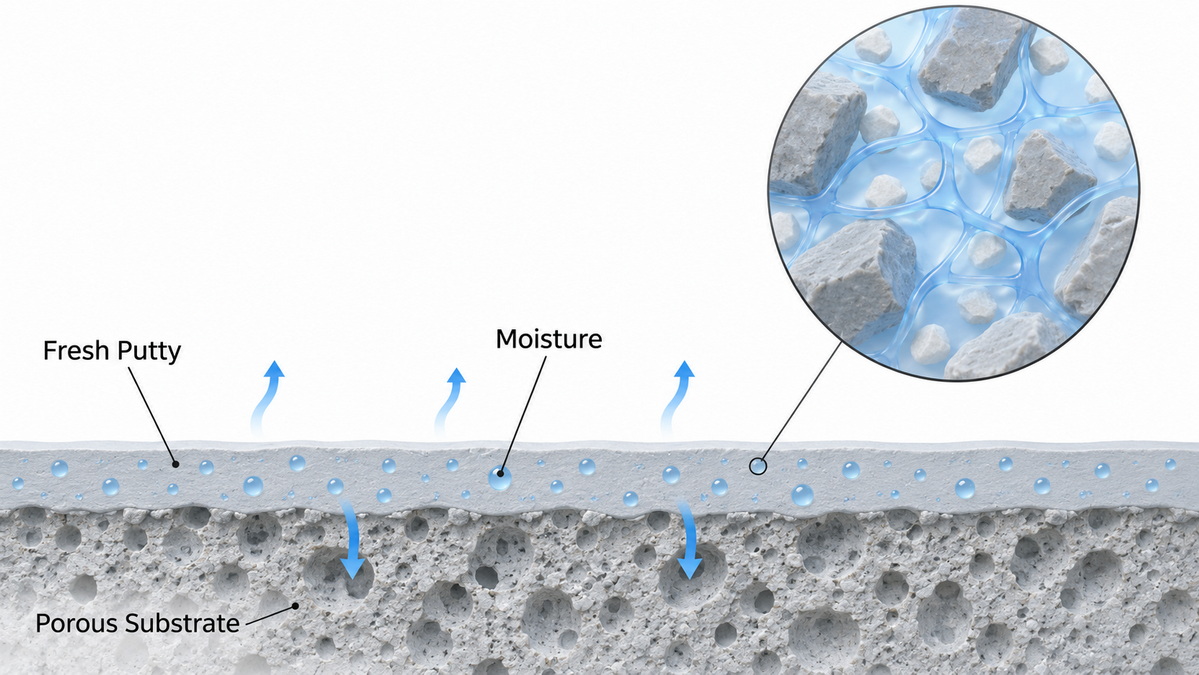
HPMC modifies the aqueous phase and increases paste cohesion. Research links its water-retaining effect to changes in water migration, filtration behavior, and the structure of the fresh cementitious mixture.
It is therefore misleading to describe HPMC simply as an additive that "locks all water inside." Water remains available within a changing cement–polymer system.
HEMC also helps limit water loss into absorbent substrates. Its effectiveness depends on molecular characteristics, concentration, and the surrounding formulation.
Neither product family guarantees a particular retention percentage. Results must identify the test method, dosage basis, water content, and environmental conditions.
For wall-putty manufacturers, the useful question is not "Which chemical retains more water?" It is "Which grade maintains sufficient moisture without making this putty unnecessarily sticky?"
Application quality involves several competing requirements.
A putty must spread under a trowel, remain stable on a vertical surface, and finish without excessive drag. Maximizing thickness alone rarely achieves that balance.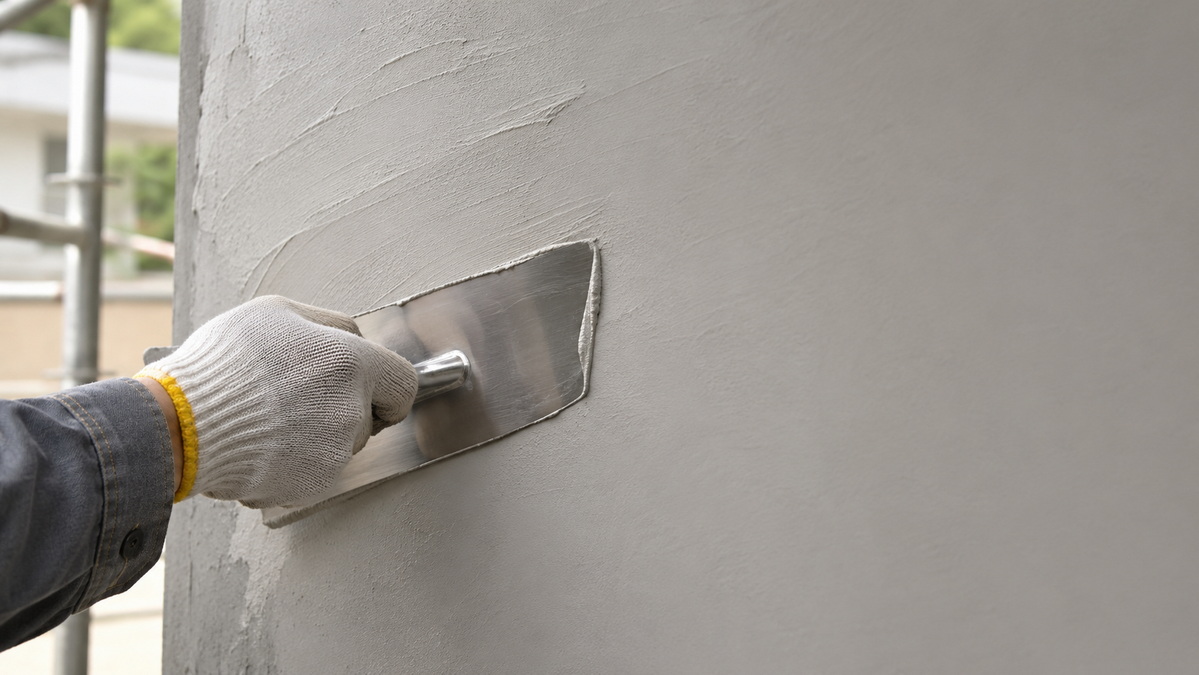
Both HPMC and HEMC influence the way putty moves under shear.
Assess:
- Initial pickup and spreading effort.
- Drag during repeated passes.
- Edge feathering.
- Blade sticking.
- Consistency after standing.
A highly cohesive paste may resist sagging but require excessive effort to spread. Conversely, an easy-spreading mixture may lack sufficient body.
Sag resistance depends on the complete rheological profile, not just solution viscosity.
Filler particle size, water addition, cellulose ether modification, and other additives all influence vertical stability. Test both candidates at the intended application thickness rather than judging them in a mixing cup.
Neither HPMC nor HEMC independently guarantees a smoother or more sandable finish.
Cement content, filler grading, water demand, air content, curing, and sanding time also matter. A cellulose ether that improves fresh application may still require adjustment elsewhere in the formulation.
Hot-weather selection requires a more careful comparison than a simple HPMC-versus-HEMC ranking.
Methyl-containing cellulose ethers have temperature-dependent behavior. Their substitution chemistry affects thermal response, but commercial grades vary substantially.
For warm-climate applications, request grade-specific data and test the complete putty under representative conditions. A thermal property measured in an aqueous solution is not a direct measure of working time on a hot wall.
Distinguish three observations:
- Bucket workability: how long mixed putty remains usable in the container.
- On-wall working window: how long an applied layer can be spread or corrected.
- Setting and hardening: development of the cementitious structure.
Both HPMC and HEMC can delay early cement hydration. That may support application time, but excessive retardation can interfere with recoating and construction schedules.
Do not assume that a longer-lasting paste is automatically a better-performing product.
Published studies provide useful guidance, but mortar findings should not be presented as guaranteed wall-putty results.
A 2020 HPMC mortar study reported 92.1% water retention at a dosage of 0.10% relative to the combined cement and sand mass.
Further additions produced smaller water-retention gains while increasing stickiness.
The lesson is not to adopt 0.10% as a universal putty dosage. The study used a particular cement, sand, polymer, and test procedure. Its practical value is demonstrating that additional polymer may eventually improve handling less than expected.
A separate 2020 HEMC study found that dosage had a greater influence on setting changes than the tested viscosity difference or binder type.
At 0.3% of dry mortar ingredients, the tested 25,000 mPa·s HEMC caused substantial setting delay. The effect was much less pronounced at 0.05%.
This supports a disciplined approach: assess dosage before assuming that another viscosity grade will solve a setting problem.
A 2025 review emphasizes molecular weight, substitution, preparation, and formulation conditions as important performance variables.
My recommendation when interpreting such research is to compare matched commercial candidates, not isolated data points from unrelated studies.
A result obtained with one HPMC cannot establish that all HPMC outperforms—or underperforms—all HEMC.
The following framework is a proposed development method, not a report of Shengda customer trials.
Set measurable requirements before testing:
- Water retention using a named method.
- Acceptable spreading effort.
- Vertical stability.
- Usable on-wall working window.
- Surface quality after curing.
- Required adhesion and sanding behavior.
Specify the substrate, layer thickness, and curing conditions.
Ask suppliers to identify:
- Solution concentration.
- Measurement temperature.
- Instrument and spindle or geometry.
- Rotational speed or shear conditions.
- Solution preparation procedure.
Without these details, two identical viscosity numbers may represent different measurements.
First, compare candidates at the same water addition. This helps reveal differences in thickening and water demand.
Next, compare them at a similar application consistency. This better reflects installer experience.
Record any water adjustment. Otherwise, apparent improvements may actually come from changing the water content.
Use the same dry-blending, mixing, resting, and remixing sequence.
A 2025 review reports that polymer addition methods can change mortar behavior. For factory-produced dry-mix putty, replicate the intended dry-blend process rather than substituting a pre-dissolved laboratory preparation.
Include a controlled baseline and conditions representing the target market.
Measure air and substrate temperature, humidity, and airflow. Use the same substrate preparation and application thickness for each candidate.
Repeat promising trials before approving a specification.
| Observed problem | What to investigate first | Practical trial response |
|---|---|---|
| Putty dries too quickly | Substrate suction, weather, water retention | Compare grades on the actual substrate |
| Excessive blade drag | Polymer dosage, rheology, water demand | Run a controlled dosage ladder |
| Slow hardening | Cement compatibility, dosage, temperature | Measure setting separately from workability |
| Pinholes or foamy paste | Mixing and air stabilization | Standardize mixing and inspect fresh density |
| Weak cured surface | Hydration, binder content, water addition, curing | Evaluate the complete formulation |
| Batch inconsistency | Raw materials, weighing, dispersion | Check production records and repeatability |
Changing HPMC to HEMC—or the reverse—without identifying the cause can replace one symptom with another.
Compare cellulose ethers by their contribution to a compliant finished product, not price per kilogram alone.
Include dosage, water demand, application productivity, finish quality, and the risk of rejected batches.
For purchasing approval, request a technical data sheet, safety data sheet, certificate of analysis, and clearly defined viscosity test conditions. Confirm how specification changes and batch deviations will be communicated.
Both product families derive from cellulose, but renewable feedstock does not establish the environmental footprint of a finished grade.
Manufacturing energy, chemical processing, transport, and dosage also matter. Sustainability claims should therefore rely on product-specific evidence rather than an assumption that either acronym represents the greener choice.
Shandong Shengda New Material Co., Ltd. focuses on HPMC, HEMC, and related cellulose ether solutions for global customers.
Contact Shengda with your cement type, filler composition, current additive dosage, application climate, and main performance concern.
Request HPMC and HEMC grade recommendations and technical documentation for a controlled comparison in your own cement-based wall-putty formulation.
No. Both can perform effectively. Selection depends on the grade, dosage, formulation, substrate, and working environment. Compare finished-putty results rather than relying on the chemical name.
It can be evaluated as a replacement, but equal dosage does not guarantee equivalent results. Recheck water demand, spreading, retention, setting, and cured performance before approval.
No. Higher viscosity can support retention, but performance may reach diminishing returns. Excessive thickening can increase drag without delivering a useful application benefit.
Choose a grade validated under representative hot-weather conditions. Neither HPMC nor HEMC should be selected solely from a general claim about temperature resistance.
No. Water retention describes fresh-state moisture control, not waterproofing after curing. Water resistance must be evaluated in the complete hardened formulation.
There is no universal dosage. Define whether percentages refer to total dry mix or binder mass, then use controlled trials to balance retention, handling, and hardening.
1. Chen, N., Wang, P., Zhao, L., and Zhang, G. (2020). ["Water Retention Mechanism of HPMC in Cement Mortar."] *Materials*, 13(13), 2918. DOI: 10.3390/ma13132918. Source for the HPMC water-retention mechanism, dosage basis, 92.1% result, and diminishing-return discussion. [pmc.ncbi.nlm.nih]
2. Spychał, E., and Czapik, P. (2020). ["The Influence of HEMC on Cement and Cement-Lime Composites Setting Processes."] *Materials*, 13(24), 5814. DOI: 10.3390/ma13245814. Source for HEMC hydration effects and the comparison of dosage and viscosity influences. [pmc.ncbi.nlm.nih]
3. He, M., Lin, Y., Huang, Y., Fang, Y., and Xiong, X. (2025). ["Research Progress of the Preparation of Cellulose Ethers and Their Applications: A Short Review."] *Molecules*, 30(7), 1610. DOI: 10.3390/molecules30071610. Source for substitution chemistry, molecular characteristics, addition-method effects, and formulation limitations. [pmc.ncbi.nlm.nih]
4. Patural, L., Marchal, P., Govin, A., Grosseau, P., Ruot, B., and Devès, O. (2011). ["Cellulose Ethers Influence on Water Retention and Consistency in Cement-Based Mortars."] *Cement and Concrete Research*, 41(1), 46–55. DOI: 10.1016/j.cemconres.2010.09.004. Source for the relationship between molecular weight, consistency, and water retention. [hal]


