


close
Choose Your Site
Global
Social Media
Views: 287 Author: Shengda Publish Time: 2026-11-13 Origin: Site


Content Menu
● What Does Early Adhesion Mean in Flexible RDP Mortar?
● How HEMC and Flexible RDP Work Together
>> HEMC Controls Water and Fresh-Mortar Behavior
>> RDP Contributes Polymeric Bonding and Flexibility
● How HEMC Modification Can Improve Early Adhesion
>> 1. It Reduces Premature Water Loss
>> 2. It Helps Maintain Effective Surface Contact
>> 3. It Supports a Usable Installation Window
● Why More HEMC Does Not Always Mean Better Adhesion
>> Hydration Retardation Can Limit Early Strength
>> Air Content Can Offset Improvements
>> Extra Water Can Hide an Unsuitable Grade
● What the One-Day Customer Feedback Actually Demonstrates
● A Practical Trial Plan for HEMC-Modified Flexible Mortar
>> Step 1: Define the Target Property
>> Step 2: Establish a Reliable Control
>> Step 3: Compare Grades Before Increasing Dosage
>> Step 4: Separate Fixed-Water and Matched-Consistency Trials
>> Step 5: Evaluate Contact and Strength Together
>> Step 6: Repeat Under Relevant Site Conditions
● Troubleshooting Early Adhesion Problems
● Selecting HEMC for Flexible RDP Mortar
● Building a Stronger Technical Performance Claim
● Conclusion: Optimize the Interface, Not Just the Viscosity
>> Does HEMC Increase One-Day Adhesion in Every Flexible RDP Mortar?
>> Is Higher-Viscosity HEMC Better for Early Adhesion?
>> Can HEMC Replace Flexible RDP?
>> Why Can Mortar Feel Sticky but Have Low Early Strength?
>> Should Water Content Remain Constant During HEMC Trials?
>> Does Good One-Day Adhesion Prove Long-Term Durability?
HEMC modification can improve early adhesion in flexible RDP mortar by controlling water retention, adjusting consistency, and helping fresh mortar maintain contact with the substrate. However, the improvement is not automatic. The wrong hydroxyethyl methyl cellulose grade—or an excessive dosage—can delay cement hydration, increase air content, or make the mortar too resistant to spreading.
For a formulator, the practical objective is balance: retain enough water for effective bonding without sacrificing wetting or early strength development.
At Shandong Shengda New Material Co., Ltd., our focus on cellulose ether research, development, production, and supply supports a formulation-centered approach. Rather than treating HEMC as a simple thickener, we consider how it works alongside flexible redispersible polymer powder, cement, water, and the application surface.
Early adhesion describes how a mortar establishes and develops its bond during the initial application and curing period. However, the term can refer to different properties.
Distinguishing them is essential when interpreting customer feedback or comparing formulations.
| Property | What it describes | How to evaluate it |
|---|---|---|
| Fresh tack | Immediate grip during application | Controlled handling and placement observations |
| Wetting and transfer | Contact between mortar and the bonded surface | Lift-off inspection and contact-area assessment |
| Early tensile adhesion | Measurable bond strength at a defined early age | A suitable tensile adhesion test |
| Open-time performance | Bonding ability after mortar remains exposed before placement | Delayed-placement adhesion testing |
A mortar can feel sticky immediately but develop strength slowly. Another may feel less tacky yet achieve better measured adhesion after curing.
For this article, "HEMC modification" means adding or optimizing HEMC within an RDP-containing mortar. It does not imply that HEMC chemically modifies the RDP itself.
Hydroxyethyl methyl cellulose is a nonionic cellulose ether used in cementitious dry-mix formulations. Its main contributions include:
- Increasing water retention.
- Adjusting viscosity and consistency.
- Supporting workable application behavior.
- Helping resist sagging.
- Influencing cement hydration and setting.
These effects shape the conditions under which adhesion develops. They do not make HEMC a substitute for the mortar's principal binders.
Redispersible polymer powder redistributes into polymer particles when the mortar is mixed with water. As curing and drying progress under suitable conditions, these particles contribute polymer bridges and films within the cementitious structure.
Depending on its chemistry and grade, RDP can improve adhesion, deformability, and other performance characteristics.
The relationship is complementary: HEMC manages the fresh mortar environment, while RDP contributes polymeric binding. Cement hydration remains central to strength development.
An absorbent substrate can draw mixing water out of fresh mortar. Evaporation creates additional losses, particularly under warm, dry, or windy conditions.
If water disappears too quickly, the interfacial mortar may stiffen before adequate contact develops. Local cement hydration can also become restricted.
HEMC improves water retention, helping the mortar preserve workable contact and supporting hydration near the interface.
However, water retention is not a direct adhesion measurement. A formulation with excellent retention still needs suitable consistency, air content, and binder development.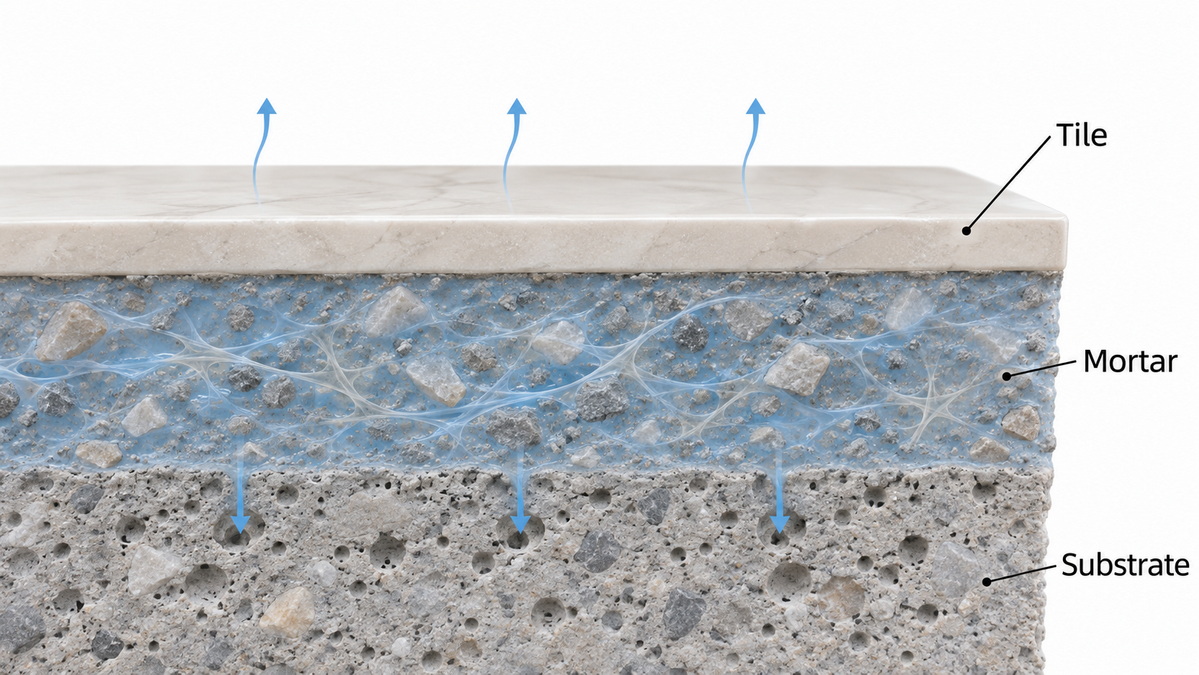
Adhesion begins with contact. Mortar must spread across the substrate and, in tile applications, transfer adequately to the tile back.
An appropriate HEMC grade helps maintain a cohesive, workable mixture during placement. This can support more consistent transfer and reduce discontinuities in the bonding layer.
Too much viscosity creates the opposite risk. Mortar ridges may resist compression, leaving gaps despite a strong impression of stickiness.
From a formulation perspective, lift-off inspection is therefore more informative than judging tack by touch alone.
HEMC can help preserve the mortar's working characteristics after spreading. This matters when installation involves delays between combing and tile placement.
Nevertheless, open time depends on the complete formulation and exposure conditions. A mortar that remains workable inside the mixing container may already have developed an unsuitable exposed surface.
Evaluate adhesion after realistic placement delays rather than assuming that good bucket consistency guarantees good open-time performance.
Research on HPMC and HEMC shows that cellulose ethers can retard cement hydration. Their molecular characteristics matter, and viscosity alone does not describe this interaction.
In one investigation, methoxyl content was an important parameter governing hydration delay within the materials studied. This should not be converted into a universal purchasing rule, but it demonstrates why similarly labeled viscosity grades can behave differently.
A mortar may retain water well while developing early tensile strength more slowly than required.
Cellulose ether additions can influence mortar air content. Excessive air may reduce the effective load-bearing area and weaken the hardened structure.
A formulation that becomes lighter, creamier, and easier to spread is not necessarily developing a stronger bond.
Measure fresh density or air content alongside adhesion whenever practical.
When a mortar becomes too stiff, operators may add water to restore workability. That adjustment changes more than application feel.
It can affect porosity, drying behavior, and strength development. An apparent HEMC comparison may therefore become a comparison between different water-to-binder conditions.
Always document water addition precisely.
The supplied customer image reports favorable adhesion after one day for a flexible RDP system modified with HEMC.
This is useful application feedback. It suggests that the combination deserves further evaluation. However, the image does not provide:
- The complete mortar composition.
- HEMC or RDP dosage.
- The substrate and bonded material.
- Mixing-water content.
- Curing temperature and humidity.
- A measured adhesion value or comparison result.
Consequently, it supports a qualitative observation—not a quantified improvement or a certified performance claim.
The strongest next step is a controlled comparison between the existing formulation and the HEMC-modified version.
Importantly, stronger one-day adhesion would not, by itself, demonstrate better adhesion after water immersion, heat exposure, or longer curing.
The following workflow is a proposed development approach, not a report of completed company testing.
Replace "better adhesion" with a specific objective.
Examples include:
- Better fresh transfer onto porcelain.
- Higher tensile adhesion after 24 hours.
- Improved adhesion after a placement delay.
- Less sagging without reduced contact coverage.
Select one primary target and track the others as constraints.
Use a documented reference formula. Record cement source, aggregate grading, RDP grade, HEMC grade, water addition, mixing sequence, and curing conditions.
Prepare independent replicate batches so that a single favorable result does not determine the conclusion.
Start by comparing suitable construction-grade HEMC products at a controlled dosage.
Record viscosity test conditions, not just the viscosity number. Concentration, temperature, and measurement method affect comparability.
Ask the supplier about intended applications and available mortar-performance information.
These experiments answer different questions.
| Trial approach | Main purpose | Important limitation |
|---|---|---|
| Fixed water content | Isolate the effect of changing HEMC | Application consistency may differ |
| Matched consistency | Compare formulations at similar workability | Water differences influence strength |
Use both approaches where resources permit. Keep the datasets separate and explain their different purposes.
Inspect mortar transfer immediately after placement. Then measure adhesion at defined ages, such as 24 hours and selected later intervals.
Record failure location as well as strength. Failure within the mortar, at the substrate interface, or within the substrate can indicate different limiting factors.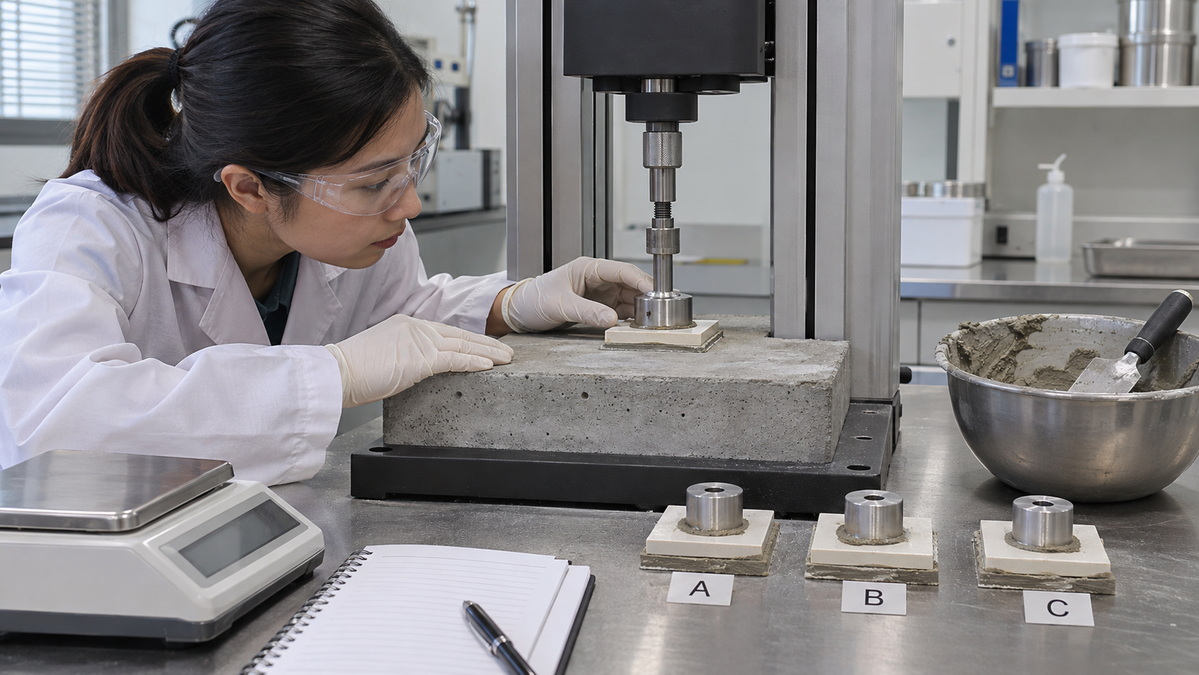
Once the reference-condition result is satisfactory, repeat selected trials under conditions relevant to the target market.
These may include absorbent substrates, delayed placement, cooler curing, or increased evaporation. Keep the protocol consistent enough to identify why performance changes.
| Observation | Possible explanation | Recommended check |
|---|---|---|
| Strong fresh tack but weak one-day bond | Slow hydration or excessive air | Compare setting behavior, density, and adhesion |
| Mortar ridges remain visible after placement | Excessive resistance to deformation | Inspect coverage and review consistency |
| Good immediate bond but poor delayed-placement results | Surface drying or insufficient usable open time | Repeat delayed-placement testing |
| Modified mortar requires substantially more water | Unsuitable grade or excessive dosage | Compare grades and document water demand |
| Results vary sharply between batches | Raw-material, mixing, or curing variation | Audit the complete preparation procedure |
These are diagnostic possibilities, not automatic explanations. Change one major variable at a time before drawing conclusions.
Selecting HEMC for early adhesion requires more than choosing the highest available viscosity.
A useful technical discussion with a supplier should cover:
1. Application type: tile adhesive, repair mortar, or another system.
2. Cement and binder composition.
3. RDP chemistry and intended flexibility.
4. Target water demand and application consistency.
5. Required open time and early adhesion.
6. Substrate absorption and expected climate.
For flexible mortars, the polymer's film-forming behavior also matters. A formulation that performs well under one temperature regime may behave differently under another.
Avoid assuming that a flexible RDP designation guarantees identical bonding performance across products.
Likewise, changing cement can alter early strength sufficiently to require renewed HEMC optimization.
A commercially useful claim should explain what improved, compared with what, and under which conditions.
Instead of writing "HEMC dramatically increases adhesion," use a documented statement identifying:
- The reference formulation.
- The specific HEMC grade and dosage.
- The test method and curing age.
- Water content and environmental conditions.
- Replicate results and observed failure modes.
Until those data are available, "favorable one-day adhesion observed in customer feedback" is more defensible than a numerical performance promise.
This approach also supports responsible material use. Better formulation control may reduce unnecessary additive changes and repeated trials, although any environmental benefit requires its own evidence.
HEMC modification can improve early adhesion in flexible RDP mortar when it preserves water, supports surface contact, and maintains workable consistency without excessive retardation or air entrainment.
The best formulation is not necessarily the thickest or stickiest. It is the one that develops the required bond under the intended installation and curing conditions.
Contact Shandong Shengda New Material Co., Ltd. with your mortar application, cement type, RDP grade, current HEMC dosage, and early-adhesion target. Request a discussion of suitable construction-grade HEMC options and a comparison plan built around your actual formulation.
No. Improvement depends on the starting formulation, HEMC grade, dosage, water content, and curing conditions. Controlled testing must confirm the result.
Not necessarily. Higher viscosity may help water retention but can reduce spreading or ridge compression. Compare wetting, transfer, and measured strength.
No. Their main functions differ. HEMC primarily manages water and rheology, while RDP contributes polymeric binding and flexibility.
Fresh tack and hardened adhesion are different properties. Slow hydration, excessive air, incomplete contact, or unsuitable curing can limit strength despite strong tack.
Use fixed-water trials to isolate material effects. Conduct separate matched-consistency trials when comparing practical application behavior, and clearly document water changes.
No. Later-age adhesion and performance after relevant environmental exposure require separate evaluation. One-day feedback cannot establish the complete durability profile.
1. Pourchez, J., et al. "HPMC and HEMC Influence on Cement Hydration." *Cement and Concrete Research* (2006). Research examining molecular characteristics, water retention, and hydration retardation. Full-text manuscript available through HAL-EMSE. [hal-emse.ccsd.cnrs]
2. Patural, L., et al. "Cellulose Ethers Influence on Water Retention and Consistency in Cement-Based Mortars." *Cement and Concrete Research* (2011). Research supporting the discussion of cellulose ether characteristics, mortar consistency, and water retention. [sciencedirect]
3. "Effect of Cellulose Ether and Starch Ether on Hydration of Cement Processes and Fresh-State Properties of Cement Mortars." *Materials* (2022). Open-access research supporting the discussion of water retention, air content, consistency, and hydration effects. Its experimental findings should not be treated as performance data for Shengda products. [pmc.ncbi.nlm.nih]
4. WACKER. "Dispersible Polymer Powders." Manufacturer technical overview explaining powder redispersion and polymer contributions to mortar adhesion and flexibility. [wacker]
5. WACKER. "VINNAPAS® 5410 N." Product technical information illustrating how a specific semi-flexible VAE powder contributes to dry-mix mortar performance. Referenced as an industry example, not as evidence about every flexible RDP or the customer's product. [wacker]
6. WACKER. "Formulating Tile Adhesives with Carbon-Reduced Cements." Technical publication discussing cement-dependent early strength and formulation adjustments. Supports the recommendation to reassess performance when binder composition changes. [wacker]
7. Customer-supplied image. Chinese-language statement reporting favorable adhesion after one day in an HEMC-modified flexible RDP system. Unpublished qualitative feedback; formulation details, measured strength, and test conditions were not supplied. [ppl-ai-file-upload.s3.amazonaws]
8. Editorial basis. Mechanism explanations synthesize the technical literature above. The trial workflow and troubleshooting framework are proposed development guidance, not published company test results or verified customer outcomes. [hal-emse.ccsd.cnrs]


