


close
Choose Your Site
Global
Social Media
Views: 287 Author: Shengda Publish Time: 2026-11-12 Origin: Site


Content Menu
● How Does Hydroxyethyl Cellulose Thicken Water?
>> Dispersion, Hydration, and Dissolution Are Different Stages
● Why Do Some Users Think HEC Requires Heating?
>> Standard HEC Versus Delayed-Hydration HEC
● How Temperature Affects HEC Hydration and Viscosity
>> Heating Can Accelerate Preparation Without Increasing Final Viscosity
>> HEC Does Not Behave Like a Typical Heat-Gelling Cellulose Ether
● How to Dissolve HEC in Water Without Heating
>> Step 1: Confirm the Product and Test Conditions
>> Step 2: Establish Effective Water Circulation
>> Step 3: Add HEC at a Controlled Rate
>> Step 4: Follow Any Delayed-Hydration Instructions
>> Step 5: Continue Mixing and Check the Endpoint
>> Step 6: Complete and Recheck the Formulation
● Why Is My HEC Not Thickening? A Troubleshooting Guide
● A Practical Bench Trial: Does Heating Help Your HEC Process?
>> Compare Ambient and Warm Preparation Fairly
● HEC Viscosity Testing: Avoid Comparing Unlike Numbers
● Construction and Daily-Chemical Applications Need Different Instructions
>> HEC for Water-Based Construction Products
>> HEC for Daily-Chemical Formulations
● What HEC Usage Instructions Should a Supplier Provide?
>> 1. Can HEC thicken cold water?
>> 2. How long does HEC take to hydrate?
>> 3. Does HEC need neutralization like carbomer?
>> 4. Will boiling water make HEC thicker?
>> 5. Why does HEC form fish-eye lumps?
>> 6. Should I add more HEC if the batch looks thin?
Does HEC need heating to thicken? No. Hydroxyethyl cellulose (HEC) can dissolve and develop viscosity in cold or room-temperature water. Heating may accelerate hydration in a suitable process, but it is not a universal requirement for thickening.
The confusion usually begins when powder disperses in water without immediately producing a thick solution. Without clear instructions, users may assume the product is defective—or that heat is the missing ingredient. In reality, grade selection, surface treatment, pH, powder addition, and mixing conditions all influence viscosity development.
At Shandong Shengda New Material Co., Ltd., our focus is cellulose ether solutions for construction and daily-chemical applications. Our practical recommendation is straightforward: identify the HEC grade and its hydration requirements before changing the batch temperature.
HEC is a nonionic, water-soluble cellulose ether. Once dissolved, its polymer chains interact with water and increase resistance to flow. The resulting viscosity depends on polymer molecular weight, concentration, temperature, and measurement conditions.
However, adding powder and developing full viscosity are not the same event.
Understanding these stages makes HEC preparation easier:
1. Dispersion: Individual powder particles separate throughout the water.
2. Hydration: Water interacts with the polymer, and particles begin swelling.
3. Dissolution: Polymer chains enter the aqueous phase, developing the intended solution viscosity.
These stages overlap, but they should not be confused. A uniformly dispersed mixture may still need time to hydrate and dissolve.
Conversely, a thick-looking batch may contain partially hydrated lumps. Appearance alone does not prove that preparation is complete.
One reason is delayed hydration. Certain surface-treated HEC grades are designed to resist immediate hydration, allowing particles to disperse before substantial thickening begins.
This processing advantage can look like poor performance when instructions are missing.
Another reason is temperature-dependent dissolution. A warmer process may develop viscosity sooner, leading operators to conclude that heating "activates" every HEC product.
The more accurate explanation is that heat can change hydration kinetics. It does not establish a general requirement that HEC must be heated to thicken.
| HEC type | Typical behavior during addition | Main processing priority |
|---|---|---|
| Non-delayed-hydration grade | Hydrates relatively promptly on contact with water | Separate particles before surface swelling creates lumps |
| Surface-treated, delayed-hydration grade | Disperses before substantial viscosity develops | Follow the grade-specific pH and temperature procedure |
| Either type after complete dissolution | Produces viscosity according to grade and concentration | Measure under controlled, comparable conditions |
Grade codes are not interchangeable between manufacturers. A letter used to identify delayed hydration in one product range should not be assumed to mean the same thing elsewhere.
Temperature influences two different questions:
- How quickly does the powder hydrate and dissolve?
- How viscous is the dissolved solution when measured?
Keeping these questions separate prevents unnecessary heating and incorrect dosage adjustments.
Under appropriate conditions, warming can accelerate hydration or dissolution. However, raising temperature before particles are properly separated may encourage rapid surface hydration and lump formation.
For an already dissolved HEC solution, increasing temperature generally reduces viscosity. Cooling normally increases it again, provided the polymer has not degraded and the composition remains unchanged.
Therefore, a warm batch can look thinner even though hydration has progressed.
Do not add extra HEC simply because a hot sample appears less viscous than a room-temperature reference.
HEC should not be treated as interchangeable with methylcellulose or hydroxypropyl methylcellulose.
Conventional water-soluble HEC does not show the same characteristic heat-induced clouding or thermal gelation behavior associated with those materials.
Published research examined three HEC samples with different molar substitution levels between 10°C and 70°C. All remained water-soluble across the investigated range without showing a cloud point.
That finding supports HEC's broad aqueous solubility. It does not mean every formulation can tolerate unlimited heating or that prolonged high-temperature processing is harmless.
The following workflow is a starting framework for laboratory development, not a substitute for the selected grade's technical instructions.
Before weighing powder, establish:
- Exact HEC grade and surface-treatment status.
- Recommended concentration and hydration procedure.
- Starting water quality, pH, and temperature.
- Target viscosity and specified measurement method.
- Compatibility requirements for the finished formulation.
Do not compare two viscosity figures unless solution concentration, temperature, instrument, spindle or geometry, and measurement speed are comparable.
Charge the vessel with the required water and start mixing.
The objective is enough circulation to separate incoming particles and move material throughout the vessel. Avoid unnecessarily deep vortices that draw excessive air into the batch.
There is no universal mixer speed. Vessel geometry, impeller design, batch size, and viscosity all influence the appropriate setting.
Introduce powder steadily into moving water. Avoid dumping the entire quantity onto the surface.
Powder addition should allow particles to separate without creating concentrated wet masses. However, excessively slow addition can also become difficult if a rapidly hydrating grade thickens the water before charging is complete.
For compatible formulations, prewetting HEC with glycerin or propylene glycol can help separate particles before water contact. Treat this as a dispersion technique, not evidence that HEC has dissolved in the prewetting liquid.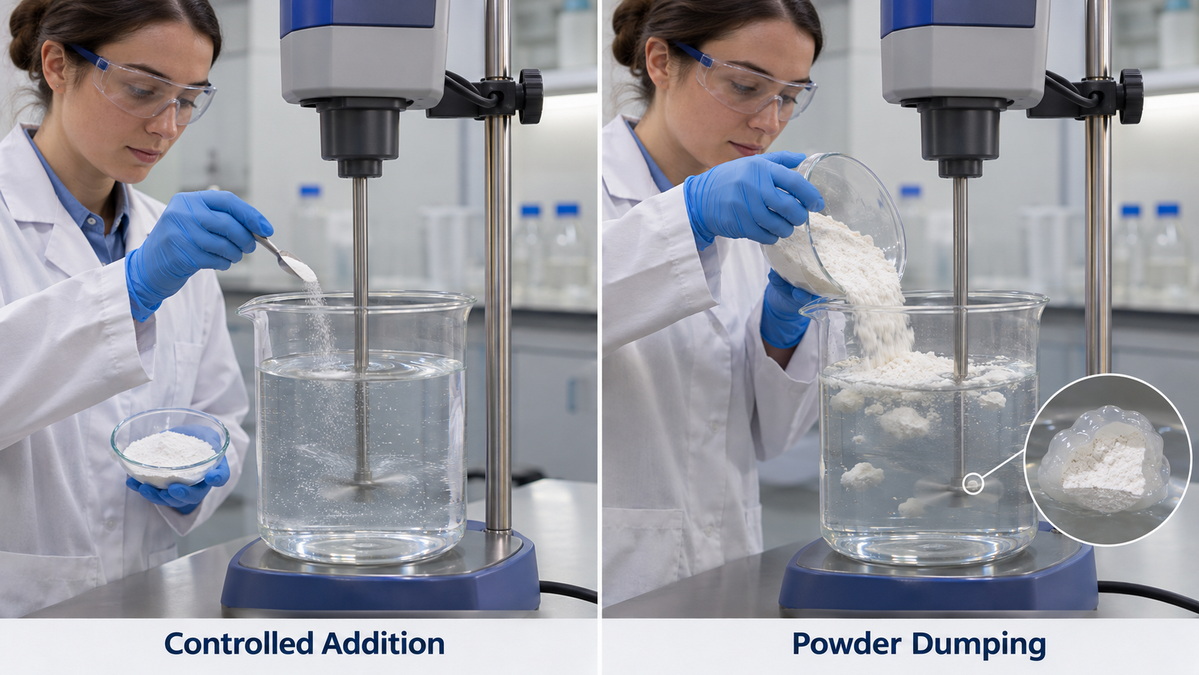
For a surface-treated grade, allow the powder to disperse before applying any specified hydration-triggering adjustment.
Some commercial delayed-hydration grades respond to increased pH. The required conditions depend on the product.
Do not add alkali blindly, and do not assume that an alkaline final formula eliminates the need for controlled powder dispersion. Premature hydration can defeat the purpose of the surface treatment.
Continue mixing until the solution is uniform and no undissolved particles remain.
Use more than one observation:
- Examine a thin sample for swollen particles or gel-coated lumps.
- Measure viscosity at defined intervals.
- Confirm that readings approach a stable plateau under the same conditions.
- Check the sample again after the agreed conditioning period.
A fixed mixing time is useful only after it has been validated for the grade, equipment, and formulation.
Where the process permits, hydrate HEC in a suitable water phase before introducing ingredients that complicate dissolution.
Add the remaining materials according to the validated formulation sequence. Then recheck pH, appearance, viscosity, and stability.
For stored aqueous products, include an appropriate preservation strategy. HEC solutions can lose viscosity through enzyme-related polymer degradation if microbial control is inadequate.
Heating should be a considered process choice, not the first response to every thin batch.
| Observation | Possible explanation | First investigation |
|---|---|---|
| Powder disperses but viscosity develops slowly | Delayed-hydration grade or unsuitable hydration conditions | Verify surface treatment, pH, temperature, and instructions |
| Translucent lumps contain dry centers | Surface hydration trapped unwetted powder | Review addition rate and particle separation |
| Smooth solution remains too thin | Wrong grade, insufficient concentration, or incomplete hydration | Check identity, weighing, preparation, and test conditions |
| Warm sample is thinner than the reference | Temperature-dependent viscosity | Compare samples at the same temperature |
| Viscosity differs between instruments or speeds | Shear-dependent flow behavior | Standardize the measurement method |
| Viscosity decreases during storage | Microbial activity, chemical degradation, or formulation instability | Investigate preservation, pH, compatibility, and storage |
A useful diagnostic distinction is whether the batch never developed viscosity or developed viscosity and subsequently lost it. Those situations require different investigations.
Instead of adopting heating based on a single observation, compare controlled laboratory batches.
This is a proposed evaluation method, not a reported Shengda production trial.
Prepare two batches using the same HEC lot, concentration, water source, vessel, and addition method.
- Batch A: Use the supplier-recommended ambient-temperature procedure.
- Batch B: Use a warmer procedure only within the supplier-approved conditions.
- Record temperature, pH, mixing settings, powder-addition time, and viscosity development.
- Account for evaporation before comparing final concentrations.
- Condition both samples to the same measurement temperature.
Evaluate hydration time, residual particles, foam, final viscosity, and subsequent stability.
If warming shortens preparation without compromising quality, it may offer a processing advantage. If both methods perform similarly, heating may add complexity without a meaningful benefit.
The decision should depend on total batch performance, including heating and cooling requirements—not hydration speed alone.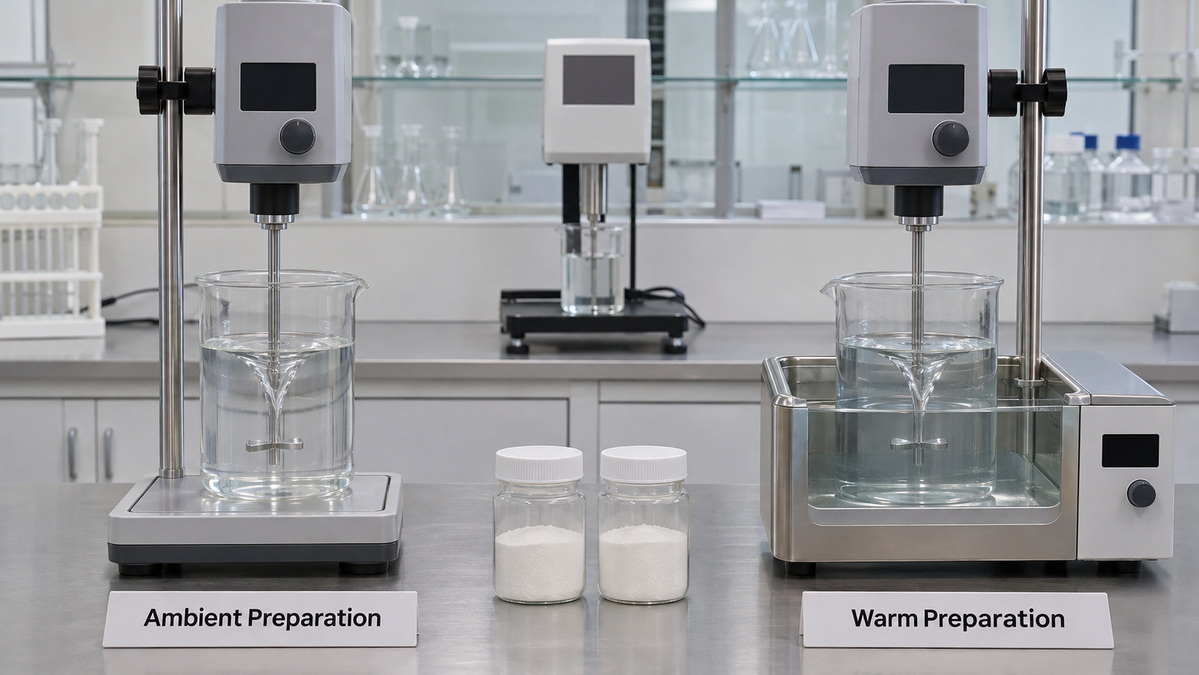
HEC solutions commonly exhibit shear-thinning behavior: apparent viscosity decreases as the applied shear rate increases.
Consequently, a viscosity number without test conditions is incomplete.
A useful quality-control record includes:
| Test variable | Information to record |
|---|---|
| Polymer concentration | Percentage and concentration basis |
| Sample preparation | Addition sequence and hydration procedure |
| Temperature | Actual temperature during measurement |
| Instrument | Model and spindle or measuring geometry |
| Test setting | Rotational speed or shear rate |
| Conditioning | Rest period and prior mixing history |
| Timing | Reading time after preparation |
A supplier's viscosity specification is a test result under defined conditions. It is not a guaranteed viscosity for every paint, cleaner, or construction formulation.
Likewise, higher solution viscosity does not automatically mean better application performance.
For liquid coatings and related aqueous building products, powder dispersion, hydration sequence, and compatibility with other ingredients influence processing consistency.
In dry-blended products, distributing HEC among suitable dry ingredients can help separate particles before water addition. However, performance must be checked in the actual mineral and additive system.
A neat-water test is valuable for quality control, but it cannot fully predict behavior in a complex construction formulation.
For cleaners and personal-care-type systems, assess the complete formula rather than water-only viscosity.
Surfactants, electrolytes, solvents, fragrances, preservatives, and final pH can influence appearance, rheology, or stability.
HEC's nonionic character supports broad compatibility, but it does not guarantee compatibility at every ingredient concentration.
Evaluate handling, pouring, appearance, and storage performance alongside viscosity.
A bag label stating only "HEC thickener" leaves too much room for error.
Buyers should request a technical data sheet, safety data sheet, batch documentation, and application-specific preparation guidance covering:
- Grade identification and intended application.
- Surface-treatment and hydration characteristics.
- Recommended powder-addition sequence.
- Water-temperature and pH requirements.
- Typical hydration endpoint and evaluation method.
- Viscosity specification with complete test conditions.
- Storage, handling, and formulation limitations.
For Shandong Shengda New Material Co., Ltd., the central recommendation is to match the product with the customer's process—not simply select the highest viscosity grade.
Share your application, formulation pH, target viscosity, water temperature, and mixing equipment with our team. Request an appropriate HEC sample together with written hydration guidance and a clearly defined viscosity-testing method before scaling up.
Yes. Suitable HEC grades can dissolve and thicken cold water. Hydration speed depends on the grade, temperature, dispersion quality, and, for certain surface-treated products, pH.
There is no universal time. Grade, concentration, surface treatment, mixing, temperature, and formulation composition all matter. Confirm completion through particle inspection and standardized viscosity measurements.
No. HEC does not generally require carbomer-style neutralization to thicken. However, some delayed-hydration grades use a pH adjustment to control hydration after dispersion.
Not necessarily. Heating an already dissolved solution generally reduces its measured viscosity temporarily. Boiling is not a universal preparation instruction and should not replace grade-specific guidance.
The outside of a powder cluster hydrates before water reaches its center. The resulting gel-like surface encloses dry material. Better particle separation and controlled addition help prevent this.
First confirm complete hydration, correct concentration, and comparable measurement temperature. Adding more polymer prematurely can produce an over-thickened batch once dissolution is complete.
1. Ashland. [Natrosol™ 250 Hydroxyethylcellulose: Formulating Elegant Liquid and Semisolid Drug Products]. Technical brochure, particularly pages 7–9, 11–15, and 17–20. Supports hot- and cold-water solubility, preparation methods, temperature and shear effects, preservation, and compatibility limitations. Pharmaceutical-grade examples are used for general polymer principles, not to establish construction- or daily-chemical-grade specifications. [ashland]
2. Ashland. [Natrosol™ 250 MHR Hydroxyethylcellulose]. Manufacturer product information describing surface-treated, delayed-hydration R grades for construction applications. [ashland]
3. Ashland. [Performance Specialties Reference Guide].pdf). Supports HEC grade differentiation, hot- and cold-water dissolution, shear-thinning behavior, and dispersion-related surface treatments. [ashland].pdf)
4. Arai, K., and Shikata, T. (2020). [Hydration/Dehydration Behavior of Hydroxyethyl Cellulose Ether in Aqueous Solution]. *Molecules*, 25(20), 4726. DOI: 10.3390/molecules25204726. Examines HEC samples with molar substitution levels of 1.3, 2.0, and 3.6 across 10–70°C. [pmc.ncbi.nlm.nih]


