


close
Choose Your Site
Global
Social Media
Views: 265 Author: Shengda Publish Time: 2026-09-14 Origin: Site


Content Menu
● Why Solution Retention Matters in Wet Wipes
>> What Is Hydroxyethyl Cellulose?
>> What Is Hydroxyethyl Methyl Cellulose?
● HEC vs HEMC in Wet-Wipe Formulations
>> HEC for Smooth and Consumer-Friendly Wipe Lotions
>> HEMC for Enhanced Structure and Liquid Control
● How HEC and HEMC Influence Non-Woven Fabric Performance
● A Practical Testing Method for HEC vs HEMC
>> Recommended Wet-Wipe Evaluation Process
● HEC vs HEMC: Selection by Wet-Wipe Application
● Common Wet-Wipe Problems and Formulation Responses
● Best Practices for Stable Wet-Wipe Solutions
>> What is the main difference between HEC and HEMC in wet wipes?
>> Can HEC improve solution retention in spunlace non-woven fabrics?
>> Is HEMC suitable for baby wipes?
>> Does higher viscosity always improve wet-wipe quality?
>> How can manufacturers compare HEC and HEMC effectively?
>> Can cellulose ethers affect wet-wipe preservation?
>> What information is needed to select the right HEC or HEMC grade?
Explore the differences between Hydroxyethyl Cellulose (HEC) and Hydroxyethyl Methyl Cellulose (HEMC) in wet-wipe formulations. Learn how these cellulose ethers influence solution viscosity, liquid retention, non-woven impregnation, controlled release, storage stability, and user feel—helping manufacturers develop reliable, high-performance wet wipes for personal care, household, and specialty applications.
Wet wipes are often judged by a simple consumer experience: whether they feel sufficiently moist, clean effectively, remain comfortable on the skin, and stay consistent from the first sheet to the last. Behind that experience is a highly technical balance between the non-woven substrate and the impregnating solution.
For manufacturers, solution retention in non-woven fabrics is one of the most important performance factors in wet-wipe development. A well-designed lotion must enter the substrate efficiently, remain evenly distributed during storage, resist drainage and leakage, and release an appropriate amount of liquid during use. If the solution is too thin, it may migrate, pool, leak, or make the first wipes overly wet while leaving later wipes less saturated. If it is too thick, it may be difficult to impregnate, feel heavy on the skin, or release insufficient liquid during wiping.
Two important cellulose ether options for controlling this balance are Hydroxyethyl Cellulose (HEC) and Hydroxyethyl Methyl Cellulose (HEMC). Both are non-ionic, water-soluble cellulose derivatives. Both can modify solution rheology, improve water management, and support the stability of aqueous wet-wipe formulations. However, their molecular structures and formulation behavior are different enough that the choice between HEC and HEMC should be made carefully.
Shandong Shengda New Material Co., Ltd. specializes in the research, development, production, and supply of cellulose ethers, including HEC and HEMC. For wet-wipe producers, selecting the appropriate cellulose ether is not simply a matter of choosing a thickener. It is a formulation decision that can influence liquid retention, skin feel, processing efficiency, storage stability, substrate compatibility, and finished-product quality.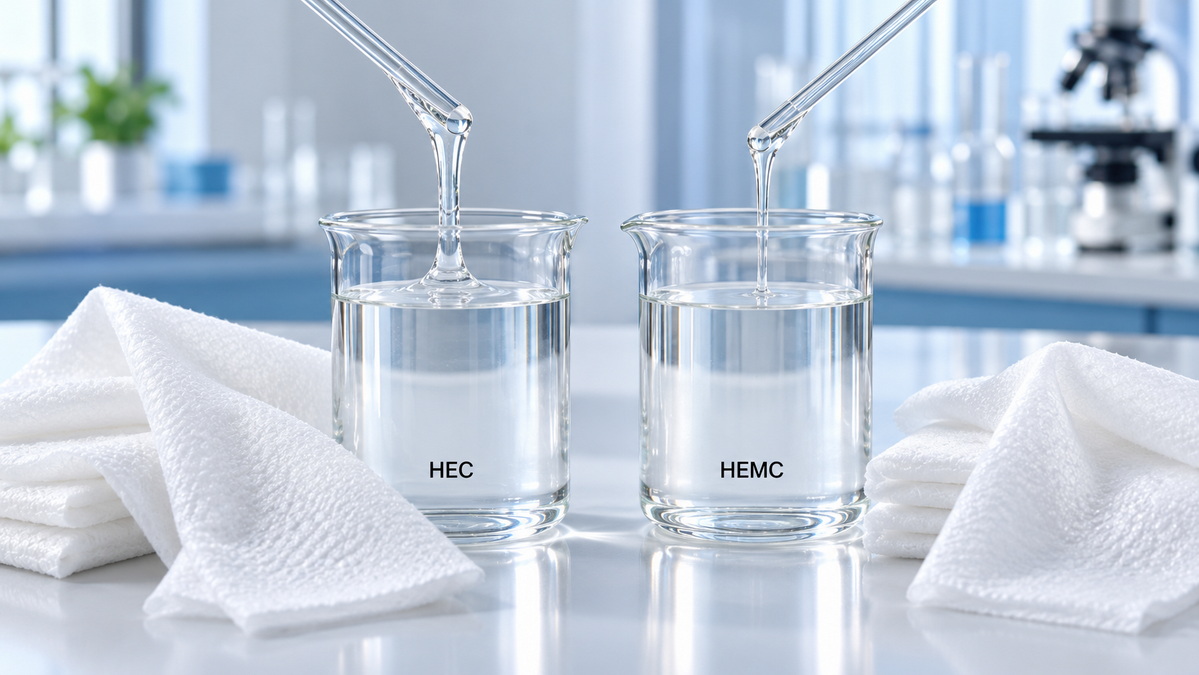
A wet wipe is built from two connected elements:
- A non-woven fabric substrate
- A liquid solution or lotion
The non-woven fabric provides softness, strength, texture, absorbency, and handling performance. The liquid solution provides the intended function, such as cleansing, moisturizing, deodorizing, refreshing, makeup removal, antibacterial support, surface cleaning, or skin conditioning.
The interaction between the substrate and the solution determines whether the product performs consistently throughout its life cycle.
Solution retention refers to the ability of the non-woven material to absorb, hold, and release the impregnating liquid in a controlled way. It is not only about how much liquid the wipe contains. It is also about where the liquid stays, how it moves through the wipe stack, and how it transfers during use.
A wet wipe with poor solution retention may create several common problems:
- Excess liquid accumulates at the bottom of the package
- The first wipes feel overly wet while later wipes feel dry
- Liquid leaks from flow-wrap packs during transportation
- The solution migrates unevenly during warehouse storage
- Active ingredients are not distributed consistently
- The wipe feels slippery, sticky, or excessively watery
- The product requires unnecessarily high liquid add-on levels
For personal-care wipes, the result may be an unpleasant consumer experience. For household and industrial wipes, poor retention may reduce cleaning efficiency or cause liquid to run off the intended surface too quickly.
A successful wet-wipe formulation should achieve a controlled balance between retention and release. The wipe must hold enough liquid to remain moist and stable in the pack, but it must also release enough liquid when pressed against skin or a surface.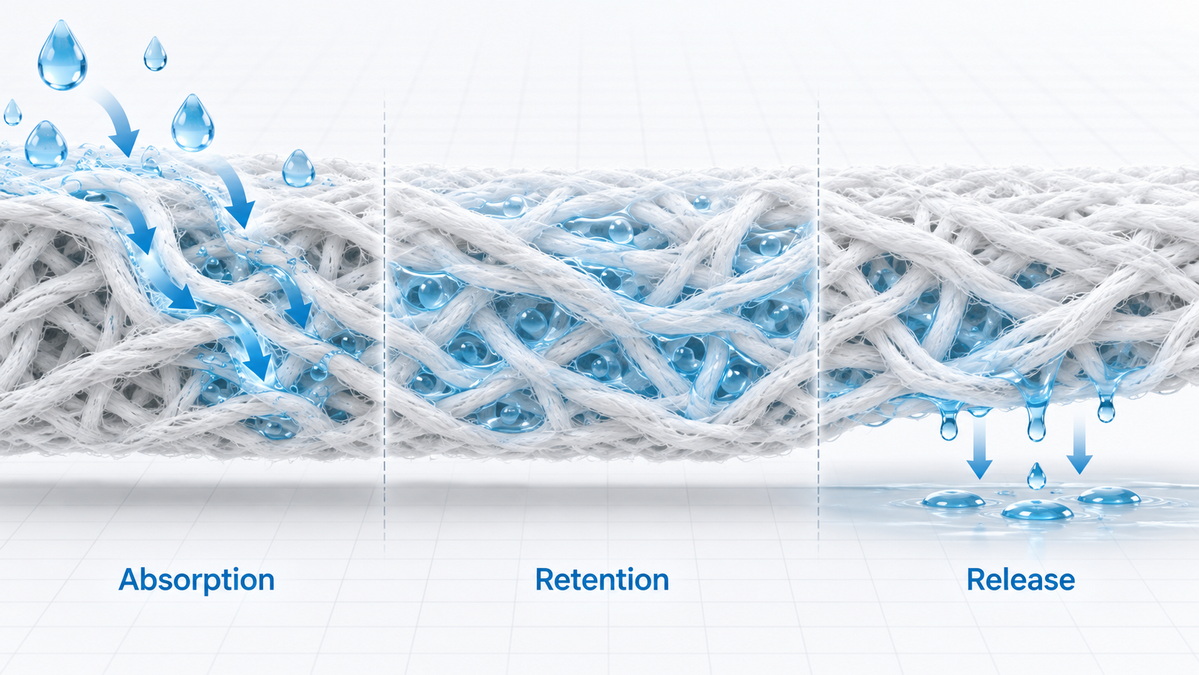
Hydroxyethyl Cellulose, commonly known as HEC, is a non-ionic cellulose ether produced by introducing hydroxyethyl groups onto the cellulose backbone. It is widely used in water-based systems as a thickener, rheology modifier, stabilizer, and water-management agent.
In wet-wipe formulations, HEC is often valued for its ability to create smooth and uniform aqueous solutions. It can help increase viscosity without producing an excessively heavy or rigid gel structure.
HEC can be particularly useful in formulations that require:
- A clear or visually clean lotion appearance
- Smooth viscosity development
- Comfortable skin feel
- Good spreadability on skin
- Controlled liquid movement in the non-woven substrate
- Compatibility with humectants and mild cosmetic ingredients
- Easy application in baby wipes, facial wipes, and body wipes
The right HEC grade can help formulators produce a lotion that feels more substantial than water while remaining light, elegant, and easy to release from the wipe.
Hydroxyethyl Methyl Cellulose, commonly known as HEMC, is another non-ionic cellulose ether. It contains hydroxyethyl groups and methyl groups on the cellulose backbone. This mixed substitution can create a different hydration and rheological profile compared with HEC.
HEMC is widely known for its water-retention and rheology-control performance in construction materials. However, the same core principle is relevant in liquid formulations: controlling how water moves, how a solution maintains its structure, and how fluid behavior changes under different conditions.
In wet-wipe development, HEMC may be considered when a formulation requires:
- More structured solution behavior
- Improved control of liquid migration
- Better retention within open or porous non-woven fabrics
- Greater resistance to uncontrolled drainage
- Stable performance under storage stress
- Customized rheological characteristics for specialty wipes
- Enhanced support for high-retention formulations
The suitability of HEMC depends on the exact grade, dosage level, substrate type, liquid formulation, processing conditions, and final product requirements. It should always be assessed in a complete wet-wipe system rather than as an isolated ingredient.
The practical difference between HEC and HEMC is not simply whether one thickens more than the other. Both materials can modify viscosity, but they may create different flow profiles, water-retention behavior, solution textures, and interactions with the non-woven substrate.
The preferred choice depends on the desired balance between solution retention, liquid release, sensory properties, formula stability, and production efficiency.
| Performance Factor | HEC in Wet Wipes | HEMC in Wet Wipes | Formulation Consideration |
|---|---|---|---|
| Water-based formulation use | Commonly used in aqueous systems | Suitable for selected aqueous systems | Proper dispersion and hydration are essential |
| Rheology profile | Often smooth and elegant | Can provide a more structured profile | Match the polymer to target flow behavior |
| Solution appearance | Often appropriate for clear lotions | Appearance depends on grade and full formulation | Confirm final clarity and visual quality |
| Liquid retention | Helps reduce uncontrolled liquid movement | May provide stronger water-movement control in selected systems | Test with the actual non-woven substrate |
| Skin feel | Often light, smooth, and comfortable | Can feel more structured at higher dosage | Important for personal-care wipes |
| Storage stability | Can support stable lotion viscosity | Can support structured retention-focused systems | Evaluate under heat and transport conditions |
| Processing behavior | Suitable for controlled mixing and impregnation | Requires optimized hydration and processing conditions | Review pumpability and production-line performance |
| Typical application focus | Baby wipes, facial wipes, cosmetic wipes | Specialty wipes, retention-focused systems, customized formulations | Product category influences the final choice |
 HEC for Smooth and Consumer-Friendly Wipe Lotions
HEC is often an excellent starting point for personal-care wet wipes. It can provide a soft and smooth lotion profile that helps reduce excessive water-like run-off while maintaining a pleasant user experience.
A carefully formulated HEC system may help create a wipe that feels moist but not dripping, conditioned but not sticky, and stable without becoming overly thick.
HEC may be particularly suitable for:
- Baby wipes
- Facial cleansing wipes
- Makeup-removal wipes
- Feminine hygiene wipes
- Sensitive-skin wipes
- Personal cleansing wipes
- Moisturizing body wipes
- Refreshing travel wipes
For example, a facial cleansing wipe may require a lotion that spreads evenly across the skin and leaves a clean, fresh finish. A moderate-viscosity HEC solution can help reduce the tendency of the liquid to run down the face or drip from the wipe while still allowing sufficient liquid transfer during use.
The desired result is not maximum viscosity. The desired result is a lotion that remains evenly distributed in the wipe and feels natural when applied.
HEMC may offer added value in wet-wipe products where solution retention and resistance to drainage are major concerns. It can be a useful option when the non-woven substrate has a more open structure, when the liquid add-on is high, or when the product must remain stable through demanding transport and storage conditions.
HEMC may be evaluated for:
- Household cleaning wipes
- Kitchen wipes
- Surface-disinfection wipes
- Industrial cleaning wipes
- High-liquid-add-on wet wipes
- Large-format cleaning wipes
- Specialty wipes requiring stronger liquid control
- Wet wipes stored or transported in warm environments
For these applications, the formulation may need more than a simple increase in viscosity. It may need a structure that helps limit gravity-driven liquid migration while still allowing the wipe to release solution when pressure is applied.
However, excessive structure can create new problems. If the polymer level is too high or the grade is not well matched to the system, the wipe may feel less wet during use because the solution is retained too tightly. It may also be harder to pump, filter, dose, or impregnate on a high-speed production line.
The objective is to create controlled liquid release, not to lock all liquid inside the substrate.
Non-woven fabrics do not all behave the same way. Their ability to absorb and retain a wetting solution depends on fiber composition, fiber bonding, basis weight, pore structure, thickness, surface texture, and manufacturing method.
Common wet-wipe substrates may include:
- Spunlace non-woven fabric
- Viscose and polyester blends
- Viscose and polypropylene blends
- Cotton-based non-woven materials
- Wood pulp and non-woven composite structures
- Biodegradable cellulose-based substrates
- Airlaid materials
- Specialty textured or embossed fabrics
An open, highly absorbent non-woven fabric may absorb a large amount of liquid quickly. However, it may also release liquid too easily if the solution is not properly structured. A denser substrate may retain liquid more effectively, but it may require a different lotion viscosity to achieve even saturation.
HEC and HEMC can improve wet-wipe performance by adjusting the flow behavior of the liquid solution. Rather than acting as absorbent fibers, they modify how the water-based lotion behaves inside the pore structure of the non-woven web.
The process can be understood in four stages:
1. Hydration: The cellulose ether is dispersed and hydrated in the aqueous formula.
2. Solution structuring: The hydrated polymer develops viscosity and modifies liquid flow.
3. Substrate impregnation: The lotion enters and distributes through the non-woven fabric.
4. Controlled release: The wipe retains the liquid in storage but releases it during use.
This balance is influenced by the solution's behavior at different shear levels.
Low-shear conditions occur when the product is standing still in a tank, stored in a warehouse, stacked vertically in a package, or exposed to gravity over time.
Under low shear, the solution should resist excessive movement. Good low-shear control can help reduce pooling, separation, and liquid migration in the package.
Medium-shear conditions occur during mixing, transfer, pumping, filling, and impregnation.
At this stage, the solution must remain processable. It should flow consistently through pipes and dosing systems without requiring excessive energy or causing unstable filling performance.
High-shear conditions occur when a consumer pulls out a wipe, squeezes it, wipes a surface, or presses it against the skin.
At this stage, the wipe should release enough solution to clean, moisturize, refresh, or deliver the intended function. If the liquid remains trapped inside the substrate, the wipe may feel dry or ineffective even when the package contains sufficient lotion.
Comparing HEC and HEMC effectively requires more than checking viscosity in a laboratory beaker. Two formulations may show similar viscosity values but perform very differently after impregnation into a non-woven fabric.
The most reliable approach is to test matched formula systems using the actual substrate, target liquid add-on level, packaging type, and storage conditions.
1. Prepare a standard base formula
Use the same water quality, humectants, preservatives, surfactants, fragrance, active ingredients, and pH target for all test batches.
2. Create HEC and HEMC comparison batches
Prepare several controlled samples using different cellulose ether grades or dosage levels.
3. Check hydration and mixing performance
Observe powder dispersion, hydration time, clarity, foam formation, lump formation, and overall solution appearance.
4. Measure viscosity under controlled conditions
Record temperature, spindle type, rotation speed, mixing history, and sample age to ensure meaningful comparisons.
5. Measure non-woven liquid pick-up
Compare the amount of solution absorbed by the dry substrate after controlled impregnation.
6. Evaluate liquid distribution
Inspect whether the solution is evenly distributed through the wipe stack and across the full wipe surface.
7. Conduct drainage tests
Store sample wipes vertically and horizontally to observe whether the solution migrates or accumulates in certain areas.
8. Perform compression-release testing
Apply controlled pressure to determine whether the wipe releases too much or too little liquid.
9. Assess package leakage
Test flow-wrap packs, canisters, refill packs, or sachets under compression, vibration, and temperature changes.
10. Conduct user-feel evaluation
Assess wetness perception, glide, tackiness, residue, comfort, and cleaning performance.
11. Confirm preservation compatibility
Validate the complete formula and packaging system to ensure that preservation performance remains reliable throughout the intended shelf life.
This method helps manufacturers identify the cellulose ether system that provides the best overall result rather than selecting a polymer based on one single parameter.
Different wet-wipe categories require different solution behavior. The same cellulose ether grade is unlikely to be ideal for every wipe type.
| Wet-Wipe Application | Typical Performance Priority | Potential Starting Direction |
|---|---|---|
| Baby wipes | Mildness, softness, smooth liquid release, low tack | HEC is often a practical starting point |
| Facial wipes | Clear lotion, fresh skin feel, controlled wetness | HEC may be suitable for elegant formulations |
| Makeup-removal wipes | Cleansing performance, glide, lotion stability | HEC or customized systems depending on surfactants and oils |
| Feminine hygiene wipes | Mildness, balanced wetness, clean sensory profile | HEC-based systems may be considered |
| Household cleaning wipes | Surface wetting, cleaning solution control, leakage resistance | HEMC may be evaluated for stronger structure |
| Kitchen wipes | Good liquid retention, surface cleaning, controlled release | HEMC or a customized rheology approach |
| Disinfecting wipes | Active ingredient stability, substrate saturation, retention | Grade selection must be tested with the full active system |
| Industrial wipes | High durability, cleaning efficiency, controlled fluid transfer | HEMC may support retention-focused formulations |
| Biodegradable wipes | Compatibility with cellulose-rich substrates and sustainable positioning | Test HEC and HEMC using the actual biodegradable substrate |
The final decision should always consider the full formulation. Humectants, surfactants, preservatives, chelating agents, fragrances, extracts, salts, and active ingredients can all influence polymer behavior.
| Common Problem | Possible Cause | Practical Formulation Response |
|---|---|---|
| Liquid pools at the bottom of the pack | Solution structure is too weak or substrate pores are too open | Increase rheology gradually and compare HEC and HEMC performance |
| Wipes feel dry despite high lotion add-on | The solution is held too tightly or distributed unevenly | Reduce polymer dosage, adjust liquid add-on, and optimize substrate selection |
| Wipes leak during transport | Low solution viscosity, overfill, poor packaging, or temperature stress | Review rheology, fill weight, package seals, and transport stability |
| Excessive dripping during use | Lotion is too thin or releases too rapidly | Increase solution structure while maintaining acceptable wipe release |
| Sticky skin feel | Excess humectant, excessive polymer, or unsuitable formula balance | Adjust polymer dosage and rebalance humectants and sensory ingredients |
| Lumps appear in the solution | Poor powder dispersion or incorrect addition sequence | Improve powder addition, pre-dispersion, mixing speed, and hydration time |
| Viscosity drops after ingredient addition | Formula incompatibility with salts, surfactants, or actives | Re-evaluate ingredient order and test alternative cellulose ether grades |
| Uneven wetness across the wipe stack | Inconsistent impregnation or liquid migration during storage | Optimize solution rheology, impregnation conditions, and package orientation testing |
A stable wet-wipe solution begins with good formulation design and continues through manufacturing, packaging, and storage.
The following practices can improve consistency:
- Select the cellulose ether grade based on the full formula, not only the target viscosity.
- Use purified or controlled-quality water to reduce unexpected formulation variability.
- Add powders gradually to avoid agglomeration and incomplete hydration.
- Allow sufficient hydration time before making final viscosity adjustments.
- Control mixing speed to avoid unnecessary air entrainment.
- Test the selected HEC or HEMC grade with the intended non-woven substrate.
- Verify performance at the target lotion add-on ratio.
- Evaluate both room-temperature and elevated-temperature storage.
- Test finished packages under compression, vibration, and shipping conditions.
- Confirm that the preservative system remains effective in the complete wipe formulation.
- Assess sensory performance with real users or trained evaluators.
- Maintain consistent incoming quality standards for cellulose ethers and non-woven materials.
For export-oriented wet-wipe products, storage stability is particularly important. Products may move through different climates, shipping routes, warehouse conditions, and retail environments before reaching consumers. A formulation that performs well in a controlled laboratory may still require optimization to withstand temperature fluctuation, long-term storage, and transportation stress.
HEC and HEMC can both support high-quality wet-wipe development, but they are not interchangeable in every system.
HEC is often well suited to personal-care wet wipes that require smooth viscosity, comfortable skin feel, controlled liquid movement, and a clean lotion profile. It can be an excellent choice for baby wipes, facial wipes, cosmetic wipes, and other skin-contact products where sensory performance matters.
HEMC may be valuable when a wet-wipe formulation needs stronger solution structuring, improved resistance to drainage, enhanced control of liquid migration, or greater retention support in selected non-woven fabrics. It may be particularly relevant for household, industrial, and specialty wipe applications.
The best-performing formulation is not the one with the highest viscosity or the strongest water retention. It is the one that delivers the right balance of:
- Non-woven saturation
- Solution retention
- Controlled release
- Processing efficiency
- Storage stability
- Package integrity
- Skin or surface performance
- Consistent consumer experience
Shandong Shengda New Material Co., Ltd. supports global wet-wipe manufacturers with cellulose ether solutions designed for formulation flexibility and stable product performance. By matching HEC or HEMC selection to the non-woven substrate, lotion ingredients, production process, and end-use requirement, manufacturers can develop wet wipes that remain evenly saturated, reliable, and effective from production through final use.
HEC and HEMC are both water-soluble, non-ionic cellulose ethers, but they can create different rheological and water-management behavior in wet-wipe solutions. HEC is often selected for smooth personal-care lotion systems, while HEMC may be considered for formulations requiring more structured solution behavior and stronger liquid-migration control.
Yes. HEC can help increase the viscosity and flow control of the wetting solution, which may reduce excessive liquid movement inside spunlace non-woven fabrics. The result depends on the HEC grade, dosage, substrate structure, liquid add-on ratio, and other formula ingredients.
HEMC may be suitable in selected baby-wipe formulas, but it must be evaluated carefully for skin feel, visual appearance, processing performance, preservation compatibility, and controlled liquid release. For many mild and elegant baby-wipe lotions, HEC is often a practical initial option.
No. Excessive viscosity can make the solution difficult to process, reduce liquid release during wiping, and cause the wipe to feel dry or heavy. The target is balanced retention and controlled release rather than maximum thickness.
Manufacturers should prepare matched formulas using the same non-woven substrate, lotion ingredients, liquid add-on level, and package type. They should compare hydration, viscosity, impregnation, liquid distribution, drainage, compression release, leakage resistance, storage stability, and user feel.
Yes. The performance of a preservation system depends on the complete formulation, packaging, water quality, and substrate interaction. Any change in polymer grade or concentration should be followed by appropriate preservation validation.
Useful information includes the wet-wipe category, non-woven fabric composition, basis weight, liquid add-on percentage, target viscosity, full ingredient list, pH range, packaging format, storage conditions, production process, and the main performance issue that needs to be solved.
1. Nonwovens Industry. "Beyond Fabric and Water: Wet Wipes Formulation and Preservation."
[https://www.nonwovens-industry.com/beyond-fabric-and-water-wet-wipes-formulation-and-preservation/]
2. Yu, et al. "Balancing the Decomposable Behavior and Wet Tensile Strength of Cellulose-Based Wet Wipes." *Polymers*, 2020.
[https://pmc.ncbi.nlm.nih.gov/articles/PMC7422816/]
3. "Why Are Wet Wipes So Difficult to Preserve? Understanding the Challenge." *Cosmetics*, MDPI.
[https://www.mdpi.com/2079-9284/8/3/73]
4. "Physicochemical Properties of Cellulose Ethers." *Cosmetics*, MDPI.
[https://www.mdpi.com/2079-9284/9/3/52]
5. Dow. "METHOCEL™ Cellulose Ethers for Cleaning Solutions."
[https://www.industrialcellulosics.com/insights/methocel-cellulose-ethers-for-cleaning-solutions]
6. Deeyeo Wipes. "Wet Wipe Manufacturing Guide: Nonwoven Substrates & Formulations."
[https://www.deeyeowipes.com/news/what-are-wet-wipes-made-of]


