


close
Choose Your Site
Global
Social Media
Views: 269 Author: Shengda Publish Time: 2026-09-17 Origin: Site


Content Menu
● What Is Hydroxypropyl Methylcellulose?
● What Solvent Dissolves HPMC?
>> Cold Water Is the Main Solvent for HPMC
>> Hot Water Can Be Used for Dispersion
● Why Temperature Changes HPMC Solubility
● How to Dissolve HPMC in Cold Water
>> Step 1: Prepare Clean Water
>> Step 2: Start Mixing Before Adding HPMC
>> Step 3: Add HPMC Slowly and Evenly
>> Step 4: Continue Mixing Until Fully Dispersed
>> Step 5: Allow Time for Hydration
>> Step 6: Check the Final Solution
● How to Use Hot Water Dispersion for HPMC
>> Step 1: Heat Part of the Water
>> Step 2: Add HPMC Under Continuous Agitation
>> Step 3: Create a Uniform Dispersion
>> Step 4: Add Cold Water or Begin Cooling
>> Step 5: Continue Mixing Until Viscosity Develops
● How to Prevent HPMC Lumps and Fish Eyes
>> Common Causes of HPMC Lumps
● HPMC Solubility in Construction Materials
● HPMC Solubility in Personal Care Products
● Selecting the Right HPMC Grade
>> 1. Does HPMC dissolve in water?
>> 2. Does HPMC dissolve in hot water?
>> 3. Why does HPMC form lumps in water?
>> 4. Is HPMC soluble in alcohol?
>> 5. What is the best temperature for dissolving HPMC?
>> 6. How long does HPMC take to dissolve?
>> 7. Can one HPMC grade be used for both tile adhesive and shampoo?
Hydroxypropyl methylcellulose (HPMC) is primarily dissolved in cold water. It is a versatile non-ionic cellulose ether used in construction materials, personal care products, pharmaceuticals, coatings, food systems, and other water-based formulations.
However, the question "What solvent dissolves HPMC?" deserves more than a one-word answer. HPMC does not behave like a simple salt or sugar that disappears immediately in liquid. It is a functional polymer that must first be properly dispersed, hydrated, and allowed to develop viscosity.
Its solubility behavior is influenced by several factors, including the HPMC grade, viscosity, substitution level, concentration, water temperature, mixing speed, addition sequence, and the presence of other ingredients.
For manufacturers of tile adhesive, wall putty, skim coat, cement mortar, gypsum products, detergent, shampoo, facial cleanser, cream, and other water-based systems, understanding how HPMC dissolves is essential. Proper hydration helps the material provide reliable thickening, water retention, workability, suspension, film formation, and stability.
Hydroxypropyl methylcellulose, commonly abbreviated as HPMC, is a modified cellulose ether derived from natural cellulose. It is also known in some industries as hypromellose.
Cellulose is a naturally occurring polymer found in plant-based raw materials. Through controlled chemical modification, cellulose can be converted into HPMC with useful water-solubility, thickening, film-forming, binding, and water-retention properties.
HPMC is widely used because it can improve the performance and consistency of many formulations without adding strong odor, color, or unwanted taste.
Depending on the selected grade, HPMC can function as:
- A thickener for water-based liquids and gels
- A water-retention agent for cement- and gypsum-based materials
- A rheology modifier for improving flow, consistency, and application properties
- A suspension stabilizer for particles and pigments
- A film former for coatings, tablets, and personal care products
- A binder for powders, granules, and formulated solids
- A thermal-gelling polymer in selected applications
The final behavior of HPMC depends strongly on the grade. A construction-grade HPMC designed for tile adhesive may not perform the same way as an HPMC grade selected for shampoo, cream, tablets, or coating systems.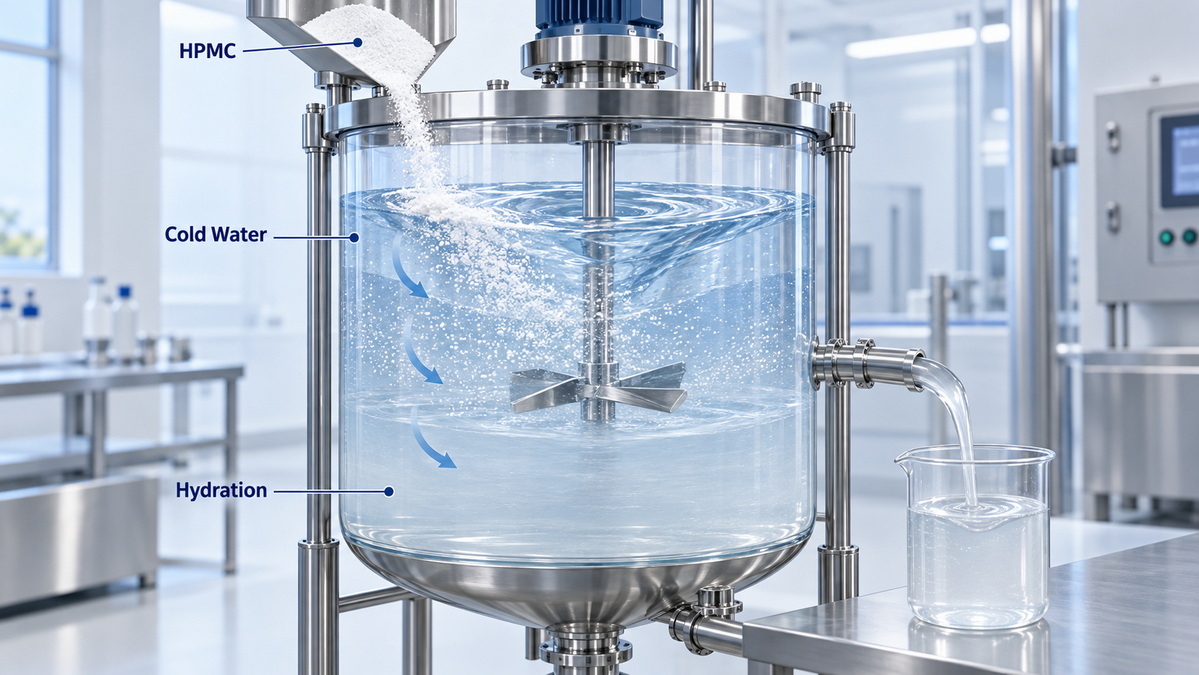
For most standard HPMC products, cold water is the preferred solvent.
When HPMC powder is gradually added to cold water under suitable mixing conditions, the particles disperse, absorb water, swell, and eventually form a uniform colloidal solution. As hydration continues, the viscosity of the system increases.
This is the most common and practical method for preparing HPMC solutions in many industries.
Cold-water dissolution is especially suitable for:
- Tile adhesive and cement-based mortar testing
- Wall putty and skim coat formulations
- Gypsum plaster and joint compound systems
- Water-based paints and coatings
- Shampoo and shower gel production
- Facial cleansers and liquid soaps
- Cosmetic creams and lotions
- Water-based industrial thickening systems
A properly hydrated HPMC solution should appear uniform and should not contain visible dry powder, gel particles, or undissolved lumps.
HPMC does not normally dissolve in hot water in the same way it dissolves in cold water. Instead, hot water can be used as part of a controlled dispersion process.
When HPMC is introduced into hot water, the particles can disperse without immediately developing full viscosity. After the mixture is cooled and additional cold water is introduced, the polymer hydrates and the viscosity begins to develop.
This method can be useful when a manufacturer wants to avoid rapid thickening during powder addition.
The process usually follows this pattern:
1. HPMC is dispersed in hot water under agitation.
2. The powder becomes evenly distributed throughout the liquid.
3. Cold water is added, or the mixture is cooled.
4. The HPMC gradually hydrates as the temperature decreases.
5. The final viscosity develops after sufficient mixing and hydration time.
This process should be carefully controlled. Water temperature, mixing speed, powder addition rate, and cooling time can all affect the final result.
HPMC generally has limited solubility in common nonpolar organic solvents. It is not typically dissolved in materials such as mineral oil, petroleum solvents, hydrocarbon solvents, or other nonpolar liquids.
Some HPMC grades may show compatibility with selected polar organic solvent mixtures. However, compatibility depends on the exact HPMC chemistry, solvent ratio, concentration, and formulation purpose.
For this reason, manufacturers should not assume that HPMC will dissolve in alcohol-only systems or solvent-based systems without testing.
| Solvent or Medium | Typical HPMC Behavior | Practical Use |
|---|---|---|
| Cold water | Forms a uniform colloidal solution | Preferred method for most applications |
| Hot water | Usually disperses rather than fully dissolves | Useful for hot dispersion followed by cooling |
| Warm water | Performance depends on grade and temperature | Requires process testing |
| Alcohol-only systems | Often limited solubility | Must be evaluated for each formula |
| Nonpolar solvents | Generally insoluble | Not recommended as primary solvents |
| Polar solvent mixtures | May be suitable in selected cases | Requires grade-specific testing |
Temperature has a major effect on HPMC hydration and viscosity development.
When HPMC is added to cold water, water molecules gradually penetrate the HPMC particles. The polymer chains absorb water, expand, and form a continuous network throughout the liquid. This hydration process is responsible for viscosity development.
As the temperature rises, the relationship between HPMC and water changes. Depending on the grade, HPMC may become less soluble at higher temperatures and may form a gel.
This effect is known as thermal gelation.
Thermal gelation is often reversible. When the temperature decreases, the HPMC may return to a more soluble or dispersed state, depending on the formulation and the material grade.
The temperature at which this occurs can vary significantly. It is influenced by:
- Methoxy substitution level
- Hydroxypropoxy substitution level
- HPMC concentration
- Viscosity grade
- Molecular weight
- Water temperature
- Dissolved salts and electrolytes
- Surfactants and emulsifiers
- Cement, gypsum, fillers, and mineral additives
- Other polymers in the formulation
- Overall solids content
This is why the same HPMC grade may behave differently in pure water, cement mortar, shampoo, detergent, paint, or cosmetic cream.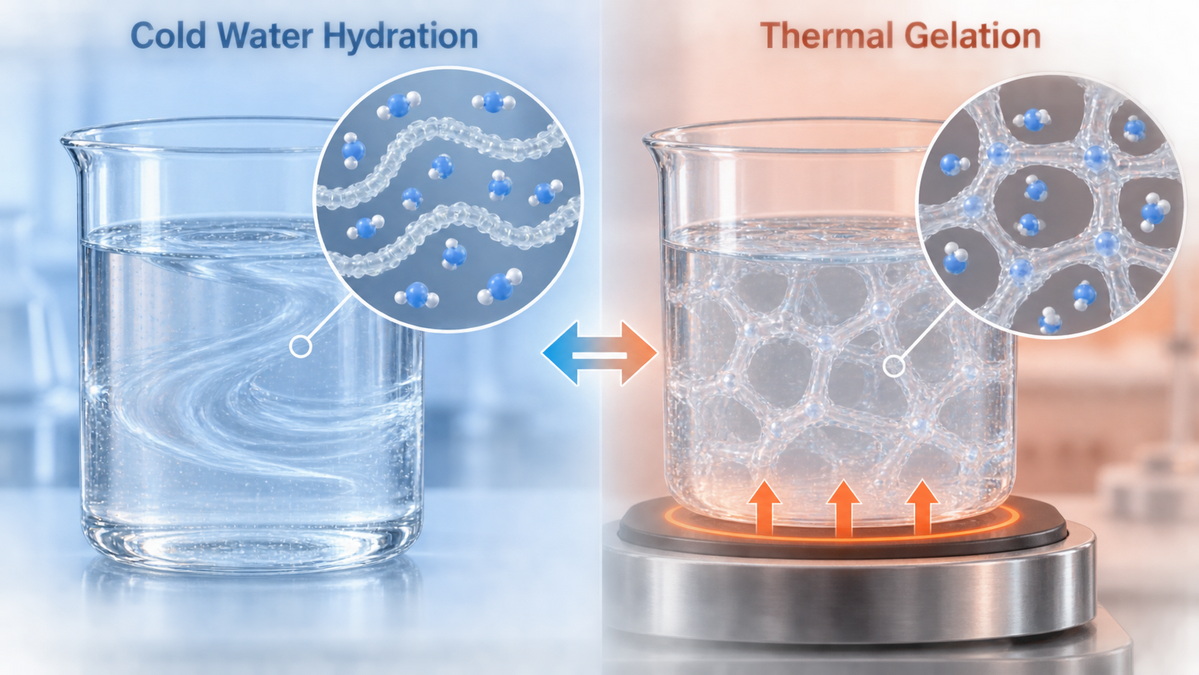
Cold-water dissolution is one of the most common methods for preparing an HPMC solution.
The key objective is to ensure that each HPMC particle is properly wetted and dispersed before it begins to hydrate and build viscosity.
Use clean water with a controlled temperature. Cool or room-temperature water is commonly used for standard HPMC hydration.
Water quality matters. Excessive salts, hardness, contaminants, or large temperature variation may affect hydration speed and final viscosity.
Begin agitation before introducing HPMC powder.
A stable vortex helps pull the powder into the water and promotes even dispersion. Without sufficient mixing, HPMC may float on the water surface or form lumps.
Add HPMC gradually into the mixing zone.
Avoid pouring a large quantity of powder into the vessel at one time. Rapid addition can cause the outer surface of the particles to hydrate immediately, creating a gel layer around dry powder.
This type of incomplete hydration is often called a fish eye.
Maintain agitation until the powder has been evenly distributed.
At this stage, the system may not yet show its final viscosity. Hydration needs time.
After dispersion, allow the mixture to hydrate completely.
The exact hydration time depends on the HPMC grade, particle size, concentration, water temperature, mixing equipment, and other ingredients in the formula.
Before using the HPMC solution in production, inspect it for:
- Visible lumps
- Dry particles
- Uneven thickness
- Poor flow consistency
- Insufficient viscosity
- Air bubbles caused by excessive agitation
A fully hydrated HPMC solution should show stable and consistent rheological behavior.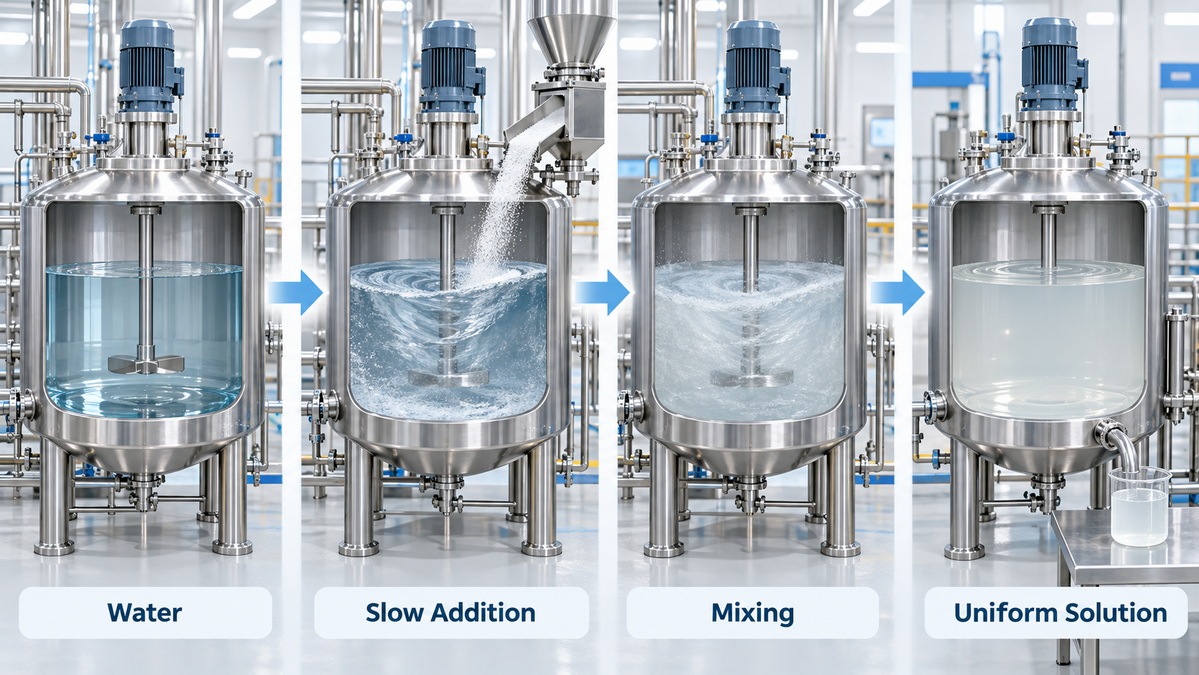
The hot-water dispersion method is useful when a formulation requires controlled powder addition without immediate thickening.
Use part of the total water quantity and heat it to a suitable temperature for dispersing the selected HPMC grade.
The exact temperature should be selected according to the grade and process conditions.
Introduce HPMC slowly while mixing.
The goal is to distribute the particles evenly throughout the hot water. At this stage, full viscosity development is not expected.
Continue mixing until the powder is fully dispersed.
Avoid leaving dry powder on the vessel wall, mixing shaft, or liquid surface.
Add the remaining water as cold water, or cool the batch under agitation.
As the temperature decreases, the HPMC begins to hydrate more completely.
Allow enough time for the final viscosity to develop.
The mixture should be evaluated only after full hydration. Measuring viscosity too early can lead to incorrect conclusions about product quality.
Lumps are one of the most common processing challenges when using HPMC.
A lump may contain dry powder in the center, surrounded by a hydrated outer layer. This makes it difficult for water to penetrate and dissolve the remaining powder.
In construction materials, incomplete HPMC hydration can lead to poor workability, inconsistent water retention, uneven mortar texture, and unstable application performance.
In personal-care products, it can cause visible particles, inconsistent viscosity, poor product appearance, and reduced consumer acceptance.
- Adding HPMC powder too quickly
- Using weak or insufficient agitation
- Adding powder directly into a stagnant liquid
- Using an unsuitable water temperature
- Introducing HPMC after the formulation has become too viscous
- Failing to allow enough hydration time
- Using a grade that does not match the manufacturing process
- Add HPMC slowly into a stable mixing vortex.
- Use appropriate mixing equipment for the batch size and viscosity target.
- Avoid dumping powder into one area of the vessel.
- Control water temperature from batch to batch.
- Allow sufficient time for complete hydration.
- Use a hot-water dispersion and cold-water hydration process when needed.
- Select a grade with suitable dissolution characteristics for the equipment and formula.
| Processing Issue | Possible Cause | Recommended Solution |
|---|---|---|
| White lumps in solution | Powder added too quickly | Feed HPMC gradually under continuous mixing |
| Low viscosity | Incomplete hydration | Extend hydration time and confirm grade selection |
| Excessive initial thickening | Rapid cold-water hydration | Use controlled hot-water dispersion followed by cooling |
| Uneven batch consistency | Variable water temperature or mixing | Standardize process conditions |
| Poor mortar workability | Grade mismatch or incomplete hydration | Evaluate viscosity, water retention, and compatibility |
| Cloudiness after heating | Thermal gelation | Cool the system and assess the formulation temperature profile |
Construction-grade HPMC is widely used in cement-based and gypsum-based dry-mix materials.
When water is added to a dry-mix mortar, HPMC begins to hydrate and influence the fresh properties of the mixture. Its ability to retain water is especially important because cement and gypsum systems require sufficient water for hydration and workability.
In tile adhesive, wall putty, cement render, EIFS mortar, skim coat, plaster, and gypsum products, HPMC can help improve:
- Water retention
- Open time
- Workability
- Trowelability
- Sag resistance
- Slip resistance
- Consistency
- Bonding performance
- Surface smoothness
The best HPMC grade is not always the grade with the highest viscosity. Excessive viscosity can increase mixing difficulty, reduce flow, or create an undesirable application feel.
A balanced selection should consider the entire dry-mix formula, including cement type, gypsum content, filler particle size, redispersible polymer powder, starch ether, retarders, accelerators, and target application method.
HPMC is also used in a variety of water-based personal-care products.
In shampoo, shower gel, facial cleanser, hand wash, lotion, cream, and cosmetic gel systems, HPMC can provide thickening, suspension, texture improvement, and formulation stability.
For personal-care applications, formulators often evaluate:
- Hydration speed
- Final viscosity
- Clarity or appearance
- Compatibility with surfactants
- Salt tolerance
- Stability during storage
- Stability during heating and cooling cycles
- Texture and sensory feel
- Compatibility with fragrance, colorants, and preservatives
The addition sequence is especially important in surfactant-rich systems. If HPMC is introduced after the formula has already become highly viscous or contains a high level of salt, hydration may become more difficult.
For best results, HPMC should usually be dispersed and hydrated under controlled conditions before sensitive ingredients are added.
Choosing the right HPMC grade requires more than comparing viscosity values.
A suitable grade should match the product, production process, target performance, and regional quality requirements.
- What is the intended application?
- What viscosity range is required?
- Will the product be mixed in cold water or through hot-water dispersion?
- What is the expected water temperature during production?
- Does the formula contain cement, gypsum, surfactants, salts, solvents, or other polymers?
- Is fast hydration required?
- Is a delayed hydration profile preferred?
- What storage stability is needed?
- What documentation and testing requirements apply to the market?
For construction products, water retention and workability may be the primary concerns.
For personal-care products, appearance, smoothness, thickening efficiency, and surfactant compatibility may be more important.
For regulated applications, the HPMC grade should be evaluated against the specific product requirements, applicable standards, documentation needs, and market regulations.
Hydroxypropyl methylcellulose is primarily dissolved in cold water, where it hydrates and forms a stable colloidal solution.
Hot water can be used to disperse HPMC before cooling, but it is not generally the preferred condition for complete dissolution. At elevated temperatures, many HPMC grades may show reduced solubility or reversible thermal gelation.
Successful HPMC use depends on selecting the right grade and controlling the complete process. Water temperature, powder addition speed, mixing intensity, hydration time, concentration, and formulation ingredients all influence the final result.
For construction-grade applications, HPMC can improve water retention, workability, open time, and application consistency. For personal-care formulations, it can support viscosity, stability, suspension, and a smooth product texture.
A well-matched HPMC grade, combined with the correct mixing method, helps manufacturers achieve more consistent production results and more reliable finished-product performance.
Shandong Shengda New Material Co., Ltd. provides construction-grade and personal-care-grade cellulose ether solutions for global customers. HPMC grade selection, samples, technical documentation, and formulation-focused support can help manufacturers identify a suitable solution for their specific application requirements.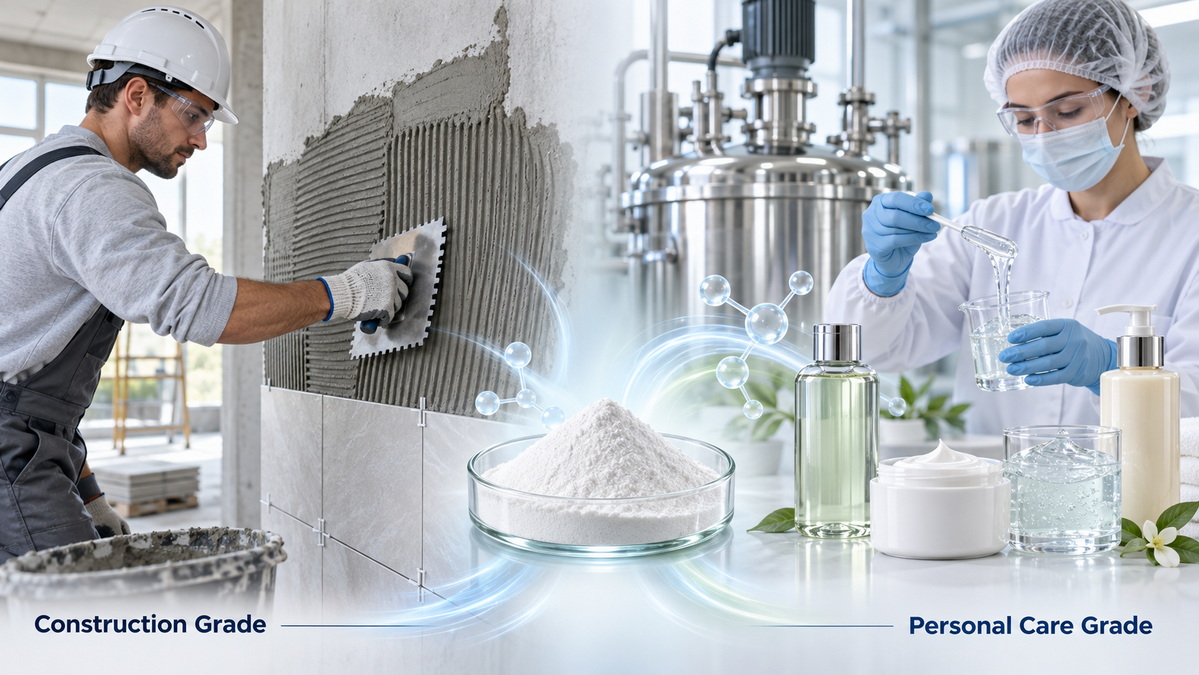
Yes. Most standard HPMC grades dissolve in cold water and form a viscous colloidal solution. The final viscosity depends on the grade, concentration, water temperature, mixing conditions, and other ingredients in the formulation.
HPMC is usually dispersed rather than fully dissolved in hot water. A common process is to disperse HPMC in hot water and then add cold water or cool the mixture to allow full hydration and viscosity development.
HPMC lumps usually form when powder is added too quickly or without sufficient agitation. The particle surface hydrates first and can trap dry powder inside. Slow addition into a strong mixing vortex helps prevent this issue.
HPMC is not generally freely soluble in alcohol-only systems. Some grades may be compatible with certain polar solvent mixtures, but this should be confirmed through grade-specific testing.
Cool or cold water is generally best for final HPMC dissolution. The best process temperature depends on the selected grade, concentration, equipment, and formulation ingredients.
The hydration time can range from several minutes to a longer period depending on HPMC particle size, viscosity grade, concentration, water temperature, mixing speed, and the other materials in the formula.
Not always. Construction and personal-care formulations have different performance requirements. The HPMC grade should be selected according to its intended use, compatibility requirements, process conditions, and desired final properties.
1. Shandong Shengda New Material Co., Ltd. "Hydroxypropyl Methyl Cellulose (HPMC) Solubility Demystified: A Comprehensive Guide to Effective Dissolution."
2. HPMC.com. "HPMC Solubility Chart."
[https://www.hpmc.com/recommend-products/hpmc-solubility-chart.html]
3. U.S. Department of Agriculture, Agricultural Marketing Service. "Hydroxypropyl Methylcellulose Technical Review."
[https://www.ams.usda.gov/sites/default/files/media/Hydroxpropyl%20Methylcellulose%20TR.pdf]
4. European Directorate for the Quality of Medicines & HealthCare. "Hypromellose."
5. Electronic Code of Federal Regulations. "21 CFR § 172.874—Hydroxypropyl Methylcellulose."
[https://www.ecfr.gov/current/title-21/chapter-I/subchapter-B/part-172/subpart-I/section-172.874]
6. Shandong Shengda New Material Co., Ltd. "What Solvent Is Hydroxypropyl Methylcellulose?"
[https://www.ihpmc.com/news/what-solvent-is-hydroxypropyl-methylcellulose/]


