


close
Choose Your Site
Global
Social Media
Views: 230 Author: Shengda Publish Time: 2026-08-03 Origin: Site


Content Menu
>> Specialty and Regulatory Grades
● Construction-Grade HPMC: What Buyers Need to Know
● HPMC in Pharmaceuticals and Personal Care
● How to Choose the Right HPMC Grade
>> Step-by-step selection framework
● HPMC, HEMC, and HEC Are Not the Same
● Sustainability and Market Trend
● Expert Insight for Formulators
● FAQs
>> 1. What are the different grades of HPMC?
>> 2. Which HPMC grade is best for tile adhesive?
>> 3. What is the difference between low and high viscosity HPMC?
>> 4. Can HPMC be used in cosmetics?
>> 5. How do I choose the right HPMC grade?
>> 6. Is HPMC the same as HEMC or HEC?
>> 7. Is HPMC environmentally friendly?
Hydroxypropyl Methyl Cellulose (HPMC) is one of the most widely used cellulose ethers in modern industry. It is valued for its water retention, thickening, binding, film-forming, and suspension properties, making it essential in construction materials, pharmaceuticals, food products, and personal care formulations.
In practical terms, HPMC grades are not just labels. They reflect differences in viscosity, substitution level, particle size, solubility, and regulatory compliance. Choosing the wrong grade can lead to poor workability, weak adhesion, inconsistent release performance, or unstable texture. Choosing the right one can improve efficiency, reduce waste, and help a product perform more predictably across batches.
HPMC is a functional polymer, and its grade determines how it behaves in a formula. A low-viscosity grade may dissolve quickly and support smoother processing, while a high-viscosity grade may provide stronger water retention and better thickening.
In construction, this can affect open time, anti-slip performance, and crack resistance. In pharmaceuticals, it can influence drug release. In personal care, it can control texture, spreadability, and sensory feel.
For that reason, formulators should never select HPMC by price alone. Performance requirements must come first. The best grade is the one that balances application needs, processing conditions, regulatory standards, and cost efficiency.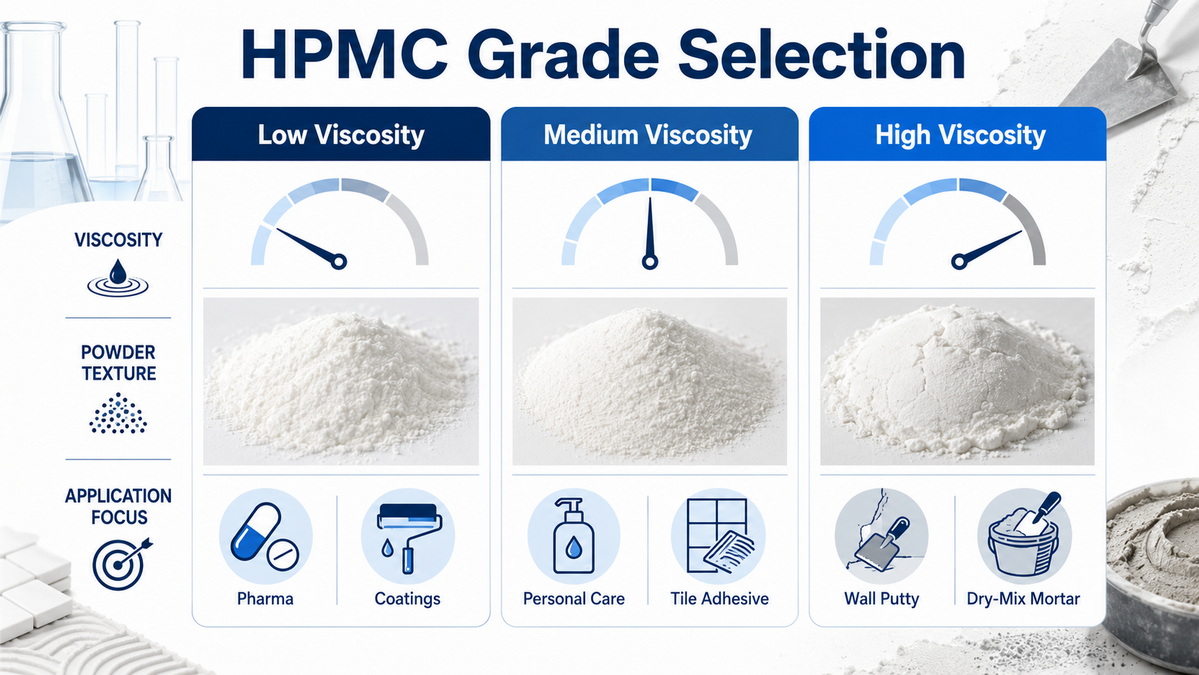
The most common way to classify HPMC is by viscosity. Typical grades range from low to very high viscosity, such as 3,000, 6,000, 15,000, 50,000, 100,000, and 200,000 cps.
Lower viscosity grades are usually preferred for applications that need easier dispersion and lighter thickening. Higher viscosity grades are preferred when stronger water retention, body, or gel strength is required.
HPMC is also defined by the degree of methoxy and hydroxypropyl substitution. These chemical differences affect solubility, gel temperature, clarity, and film performance.
In simple terms, substitution controls how HPMC behaves under heat, in water, and in interaction with other ingredients.
Particle size affects dispersibility, hydration speed, and texture. Fine powders disperse more smoothly and are often better for personal care or pharmaceutical use.
Coarser grades may be more suitable for construction systems where controlled hydration and processing behavior are desirable.
Some HPMC products are designed for pharmaceutical, food, detergent, ceramic, or construction use. These grades must meet specific standards for purity, safety, and performance.
For example, pharmaceutical grades are often aligned with USP, EP, or JP requirements, while food-grade HPMC must comply with food safety regulations.
| Application | Typical Grade Focus | What It Improves |
|---|---|---|
| Tile adhesives | Medium to high viscosity | Water retention, slip resistance, open time |
| Wall putty | Medium viscosity | Workability, smoothness, crack resistance |
| Cement mortar | Medium to high viscosity | Adhesion, water retention, consistency |
| Gypsum plaster | High viscosity | Sag resistance, smoothing, stability |
| Pharmaceuticals | Controlled substitution and viscosity | Release profile, binding, coating |
| Food products | Food-grade, regulated HPMC | Texture, stabilization, emulsification |
| Personal care | Fine particle, medium viscosity | Thickness, spreadability, film feel |
This application-based view is the most practical way to understand HPMC grades. A single viscosity number is not enough. The right choice depends on what the formula is supposed to do, how it is processed, and the environment in which it must perform.
Construction-grade HPMC is one of the most important segments in the market. It is widely used in tile adhesives, wall putty, gypsum products, cement mortars, EIFS systems, and self-leveling compounds. In these systems, HPMC helps control water movement, improves workability, and supports a more stable application window.
A good construction-grade HPMC should deliver:
- Strong water retention
- Stable viscosity under mixing
- Good open time
- Improved adhesion and anti-slip behavior
- Balanced thickening without over-thinning the formula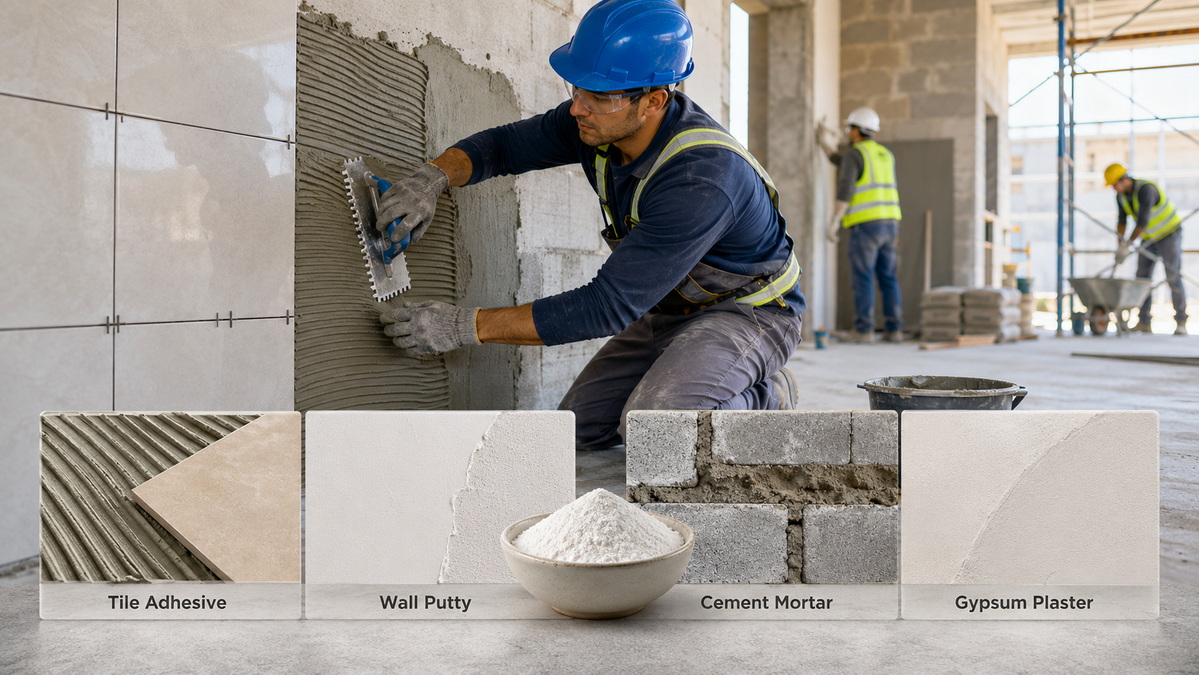
HPMC is also highly valuable outside construction. In pharmaceuticals, it is widely used in tablet binding, film coating, and controlled-release systems. Its performance is linked to viscosity, substitution pattern, and consistency from batch to batch.
In personal care, HPMC contributes to smooth texture, thickening, and film formation. It is often used in lotions, creams, shampoos, and other cosmetics where users expect a stable, elegant sensory profile.
Fine-particle grades are especially useful when a formula needs fast hydration and uniform dispersion.
This is the section many buyers overlook. Customers often ask for "HPMC" without defining the performance target. That leads to delays, trial-and-error, and unnecessary reformulation.
1. Define the application: construction, pharma, food, or personal care.
2. Clarify the key function: water retention, thickening, film formation, suspension, or release control.
3. Set the processing conditions: temperature, mixing speed, pH, salt content, and dosage level.
4. Choose a viscosity band: low, medium, or high.
5. Check regulatory requirements: especially for food and pharma.
6. Run pilot tests: confirm open time, texture, stability, and final performance.
This simple workflow can save time and reduce formulation risk. It also improves communication between suppliers, formulators, and production teams.
Many buyers compare cellulose ethers during product development. That is smart, because the best solution is not always HPMC alone.
In construction, HEMC may perform better in certain hot-weather or extended open-time systems, while HEC is often preferred in coatings and personal care where smooth rheology and film behavior matter.
| Property | HPMC | HEMC | HEC |
|---|---|---|---|
| Water retention | Excellent | Excellent | Good |
| Thickening | Excellent | Very good | Excellent |
| Construction use | Excellent | Excellent | Limited |
| Paint/coating use | Good | Good | Excellent |
| Temperature resistance | Excellent | Excellent | Medium |
| Film formation | Good | Good | Excellent |
For buyers, the message is clear: do not choose based on name alone. Choose based on formula behavior, climate, substrate, and end-use performance.
The cellulose ethers market continues to grow, driven by construction demand, pharmaceuticals, food processing, and personal care. At the same time, sustainability has become a major buying criterion.
Market reports point to continued expansion through 2031–2033, while manufacturers are also launching more eco-aligned grades that support compliance and lower environmental impact.
For global buyers, this means HPMC selection is no longer only a technical issue. It is also a procurement and compliance issue. Companies increasingly want suppliers that can provide:
- Stable quality and traceability
- Sustainable manufacturing practices
- Product documentation and technical support
- Grades suitable for export and regulatory review
The best HPMC supplier is not always the one offering the widest product list. It is the one that can translate application needs into a workable grade recommendation.
A strong technical supplier should help you answer:
- What viscosity range fits my formulation?
- How fast should the powder hydrate?
- What should the dosage be?
- Will the grade work in hot or humid conditions?
- Is there a better alternative such as HEMC or HEC?
This kind of support is especially important for export-focused manufacturers that need consistent performance across markets and climates.
HPMC grades are defined by more than just thickness. Viscosity, substitution, particle size, and regulatory grade all influence how a product behaves in real-world applications.
For manufacturers and formulators, the key is to match the grade to the application, processing conditions, and performance goals. When selected correctly, HPMC can improve stability, efficiency, product quality, and customer satisfaction.
If you are developing construction-grade or personal-care-grade HPMC formulations, the right grade can significantly improve performance and reduce production risk. Contact Shandong Shengda New Material Co., Ltd. for technical guidance, grade selection support, and customized cellulose ether solutions.
HPMC grades are usually classified by viscosity, substitution level, particle size, and application type. Common categories include construction, pharmaceutical, food, personal care, and specialty grades.
For tile adhesive, medium to high viscosity HPMC is commonly used because it improves water retention, adhesion, open time, and anti-slip performance.
Low-viscosity HPMC disperses more easily and gives lighter thickening, while high-viscosity HPMC provides stronger body, water retention, and gel strength.
Yes. HPMC is used in cosmetics and personal care products for thickening, stabilization, film formation, and texture improvement.
Start with the application, then define the required function, processing conditions, viscosity range, and regulatory needs. Pilot testing is essential before mass production.
No. They are related cellulose ethers, but they differ in chemical structure and performance. HPMC is widely used in construction and regulated industries, HEMC is often strong in construction performance, and HEC is especially common in coatings and personal care.
HPMC is derived from cellulose, a renewable raw material, and it is increasingly aligned with sustainability-focused product development and green procurement trends.
1. Kima Chemical, "What are the different grades of HPMC?" https://www.kimacellulose.com/what-are-the-different-grades-of-hpmc.html
2. Cellulose Ethers & Derivatives Market Size & Share, 2033. https://www.example.com
3. The Ultimate HPMC Grades Breakdown. https://www.example.com
4. Cellulose Ether & Derivatives Market Outlook 2026. https://www.example.com
5. HPMC vs. HEMC vs. HEC: Which Cellulose Ether Is Right for... https://www.example.com
6. Understanding the Different HPMC Grades and Their ... https://www.example.com
7. Future Trends in Global Cellulose Ether and Its Derivatives... https://www.example.com
8. What is the difference between HPMC and HEC? https://www.example.com
9. HPMC vs HEC: Water-Based Coatings Comparison Guide. https://www.example.com
10. Cellulose Ether & Derivatives Market Report 2026–2031. https://www.example.com


