


close
Choose Your Site
Global
Social Media
Views: 230 Author: Shengda Publish Time: 2026-07-27 Origin: Site


Content Menu
● Why HEC Matters in Latex Paint Formulation
● Core Benefits of HEC in Latex Paint
>> 1. Viscosity Control and Thickening
>> 2. Better Brush, Roller, and Spray Performance
>> 4. Strong Pigment Suspension and Anti-Sedimentation
>> 5. Better Leveling and Film Appearance
>> 6. Reduced Foam and Spatter During Production and Use
>> 7. Broad Compatibility with Paint Ingredients
● HEC in Water-Based Coatings: A Wider Industry View
● How HEC Works in the Paint System
● HEC vs Other Cellulose Ethers in Paint
● Choosing the Right HEC Grade
● Formulator's Checklist for Better Results
● Common Problems HEC Helps Solve
● Industry Perspective: Why HEC Still Has Strong Demand
● Why Choose Shandong Shengda New Material Co., Ltd.
● FAQ
>> 1. What is Hydroxyethyl Cellulose used for in latex paint?
>> 2. Why is HEC popular in water-based coatings?
>> 3. Does HEC improve storage stability?
>> 4. Can HEC reduce paint spatter?
>> 5. How do I choose the right HEC grade for latex paint?
>> 6. Is HEC suitable for low-VOC paint formulations?
Hydroxyethyl Cellulose (HEC) is one of the most widely used additives in latex paint and other water-based coating systems. It helps formulators control viscosity, improve application behavior, stabilize pigments, and support long-term storage performance.
For paint manufacturers, HEC is not just a thickener. It is a functional additive that affects production, packaging, brushing, rolling, spraying, leveling, and final film appearance.
Latex paint is a complex system made up of binders, pigments, fillers, water, surfactants, defoamers, preservatives, and other performance additives. Without proper rheology control, the system can become unstable, difficult to apply, or visually inconsistent.
HEC helps solve these problems by building body into the coating while keeping the paint easy to use and smooth. Because it is a non-ionic cellulose ether, it is also valued for its compatibility across a broad pH range and its tolerance to common paint ingredients. This makes it especially suitable for modern water-based formulations that aim for low VOC performance and reliable shelf stability.
HEC is mainly used to increase and fine-tune viscosity in latex paint. When dispersed in water, its polymer chains hydrate and expand, creating a more structured liquid phase that resists sagging and improves coating control.
This thickening effect is important because it helps paint stay on the brush, roller, or spray surface instead of running or dripping. It also gives the formulator a practical way to balance flow and body without making the paint feel overly heavy.
A well-designed latex paint should feel smooth during application. HEC supports pseudoplastic flow, which means the paint becomes easier to apply under shear and then rebuilds viscosity afterward.
That behavior improves:
- Brushability.
- Roller loading and release.
- Spray control.
- Resistance to dripping and spattering.
For painters, this means less mess and better coverage. For manufacturers, it means a more professional product experience and fewer complaints about application defects.
Sagging occurs when fresh paint slides downward on vertical surfaces before it has time to level and set. HEC helps reduce this issue by supporting body at rest while still allowing the coating to move under application stress.
This is especially useful in wall coatings, decorative paints, and high-build systems where film thickness must remain consistent. Better sag resistance also helps reduce rework and improve finish appearance on corners, edges, and textured surfaces.
Pigment settling is one of the most common storage problems in paint production. HEC helps suspend pigments and fillers more effectively, which keeps the formulation more uniform during storage and transportation.
This matters because sedimentation can lead to color inconsistency, poor hiding power, and unstable product performance. By improving suspension, HEC helps maintain:
- Better color consistency.
- Reduced floating and flooding.
- More stable shelf life.
- Easier remixing before use.
A good latex paint should flow out evenly after application. HEC supports leveling by giving the coating controlled flow without excessive running or splashing.
This leads to a smoother film surface, fewer brush marks, and a more uniform final appearance. In decorative coatings, this visual improvement is a major part of perceived product quality.
HEC solutions generally show low surface-tension disturbance, which helps reduce foaming during manufacturing and application. Lower foam levels can make production more efficient and improve the visual quality of the final film.
It also supports cleaner application because less spatter means less material loss, less cleanup, and a better finish on adjacent surfaces. For contractors, this is a practical advantage. For brands, it is a selling point.
One of HEC's strongest advantages is compatibility. As a non-ionic polymer, it works well with many pigments, binders, salts, and additives commonly used in latex paint systems.
This helps manufacturers formulate with more flexibility. It also reduces the risk of unexpected instability, phase separation, or incompatibility problems during development and production.
The coatings industry continues to move toward water-based, low-VOC, and more sustainable formulations. In that environment, HEC remains highly relevant because it delivers performance without relying on solvent-heavy systems.
HEC is widely regarded as a baseline rheology solution for waterborne paints, especially where formulators need balanced thickening, suspension, and application stability. In practice, this means HEC is not only useful in latex paint, but also in decorative coatings, architectural coatings, protective coatings, and other water-based systems.
HEC works through hydration and polymer network formation. Once added to water, it absorbs moisture and expands, which increases the viscosity of the liquid phase.
This creates three important effects:
1. It strengthens the paint body.
2. It slows pigment settling.
3. It improves application control.
The result is a coating that is easier to handle in production and more reliable in real-world use.
Different cellulose ethers serve different formulation goals. HEC is especially strong in water-based coatings because of its non-ionic behavior and broad compatibility, while HPMC and HEMC are often selected for other material systems and performance priorities.
| Additive | Main Strength | Typical Advantage in Paint |
|---|---|---|
| HEC | Rheology control and compatibility | Good suspension, smooth application, stable viscosity |
| HPMC | Water retention and thickening | Useful in construction materials and some coating systems |
| HEMC | Water retention and workability | Common in building materials and cement-based products |
For latex paint, HEC is often preferred when the priority is balanced application, pigment suspension, and storage stability.
Not all HEC grades perform the same way. Formulators should evaluate the right grade based on viscosity target, dissolution behavior, application method, and final coating feel.
- Target viscosity.
- Paint type and binder system.
- Brush, roller, or spray application.
- Required leveling and anti-sag performance.
- Production process and dissolution speed.
If the paint is designed for high-build wall coverage, a higher-viscosity grade may be useful. If the system is meant for spraying, a more controlled viscosity profile may be better to avoid over-thickening and poor atomization.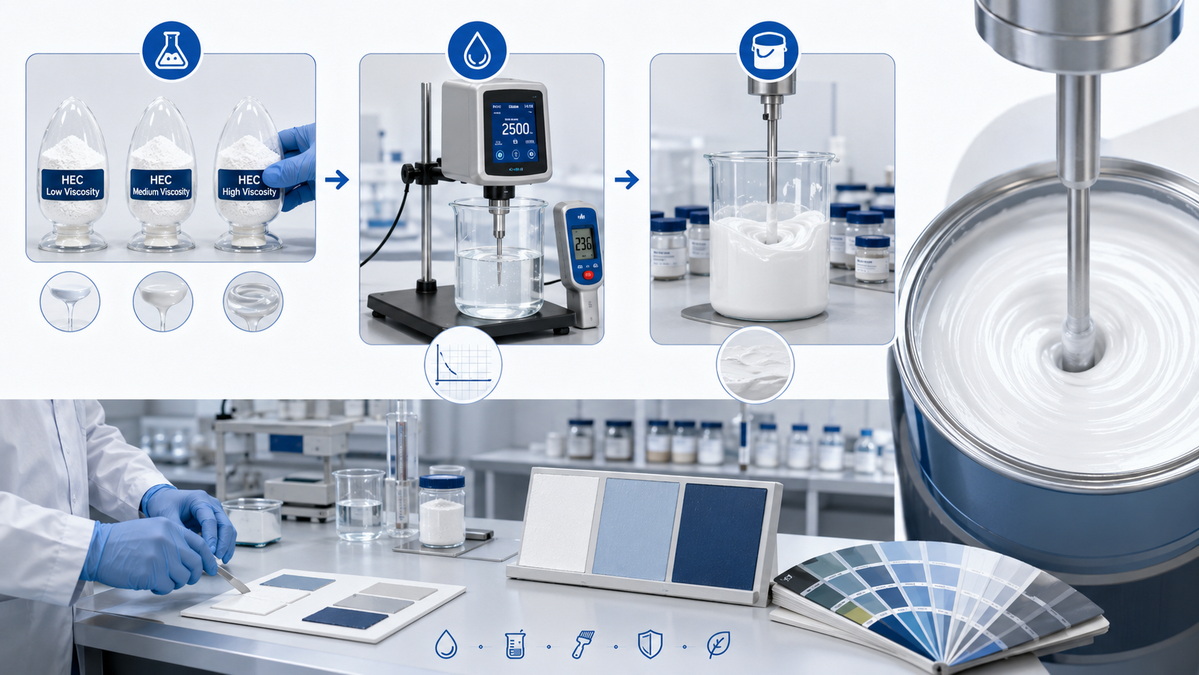
Before finalizing an HEC-based latex paint formula, manufacturers should evaluate the following points:
1. Check pigment suspension stability after 24, 72, and 168 hours.
2. Test brushability, rolling feel, and spray atomization.
3. Measure sag resistance on vertical panels.
4. Verify leveling and film smoothness after drying.
5. Confirm storage stability under heat and cold cycling.
6. Review compatibility with dispersants, defoamers, preservatives, and coalescents.
This type of structured testing helps move the discussion from "what HEC does" to "how HEC performs in a specific formulation," which is where real formulation value begins.
HEC is often chosen to solve practical manufacturing and application issues. These include:
- Pigment settling during storage.
- Poor brush feel.
- Excessive dripping.
- Splashing during roller application.
- Uneven coverage.
- Weak leveling.
- Unstable viscosity across temperature changes.
When these issues are controlled well, the result is a more commercial and easier-to-sell paint product.
Despite the availability of many modern rheology modifiers, HEC remains important because it offers a reliable balance of performance, cost, and formulation flexibility. It is especially attractive in water-based coatings that must meet environmental expectations without sacrificing application quality.
That balance matters for export-oriented manufacturers. Buyers increasingly want products that are easy to use, stable in transit, and aligned with low-emission requirements. HEC supports all three goals when selected correctly.
As a manufacturer focused on cellulose ether research, development, production, and sales, Shandong Shengda New Material Co., Ltd. can support customers with building-grade and daily chemical-grade cellulose product solutions for global markets. With HPMC, HEMC, and HEC product lines, the company is positioned to support formulators who need stable supply and technical consistency.
For latex paint applications, the key value is not only product delivery, but also application guidance, grade selection support, and formulation-oriented service. That is what international buyers expect from a serious supplier.
Hydroxyethyl Cellulose plays a central role in modern latex paint formulations. It improves viscosity, helps control flow, reduces sagging, stabilizes pigments, supports leveling, and enhances storage stability.
For manufacturers, the real advantage of HEC is its ability to combine processing convenience with strong end-use performance. When the right grade is selected and tested properly, it can make latex paint easier to produce, easier to apply, and more consistent in the market.
HEC is used as a thickener, rheology modifier, suspension stabilizer, and application aid in latex paint.
HEC performs well in water-based systems because it offers good compatibility, stable viscosity control, and improved application behavior.
Yes. HEC helps keep pigments and fillers suspended, which reduces settling and improves shelf life.
Yes. HEC contributes to better rheology and lower spatter during roller application, which improves cleanliness and finish quality.
Choose based on target viscosity, application method, desired leveling, and the stability profile of your formulation.
Yes. HEC is widely used in modern water-based, low-VOC coating systems because it supports performance without relying on solvent-heavy chemistry.
1. KIMA CHEMICAL CO., LTD. "What Are the Benefits of Hydroxyethyl Cellulose in Latex Paint." [https://www.kimacellulose.com/what-are-the-benefits-of-hydroxyethyl-cellulose-in-latex-paint.html]
2. KIMA CHEMICAL CO., LTD. "Hydroxyethyl Cellulose (HEC) in Coatings: How HEC Improves ..." [https://www.kimacellulose.com/introduction-the-growing-importance-of-hec-in-the-coatings-industry.html]
3. WOTAI CHEM. "HEC for Paints." [https://wotaichem.com/hec-for-paints/]
4. American Coatings Association. "Additives - Rheology of Paints and Coatings." [https://www.paint.org/wp-content/uploads/2022/02/Additives-Rheology-of-Paints-and-Coatings_Oct-2021.pdf]
5. Safic-Alcan. "Rheology Modifiers for Waterborne Systems." [https://www.safic-alcan.com/en-fr/industry-articles/rheology-modifiers-waterborne-systems/]
6. HEC coating-grade technical document. [https://celluloseether.com/wp-content/uploads/2020/07/TDS-HEC-Coating-grade.pdf]


