


close
Choose Your Site
Global
Social Media
Views: 259 Author: Shengda Publish Time: 2026-10-05 Origin: Site


Content Menu
● How to Evaluate a Reliable HEC Supplier
>> Manufacturing and Quality Transparency
>> Production and Delivery Stability
>> Environmental and Regulatory Readiness
● France's HEC Sourcing Position
● Top Hydroxyethyl Cellulose HEC Manufacturers and Suppliers in France
>> 1. Shandong Shengda New Material Co., Ltd.
>>> Core Strengths
>>> OEM and Customization Considerations
>> 2. Ashland
>> 3. Dow
>>> Core Strengths
>> 4. SE Tylose
>>> Core Strengths
>> 5. TENESSY
>>> Core Strengths
>>> Core Strengths
● HEC Grades and Application Requirements
>> HEC for Architectural Paints
>> HEC for Construction Chemicals
>> HEC for Personal Care and Home Care
● Common HEC Procurement Risks
>> Comparing Viscosity Without Checking the Test Method
>> Approving a Low-Cost Grade Without Formula Testing
>> Using an Expired or Incomplete ISO Certificate
>> Assuming French Stock Means French Manufacturing
>> Ignoring Packaging and Moisture Protection
● Insider Guidance: The "Same Viscosity, Different Paint" Problem
● Buyer's Qualification Process
>> Step 1: Define Your Requirement Clearly
>> Step 2: Request a Complete Documentation Package
>> Step 3: Verify Manufacturing and Certification Details
>> Step 4: Test Samples in the Final Formula
>> Step 5: Start With a Controlled Commercial Trial
>> Step 6: Build a More Resilient Supply Plan
>> 1. How can I verify whether an HEC supplier's ISO 9001 certificate is still valid?
>> 2. Is HEC manufactured in France always better than HEC imported from China?
>> 3. What is the most important test before replacing an existing HEC grade?
>> 4. Can HEC replace HPMC or HEMC in construction chemicals?
>> 5. What documents should an HEC supplier provide for the French and European markets?
France is an important procurement and formulation hub for Hydroxyethyl Cellulose (HEC), particularly for water-based paints, coatings, construction chemicals, adhesives, home-care products, and personal-care formulations.
For professional procurement teams, the right HEC partner is not always the supplier with the nearest warehouse or the lowest quoted unit price. The more suitable choice depends on the required viscosity range, dissolution behavior, batch consistency, raw-material traceability, regulatory documentation, production capacity, lead-time reliability, and technical support capability.
France has a mature chemical-industry ecosystem supported by major coatings manufacturers, personal-care brands, industrial formulators, specialty-material distributors, and cross-border European logistics networks. For buyers serving France, Benelux, Germany, Spain, Italy, and other European markets, sourcing from suppliers with strong EU-market experience can reduce documentation risk and improve response speed.
However, buyers should distinguish carefully between a supplier that sells HEC in France, a distributor that holds local stock, and an actual manufacturer with verified production capability. A French sales office or warehouse does not necessarily mean that the HEC itself is manufactured in France.
This guide evaluates major HEC manufacturers and suppliers that serve the French market, including European producers, international specialty-material groups, and export-oriented manufacturers that provide flexible sourcing programs for small and medium-sized buyers.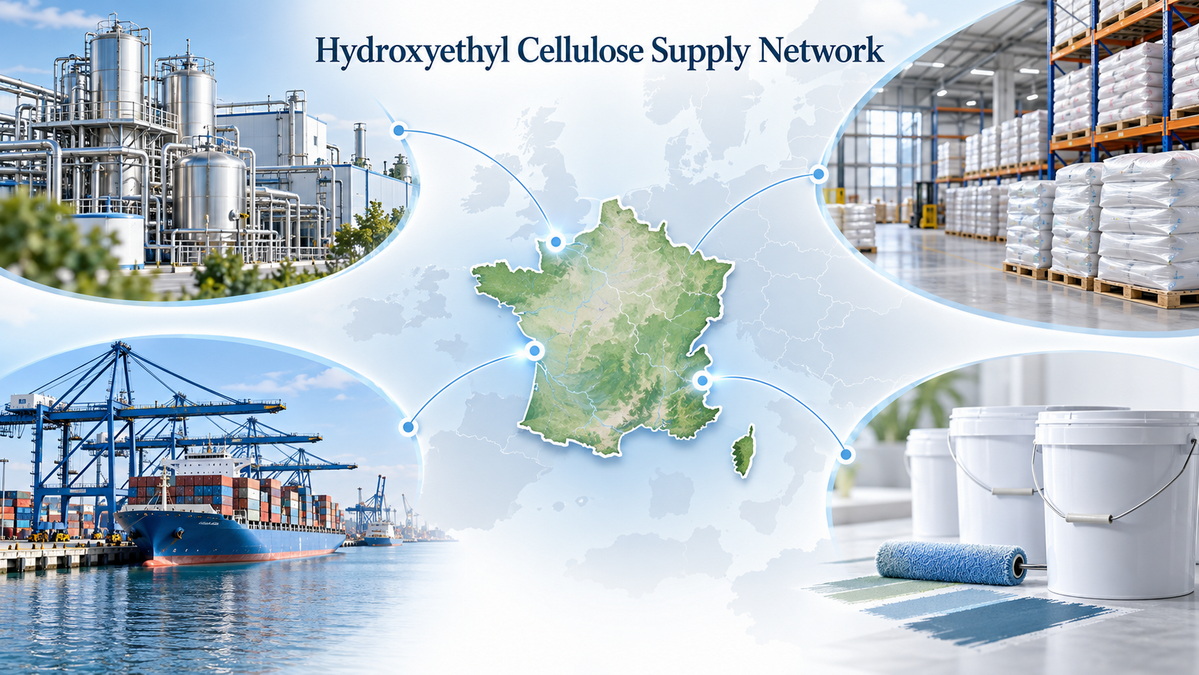
Hydroxyethyl Cellulose is a performance-sensitive cellulose ether. Two HEC powders may look similar on a basic Certificate of Analysis, yet perform very differently in a paint, adhesive, detergent, wall-putty, shampoo, or cosmetic formulation.
A reliable supplier should be evaluated using technical, commercial, and operational criteria.
A qualified HEC supplier should be able to provide clear and current information about its production and quality-management system.
Important documents and evidence include:
- Manufacturing-site address and legal company information
- ISO 9001 quality-management certificate with validity dates
- Certificate of Analysis for the actual production batch
- Technical Data Sheet and Safety Data Sheet
- Defined testing standards for viscosity, moisture, pH, ash content, and particle size
- Product traceability from production to shipment
- Storage conditions and shelf-life information
- Packaging specification and moisture-protection measures
- Change-control procedures for raw materials, production processes, or specifications
Buyers should pay close attention to the scope of a supplier's ISO certificate. An ISO certificate for chemical trading is not the same as an ISO certificate covering the manufacture of Hydroxyethyl Cellulose or cellulose ethers.
HEC is a nonionic, water-soluble cellulose ether. It is typically produced through the etherification of alkali cellulose with ethylene oxide under controlled reaction conditions.
Its final performance can be influenced by:
- Molecular weight
- Degree of hydroxyethyl substitution
- Substitution distribution
- Viscosity profile
- Particle size
- Moisture content
- Surface treatment
- Dissolution speed
- Hydrophobic modification
- Purity level
- Compatibility with other formulation ingredients
A supplier should understand the difference between standard industrial HEC and application-specific grades.
Common categories include:
- Standard HEC for general thickening
- High-viscosity HEC for architectural paints and wall putty
- Low-viscosity HEC for easier processing and controlled rheology
- Delayed-solubility HEC for reduced lump formation
- Hydrophobically modified HEC for coatings with enhanced leveling or rheology control
- Personal-care-grade HEC for shampoos, body washes, gels, and lotions
- Higher-purity HEC for cosmetic and specialty applications
- Construction-oriented cellulose ether solutions for workability and water retention
HEC is often a recurring raw material in industrial production. A supplier may provide a successful first shipment, but long-term performance depends on stable quality across multiple batches.
Procurement teams should review:
- Actual HEC production capacity rather than total company capacity
- Available stock and production lead time
- Historical export experience
- Container loading and packaging controls
- Ability to maintain the same product specification across repeat orders
- Batch-to-batch viscosity consistency
- Technical response time when a formulation problem occurs
- Supply-chain contingency plans for raw materials and export logistics
For French and European buyers, compliance documentation is not optional. The supplier should understand the documentation requirements of the intended market and application.
Depending on the use case, buyers may require:
- REACH-related declarations
- Product safety documentation
- Non-animal-origin statements
- Allergen statements
- GMO statements
- Microbiological specifications
- Heavy-metal statements
- Cosmetic application documentation
- Food-contact-related declarations where relevant
- Sustainability or bio-based material declarations
A sustainability claim should be confirmed for the exact grade being purchased. Buyers should not assume that a supplier's general environmental statement applies to every HEC grade, packaging format, production site, or shipment route.
France is a strategically important market within the European specialty-chemicals supply chain. It has strong links to the coatings, construction, personal-care, home-care, adhesives, pharmaceutical, and specialty-formulation sectors.
For HEC buyers, France offers practical sourcing advantages:
- Access to major multinational chemical suppliers
- Strong regional technical-service networks
- Efficient distribution routes across Europe
- Established customs, warehousing, and logistics infrastructure
- Mature paints and coatings manufacturing sector
- Advanced personal-care and cosmetics ecosystem
- Access to EU-compliant documentation and regulatory support
- Proximity to neighboring industrial markets
The French market is particularly relevant for water-based formulations, where HEC is used as a thickener, rheology modifier, stabilizer, suspending agent, and water-retention aid.
Still, buyers should avoid making assumptions based on sales location alone. A supplier serving France may manufacture HEC in France, Germany, the United States, China, or another production region. The source country, packaging location, warehouse location, and legal invoicing entity can all be different.
Before approving a supplier, ask four direct questions:
1. Where is this exact HEC grade manufactured?
2. Where is the material packed or repacked?
3. Where is the available inventory stored?
4. Which production site issues the batch Certificate of Analysis?
Supply Position: Direct export manufacturer from China
Main Products: HEC, HPMC, HEMC, and related cellulose ether solutions
Primary Applications: Paints and coatings, wall putty, gypsum/plaster, tile adhesive, construction chemicals, daily chemicals, and water-based industrial formulations
Shandong Shengda New Material Co., Ltd. is a Chinese manufacturer focused on the research, development, production, and sales of cellulose ethers, including Hydroxyethyl Cellulose, Hydroxypropyl Methyl Cellulose, and Hydroxyethyl Methyl Cellulose.
For French buyers, Shengda is not positioned as a local French producer. Instead, it represents an export-oriented manufacturing option for companies seeking direct factory communication, flexible commercial support, customized cellulose ether grades, and a competitive long-term supply model.
The company is particularly relevant for procurement teams that need more than a standard HEC product. Many small and medium-sized paint manufacturers, construction-chemical producers, distributors, and private-label businesses require customized technical support, mixed product procurement, flexible packaging, and responsive communication during the qualification process.
- Dedicated focus on cellulose ether production
- Product portfolio covering HEC, HPMC, and HEMC
- Suitable for construction, coatings, and daily-chemical applications
- Flexible support for customized viscosity and application requirements
- Direct manufacturer communication for technical and commercial discussions
- Suitable for buyers sourcing multiple cellulose ether types
- Potentially efficient option for container-scale import programs
- Support for OEM, distributor, and private-label packaging discussions
Shengda's product range is especially useful for buyers that require multiple cellulose ether materials from one supplier. For example, a construction-chemical manufacturer may need HPMC or HEMC for tile adhesive and dry-mix mortar, while also requiring HEC for water-based coating, wall-putty, or daily-chemical formulations.
This multi-product capability can simplify supplier management, reduce administrative workload, and make mixed-container purchasing more practical.
Shandong Shengda may be a suitable option for:
- Small and medium-sized paint manufacturers
- Construction-material producers
- Wall-putty and gypsum-product manufacturers
- Distributors building a cellulose ether product portfolio
- Private-label chemical-material programs
- Buyers requiring HEC, HPMC, and HEMC from one source
- Importers seeking flexible packaging and communication
- Companies looking for a secondary source to reduce supply risk
Before requesting a quotation, buyers should provide clear technical requirements, including:
- Target application
- Current benchmark grade
- Required viscosity range
- Viscosity test method
- Desired dissolution behavior
- Required moisture level
- Preferred particle size
- Packaging requirements
- Annual purchasing volume
- Target destination port
- Required compliance documentation
- Trial-order quantity
- Private-label or neutral-packaging requirements
The most effective approach is to send a current Technical Data Sheet or Certificate of Analysis from the existing HEC grade. This allows the supplier to recommend a technically comparable product rather than offering a generic alternative.
For HEC imported into France or the wider European market, buyers should confirm current regulatory documents before placing a commercial order. The document package should include the latest SDS, batch-specific COA, product specification, origin documentation, and relevant compliance declarations.
Best fit: Buyers seeking direct manufacturer sourcing, flexible OEM support, tailored HEC specifications, multi-product cellulose ether purchasing, and responsive communication for growing brands or regional distribution programs.
Supply Position: Global specialty-material supplier with French and European operations
Main HEC Brand: Natrosol™ Hydroxyethylcellulose
Primary Applications: Coatings, adhesives, personal care, home care, construction, oilfield, pharmaceutical, and specialty water-based systems
Ashland is one of the most established names in cellulose-based rheology modifiers. Its Natrosol™ Hydroxyethylcellulose range is widely associated with thickening, stabilization, rheology control, suspension support, and viscosity management in water-based formulations.
Ashland has a significant European footprint and operational relevance for French buyers. Its broader manufacturing and technical network makes it a strong choice for procurement teams that need structured documentation, established product brands, global technical support, and performance consistency.
Natrosol™ HEC is typically supplied as a white, free-flowing granular powder. It is a nonionic, water-soluble polymer that can be used in a broad range of industrial and consumer applications.
- Long-established cellulose ether expertise
- Recognized Natrosol™ HEC brand
- Broad application coverage
- Strong presence in specialty materials
- French and European operational relevance
- Structured technical documentation
- Established support for coatings and personal-care applications
- Suitable for high-value and technically demanding formulations
Ashland is particularly relevant to buyers manufacturing premium water-based paints, personal-care products, adhesives, oral-care products, and specialized industrial formulations.
Ashland's HEC portfolio can support important formulation requirements such as:
- Thickening efficiency
- Storage stability
- Pigment suspension
- Improved product texture
- Viscosity control
- Water retention
- Improved application properties
- Better formulation consistency
- Support for clear or translucent aqueous systems, depending on formulation design
For cosmetic and personal-care applications, purchasers should request purity specifications, microbiological data, odor specifications, color specifications, and compatibility guidance for surfactant systems.
Ashland may be suitable for:
- Large coatings manufacturers
- Personal-care brands
- International formulation companies
- Specialty chemical distributors
- Pharmaceutical and oral-care manufacturers
- Buyers with high documentation requirements
- Companies requiring consistent global product standards
Ashland is generally selected for application performance, technical support, and established product identity rather than only for lowest price. Buyers should evaluate total formulation cost, because a higher-efficiency HEC grade may reduce required dosage, minimize production adjustment time, and improve finished-product stability.
Best fit: Larger buyers and technically demanding formulators requiring branded HEC grades, structured documentation, and broad international support.
Supply Position: Global materials-science supplier serving the European market
Main HEC Brand: CELLOSIZE™ Hydroxyethyl Cellulose
Primary Applications: Personal care, paints, coatings, home care, industrial fluids, construction systems, and water-based formulations
Dow supplies Hydroxyethyl Cellulose under the CELLOSIZE™ product family. The range includes different viscosity profiles and rheology-control characteristics for water-based formulations.
Dow's HEC products are particularly relevant for buyers focused on performance consistency, rheology engineering, sustainable formulation development, and large-scale manufacturing requirements.
The CELLOSIZE™ range includes nonionic water-soluble grades designed to thicken aqueous systems, support emulsion stability, improve formulation texture, and provide rheological control.
- Large global manufacturing and technical-service network
- Recognized CELLOSIZE™ HEC product portfolio
- Broad range of viscosity profiles
- Suitable for personal-care and coatings formulations
- Strong documentation systems
- Sustainability-related product positioning for selected grades
- Suitable for multinational brands and standardized global formulas
- Technical relevance for water-based systems
Dow's HEC products are used in applications requiring controlled rheology and formulation stability.
Potential performance functions include:
- Thickening
- Suspension
- Emulsion stabilization
- Improved sensory feel
- Rheology control
- Viscosity retention
- Better process consistency
- Improved texture
- Better flow and application behavior in selected coating systems
Different grades may be suitable for low-, medium-, or high-viscosity targets. However, buyers should not compare grade names or published viscosity numbers without checking the full test conditions.
Viscosity may be measured using different solution concentrations, Brookfield spindle configurations, rotational speeds, temperatures, and hydration procedures. A grade measured at 1% concentration cannot be directly compared with another grade measured at 2% concentration unless the testing conditions are fully understood.
Dow may be suitable for:
- Premium paint and coatings manufacturers
- Personal-care formulators
- Global consumer-product brands
- Buyers requiring high-quality documentation
- Companies developing sustainable water-based products
- Large-scale industrial producers
- Formulators requiring highly specific rheology profiles
Dow's HEC products are typically selected for defined performance requirements. Buyers should request guidance for the intended application, especially when the product must meet specific targets for leveling, gloss, spatter resistance, thickening efficiency, color acceptance, or sensory performance.
Best fit: Buyers seeking technically advanced HEC products for premium, sustainable, or globally standardized water-based formulations.
Supply Position: European cellulose ether manufacturer serving France and nearby markets
Main HEC Brand: Tylose® Hydroxyethyl Cellulose
Primary Applications: Paints, coatings, construction materials, polymerization, adhesives, and industrial water-based systems
SE Tylose is a European cellulose ether specialist with a strong industrial focus. Its Tylose® HEC grades are used in a variety of water-based applications, including paints, coatings, construction materials, adhesives, and polymerization systems.
The company is especially relevant for buyers that value controlled dissolution behavior, reliable rheology, and technical guidance for industrial processes.
Tylose® HEC products are nonionic cellulose ethers supplied in powder or granular form. Certain grades are designed with delayed solubility characteristics to help reduce lump formation during mixing.
- European cellulose ether specialization
- Focus on industrial applications
- Relevant coverage for France and neighboring markets
- Controlled-dissolution HEC options
- Technical relevance for coatings and construction systems
- Suitable for process-sensitive manufacturing environments
- Experience in rheology and water-based formulation performance
For coatings and industrial water-based products, dissolution behavior is often as important as final viscosity.
Fast-wetting HEC can create gel particles, lumps, or "fish eyes" when operators add the powder too quickly or use an unsuitable mixing sequence. These undissolved particles can cause filtration problems, visible coating defects, inconsistent viscosity, and production delays.
Delayed-solubility grades can help manufacturers disperse HEC more evenly before viscosity develops. This may improve production repeatability and reduce dependence on operator technique.
SE Tylose may be a strong option for:
- Architectural paint manufacturers
- Industrial coating formulators
- Construction-chemical producers
- Adhesive manufacturers
- European distributors
- Buyers requiring controlled hydration
- Plants with high-speed mixing operations
- Companies seeking lower risk of lump formation during production
SE Tylose serves France through a wider European supply structure. Buyers should confirm the exact product origin, warehouse route, local representative arrangement, lead time, and available inventory for the required grade.
Best fit: European industrial buyers prioritizing controlled dissolution, reliable rheology, and technical fit for paint, coating, adhesive, and building-material applications.
Supply Position: Export-oriented cellulose ether manufacturer and supplier from China
Main Products: HEC, HPMC, HEMC, and related cellulose ether products
Primary Applications: Coatings, construction chemicals, adhesives, detergents, and industrial water-based systems
TENESSY is a cellulose ether supplier offering HEC, HPMC, and HEMC for industrial applications. It is relevant for buyers seeking direct sourcing options from China and for distributors that want to build a broader cellulose ether portfolio.
The company positions its HEC as a nonionic cellulose ether that can dissolve in cold water and form a transparent viscous solution. Its product coverage makes it relevant to buyers that require more than one cellulose ether type.
- Product range including HEC, HPMC, and HEMC
- Direct export-sourcing option
- Suitable for industrial applications
- French-language commercial communication materials
- Relevant for distributors and importers
- Suitable for multi-product purchasing programs
- Potentially flexible commercial approach for international customers
TENESSY may be suitable for:
- Importers comparing Chinese HEC manufacturers
- Distributors sourcing multiple cellulose ether types
- Construction-chemical producers
- Paint and coating manufacturers
- Buyers seeking alternative supply sources
- Companies with established international logistics capacity
Buyers should independently validate product quality systems, production-site details, sample consistency, and documentation. Before approving a commercial order, compare the supplier's sample against the expected finished-product performance, not only against a water-solution viscosity number.
Best fit: Buyers seeking an additional direct-source option for HEC, HPMC, and HEMC procurement.
Supply Position: International cellulose ether supplier with water-based formulation focus
Main Products: HEC and other cellulose ether solutions
Primary Applications: Paints, coatings, adhesives, construction materials, and industrial aqueous formulations
LANDERCOLL supplies Hydroxyethyl Cellulose products designed for water-based formulation performance. Its HEC range is positioned around thickening, rheology control, suspension stability, texture improvement, water retention, and formula consistency.
The supplier is relevant for buyers seeking an application-oriented discussion rather than only a product code or viscosity value.
- HEC positioning focused on practical formulation performance
- Strong relevance for water-based systems
- Product emphasis on thickening and rheology control
- Suitable for coatings, adhesives, and construction applications
- Multilingual market communication
- Broader cellulose ether sourcing potential
For water-based systems, HEC can influence:
- Low-shear viscosity
- Suspension stability
- Flow behavior
- Product appearance
- Application feel
- Anti-settling performance
- Water retention
- Texture
- Processing stability
However, the correct HEC grade must be selected according to the complete formula. Latex type, pigment loading, pH, dispersant, surfactant, salt concentration, defoamer, coalescent, and mixing conditions can all affect HEC performance.
LANDERCOLL may be suitable for:
- Paint manufacturers
- Water-based adhesive producers
- Construction-chemical companies
- Formulators needing rheology guidance
- Distributors seeking a broader cellulose ether portfolio
- Buyers comparing multiple application-oriented suppliers
Request grade-specific technical documents rather than relying on general HEC descriptions. Confirm the exact viscosity test method, moisture specification, particle size, pH, dissolution profile, recommended dosage range, and compatibility guidance for your intended formula.
Best fit: Buyers seeking water-based formulation support and broader cellulose ether sourcing options.
| Supplier | Supply Position for France | Main HEC Focus | Capacity and Scale | MOQ Approach | Documentation to Request | Suitable Buyer Profile |
|---|---|---|---|---|---|---|
| Shandong Shengda New Material Co., Ltd. | Direct export manufacturer from China | HEC for coatings, construction, wall putty, and daily chemicals | Large-scale cellulose ether manufacturing capability | Flexible depending on grade, packaging, and shipment arrangement | ISO certificate, COA, SDS, product specification, batch traceability, compliance declarations | SMEs, distributors, private-label programs, construction and coating manufacturers |
| Ashland | Global supplier with French and European operations | Natrosol™ HEC for coatings, personal care, adhesives, and specialty systems | Global specialty-materials network | Often dependent on product grade, distributor route, and annual volume | Current ISO certificate, TDS, SDS, application documentation, regulatory declarations | Large and technical buyers requiring branded HEC grades |
| Dow | Global supplier serving Europe | CELLOSIZE™ HEC for premium water-based formulations | Global materials-science network | Usually dependent on commercial volume and regional supply route | TDS, SDS, COA, viscosity test methods, sustainability documentation, compliance declarations | Premium coatings, personal care, and multinational formulators |
| SE Tylose | European cellulose ether supplier serving France | HEC for coatings, construction, adhesives, and industrial systems | European specialist manufacturing network | Depends on grade and supply route | ISO certificate, TDS, SDS, REACH-related documentation, dissolution guidance | Industrial users requiring controlled hydration and consistent rheology |
| TENESSY | Direct export supplier from China | HEC, HPMC, and HEMC for industrial use | Capacity should be confirmed for the specific grade | Potentially flexible for export programs | ISO validity confirmation, COA, SDS, origin documents, sample data | Importers, distributors, and buyers comparing China supply options |
| LANDERCOLL | International cellulose ether supplier | Water-based thickening, rheology control, suspension, and water retention | Capacity should be confirmed by grade | Confirm directly based on product and destination | TDS, COA, SDS, product specifications, application data | Formulators and distributors seeking application-oriented support |
Hydroxyethyl Cellulose is widely used in water-based architectural paints because it can contribute to thickening, pigment suspension, anti-settling behavior, storage stability, and application control.
Potential paint-performance benefits include:
- Improved viscosity build
- Better pigment suspension
- Reduced settling during storage
- Improved brush drag
- Better roller application
- Improved spatter resistance
- Better color acceptance
- Enhanced leveling balance
- More stable rheological properties
- Improved formulation consistency
For paint applications, the goal is not simply to choose the highest-viscosity HEC. The selected grade should provide the right balance between low-shear viscosity, mid-shear flow, high-shear application behavior, and storage stability.
A paint that is too thick at low shear may have poor leveling. A paint with insufficient low-shear viscosity may experience pigment settling. A product with excessive high-shear viscosity may feel difficult to apply by roller or brush.
HEC may be used in wall putty, gypsum-based materials, cementitious systems, and certain water-based construction products.
Possible functions include:
- Water retention
- Improved workability
- Better application smoothness
- Improved consistency
- Reduced sagging
- Better spreadability
- Improved open time in selected systems
- Improved adhesion-related performance in specific formulations
However, HEC should not be treated as an automatic replacement for HPMC or HEMC.
In cement-based tile adhesives, dry-mix mortar, and certain high-performance construction applications, HPMC or HEMC is often selected because of its water-retention and cement-compatible behavior. HEC may be effective in particular wall-putty, paint, or aqueous systems, but every substitution should be validated through laboratory and production trials.
HEC is used in many personal-care and household formulations, including:
- Shampoo
- Body wash
- Facial cleanser
- Liquid hand soap
- Shower gel
- Hair styling products
- Lotions
- Creams
- Household cleaners
- Detergent systems
- Surface-care products
In these applications, HEC may provide thickening, texture enhancement, suspension, viscosity stability, and improved product appearance.
For personal-care HEC, procurement teams should evaluate more than viscosity. Important factors include:
- Purity
- Odor
- Color
- Microbiological limits
- Heavy-metal specifications
- Compatibility with surfactants
- Salt tolerance
- Clarity
- Long-term stability
- Sensory performance
- Regulatory documentation
A supplier may state "30,000 cps," while another supplier provides "30,000 mPa·s." These figures can appear comparable but may be based on entirely different testing conditions.
Always verify:
- Solution concentration
- Water quality
- Hydration time
- Temperature
- Brookfield spindle number
- Rotational speed
- Test equipment
- pH adjustment method
- Sample preparation procedure
A viscosity result measured at 1% concentration cannot be directly compared with a result measured at 2% concentration. Similarly, a viscosity tested with one Brookfield spindle at 6 rpm is not automatically comparable with another result measured using a different spindle at 12 rpm.
A lower-priced HEC grade may require a higher dosage or create unexpected production problems.
Potential issues include:
- Lower thickening efficiency
- Slow dissolution
- Gel particles or fish eyes
- Poor paint leveling
- Reduced gloss
- Increased spatter
- Viscosity drift during storage
- More operator intervention
- Higher defect rate
- Unstable final-product appearance
The real comparison should be based on total formulation cost rather than HEC purchase price alone.
A lower kilogram price does not necessarily produce a lower cost per finished product.
Some suppliers display ISO certificates online without showing the full certificate number, legal entity, site address, scope, or expiry date.
Before qualification, confirm:
- Certificate number
- Issuing certification body
- Accreditation status of the certification body
- Legal company name
- Certified site address
- Scope of certification
- Issue date
- Expiry date
- Manufacturing scope versus trading scope
- Latest surveillance or renewal status
A supplier may hold stock in France but manufacture the material elsewhere. This is not necessarily a problem, but buyers should understand the supply chain.
Ask:
- Is the HEC manufactured in France, another European country, China, or another region?
- Is the product imported in finished form?
- Is it repacked locally?
- Which site performs final quality release?
- Which site issues the COA?
- How long is replenishment lead time when French stock is depleted?
HEC is sensitive to moisture exposure. Poor packaging may affect powder flowability, dissolution behavior, and shelf life.
For export purchases, confirm:
- Inner polyethylene liner
- Multiwall paper bag or valve-bag construction
- Net weight per bag
- Pallet size and loading configuration
- Moisture barrier requirements
- Container desiccant plan
- Maximum pallet stacking height
- Storage temperature and humidity guidance
- Shelf-life period
- Damage and leakage prevention procedures
One of the most common but least discussed HEC sourcing mistakes is assuming that two products with the same stated viscosity will produce the same result in a paint formulation.
They often do not.
Two HEC products may show similar viscosity in a simple water solution, but perform differently in a finished coating because of differences in molecular-weight distribution, hydroxyethyl substitution, particle properties, hydration speed, surface treatment, hydrophobic modification, salt tolerance, and compatibility with latex binders or dispersants.
A water-solution viscosity result is only an initial screening indicator. It is not sufficient evidence that one HEC can replace another in a finished paint.
Run a controlled side-by-side test using:
1. Your approved HEC grade
2. The proposed replacement grade
3. The same water quality
4. The same pigment-volume concentration
5. The same latex emulsion
6. The same dispersant package
7. The same defoamer and coalescent
8. The same mixing speed and addition sequence
9. The same pH adjustment process
10. The same storage and testing schedule
Then evaluate:
- Initial viscosity
- Viscosity after 24 hours
- Viscosity after accelerated storage
- Dissolution time
- Paint appearance
- Pigment settling
- Leveling
- Sag resistance
- Spatter resistance
- Roller feel
- Brush drag
- Gloss
- Color acceptance
- Freeze-thaw performance where applicable
This process is especially important for premium interior paints, low-VOC coatings, high-gloss paints, and products where application feel is a key selling point.
A useful HEC inquiry should include more than "Please quote HEC 30,000 cps."
Provide:
- Application type
- Current benchmark product
- Target viscosity range
- Full viscosity test method
- Required annual quantity
- Expected order frequency
- Destination country and port
- Packaging requirement
- Required regulatory documents
- Sample quantity
- Trial-order quantity
- Target commercial delivery date
- Whether you need HEC only or HPMC and HEMC as well
Before evaluating samples, request:
- Technical Data Sheet
- Safety Data Sheet
- Recent batch-specific Certificate of Analysis
- Product specification sheet
- Viscosity test method
- ISO certificate with scope and validity period
- Country-of-origin statement
- Packaging specification
- Shelf-life statement
- Storage recommendation
- Regulatory documentation relevant to France and the EU
- Application-specific statements where needed
For personal-care or cosmetic uses, request additional documentation relating to purity, microbial limits, allergens, animal origin, heavy metals, odor, and color.
Check whether the supplier's manufacturing information is consistent across all documents.
Compare:
- Website company name
- Invoice entity
- Certificate entity
- Factory address
- SDS manufacturer name
- COA issuing site
- Export documents
- Bank beneficiary name
If these details do not match, ask for a clear explanation before proceeding.
Do not approve HEC based only on a water-solution viscosity result.
For coatings, evaluate:
- Dissolution speed
- Viscosity profile
- Storage stability
- pH drift
- Leveling
- Gloss
- Pigment settling
- Color acceptance
- Roller application
- Brush application
- Spatter resistance
- Film appearance
For personal care, evaluate:
- Clarity
- Foam compatibility
- Thickening efficiency
- Salt response
- Odor
- Color
- Sensory feel
- Elevated-temperature stability
- Low-temperature stability
- Microbiological suitability where required
Before approving a long-term supplier agreement:
- Purchase a representative commercial batch
- Retain a sealed reference sample
- Check the incoming COA against agreed specifications
- Test the production batch in your own process
- Record all processing and formulation observations
- Compare finished-product performance with the approved sample
- Set acceptance limits for critical quality parameters
For critical HEC applications, consider a dual-sourcing strategy.
A practical model may include:
- One established premium supplier for technically demanding or regulated products
- One qualified direct manufacturer for cost management and supply flexibility
- Defined safety stock for key grades
- Annual supplier-performance evaluation
- Change-control requirements for any production or raw-material modifications
- Documented alternative-grade approval procedures
France remains an important market for Hydroxyethyl Cellulose sourcing because it is connected to a mature European network of specialty chemicals, coatings manufacturers, construction-material producers, personal-care brands, distributors, and technical service providers.
Buyers can choose from established multinational HEC brands, European cellulose ether specialists, and direct export manufacturers. Ashland, Dow, and SE Tylose are relevant for buyers that require recognized product brands, advanced technical support, and established performance systems. TENESSY and LANDERCOLL provide additional options for buyers comparing cellulose ether supply sources across international markets.
For buyers seeking a flexible direct-manufacturer model, Shandong Shengda New Material Co., Ltd. is a practical option to consider. Its product coverage across HEC, HPMC, and HEMC can support buyers that need multiple cellulose ether materials, customized technical discussions, flexible packaging, and responsive communication for coatings, construction chemicals, wall putty, and daily-chemical applications.
The most reliable HEC procurement decision should not be based only on supplier name, product price, or stated viscosity. It should be based on verified manufacturing information, valid documentation, full-formula testing, batch consistency, delivery reliability, packaging protection, and the supplier's ability to support long-term production requirements.
A structured qualification process helps buyers reduce formulation risk, avoid unexpected production problems, and establish a more stable cellulose ether supply program.
Ask for the complete certificate PDF rather than a screenshot. Check the certificate number, issuing certification body, legal company name, factory address, certified scope, issue date, and expiration date. The certification scope should clearly relate to manufacturing or processing, not only trading. If the certificate is close to expiry, request the renewed certificate or recent surveillance-audit evidence.
No. Country of manufacture alone does not determine product quality. European suppliers may provide shorter lead times, local technical support, and easier regional documentation. Qualified Chinese manufacturers may provide competitive total cost, direct factory communication, flexible MOQ, customized grades, and multi-product cellulose ether supply. The correct decision should be based on actual formulation performance, document quality, batch consistency, logistics reliability, and landed cost.
The most important test is a side-by-side comparison in your actual finished formulation. A water-solution viscosity test is only a preliminary check. For coatings, compare leveling, viscosity stability, spatter, gloss, sag resistance, pigment suspension, and storage stability. For personal care, compare clarity, sensory feel, thickening efficiency, surfactant compatibility, salt tolerance, and long-term stability.
Not automatically. HEC, HPMC, and HEMC have different performance characteristics. HPMC and HEMC are commonly selected in cement-based tile adhesive and dry-mix mortar because of their water-retention and workability properties. HEC may be suitable in wall putty, paint, daily chemicals, and selected aqueous construction systems. Any replacement should be validated through complete laboratory and production trials.
At minimum, request a current SDS, TDS, batch-specific COA, product specification, ISO certificate, origin declaration, packaging specification, shelf-life statement, storage guidance, and relevant regulatory declarations. For cosmetic, food-adjacent, or other regulated applications, request additional product-specific documents related to purity, microbial limits, allergens, heavy metals, animal origin, and safety requirements.
- [Shandong Shengda New Material Co., Ltd. — About Us]
- [Ashland — Natrosol™ Hydroxyethylcellulose]
- [Ashland — Natrosol™ Hydroxyethylcellulose for Personal and Home Care]
- [Ashland — ISO 9001:2015 Certificate]
- [Dow — CELLOSIZE™ Hydroxyethyl Cellulose HEC Thickeners]
- [Dow — CELLOSIZE™ Hydroxyethyl Cellulose QP-300 Europe]
- [SE Tylose — Tylose® Hydroxyethyl Cellulose]
- [SE Tylose — Worldwide Representation]
- [Cefic — France Chemical Industry Profile]
- [MarketsandMarkets — France Cellulose Ether and Derivatives Market]


