


close
Choose Your Site
Global
Social Media
Views: 247 Author: Shengda Publish Time: 2026-10-11 Origin: Site


Content Menu
● HEMC vs HPMC: Understanding the Chemical Difference
>> Why Substitution Chemistry Matters
>> HEMC and HPMC Comparison Table
● What Is Gelation Temperature in Cellulose Ethers?
>> Aggregation, Clouding, and Gelation Are Different Events
>> Why Published Temperature Ranges Need Context
● What Does Open Time Mean in Tile Adhesive?
>> Why Surface Appearance Is Not Enough
>> Understanding the Test Framework
● How Gelation Temperature Relates to Open Time
>> Higher Gelation Temperature Provides a Selection Clue
>> Open Time Can Decline Below the Gelation Temperature
● HEMC vs HPMC for Tile Adhesive Selection
>> A Performance-Based Selection Matrix
● A Six-Step Method for Comparing HEMC and HPMC
>> 1. Define the Application Target
>> 2. Establish a Controlled Baseline
>> 3. Compare Thermal Behavior Consistently
>> 4. Test Open Time in the Finished Mortar
>> 5. Add Relevant Environmental Trials
>> 6. Evaluate the Complete Performance Balance
● A Practical Troubleshooting Example
● Working With a Cellulose Ether Manufacturer
>> Does HEMC Always Have a Higher Gelation Temperature Than HPMC?
>> Does Higher Gelation Temperature Guarantee Longer Open Time?
>> Are HEMC and MHEC the Same Material?
>> Can HPMC Be Replaced With HEMC at the Same Dosage?
>> Is EN 1346 Still the Current Open-Time Reference?
>> Is the Highest-Viscosity Grade Always the Best Choice?
HEMC vs HPMC is an important comparison for manufacturers developing tile adhesives, renders, and other dry-mix mortars. Both cellulose ethers help control water retention and application consistency. However, differences in their thermal behavior can influence how a formulation responds to demanding conditions.
Hydroxyethyl methyl cellulose (HEMC) often attracts attention for its higher gelation temperature relative to certain hydroxypropyl methyl cellulose (HPMC) grades. Yet a higher gelation temperature does not automatically guarantee longer open time or better adhesive performance.
From a formulation perspective, the most reliable approach is validation: compare specific grades using consistent methods, then evaluate them in the finished mortar.
This guide explains the relationship between cellulose ether chemistry, gelation temperature, and tile adhesive open time. It also provides a practical framework for choosing between HEMC and HPMC without relying on oversimplified product claims.
HEMC and HPMC are chemically modified cellulose derivatives. Both contain methyl groups, but their additional substituents differ:
- HEMC contains hydroxyethyl groups.
- HPMC contains hydroxypropyl groups.
HEMC is also commonly called methyl hydroxyethyl cellulose, or MHEC.
These differences influence polymer hydration and association during heating. However, the product name alone does not establish a specific viscosity, gelation temperature, or mortar performance level.
Cellulose ether behavior depends on more than the presence of hydroxyethyl or hydroxypropyl groups.
Relevant characteristics include:
- Degree of methyl substitution.
- Hydroxyalkyl substitution.
- Distribution of substituents along the polymer.
- Molecular weight.
- Solution concentration.
- Testing conditions.
A published rheological comparison found higher aggregation and gelation temperatures in the HEMC samples than in the HPMC samples examined. The researchers associated lower transition temperatures with greater hydrophobic character.
The practical lesson is not that every HEMC grade is superior. It is that substitution chemistry provides an important basis for comparing specific products.
| Comparison factor | HEMC | HPMC |
|---|---|---|
| Additional substituent | Hydroxyethyl | Hydroxypropyl |
| Alternative name | MHEC | Hydroxypropyl methyl cellulose |
| Thermal behavior | Higher transition temperatures in the comparative study discussed | Lower transition temperatures in the samples examined |
| Construction function | Water retention and rheological control | Water retention and rheological control |
| Open-time prediction | Requires finished-mortar testing | Requires finished-mortar testing |
| Selection priority | Grade-specific performance evidence | Grade-specific performance evidence |
These are comparative characteristics, not universal specifications for all commercial grades.
Gelation temperature describes a thermally induced transition toward a polymer network with a stronger elastic response.
For HPMC, heating can produce inverse thermal gelation. Unlike materials that gel when cooled, these aqueous systems can develop a gel structure as temperature rises.
However, the process is not simply a steady increase in viscosity.
During heating, changes in polymer hydration and association can produce several observable transitions.
These may include:
1. Changes in solution viscosity.
2. Polymer aggregation.
3. Visible clouding or phase separation.
4. Development of an elastic gel network.
Different measurement methods may identify different stages.
In the comparative HEMC and HPMC study, shear viscosity decreased at the aggregation temperature. A substantial increase in storage modulus occurred later at the gelation temperature.
Storage modulus describes the elastic component of a material's response. Its increase helps identify network formation.
For buyers, this distinction is important: a reported cloud point should not automatically be treated as a rheologically measured gelation temperature.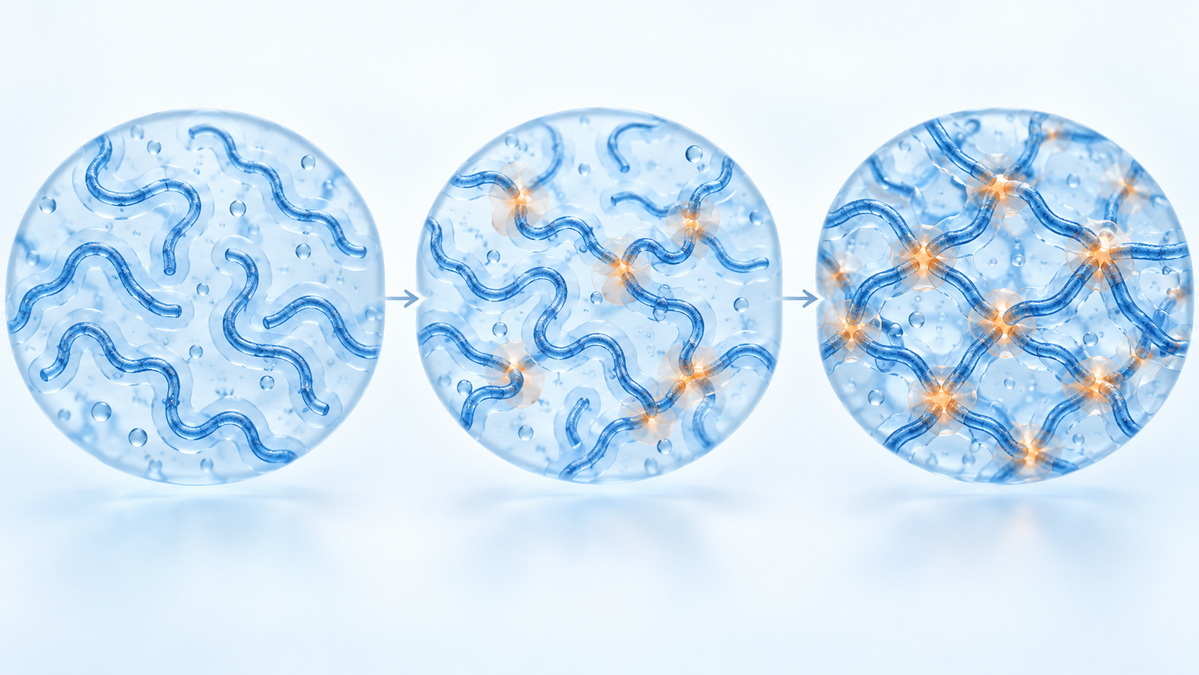
Broad temperature ranges can be useful for preliminary screening. They are less useful when their measurement conditions are missing.
Before comparing HEMC gelation temperature with HPMC gelation temperature, ask:
- Which grade was tested?
- What solution concentration was used?
- How was the solution prepared?
- What heating rate was applied?
- Which instrument and endpoint defined the transition?
- Was the result aggregation, clouding, or gelation?
A temperature without its test method is incomplete technical information.
Results from an aqueous solution also should not be assumed to describe the complete behavior of a cementitious mortar.
Open time is the interval after adhesive application during which tiles can be embedded and still achieve the required adhesion under the specified test conditions.
It concerns adhesive already spread on a substrate.
This differs from pot life, which concerns how long mixed adhesive remains usable before application. It also differs from setting behavior, which concerns the development of the hardened binder structure.
A mortar may remain workable in a mixing container while its spread surface no longer supports satisfactory delayed tile placement.
A visually moist surface does not establish acceptable open time.
Similarly, subjective tack or trowel feel cannot replace adhesion testing after delayed placement.
For a meaningful HEMC vs HPMC open-time comparison, manufacturers should evaluate the finished adhesive rather than relying only on solution viscosity or application impressions.
EN 12004-2:2017 includes methods for determining tile adhesive open time. It replaced EN 1346:2007, which still appears in older technical documents.
The standardized framework uses controlled conditions to improve comparability. These include temperature, relative humidity, and airflow controls.
Laboratory conditions help isolate formulation differences. They do not reproduce every installation environment.
Manufacturers should therefore distinguish between standardized compliance testing and additional internal trials intended to assess application robustness.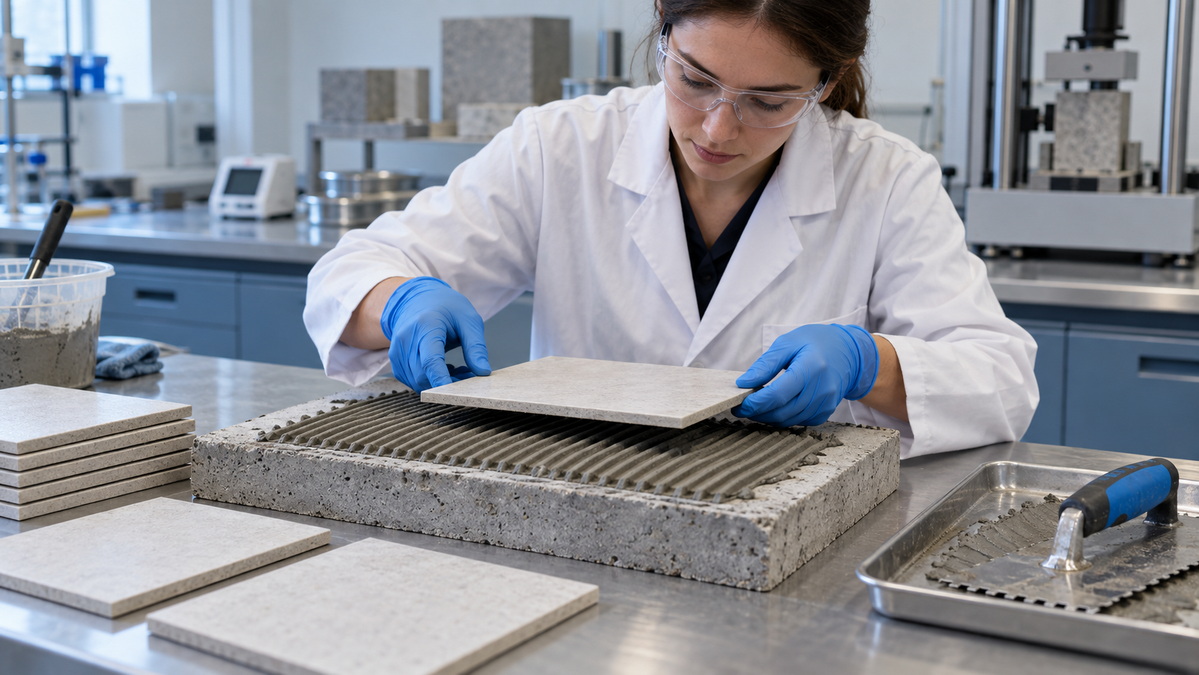
Gelation temperature and open time are related through formulation behavior, but they are not interchangeable measurements.
Cellulose ethers support water retention and rheological control in dry mortar. Their thermal response is consequently relevant when assessing performance under elevated temperatures.
Nevertheless, gelation temperature cannot independently predict the delayed-placement window of a complete adhesive.
A higher transition temperature can justify investigating a grade for demanding thermal conditions.
It does not establish that the grade will deliver:
- Longer open time.
- Higher adhesion strength.
- Lower slip.
- Better workability.
- Reduced additive consumption.
These outcomes depend on the complete formulation and must be measured.
The useful comparison follows three separate questions:
1. How does the polymer solution respond to heating?
2. How does the mortar behave during application?
3. Does delayed tile placement still achieve the required adhesion?
Each question needs appropriate evidence.
Temperature-related adhesive problems do not always indicate thermal gelation.
Water loss and surface drying can reduce the practical placement window before a cellulose ether reaches its characterized gelation transition.
When diagnosing a failure, examine:
- Actual mortar temperature.
- Substrate condition.
- Ambient humidity.
- Air movement.
- Surface drying.
- Mixing and application procedures.
The strongest troubleshooting question is not "Which polymer has the highest gel point?" It is "What caused delayed-placement adhesion to decrease?"
Neither cellulose ether should be selected solely by its abbreviation.
HEMC deserves consideration when thermal behavior is a major development priority. HPMC remains a valid candidate because its substitution chemistry and thermal response vary between grades.
| Development objective | Useful evaluation approach |
|---|---|
| Performance under warmer conditions | Compare matched grades in solution and mortar trials |
| Longer open time | Measure adhesion after defined placement delays |
| Vertical tile installation | Evaluate slip alongside open time |
| Replacement of an existing grade | Retest the complete formulation |
| Lower formulation cost | Compare the cost of meeting the full performance target |
Open time, slip, and adhesion should remain separate evaluation criteria.
An improvement in one property does not prove improvement in the others. Development work should identify the grade that delivers the required balance rather than maximizing a single laboratory value.
The following workflow is a practical development proposal, not a claim of completed company testing.
Specify the adhesive type, intended market, application environment, and required performance classification.
Separate formal compliance targets from internal development goals.
This prevents a successful screening trial from being mistaken for a certified performance result.
Use the same cement, aggregates, redispersible polymer powder, and other additives during the initial comparison.
Record:
- Cellulose ether dosage.
- Water addition.
- Mixing sequence.
- Mixing time.
- Resting procedure.
- Application method.
Avoid changing several variables simultaneously. Otherwise, it becomes difficult to identify why performance changed.
Use the same solution preparation and heating procedure for both candidates.
Where suitable equipment is available, compare viscosity and oscillatory rheological behavior.
Document the endpoint used to define the thermal transition. Do not compare a supplier's cloud-point result with another supplier's rheological gelation result as though they were identical.
Prepare the adhesive and place tiles after defined delays according to the applicable method.
Measure the resulting adhesion.
Do not substitute finger-touch testing, visual inspection, or an estimated surface-drying time for the required performance measurement.
Conduct separate internal trials that represent the intended application environment while respecting the finished adhesive's application limits.
Record mortar temperature, substrate temperature, humidity, and airflow.
Identify these results clearly as internal comparative testing unless they follow an applicable standardized procedure.
Review open time together with slip, adhesion, and application behavior.
Repeat promising comparisons to assess consistency.
The best candidate is the one that meets the intended performance requirements reliably, not necessarily the one with the highest viscosity or gelation temperature.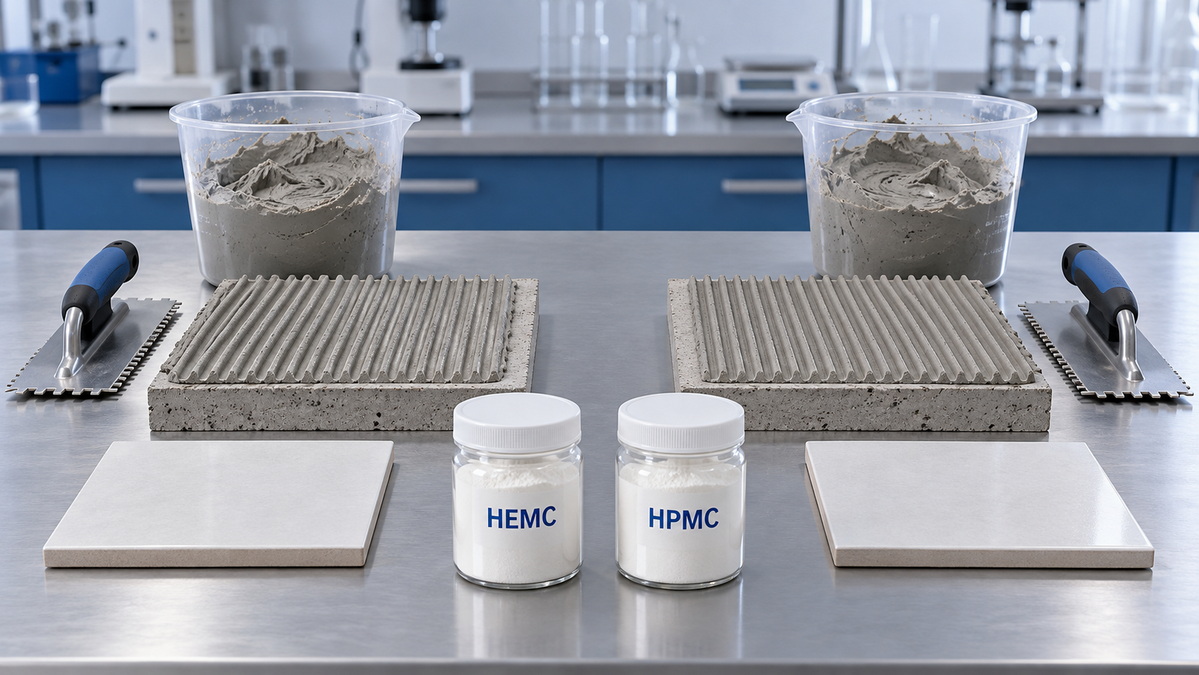
Consider a hypothetical adhesive that performs acceptably under controlled laboratory conditions but loses delayed-placement adhesion during a warmer internal trial.
Replacing HPMC with HEMC immediately may produce a different result. However, it would not necessarily explain the original failure.
A better investigation would:
1. Measure the actual mortar and substrate temperatures.
2. Compare these with the characterized thermal transition.
3. Examine surface drying and water loss.
4. Evaluate matched HEMC and HPMC candidates.
5. Repeat delayed-placement adhesion testing.
If an HEMC grade improves performance, document the result as specific to that grade, formulation, and test condition.
Do not convert one successful comparison into a universal statement that HEMC always provides longer open time.
Shandong Shengda New Material Co., Ltd. focuses on the research, development, production, and sale of HPMC, HEMC, and related cellulose ethers for construction and daily chemical applications.
For construction-grade selection, buyers should request information relevant to the intended mortar rather than relying on general product descriptions.
Useful documentation includes:
- Grade-specific technical information.
- Defined viscosity measurement methods.
- Available thermal characterization.
- Representative samples.
- Batch-quality information.
- Application-relevant evaluation data.
Daily chemical applications require separate assessment. Successful tile adhesive performance does not establish suitability for a different formulation.
Likewise, sustainability claims should be supported by relevant documentation rather than inferred from product functionality alone.
The central lesson in HEMC vs HPMC is that thermal behavior and open time must be evaluated together without treating them as equivalent.
HEMC may offer a higher gelation temperature than certain HPMC grades. However, finished-mortar performance depends on the specific polymer, formulation, and application conditions.
A reliable selection combines clearly defined thermal measurements with delayed-placement adhesion testing and a balanced assessment of application behavior.
Contact Shandong Shengda New Material Co., Ltd. with your intended application, target market, current formulation constraints, and open-time requirement. Request suitable HEMC and HPMC samples for a matched evaluation before approving a production-scale change.
No universal ranking should be assumed. Comparative research found higher transition temperatures in the HEMC samples examined, but substitution chemistry influenced the results. Compare specific grades using consistent methods.
No. Gelation temperature characterizes polymer thermal behavior. Open time evaluates delayed tile placement and adhesion in the finished adhesive. One measurement cannot replace the other.
These abbreviations commonly refer to hydroxyethyl methyl cellulose and methyl hydroxyethyl cellulose. Confirm the exact grade and specification because the abbreviation does not define performance.
An equal-dosage trial can provide an initial comparison, but it does not prove interchangeability. Reevaluate water addition, open time, slip, adhesion, and application behavior before approving the substitution.
EN 1346:2007 was replaced by EN 12004-2:2017, which includes open-time determination. Check the applicable standard edition and market requirements before making compliance claims.
No. Viscosity does not independently establish thermal behavior or finished-adhesive performance. Select a grade based on the required balance of open time, application consistency, slip, and adhesion.
1. Yoo, Y. J., and Um, I. C. (2013). ["Examination of thermo-gelation behavior of HPMC and HEMC aqueous solutions using rheology."] *Korea-Australia Rheology Journal*, 25, 67–75. DOI: 10.1007/s13367-013-0007-8. Supports the comparison of thermal transitions, the distinction between aggregation and gelation, and the influence of substitution chemistry. [link.springer]
2. ["Effect on the Thermo-Gelation Process of the Degree and Molar Substitution."] *Macromolecular Symposia* (2022). DOI: 10.1002/masy.202100277. Discusses HPMC thermal gelation and the relevance of degree and molar substitution. [onlinelibrary.wiley]
3. ["A thermorheological investigation into the gelation and phase separation of hydroxypropyl methylcellulose aqueous systems."] *Polymer* (2002). Examines the concentration and substitution dependence of HPMC thermal behavior. [sciencedirect]
4. European Committee for Standardization. [EN 12004-2:2017: "Adhesives for ceramic tiles — Part 2: Test methods."] Standards catalogue record identifying the replacement of EN 1346:2007 and describing tile adhesive testing. The complete official standard should be used for laboratory procedures and compliance assessment. [standards.iteh]
5. [US20110281970A1: "Cellulose ether composition for dry mortar formulations."] Published patent application (2011). Provides technical context on cellulose ether functions, open time, and the balance between slip resistance and other mortar properties. Patent disclosures do not establish universal performance for commercial grades. [patents.google]
6. Celotech. ["How Temperature Affects Cement-Based Tile Adhesives."] (2025). Supplier technical discussion offering application context on temperature and moisture-related adhesive behavior. It supplements, rather than replaces, standardized testing and peer-reviewed research. [celotech]


