


close
Choose Your Site
Global
Social Media
Views: 265 Author: Shengda Publish Time: 2026-10-15 Origin: Site


Content Menu
● Is Cellulose a Natural or Synthetic Polymer?
● Why Cellulose Is Classified as a Natural Polymer
>> Where Commercial Cellulose Comes From
>> Why Ordinary Cellulose Does Not Dissolve in Water
● Natural Cellulose, Regenerated Cellulose, and Cellulose Derivatives
>> Does Chemical Modification Remove the Natural Origin?
● Is Hydroxyethyl Cellulose Natural or Synthetic?
>> How Hydroxyethyl Modification Changes Performance
>> Why HEC Grades Are Not Interchangeable
● How HEC Works in Construction and Personal Care Products
>> Construction and Water-Based Coatings
>> Personal Care and Daily Chemical Formulations
● A Five-Step Process for Selecting the Right HEC Grade
>> 1. Define the Finished Product Requirements
>> 2. Request Comparable Supplier Documentation
>> 3. Test in the Actual Formulation
>> 4. Evaluate Performance Over Time
>> 5. Verify Production-Scale Processing
● Why HEC Forms Lumps During Mixing
>> A Practical Troubleshooting Checklist
● Is Cellulose-Derived HEC Automatically Sustainable?
>> Renewable Origin Is Not the Same as Biodegradability
>> What Evidence Should Buyers Request?
● Conclusion: Connect Cellulose Chemistry with Practical Performance
>> Is Cellulose a Natural or Synthetic Polymer?
>> Is Hydroxyethyl Cellulose the Same as Cellulose?
>> Can HEC Be Called a Natural Ingredient?
>> Does HEC Dissolve in Cold Water?
>> Is Every HEC Grade Suitable for Personal Care?
>> Does Cellulose Origin Guarantee HEC Biodegradability?
Cellulose is a natural polymer produced by living organisms, particularly plants. It forms an important part of plant cell walls, providing structural strength through long chains of repeating glucose-derived units.
However, not every cellulose-based material is chemically identical to native cellulose. Hydroxyethyl cellulose, commonly abbreviated as HEC, undergoes chemical modification to develop properties that ordinary cellulose does not provide.
For construction material manufacturers, personal care formulators, and international buyers, this distinction has practical consequences. It explains differences in water solubility, thickening behavior, processing requirements, and the evidence needed to support environmental claims.
At Shandong Shengda New Material Co., Ltd., we focus on developing, manufacturing, and supplying HEC for construction and daily chemical applications. Understanding the relationship between cellulose and HEC helps customers make more informed formulation and purchasing decisions.
A polymer is a large molecule built from repeating structural units. Cellulose consists of glucose-derived units connected through β-1,4-glycosidic bonds.
Plants produce these chains biologically. Industrial processing extracts cellulose from raw materials rather than creating its original backbone through conventional synthetic polymerization.
Wood pulp and cotton are important commercial cellulose sources. Their cellulose content differs, and extraction and purification processes influence the quality of the resulting material.
Raw biomass also contains other components. Processing removes unwanted substances to obtain cellulose suitable for subsequent manufacturing.
This separation does not make cellulose synthetic. Its polymer chains still originate from biological production.
Cellulose contains hydroxyl groups that interact with water, but native cellulose is not ordinarily water-soluble.
Strong interactions between neighboring chains and the organized structure of cellulose make dissolution difficult. Water can wet or swell cellulose without separating its chains into a conventional dissolved polymer solution.
This is why adding cellulose fibers to water does not produce the same result as adding a suitable water-soluble cellulose ether.
Chemical modification changes those interactions and enables different properties.
"Cellulose-based" describes a broad family of materials. Buyers should distinguish the polymer's origin from the processing used to create the finished ingredient.
| Material | Practical classification | What makes it different? |
|---|---|---|
| Native cellulose | Natural polymer | Biologically produced cellulose chains |
| Regenerated cellulose | Processed cellulose | Cellulose is dissolved and reformed |
| Hydroxyethyl cellulose | Chemically modified cellulose ether | Hydroxyethyl groups are introduced |
| Cellulose acetate | Chemically modified cellulose ester | Acetate groups modify the cellulose structure |
Regeneration and chemical derivatization are different processes. Regenerated cellulose is reformed from dissolved cellulose, while derivatives contain intentional chemical changes to the original structure.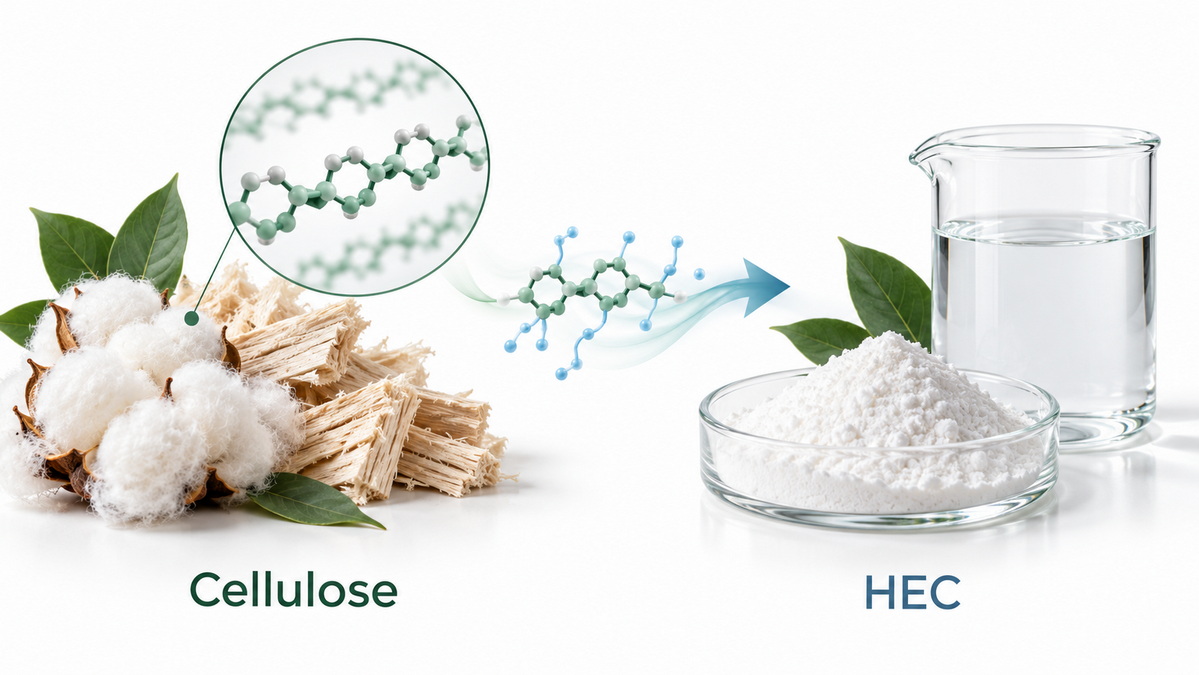
No. The starting cellulose still has a biological origin. However, the finished derivative is no longer chemically identical to native cellulose.
Descriptions such as "cellulose-derived polymer" or "chemically modified cellulose" communicate this distinction more clearly than an unqualified "natural" label.
"Semi-synthetic" is also used to describe polymers manufactured by modifying naturally occurring materials.
For technical communication, the most useful approach is to explain both the source and the transformation.
Hydroxyethyl cellulose is a chemically modified, natural-origin cellulose ether.
It is manufactured by reacting alkali-treated cellulose with ethylene oxide under controlled conditions. This introduces hydroxyethyl functionality while retaining the cellulose backbone.
Therefore, HEC is not unmodified natural cellulose. Equally, describing it simply as an entirely synthetic polymer overlooks its cellulose origin.
Hydroxyethyl substitution changes how cellulose chains interact with water and with one another.
Suitable modification enables HEC to dissolve in water and develop useful viscosity. This turns a naturally sourced structural polymer into a functional ingredient for water-based formulations.
HEC is also nonionic. Unlike charged cellulose derivatives, it does not carry ionic groups along its structure.
This characteristic supports compatibility with a broad range of ingredients. However, it does not guarantee compatibility with every concentration of salts, surfactants, or other formulation components.
HEC is a polymer family rather than one universal specification.
Commercial grades may differ in:
- Viscosity characteristics.
- Molecular weight.
- Hydroxyethyl substitution.
- Particle properties.
- Surface treatment.
- Dispersion and hydration behavior.
Some grades are surface-treated to delay hydration, allowing the powder to disperse before substantial viscosity develops.
Two products with the same ingredient name can therefore behave differently during manufacturing. Grade-specific documentation matters more than the name alone.
HEC's value comes from its ability to modify the water phase of a formulation.
It can provide thickening and rheology modification. Rheology describes how a material flows and changes shape under applied forces.
In water-based coatings, viscosity affects mixing, handling, and application.
HEC solutions can show shear-thinning behavior: viscosity decreases as shear increases. This is relevant when a formulation must move during mixing or application but behave differently at rest.
A useful evaluation should consider:
- Powder incorporation.
- Hydration time.
- Application consistency.
- Flow and leveling.
- Compatibility with the binder and pigment package.
- Viscosity stability during storage.
These are evaluation criteria, not guaranteed outcomes for every grade.
The complete formulation determines performance. Testing HEC in water alone cannot establish how it will behave in a finished coating.
HEC can support aqueous thickening in personal care and daily chemical products.
The preferred grade depends on the desired texture, appearance, and ingredient system. A transparent gel, liquid cleanser, and opaque cream may require different performance characteristics.
Buyers should not assume that a construction-grade product is suitable for personal care.
Instead, request application-appropriate specifications, quality documentation, and evidence that the proposed grade meets the intended product requirements.
For a formulator, the most useful question is not only "Is this polymer natural?" It is also "Will this grade perform consistently in my product?"
The following process provides a practical framework for comparison.
Document the application, target appearance, desired flow, and manufacturing constraints.
Identify the main priority:
- Easy pumping.
- Controlled application.
- Transparent appearance.
- Desired texture.
- Storage stability.
A clear target prevents grade selection from becoming a comparison of isolated viscosity numbers.
Ask for:
- Technical data sheet.
- Safety data sheet.
- Certificate of analysis.
- Viscosity specification and measurement method.
- Recommended incorporation procedure.
- Application-specific quality information.
A viscosity value is incomplete without test conditions.
Compare solution concentration, temperature, instrument, and measurement settings before treating two supplier specifications as equivalent.
Evaluate candidate grades with the ingredients used in production.
Surfactants, salts, pigments, binders, and other additives can influence the finished result. Broad compatibility does not eliminate the need for formulation-specific testing.
Keep preparation conditions consistent so differences between samples remain meaningful.
Measure initial properties, then repeat the assessment after a defined storage period.
Track viscosity, appearance, separation, and application behavior.
Select storage conditions relevant to distribution and use. A single initial viscosity measurement does not establish long-term stability.
A successful laboratory sample is an important milestone, but it does not complete qualification.
Confirm the mixing sequence, hydration time, and handling behavior at a scale representative of manufacturing.
Establish acceptance criteria and batch documentation before routine purchasing. The objective is repeatable finished-product performance.
Powder can become difficult to disperse when its surface hydrates before the individual particles separate.
Delayed-hydration surface treatments help address this issue by allowing initial dispersion before substantial thickening occurs.
However, incorporation conditions remain grade-dependent.
When lumps appear:
1. Confirm the exact grade and surface treatment.
2. Review the supplier's recommended addition procedure.
3. Check powder addition rate and mixing conditions.
4. Record water temperature and pH.
5. Allow the specified hydration time before evaluating viscosity.
Increasing dosage should not be the first response to poor dispersion.
Likewise, avoid copying the preparation method used for another cellulose ether without checking whether it applies to the selected HEC grade.
For effective technical support, provide the formula, batch size, mixer configuration, addition sequence, and observed problem.
Cellulose provides a renewable starting material. That is an important attribute, but it does not establish every environmental characteristic of HEC.
Feedstock origin, manufacturing inputs, product performance, and end-of-life behavior are separate considerations.
"Bio-based," "biodegradable," and "compostable" describe different properties.
A renewable feedstock does not prove how quickly a finished derivative will degrade in water, soil, or a managed treatment system.
Similarly, water solubility means a substance can dissolve. It does not demonstrate complete biological breakdown.
Research on cellulose derivatives shows why chemical modification and testing conditions matter. Environmental conclusions should apply to the specific material being assessed.
When reviewing an environmental claim, ask:
- Which exact grade was tested?
- What method was used?
- Under what conditions?
- What result and timeframe were reported?
- Does the evidence concern the ingredient or the finished product?
Broader comparisons should also consider sourcing, processing, transport, and the amount required to achieve the intended function.
Without appropriate evidence, avoid claims such as "100% natural," "fully biodegradable," or "zero environmental impact."
Cellulose is a natural polymer. HEC is a chemically modified cellulose derivative designed to provide useful water-based performance.
Understanding this distinction helps buyers describe ingredients accurately, compare grades meaningfully, and evaluate environmental statements responsibly.
For construction and daily chemical products, successful selection requires more than a familiar ingredient name. It requires suitable specifications, controlled processing, and testing in the finished formulation.
Contact Shandong Shengda New Material Co., Ltd. with your application, target viscosity, ingredient system, and mixing conditions. Discuss an appropriate HEC grade and request technical documentation and samples for validation before commercial adoption.
Cellulose is a natural polymer produced biologically. Its chains contain repeating glucose-derived units. Industrial extraction does not change its biological origin.
No. HEC contains chemical modifications that distinguish it from native cellulose. Those modifications enable useful water solubility and thickening behavior.
"Cellulose-derived" or "chemically modified natural-origin polymer" is more precise. Whether another description is acceptable depends on the applicable definition and supporting documentation.
Commercial HEC grades can dissolve in cold or hot water. However, dispersion procedure and hydration rate depend on the grade, especially when surface treatment is present.
No assumption should be made from the ingredient name alone. Suitability should be established through intended-use information, specifications, and relevant quality documentation.
No. Chemical modification can influence degradation. Claims should rely on evidence applicable to the specific grade and environmental conditions.
1. "Is Cellulose a Natural or Synthetic Polymer?" Original article, April 24, 2024. Background source for the initial explanation of cellulose's natural origin. [ihpmc]
2. Aziz, T., et al. "A Review on the Modification of Cellulose and Its Applications." *Polymers*, 2022, 14(15), 3206. DOI: 10.3390/polym14153206. Scientific background on cellulose structure, sources, and chemical modification. [pmc.ncbi.nlm.nih]
3. Ashland. "Natrosol™ Hydroxyethylcellulose." Technical background on HEC manufacture, nonionic character, water solubility, and personal care applications. Describes Ashland products rather than independently verified performance of Shandong Shengda products. [ashland]
4. Ashland. "Natrosol™ 250 Hydroxyethylcellulose (HEC): Formulating Elegant Liquid and Semisolid Drug Products." Technical information on substitution, solubility, and compatibility. Used for general polymer chemistry, not to imply pharmaceutical suitability of the products discussed here. [ashland]
5. Ashland. "Natrosol™ 250 HHRP Hydroxyethylcellulose." Technical explanation of surface treatment and delayed hydration. [ashland]
6. "Degradation of Cellulose Derivatives in Laboratory, Man-Made, and Natural Environments." *Biomacromolecules*, 2022, 23(7), 2713–2729. DOI: 10.1021/acs.biomac.2c00336. Background on the relationship between cellulose modification and degradation behavior. [pubs.acs]
7. Bading, M., Olsson, O., and Kümmerer, K. "Analysis of Environmental Biodegradability of Cellulose-Based Pharmaceutical Excipients in Aqueous Media." *Chemosphere*, 2024. Evidence supporting material-specific, condition-specific biodegradability assessment. Does not establish biodegradability of Shandong Shengda HEC grades. [sciencedirect]
8. Celotech. "Introduction and Classification of Cellulose-Based Polymers." December 17, 2021. Supplementary industry background on natural, regenerated, and chemically modified cellulose-based materials. [celotech]


