


close
Choose Your Site
Global
Social Media
Views: 249 Author: Shengda Publish Time: 2026-09-23 Origin: Site


Content Menu
● What Is Hydroxyethyl Methylcellulose?
● Why HEMC Selection Matters in Pharmaceutical Development
>> Critical Material Attributes to Evaluate
● HEMC as a Thickening Agent in Pharmaceutical Liquids
>> Viscosity Must Be Evaluated Under Real Conditions
● HEMC for Suspension Stability and Redispersibility
>> How to Evaluate HEMC in an Oral Suspension
● HEMC in Topical Pharmaceutical Formulations
>> Important Considerations for Topical Systems
● HEMC and Film Formation for Solid Dosage Forms
>> Factors That Influence Coating Performance
● HEMC and Modified-Release Formulation Research
>> A Practical Development Approach
● HEMC, HPMC, HEC and Other Cellulose Ethers
● Quality Control and Supplier Qualification
>> Why Batch Consistency Is Essential
● A Better Framework for Selecting HEMC
>> Step 1: Define the Product Requirement
>> Step 2: Identify Critical Performance Targets
>> Step 3: Screen Multiple Grades
>> Step 4: Evaluate the Full Formula
>> Step 5: Confirm Manufacturing Fit
>> Step 6: Verify Stability and Documentation
>> What is Hydroxyethyl Methylcellulose used for in pharmaceutical formulations?
>> Can HEMC improve oral suspension stability?
>> Does higher HEMC viscosity always provide better suspension performance?
>> Can HEMC be used in topical gels and creams?
>> Can HEMC be used for tablet coating?
>> Can HEMC create a controlled-release tablet?
>> What should buyers request from a cellulose ether supplier?
Hydroxyethyl Methylcellulose (HEMC) is a versatile non-ionic cellulose ether that can support viscosity control, suspension stability, film formation, and formulation consistency in selected pharmaceutical systems. Its water-responsive behavior makes it an important material for formulators developing oral liquids, topical preparations, coated tablets, and other dosage forms that require reliable rheological performance.
In pharmaceutical development, a cellulose ether is not selected simply because it can thicken water. The right material must support the desired dosage form, manufacturing method, storage conditions, active pharmaceutical ingredient characteristics, and patient-use requirements. HEMC can provide useful functionality, but successful use depends on grade selection, material qualification, compatibility testing, and consistent quality control.
For pharmaceutical manufacturers, the most important consideration is not whether HEMC can perform a general function. It is whether a specific HEMC grade can deliver that function consistently throughout production, storage, distribution, and patient use.
Hydroxyethyl Methylcellulose, commonly known as HEMC, is a chemically modified cellulose polymer. It is produced by introducing hydroxyethyl and methyl groups onto the natural cellulose backbone. These modifications improve the polymer's hydration behavior, water dispersibility, viscosity-building ability, and film-forming properties.
Like other cellulose ethers, HEMC can absorb water and create a structured system in aqueous formulations. Depending on the grade, concentration, processing conditions, and surrounding ingredients, it may help control flow behavior, reduce particle settling, improve product texture, or support coating performance.
HEMC belongs to a broader group of functional cellulose derivatives used across pharmaceutical, personal-care, food, construction, and industrial applications. Common related materials include:
- Hydroxypropyl Methylcellulose (HPMC)
- Methylcellulose (MC)
- Hydroxyethyl Cellulose (HEC)
- Ethyl Cellulose (EC)
- Hydroxypropyl Cellulose (HPC)
- Sodium Carboxymethyl Cellulose (CMC)
- Methyl Hydroxyethyl Cellulose (MHEC)
Although these materials belong to the same chemical family, they should not be treated as direct replacements for one another. Their molecular structures, substitution patterns, hydration rates, viscosity behavior, solubility, film properties, and formulation performance can differ.
In a drug product, an excipient may be considered inactive from a therapeutic perspective, but it can have an active influence on product quality. The selected polymer can affect how a liquid flows, how a suspension redistributes after shaking, how a coating forms around a tablet, how a gel feels on the skin, and how consistently a medicine performs over its shelf life.
A well-selected HEMC grade may contribute to:
- Improved viscosity control
- Better suspension stability
- Enhanced redispersibility
- More consistent topical product texture
- Improved film-forming performance
- Better processing control during mixing
- Reduced risk of visible phase separation
- More uniform product appearance
- Improved patient handling and dosing experience
However, the same cellulose ether can behave differently when combined with various active ingredients, preservatives, buffers, salts, sweeteners, surfactants, solvents, pigments, or oils. This is why formulation testing is essential.
Before using HEMC in a pharmaceutical formulation, development teams should evaluate the properties most likely to influence product performance.
| Material Attribute | Why It Is Important |
|---|---|
| Chemical identity | Confirms that the intended cellulose ether chemistry is being used |
| Viscosity grade | Affects flow behavior, suspension performance, coating properties, and gel structure |
| Degree of substitution | Can influence hydration, solubility, and polymer interaction with other ingredients |
| Particle size | Affects dispersion speed, dust control, mixing uniformity, and hydration time |
| Moisture content | May influence flowability, storage stability, and compatibility with moisture-sensitive ingredients |
| Microbiological quality | Important for oral and topical non-sterile dosage forms |
| Residual impurities | Must be evaluated according to product-specific safety and quality requirements |
| Batch consistency | Supports reproducible manufacturing and stable finished-product performance |
| Storage stability | Helps ensure the material remains functional before and during production |
A supplier's technical data sheet can provide a useful starting point, but the final decision should be based on testing in the actual formulation.
One of the most recognized functions of Hydroxyethyl Methylcellulose is viscosity modification. HEMC can help increase the viscosity of water-based systems, making it useful for products that require a more controlled flow profile.
In pharmaceutical liquids, viscosity affects much more than appearance. It can influence how easily a product is poured, how well suspended particles remain distributed, how comfortably a patient swallows an oral liquid, and how accurately the product can be dosed using a spoon, cup, syringe, or dropper.
Common dosage forms that may require viscosity control include:
- Oral suspensions
- Oral syrups
- Antacid liquids
- Pediatric liquid medicines
- Topical gels
- Creams and lotions
- Dermatological preparations
- Ophthalmic-related formulation research systems
- Coating dispersions
- Nutraceutical liquid products
A formulation that is too thin may allow insoluble particles to settle quickly. A formulation that is too thick may be difficult to pour, pump, fill, or dose accurately. The goal is therefore not the highest possible viscosity. The goal is a viscosity profile that supports stability, manufacturability, and patient use.
A nominal viscosity value measured in water does not always predict behavior in a finished pharmaceutical product. The final rheology can be changed by many formulation variables, including:
- pH
- Temperature
- Electrolytes
- Preservatives
- Surfactants
- Sweeteners
- Flavor systems
- Cosolvents
- Active ingredient loading
- Mixing speed
- Processing sequence
- Storage time
For this reason, formulators should test HEMC in the complete formulation rather than only in purified water.
A practical screening program may include:
1. Preparing laboratory batches with different HEMC concentrations.
2. Measuring viscosity at controlled temperatures and shear rates.
3. Observing hydration speed and checking for lumps or undispersed particles.
4. Evaluating flow behavior after mixing and deaeration.
5. Measuring viscosity after short-term stress and storage.
6. Confirming that the product remains easy to pour and dose.
7. Repeating the evaluation with different material batches.
This process helps identify a grade that offers reliable performance under real production conditions.
Suspensions contain solid particles dispersed in a liquid vehicle. These particles may gradually settle during storage, especially when the active ingredient is insoluble or only slightly soluble in the formulation medium.
If sediment forms too quickly or becomes difficult to redisperse, the patient may receive an inconsistent dose. This makes suspension design one of the most important practical uses of rheology-modifying polymers.
HEMC may help support suspension stability by increasing the viscosity of the liquid phase and creating a structured environment around suspended particles. This can slow sedimentation while allowing the product to flow when shaken, poured, or drawn into a dosing device.
The ideal suspension often has shear-thinning behavior:
- At rest, the formulation has sufficient structure to reduce particle settling.
- During shaking, pouring, pumping, or dosing, the formulation becomes easier to move.
- After the stress is removed, the structure can recover and support particle suspension again.
This balance can improve both physical stability and user experience.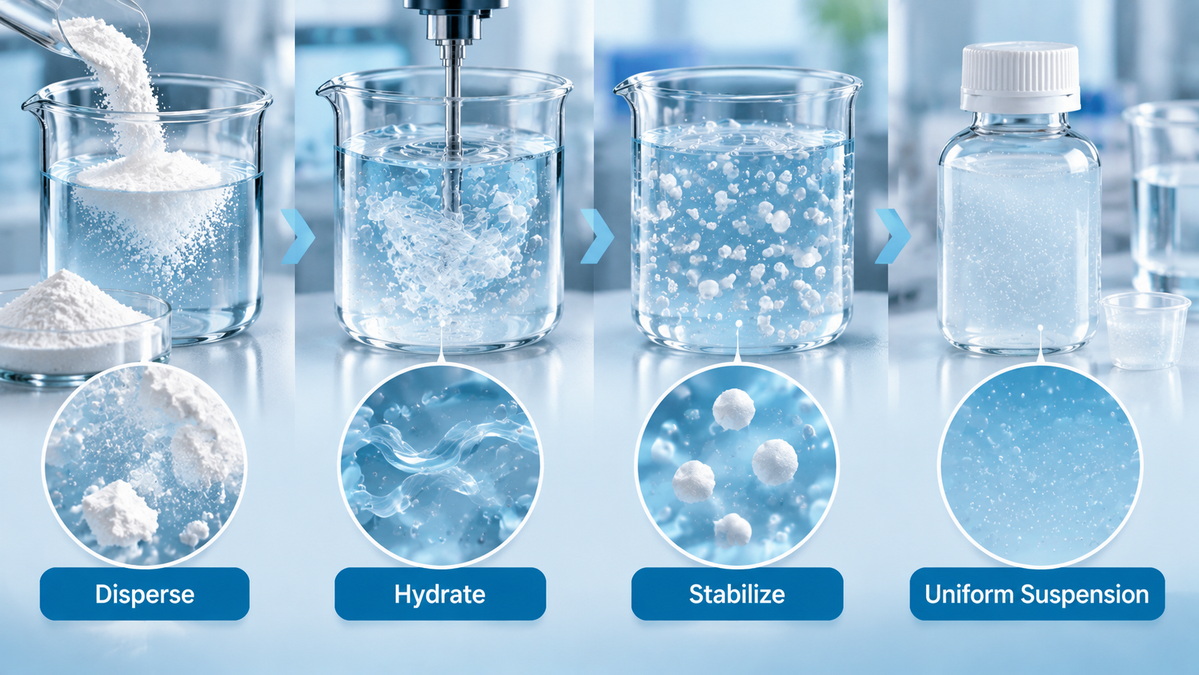
A strong suspension-development program should evaluate more than appearance. A bottle may look acceptable while still delivering inconsistent doses after storage.
Useful tests include:
- Sedimentation volume measurement
- Redispersibility after storage
- Number of inversions required for uniform mixing
- Viscosity before and after storage
- Dose uniformity from the top, middle, and bottom of the bottle
- Particle-size distribution
- Appearance under temperature cycling
- Pourability and syringeability
- Compatibility with preservatives
- Stability after repeated opening and closing
- Assay consistency after simulated patient shaking
Topical products often require controlled viscosity, smooth texture, uniform drug distribution, and acceptable sensory properties. HEMC can be considered for water-based gels, creams, lotions, and other dermatological systems where rheology is important.
A topical formulation should be easy to remove from the package, spread evenly across the skin, and remain physically stable during storage. The rheology modifier may influence whether the product feels light, rich, smooth, sticky, watery, stringy, or difficult to spread.
In topical products, HEMC may contribute to:
- Improved gel structure
- Better viscosity control
- Reduced phase separation
- Improved active ingredient suspension
- Enhanced application consistency
- Smoother product appearance
- Improved skin-feel balance
- Better product retention on the application area
The final sensory profile depends on the complete system. For example, humectants, oils, emulsifiers, surfactants, preservatives, fragrances, active ingredients, and pH adjusters may all affect the way a cellulose ether performs.
When assessing HEMC for a topical product, development teams should consider:
- Desired viscosity at room temperature and under warm conditions
- Spreadability on the skin
- Appearance and clarity
- Potential interactions with electrolytes
- Compatibility with emulsifier systems
- Stability after freeze-thaw cycling
- Changes in viscosity during shelf-life testing
- Active ingredient distribution
- Consumer sensory feedback
- Packaging compatibility
For high-value dermatological or medicated topical products, the best polymer choice is usually the one that provides a balance of stability, appearance, spreadability, and controlled delivery from the package.
Cellulose ethers are often associated with film-forming applications because they can create polymer films around tablets, granules, pellets, or other solid dosage forms. A film coating may improve a product's appearance, reduce dusting, enhance swallowability, protect the core from environmental exposure, or help separate incompatible ingredients.
Depending on the intended coating system, a cellulose ether may contribute to the formation of a smooth and continuous film. The quality of that film depends on both polymer selection and process control.
A successful coating system should aim to avoid:
- Cracking
- Peeling
- Chipping
- Tablet sticking
- Rough surfaces
- Uneven color
- Poor adhesion
- Delayed dissolution
- Inconsistent coating weight
| Formulation or Process Factor | Potential Effect on Film Quality |
|---|---|
| Polymer concentration | Can influence coating solution viscosity and sprayability |
| Plasticizer level | Can affect film flexibility and cracking resistance |
| Pigment dispersion | Can affect color uniformity and surface smoothness |
| Spray rate | Can influence overwetting, drying, and coating uniformity |
| Atomization conditions | Can affect droplet size and surface coverage |
| Tablet core quality | Can influence coating adhesion and risk of edge chipping |
| Inlet air temperature | Can influence drying efficiency and film formation |
| Pan speed | Can affect mixing, coating distribution, and tablet movement |
| Coating weight gain | Can affect appearance, protection, and dissolution behavior |
A coating polymer should be evaluated through laboratory and pilot-scale trials. Visual assessment alone is not sufficient. The coated dosage form should also be tested for dissolution, storage stability, mechanical durability, and appearance after transportation simulation where relevant.
Hydrophilic cellulose ethers may influence drug-release behavior when they hydrate and form a gel-like matrix around a tablet or granule. Water enters the dosage form, the polymer begins to swell, and drug release may be affected by diffusion through the hydrated layer, polymer erosion, tablet structure, and the solubility of the active ingredient.
This type of mechanism is important in modified-release formulation research. However, it is essential to understand that controlled release is not determined by the polymer name alone.
The following variables may influence release behavior:
- Polymer chemistry
- Polymer viscosity grade
- Polymer concentration
- Active ingredient solubility
- Active ingredient particle size
- Tablet hardness
- Compression force
- Drug loading
- Filler selection
- Lubricant concentration
- Tablet porosity
- Granulation method
- Dissolution medium
- Storage conditions
A formulation containing a hydrophilic cellulose ether may show different release patterns depending on whether the active ingredient is highly soluble, poorly soluble, acidic, basic, hydrophilic, or hydrophobic.
For any modified-release project, development teams should establish a clear target release profile before selecting the polymer system.
A practical approach includes:
1. Define the desired release window and test conditions.
2. Select several candidate polymer grades or concentrations.
3. Produce small-scale prototype batches.
4. Measure tablet hardness, friability, disintegration, and dissolution.
5. Compare release profiles under different pH conditions.
6. Evaluate the impact of compression force and manufacturing method.
7. Conduct stability testing on selected prototypes.
8. Confirm that the final formula remains reproducible at pilot scale.
It is important not to claim sustained, delayed, or controlled release until the finished dosage form has demonstrated consistent dissolution performance under relevant conditions.
Cellulose ethers are often discussed together, but selecting the correct one requires understanding their different functional roles.
| Cellulose Ether | General Functional Profile | Key Development Consideration |
|---|---|---|
| HEMC | Viscosity modification, rheology control, suspension support, water retention, potential film formation | Grade-specific hydration and compatibility performance |
| HPMC | Commonly used for coating, binding, viscosity control, and matrix-forming applications | Substitution type, viscosity grade, dissolution performance |
| HEC | Often selected for aqueous thickening and rheology control | Clarity, electrolyte response, topical sensory characteristics |
| EC | Water-insoluble polymer used in some coating and release-modification systems | Permeability, film integrity, plasticizer selection |
| HPC | Can provide binding, film-forming, and solubility-related functions | Solvent system compatibility and process behavior |
| CMC | Can provide viscosity and suspension support in selected systems | Ionic interactions and electrolyte sensitivity |
| MHEC | Provides rheology and water-retention properties in multiple industrial applications | Specific grade documentation and application suitability |
The best selection is not always the polymer with the highest viscosity or the lowest cost. It is the material that meets the required performance profile while remaining stable, processable, well-documented, and consistent across batches.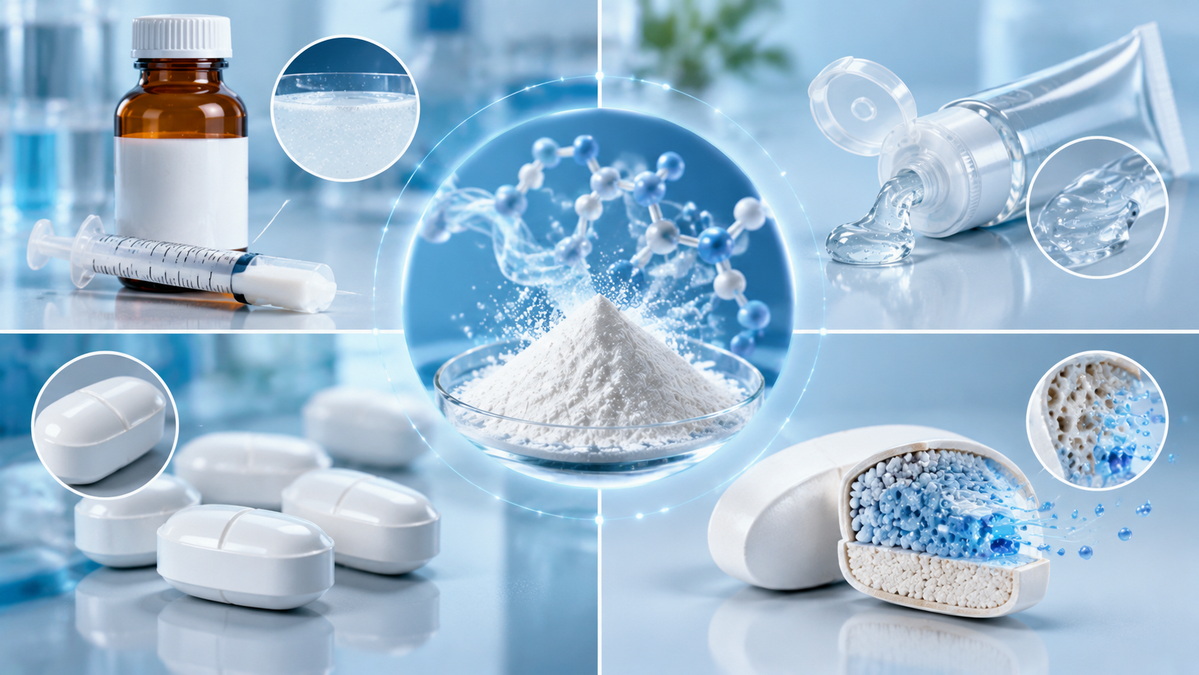
Selecting a cellulose ether supplier requires more than reviewing a specification sheet. A reliable pharmaceutical development program should evaluate the supplier's ability to provide consistent material quality, traceability, technical communication, and change-control support.
For a cellulose ether intended for pharmaceutical development, buyers should request detailed information about:
- Material identity
- Product specifications
- Typical viscosity range
- Moisture content
- Particle-size information
- Microbiological limits
- Residual impurities
- Packaging materials
- Storage conditions
- Shelf life
- Batch traceability
- Certificate of analysis availability
- Manufacturing controls
- Change-notification procedures
- Quality-management practices
- Relevant regulatory-support documentation
- Sampling and retention procedures
A small change in polymer viscosity, particle size, moisture content, or substitution pattern may influence the final product. For an oral suspension, this could affect settling and redispersibility. For a gel, it could change texture and spreadability. For a coating system, it could alter sprayability or film integrity. For a matrix tablet, it could shift the dissolution profile.
For this reason, formulation teams should test more than one batch during development whenever possible. Early multi-batch assessment can identify risks before commercial scale-up.
A structured material-selection process can reduce development risk and improve communication between formulators, procurement teams, and suppliers.
Start with the dosage form and intended function.
Ask:
- Is the goal to thicken a liquid?
- Is the product a suspension that requires redispersibility?
- Is a smooth topical gel required?
- Is the polymer being evaluated for film formation?
- Is modified release being explored?
- Does the product need to remain pourable?
- Is visual clarity important?
- Will the formulation contain salts, surfactants, oils, or solvents?
Translate the product requirement into measurable targets.
Examples include:
- Target viscosity range
- Sedimentation volume
- Redispersibility time
- Coating weight gain
- Film flexibility
- Dissolution profile
- Spreadability
- Microbiological limits
- Stability after temperature cycling
- Appearance after storage
Do not rely on a single grade during early development. Compare several candidate grades with different viscosity ranges or particle characteristics.
This provides a better understanding of the formulation window and helps identify a more robust design.
Test the polymer in the actual formula, including the active ingredient and all functional additives. A polymer that performs well in water may behave differently in the presence of salts, acids, bases, preservatives, surfactants, or high drug loading.
Laboratory success does not always translate to commercial production. Check mixing time, dispersion behavior, powder handling, dust generation, pumping, filling, coating performance, and cleaning requirements.
The final material selection should be supported by stability studies, quality records, supplier documentation, and product-specific evaluation.
Hydroxyethyl Methylcellulose can offer useful functionality in pharmaceutical formulation research and product development, particularly where viscosity control, suspension stability, rheology modification, topical texture, or film-forming performance is required.
Its value lies not simply in its ability to thicken a system. The real value comes from selecting the correct grade, understanding its interaction with the full formulation, controlling critical material attributes, and confirming consistent performance during manufacturing and storage.
For pharmaceutical manufacturers, formulators, and sourcing teams, the most reliable approach is evidence-based selection. Evaluate HEMC according to the intended dosage form, formulation target, process conditions, and quality requirements. A carefully qualified cellulose ether can help improve product stability, manufacturability, appearance, and user experience.
Shandong Shengda New Material Co., Ltd. is committed to the research, development, production, and supply of cellulose ether solutions, including HEMC and related products. By sharing formulation requirements, viscosity targets, processing conditions, and supply expectations, customers can identify a more suitable starting point for technical evaluation and material selection.
Hydroxyethyl Methylcellulose may be evaluated as a thickener, viscosity modifier, suspending aid, rheology-control polymer, film-forming material, or functional additive in selected pharmaceutical dosage forms. Its suitability depends on the grade, formulation, route of administration, performance requirements, and material qualification.
No. HEMC and HPMC are different cellulose ethers. They have different chemical substitution patterns and may show different hydration behavior, rheology, film formation, and drug-release characteristics. They should not be substituted without comparative formulation testing.
Yes. HEMC may help slow particle settling by increasing viscosity and creating a structured liquid system. It can also support redispersibility when the formulation is properly designed and tested.
No. A higher-viscosity grade may reduce sedimentation, but it can also make the product difficult to pour, pump, fill, or dose. The preferred grade is the one that balances suspension stability with acceptable handling and patient use.
HEMC may be evaluated for aqueous gels, creams, lotions, and other topical systems where rheology, spreadability, active ingredient distribution, and stability are important. Performance should be confirmed in the complete formulation.
A cellulose ether may be evaluated for film-forming applications, but coating performance depends on the polymer grade, plasticizer system, pigment loading, spray conditions, drying profile, and tablet-core properties.
A hydrated cellulose ether matrix may influence drug-release behavior, but controlled-release suitability is formulation-specific. Developers should conduct dissolution testing, stability studies, and manufacturing assessments before making release-profile claims.
Buyers should request technical data sheets, certificates of analysis, specifications, impurity information, microbiological limits, storage guidance, packaging details, batch traceability information, quality-system documentation, and change-control procedures.
1. U.S. Food and Drug Administration. *Inactive Ingredient Search for Approved Drug Products.*
[https://www.accessdata.fda.gov/scripts/cder/iig/index.cfm] [accessdata.fda]
2. U.S. Food and Drug Administration. *Inactive Ingredients in Approved Drug Products Search: Frequently Asked Questions.*
[https://www.fda.gov/drugs/drug-approvals-and-databases/inactive-ingredients-approved-drug-products-search-frequently-asked-questions] [fda]
3. U.S. Food and Drug Administration. *Inactive Ingredients Database Download.*
[https://www.fda.gov/drugs/drug-approvals-and-databases/inactive-ingredients-database-download] [fda]
4. International Council for Harmonisation. *ICH Q8(R2): Pharmaceutical Development.*
[https://database.ich.org/sites/default/files/Q8(R2)%20Guideline.pdf]%20Guideline.pdf) [database.ich]%20Guideline.pdf)
5. European Medicines Agency. *ICH Q8(R2) Pharmaceutical Development—Scientific Guideline.*
[https://www.ema.europa.eu/en/ich-q8-r2-pharmaceutical-development-scientific-guideline] [ema.europa]
6. European Medicines Agency. *Excipients Labelling.*
[https://www.ema.europa.eu/en/human-regulatory-overview/marketing-authorisation/product-information-requirements/excipients-labelling] [ema.europa]
7. European Medicines Agency. *Annex to the European Commission Guideline on Excipients in the Labelling and Package Leaflet of Medicinal Products for Human Use.*
[https://www.ema.europa.eu/en/annex-european-commission-guideline-excipients-labelling-package-leaflet-medicinal-products-human-use] [ema.europa]
8. Kima Chemical. *The Role of Hydroxyethyl Methylcellulose in the Pharmaceutical Industry.*
[https://www.kimacellulose.com/the-role-of-hydroxyethyl-methylcellulose-in-the-pharmaceutical-industry.html] [kimacellulose]


