


close
Choose Your Site
Global
Social Media
Views: 234 Author: Shengda Publish Time: 2026-11-10 Origin: Site


Content Menu
● What Is Hydroxyethyl Cellulose in Skin Care?
>> How Is Hydroxyethyl Cellulose Made?
>> Is HEC Natural or Synthetic?
● Is Hydroxyethyl Cellulose Safe for Skin?
>> Can Hydroxyethyl Cellulose Cause Skin Irritation?
● What Does Hydroxyethyl Cellulose Do in Cosmetics?
>> Does HEC Moisturize the Skin?
>> Where Is HEC Commonly Used?
● Is Hydroxyethyl Cellulose Suitable for Sensitive Skin?
>> How to Test a New HEC-Containing Product
● Why Personal-Care HEC Grade Selection Matters
>> What Documentation Should Buyers Request?
● How to Formulate With HEC: A Practical Validation Workflow
>> 1. Define the Target Product
>> 2. Select the Grade Before Setting the Dosage
>> 3. Follow Grade-Specific Hydration Instructions
>> 4. Evaluate the Complete Formula
>> 5. Validate Preservation and Stability
● Does Plant-Derived HEC Make a Product Sustainable?
● Discuss Your Personal-Care HEC Requirements With Shengda
● Frequently Asked Questions About Hydroxyethyl Cellulose
>> Is hydroxyethyl cellulose harmful to the skin?
>> Can hydroxyethyl cellulose cause an allergic reaction?
>> Is HEC suitable for acne-prone skin?
>> Can hydroxyethyl cellulose be used in leave-on products?
>> Is hydroxyethyl cellulose the same as hydroxypropyl methylcellulose?
>> Is hydroxyethyl cellulose a preservative?
>> What concentration of HEC should a manufacturer use?
Is hydroxyethyl cellulose harmful to the skin? Generally, no: hydroxyethyl cellulose, or HEC, is considered safe for cosmetic use under the conditions covered by ingredient safety assessments. However, that does not guarantee that every HEC-containing product will suit every person. Skin tolerance depends on the complete formula, raw-material quality, preservation, and intended use.
For consumers, the ingredient's unfamiliar name can create unnecessary concern. For manufacturers, the more useful question is whether the selected HEC grade performs reliably in a properly assessed formulation.
At Shandong Shengda New Material Co., Ltd., we focus on cellulose ether research, development, production, and supply. Our approach to this question starts with an important distinction: ingredient safety and finished-product safety are related, but they are not interchangeable.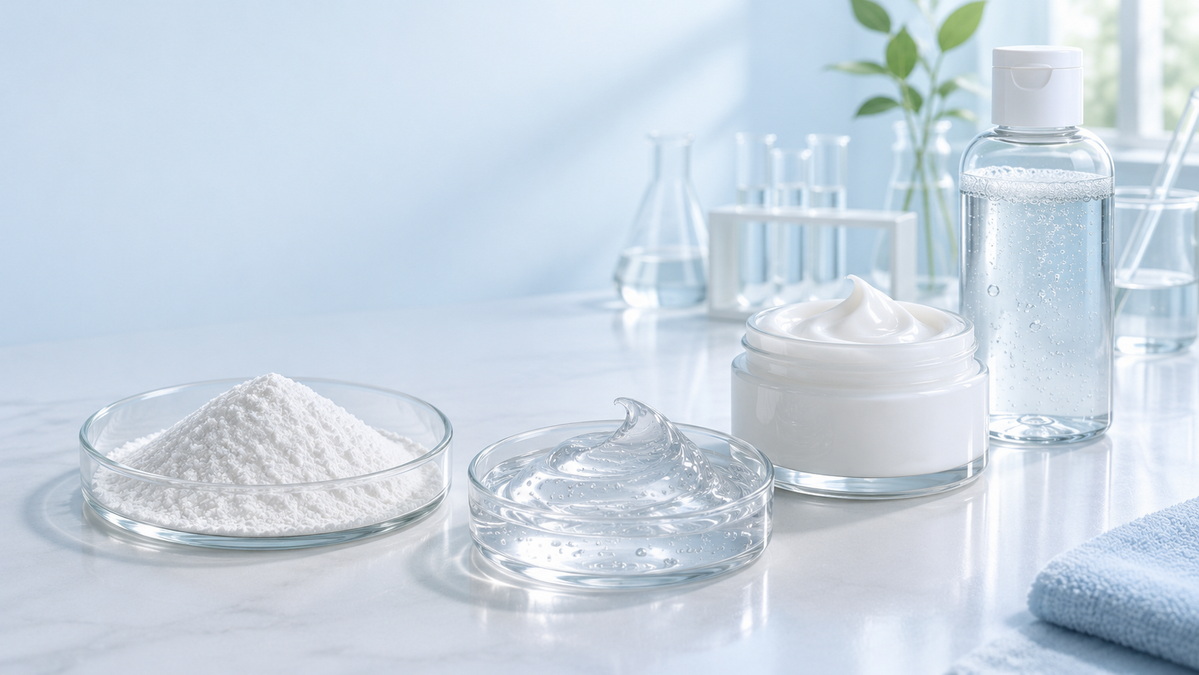
Hydroxyethyl cellulose is a water-soluble, nonionic polymer made by chemically modifying plant-derived cellulose. "Nonionic" means that the polymer does not carry an overall ionic charge, a characteristic that helps explain its usefulness across many formulation systems.
HEC usually arrives as a white or off-white powder. After suitable dispersion and hydration, it produces solutions with viscosity determined by the grade, concentration, and processing conditions.
On cosmetic ingredient labels, its standard name is Hydroxyethylcellulose.
HEC is manufactured by reacting alkali-treated cellulose with ethylene oxide under controlled conditions, followed by processing and purification.
Ethylene oxide should not be confused with propylene oxide. They are different chemicals, and substituting one name for the other gives an inaccurate explanation of HEC chemistry.
The finished polymer must also be distinguished from its manufacturing reactants. Safety decisions should consider the purified material, relevant impurities, and intended exposure—not simply the names of chemicals used during production.
HEC is best described as a chemically modified, cellulose-derived ingredient. Its starting material is plant-derived, but chemical processing gives it the water-solubility and performance needed in formulations.
Neither "natural" nor "synthetic" establishes skin safety by itself. Material specifications and product-level evidence provide a more useful basis for evaluation.
Cosmetic Ingredient Review safety summaries list hydroxyethylcellulose among ingredients assessed as safe under the practices of use and concentrations covered by the relevant assessment.
The key qualification is context. This conclusion supports appropriate cosmetic use; it does not establish that any concentration, any raw-material grade, or any finished product is automatically suitable.
A reliable assessment separates three questions:
- Ingredient suitability: Is HEC appropriate for the intended cosmetic application?
- Material quality: Does the supplied grade meet agreed specifications?
- Product performance: Is the complete formula adequately preserved, stable, and suitable for its intended users?
These questions matter because a familiar ingredient cannot compensate for poor manufacturing or an unsuitable formulation.
A safe-use assessment is not a promise that individual reactions are impossible.
If a lotion causes burning, redness, or itching, its ingredient list alone cannot establish the cause. Fragrance, preservatives, cleansing agents, active ingredients, product deterioration, and individual sensitivity may all require investigation.
It is therefore inaccurate to describe HEC as having "no side effects" or being "safe for everyone."
For someone with persistent or recurring reactions, professional assessment is more useful than eliminating ingredients solely because their names sound technical.
HEC primarily helps control how a product looks, flows, spreads, and remains physically uniform. These functions affect usability, even when the ingredient is not the formula's main skin-care active.
| Function | Formulation contribution | Practical benefit |
|---|---|---|
| Viscosity control | Adjusts thickness and flow | Helps prevent watery, difficult-to-handle textures |
| Emulsion stabilization | Supports physical stability | Helps maintain a more consistent product |
| Film formation | Forms a film after application | Can influence surface feel |
| Rheology modification | Changes flow under applied force | Helps balance dispensing and spreading |
These outcomes depend on the specific formulation. HEC does not automatically prevent separation, suspend every particle, or create the same texture in every system.
HEC interacts with water and contributes to aqueous product structure. However, its presence does not, by itself, prove meaningful or long-lasting skin hydration.
A moisturizing claim should be supported by the complete formula and appropriate testing. HEC should not be presented as a substitute for established humectants, emollients, or other ingredients selected specifically for moisturization.
Its contribution is often indirect: helping a moisturizer achieve a consistent, usable texture.
HEC can be useful in water-containing products such as:
- Facial cleansers and body washes.
- Shampoos and liquid personal-care products.
- Creams and lotions.
- Serums, gels, and masks.
Suitability still depends on the formulation. A thickener that works well in an aqueous gel may not be appropriate for an anhydrous oil or wax-based product.
Sensitive-skin suitability cannot be determined from one ingredient.
A product containing HEC may be well tolerated, but its fragrance system, cleansing ingredients, active concentration, and overall composition remain important. People with eczema, rosacea, or a history of cosmetic reactions should evaluate the complete product rather than rely on an ingredient-level reassurance.
For ordinary cosmetic products suitable for home testing, dermatology guidance recommends:
1. Apply the normal amount to a small test area, such as the inner arm.
2. Repeat twice daily for seven to ten days.
3. Leave the product on for its intended contact time.
4. For rinse-off products, follow the label's directions.
5. Stop using it if redness, itching, swelling, or another reaction develops.
This home-use check cannot identify a specific allergen and does not replace diagnostic patch testing.
Do not apply raw HEC powder to your skin as a substitute for testing a finished product. If a reaction is severe or persistent, seek medical advice.
HEC is used in both personal-care and industrial applications. A shared chemical name does not establish that every commercial grade is interchangeable.
Construction-grade material should not be substituted into a skin-care formula without documented evidence that it meets the application's quality and safety requirements.
For buyers, grade selection should begin with intended use, specifications, and traceability—not price or viscosity alone.
A practical supplier review should cover:
| Item | What to clarify |
|---|---|
| Product identity | Ingredient name, grade designation, and intended application |
| Viscosity | Specification and measurement conditions |
| Quality documentation | Technical data sheet, safety data sheet, and batch certificate of analysis |
| Microbiological controls | Applicable limits and supporting information |
| Impurity controls | Relevant specifications and available supporting documentation |
| Traceability | Batch identification and change-notification arrangements |
Viscosity figures require particular care. Results measured at different concentrations, temperatures, or instrument settings may not be directly comparable.
A useful purchasing specification defines the test method as well as the acceptable range.
A technically suitable ingredient still needs controlled processing and finished-product testing. The following workflow provides a starting framework, not a ready-to-use cosmetic recipe.
Specify whether the product is a cleanser, lotion, serum, or gel. Establish target viscosity, appearance, dispensing behavior, packaging, and intended users.
"Thicker" is not always better. Excessive structure can make pumping, spreading, or rinsing less convenient.
Choose a grade suited to the desired flow and processing conditions. Then determine the concentration through laboratory trials.
A universal HEC percentage is not a reliable recommendation because grades differ in viscosity-building efficiency.
Control addition order, mixing, temperature, and hydration time according to the supplier's guidance.
Avoid judging viscosity before hydration is complete. A batch can appear too thin simply because the polymer has not fully developed its structure.
Check viscosity, appearance, pH, dispensing, and compatibility after all ingredients have been added.
Do not assume that satisfactory performance in water predicts identical behavior in a surfactant-rich cleanser or electrolyte-containing serum.
HEC is not a preservative. Water-containing formulations need an appropriate preservation strategy and relevant testing.
Polymer–preservative interactions can affect performance, so preservation should be evaluated in the final formulation rather than assumed from the preservative dosage.
Storage testing and packaging evaluation should also reflect the intended product and distribution conditions.
Plant-derived feedstock is relevant, but it does not establish the environmental performance of every HEC grade or finished product.
A meaningful sustainability discussion considers cellulose sourcing, manufacturing, energy use, transport, and the evidence supporting environmental claims.
Biodegradability claims also require care. Results for one supplier's tested grade should not automatically be transferred to another manufacturer's material.
For procurement teams, the practical approach is to request grade-specific evidence and define the claim being evaluated. "Cellulose-derived" is a material description; "sustainable" requires a broader supporting case.
Choosing HEC should connect raw-material quality with the practical needs of the finished product.
Shandong Shengda New Material Co., Ltd. focuses on cellulose ether solutions for construction and daily chemical applications. For a personal-care project, send our team your product type, target viscosity, formulation pH, processing conditions, destination market, and documentation requirements.
Contact Shengda to discuss HEC grade selection, request available technical documentation, and arrange samples for your own formulation testing.
It is generally considered safe for cosmetic use under assessed conditions. However, the complete product, material quality, and individual tolerance still matter. An ingredient-level safety conclusion is not a guarantee for every user.
Individual reactions cannot be ruled out simply because an ingredient has a favorable safety assessment. If a product causes symptoms, stop using it. Persistent reactions may require professional evaluation to identify the cause.
HEC's presence alone cannot establish whether a product will suit acne-prone skin. Assess the finished formula and any product-specific evidence rather than treating one thickener as proof that a product will or will not cause breakouts.
HEC is used in personal-care applications that include leave-on formulations. Suitability depends on the selected grade, formulation, exposure, preservation, and relevant finished-product assessment.
No. HEC and HPMC are different cellulose ethers. Their chemical modifications and performance characteristics differ, so substitution requires evaluation rather than a simple one-for-one replacement.
No. Its principal cosmetic functions include viscosity control, stabilization, and film formation. It does not replace a validated antimicrobial preservation system in a water-containing product.
There is no single correct concentration for every formula. The appropriate amount depends on grade, target viscosity, other ingredients, and processing. Begin with supplier guidance and confirm performance through laboratory trials.
1. ["Is hydroxyethyl cellulose harmful to the skin when used in skin care products?" — hpmc.com, December 12, 2023]. Source material reviewed for the rewrite; its chemistry, absolute safety statements, and company attribution required correction. [hpmc]
2. [Cosmetic Ingredient Review — Quick Reference Table, September 2020]. Lists hydroxyethylcellulose with its safety classification and references the 1986 assessment and March 2009 final report. This is a safety-summary source, not a new clinical trial. [cir-safety]
3. [COSMILE Europe — Hydroxyethylcellulose ingredient profile]. Supports ingredient identity, modified-cellulose description, and cosmetic functions including viscosity control, emulsion stabilization, and film formation. [cosmileeurope]
4. [Ashland — Natrosol™ Hydroxyethylcellulose: Oral Care]. Technical explanation of HEC production using ethylene oxide, nonionic character, water solubility, and grade selection. Supplier-specific specifications are not attributed to Shengda. [ashland]
5. [Ashland — Natrosol™ 250 HEC: Formulating Elegant Liquid and Semisolid Drug Products]. Technical reference for aqueous solutions, preservation considerations, and potential polymer–preservative interactions. Its pharmaceutical-grade claims are not generalized to all HEC. [ashland]
6. [American Academy of Dermatology — How to Test Skin Care Products]. Basis for the seven-to-ten-day home-use testing guidance and advice to discontinue products that cause reactions. [aad]
7. [American Academy of Dermatology — Patch Testing Can Find What's Causing Your Rash]. Supports the distinction between home product testing and professional diagnostic patch testing. [aad]
8. [Ashland — Natrosol™ Hydroxyethylcellulose: Skin and Sun Care]. Provides application context and examples of supplier-specific sourcing and biodegradability claims; these are not presented as verified Shengda product attributes. [ashland]


