


close
Choose Your Site
Global
Social Media
Views: 260 Author: Shengda Publish Time: 2026-07-13 Origin: Site


Content Menu
● What HPMC Grades and Levels Really Mean
● Degree of Substitution: Low, Medium, and High DS Levels
● Viscosity Grades: From Low-Flow to High-Build Systems
● Substitution Types: E, K, F and Other HPMC Codes
● Four Main End-Use Grades of HPMC
>> Food-Grade and Personal Care HPMC
● Practical Table: HPMC Levels and Typical Applications
● Expert View: How I Select HPMC Grades with Customers
● Trends and Market Requirements for Modern HPMC Grades
● Where Shandong Shengda Fits: Application-Driven HPMC Portfolio
● Get a Tailored HPMC Grade Recommendation
● FAQs
Choosing the right Hydroxypropyl Methyl Cellulose (HPMC) grade can make the difference between a stable, easy-to-use formulation and a product that fails on site or in the market. [kdochem]
From my work with construction and daily chemical formulators, I've seen that understanding HPMC grades, levels, and end-use categories is one of the most under-estimated skills for both buyers and R&D teams. [wotaichem]
HPMC grades (or levels) describe how a specific product behaves in real formulations. [shengdahpmc]
In practice, an HPMC grade is defined by degree of substitution (DS), viscosity level, substitution type (E, K, F, etc.), and end-use quality level (construction, pharmaceutical, food, industrial). [kimacellulose]
Key dimensions:
- Degree of substitution (DS) – how many methoxy and hydroxypropyl groups are attached to the cellulose backbone. [shengdahpmc]
- Viscosity grade – viscosity of a defined aqueous solution (for example, 2%) at a specified temperature. [wotaichem]
- Substitution type codes – letters like E, K, F, J, which signal different methoxy/hydroxypropyl ratios and gel behavior. [shengdahpmc]
- End-use grade – construction-grade, pharmaceutical-grade, food/personal care-grade, or industrial-grade quality. [hixenchem]
Commercially, you will see codes such as E5, K4M, F50, where:
- The letter indicates substitution type. [shengdahpmc]
- The number indicates approximate viscosity range (e.g., 5 cP, 4,000 mPa·s). [youtube]
The degree of substitution (DS) expresses the average number of substituent groups per anhydroglucose unit in the cellulose chain. [sciencedirect]
A higher DS usually means greater hydrophilicity, better water solubility, stronger gel formation, and improved film-forming ability. [sciencedirect]
Common DS levels:
- Low DS (approx. 0.5–1.5)
- Lower gel strength and viscosity, good solubility. [shengdahpmc]
- Used in some food systems, basic pharmaceutical binders, and simple coatings that need thin solutions. [sciencedirect]
- Medium DS (approx. 1.5–2.5)
- Balanced water retention and viscosity. [shengdahpmc]
- Very common in construction mortars, tile adhesives, and controlled-release tablets. [kdochem]
- High DS (approx. 2.5–3.5)
- High hydrophilicity, strong gel and film formation. [shengdahpmc]
- Used in hydrophilic gels, advanced sustained-release systems, and high-performance coatings. [pmc.ncbi.nlm.nih]
Selecting DS is not just an academic decision; it impacts setting time, open time, film strength, and mechanical performance in real products. [sciencedirect]
HPMC viscosity grades are defined by the viscosity of a standard solution, typically a 2% aqueous solution measured at a set temperature. [wotaichem]
Typical viscosity ranges:
- Low viscosity (approx. 3–50 cP)
- Thin solutions with excellent flow and leveling. [shengdahpmc]
- Used in water-based paints, certain adhesives, food stabilizers, and low-viscosity pharmaceutical binders. [wotaichem]
- Medium viscosity (approx. 100–4,000 cP and mid-range thousands)
- Balanced thickening and flow. [shengdahpmc]
- Common in construction mortars, tile adhesives, cement renders, gypsum-based materials, and tablet matrices. [kdochem]
- High viscosity (up to about 200,000 mPa·s)
- Strong thickening, high water retention, and excellent sag resistance. [shengdahpmc]
- Ideal for vertical tile adhesives, high-build coatings, and some controlled-release drug matrices. [pmc.ncbi.nlm.nih]
For construction, viscosity is directly linked to workability, open time, sag resistance, and water demand, while in pharmaceuticals it controls gel layer formation and release profiles. [actabiotechnology]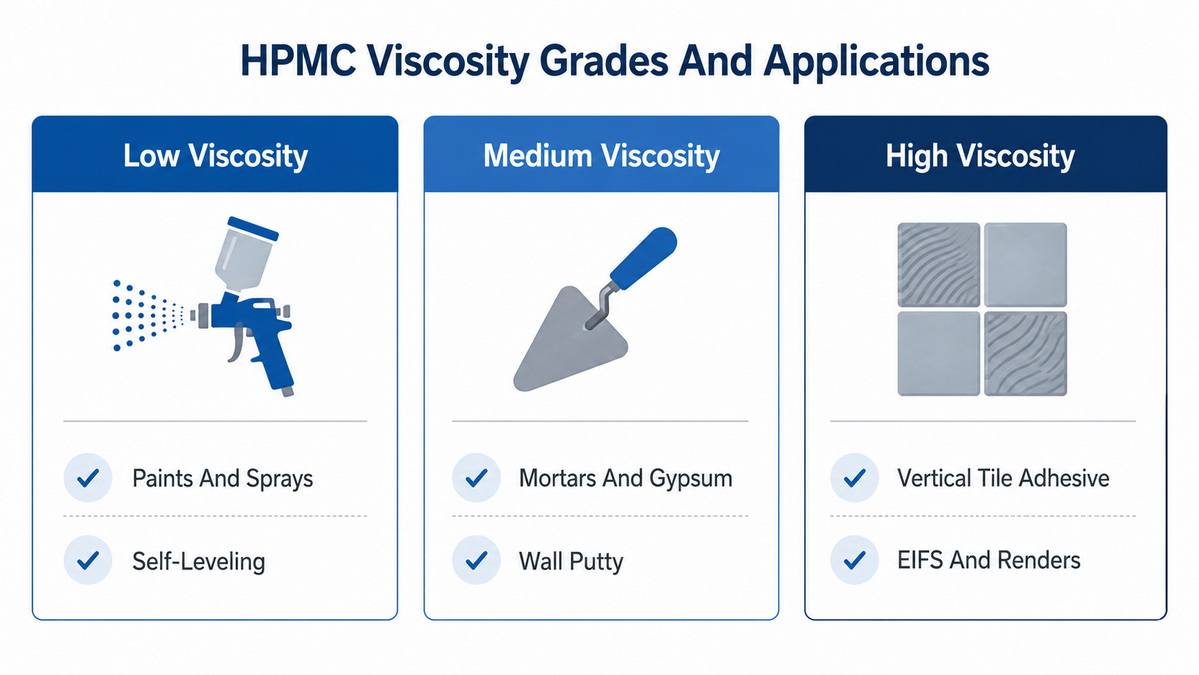
Different substitution types reflect specific methoxy and hydroxypropyl ratios. [kimacellulose]
Typical patterns:
- E-type HPMC
- Balanced methoxy/hydroxypropyl content. [shengdahpmc]
- Good film-forming and solubility profile. [shengdahpmc]
- Often used in pharmaceutical and food applications for coatings and binders. [pharmaexcipients]
- K-type HPMC
- Typically higher hydroxypropyl content. [shengdahpmc]
- Strong water retention and thickening, particularly in cement mortars and controlled-release systems. [pmc.ncbi.nlm.nih]
- F-type and J-type HPMC
- Designed for enhanced film strength, gel behavior, or high viscosity. [shengdahpmc]
- Applied in sustained-release tablets, ophthalmic formulations, and specialized coatings. [pharmaexcipients]
Codes like K4M, E4M, F4M may share similar viscosity but differ in substitution pattern, leading to different thermal gelation behavior, gel strength, and compatibility with other ingredients. [pmc.ncbi.nlm.nih]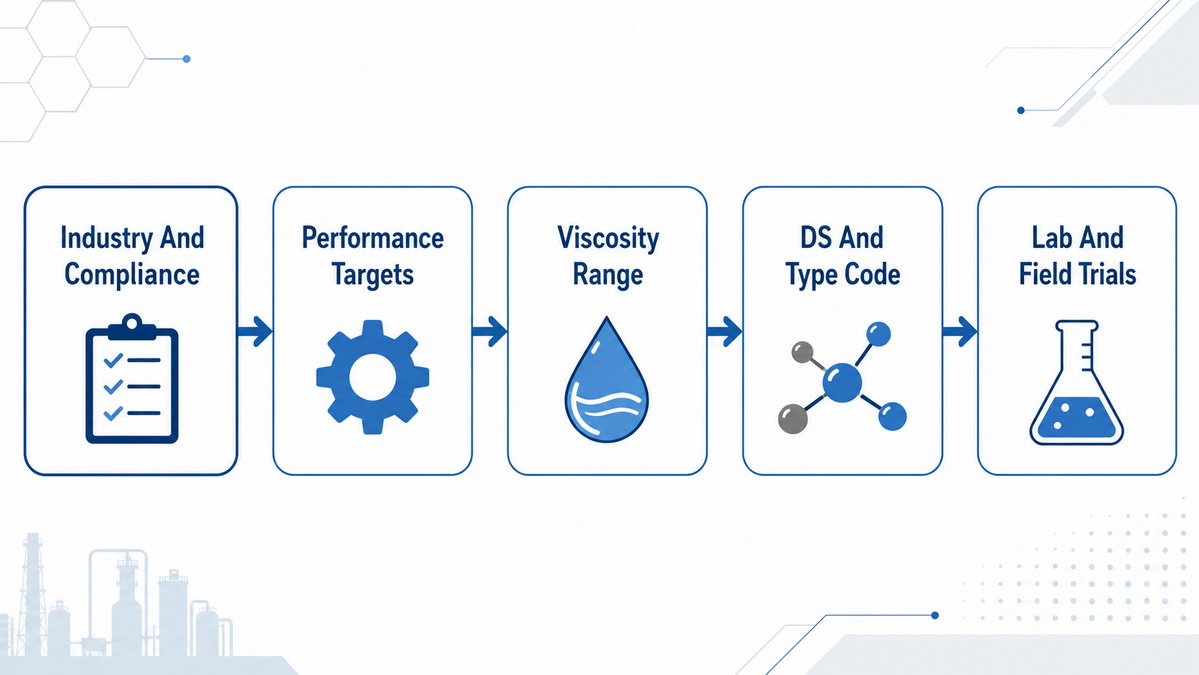
Construction grade HPMC is optimized for cement, gypsum, and lime-based systems. [kdochem]
Core functions:
- Water retention to support cement hydration and prevent premature drying. [kimacellulose]
- Improved workability and open time in mortars and tile adhesives. [kdochem]
- Sag resistance and anti-slip properties for vertical applications. [tangzhihpmc]
- Stabilization of mixtures, reducing segregation and bleeding. [kimacellulose]
Typical uses:
- Tile adhesives and thin-set mortars.
- Wall putty, skim coat, and plaster.
- Self-leveling compounds and renders. [kimacellulose]
Pharmaceutical HPMC must meet pharmacopeial standards such as USP, EP, or JP, with strict limits on impurities and residuals. [pmc.ncbi.nlm.nih]
Key roles:
- Tablet binder and disintegrant in oral solid dosage forms. [pmc.ncbi.nlm.nih]
- Film-coating polymer for tablets and capsules. [pharmaexcipients]
- Controlled/sustained release matrix former in hydrophilic tablet systems. [actabiotechnology]
- Thickener and stabilizer in ophthalmic and topical gels. [pmc.ncbi.nlm.nih]
Multiple viscosity grades allow formulators to fine-tune release profiles, coating properties, and processing behavior. [actabiotechnology]
Food-grade HPMC must comply with food regulations on purity, additive status, and labeling. [sciencedirect]
Typical applications:
- Thickener and stabilizer in sauces, gravies, bakery products, and dairy analogues. [kimacellulose]
- Mouthfeel enhancer and emulsifier in beverages and desserts. [sciencedirect]
- Rheology modifier in creams, lotions, shampoos, and shower gels, providing smooth texture. [kimacellulose]
In personal care, HPMC improves texture, stability, and sensory feel, especially in transparent gels and shampoos. [youtube]
Industrial HPMC targets coatings, adhesives, inks, and technical products where process stability and environmental performance matter. [hpmcfactory]
Features:
- Emphasis on rheology control, leveling, and film formation rather than food/pharma purity. [hpmc]
- Used in paints, adhesives, printing inks, textiles, and specialty chemicals. [sciencedirect]
| Dimension | Level / Type | Main Role | Typical Applications |
|---|---|---|---|
| DS level | Low DS (0.5–1.5) | Lower gel strength, thin solutions | Food stabilizers, simple pharma binders, certain coatings |
| DS level | Medium DS (1.5–2.5) | Balanced water retention and viscosity | Tile adhesives, cement mortars, controlled-release tablets |
| DS level | High DS (2.5–3.5) | Strong gel and film formation | Hydrogels, advanced sustained-release systems |
| Viscosity | Low (3–50 cP) | Excellent flow and spraying | Paints, low-viscosity adhesives, liquid stabilizers |
| Viscosity | Medium (100–4,000+ cP) | Balanced thickening and flow | Mortars, gypsum products, tablet matrices |
| Viscosity | High (up to ~200,000 mPa·s) | Strong thickening, sag resistance | Vertical tile adhesives, renders, high-build coatings |
| End-use | Construction grade | Water retention, workability, anti-sag | Cement mortar, tile adhesive, plaster, grout |
| End-use | Pharmaceutical grade | Binding, release control, coating | Tablets, capsules, ophthalmic preparations |
| End-use | Food/personal care | Texture, stabilization, viscosity | Sauces, creams, shampoos, gels |
| End-use | Industrial grade | Processability, rheology | Coatings, adhesives, technical inks |

When I work with formulation teams, we typically follow a structured selection process. [tangzhihpmc]
Step 1 – Define industry and compliance level
- Construction: focus on construction-grade HPMC aligned with local standards. [kdochem]
- Pharma/food: only pharmacopeial or food-approved grades. [pmc.ncbi.nlm.nih]
Step 2 – Clarify performance targets
- Construction: open time, water retention, anti-sag, anti-slip, workability. [kimacellulose]
- Pharma: release profile, hardness, disintegration, coating quality. [actabiotechnology]
- Personal care: viscosity curve, clarity, sensory profile, stability. [kimacellulose]
Step 3 – Choose viscosity ranges
- Lower viscosity for better pumping and spraying.
- Higher viscosity for stronger thickening and vertical hold. [wotaichem]
Step 4 – Fine-tune DS and substitution type
- E/K/F codes are chosen based on desired gel behavior, temperature response, and compatibility. [kimacellulose]
Step 5 – Validate with lab and field trials
- Always run side-by-side tests of at least two grades and monitor workability, sag, strength, or release curves. [tangzhihpmc]
Recent industry data show a steady growth in HPMC demand, driven by construction, pharmaceuticals, and personal care. [linkedin]
Key trends:
- Application-specific construction grades, optimized for local cement, filler systems, and climate conditions. [tangzhihpmc]
- Increased use of low-viscosity HPMC as a powder modifier in pharma for flow and compressibility improvements. [actabiotechnology]
- Stronger emphasis on traceability, clean-label positioning, and sustainability, especially in food and personal care. [kimacellulose]
- Heightened regulatory scrutiny on impurities, residual solvents, and heavy metals in high-purity HPMC grades. [pmc.ncbi.nlm.nih]
Producers that combine R&D, process control, and application support are better positioned to meet these evolving requirements. [tangzhihpmc]
Shandong Shengda New Material Co., Ltd. focuses on HPMC, HEMC, HEC, and redispersible polymer powder solutions for global construction and daily chemical customers. [shengdahpmc]
Key strengths for HPMC users:
- Application-focused grades: construction-grade HPMC optimized for tile adhesive, wall putty, EIFS, and gypsum products, plus daily-chemical HPMC for shampoos and cleaners. [kimacellulose]
- Stable viscosity and DS control, ensuring consistent performance batch to batch. [shengdahpmc]
- Technical support: lab-scale evaluation, formulation suggestions, and jobsite or plant troubleshooting for international customers. [shengdahpmc]
For buyers and formulators who want both cost-effective and robust HPMC grades, partnering with a cellulose ether specialist simplifies grade selection and long-term supply. [shengdahpmc]
If you are developing or optimizing tile adhesives, wall putty, drymix mortars, tablets, coatings, or personal care products, choosing the correct HPMC grade is a strategic decision. [kdochem]
Share your application type, target viscosity, performance requirements, and market region with Shandong Shengda's technical team to:
- Receive grade recommendations and viscosity options tailored to your formulations. [shengdahpmc]
- Request samples and lab support to run comparative trials.
- Explore long-term OEM/ODM cooperation, including customized grades for your brand or channel. [shengdahpmc]
1. What is the main difference between HPMC levels and HPMC grades?
HPMC levels usually describe broad categories such as DS or viscosity ranges, while grades refer to specific commercial products defined by substitution code (E, K, F) and viscosity numbers (e.g., K4M). [kimacellulose]
2. Can I use the same HPMC grade for both construction and pharmaceutical applications?
No. Construction-grade and pharma-grade HPMC differ in purity, regulatory compliance, and impurity limits; always select grades explicitly approved for the target industry. [pmc.ncbi.nlm.nih]
3. How do I choose an HPMC viscosity grade for tile adhesive?
Start with medium to high-viscosity construction grade HPMC to ensure water retention and sag resistance, then fine-tune based on lab tests and jobsite trials for open time and workability. [kdochem]
4. Why do different HPMC codes (E4M, K4M, F4M) share the same viscosity number?
They share similar viscosity but differ in methoxy/hydroxypropyl ratios, which affects gel strength, thermal behavior, and compatibility with other formulation ingredients. [kimacellulose]
5. What is the fastest way to screen multiple HPMC grades for a new product?
Design a simple screening matrix: test at least two viscosity levels and two substitution types, run standardized performance tests (e.g., sag, open time, release profile), and rank grades against your key KPIs (cost, performance, processing). [tangzhihpmc]
1. Shandong Shengda New Material Co., Ltd. "Hydroxypropyl Methylcellulose (HPMC) Grades: A Complete Guide for Formulators and Buyers."
https://www.shengdahpmc.com/hydroxypropyl-methylcellulose-hpmc-grades-a-complete-guide-for-formulators-and-buyers.html [shengdahpmc]
2. Kima Chemical. "Understanding the Different HPMC Grades and Their Applications."
https://www.kdochem.com/news/understanding-the-different-hpmc-grades-and-their-applications.html [kdochem]
3. WoTai Chem. "HPMC Grades Breakdown."
https://wotaichem.com/hpmc-grades-breakdown/ [wotaichem]
4. Kima Cellulose. "Application of HPMC in Construction and Personal Care Products."
https://www.kimacellulose.com/application-of-hpmc-in-construction-and-personal-care-products.html [kimacellulose]
5. Acta Biotechnology / SciDirect. "Updates on Applications of Low-Viscosity Grade HPMC."
https://www.sciencedirect.com/science/article/abs/pii/S0144861723001959 [sciencedirect]
6. PMC / PharmaExcipients. "Hydroxypropyl Methylcellulose—A Key Excipient in Pharmaceutical and Nutraceutical Formulations."
https://pmc.ncbi.nlm.nih.gov/articles/PMC12196896/ [pmc.ncbi.nlm.nih]
7. HPMC Factory / Landu-related resources on HPMC properties and daily-chemical grades.
https://www.hpmcfactory.com/resources/application-and-properties-of-hydroxypropylmethylcellulose-hmpc.html [hpmcfactory]


