


close
Choose Your Site
Global
Social Media
Views: 213 Author: Shengda Publish Time: 2026-09-19 Origin: Site


Content Menu
● Understanding HPMC and HEMC in Shaving Foam Formulations
● HPMC vs HEMC: Key Differences for Shaving Foams
● How HPMC Improves Razor Glide
● How HEMC Supports Foam Stability and Texture
>> HEMC and Viscosity Development
>> HEMC and Product Appearance
● Lubricity, Foam Density, and Shaving Comfort
>> Important Shaving Foam Performance Targets
● Choosing HPMC or HEMC by Shaving Product Format
>> HPMC for Brushless Shaving Cream
>> HEMC for Aerosol Shaving Foam
>> HPMC for Transparent Shaving Gel
>> HPMC and HEMC for Hybrid Shaving Products
● Practical Formulation Guide for HPMC and HEMC
>> Step 1: Define the Target Product Experience
>> Step 2: Select Comparable Cellulose Ether Grades
>> Step 3: Optimize Addition Level
>> Step 4: Use the Correct Hydration Process
● Common Formulation Mistakes to Avoid
>> Selecting Only by Viscosity
>> Over-Thickening the Product
>> Ignoring Long-Term Stability
>> Neglecting the Full Formula
● Quality and Supplier Considerations
● FAQ
>> What is the main difference between HPMC and HEMC in shaving foam?
>> Can HPMC improve razor glide in shaving cream?
>> Is HEMC suitable for aerosol shaving foam?
>> Can HPMC and HEMC be used together in shaving products?
>> Does higher viscosity always improve shaving foam performance?
>> What should be tested when developing shaving foam with HPMC or HEMC?
>> Which cellulose ether is better for brushless shaving cream?
Shaving foam must do far more than create visible bubbles. A high-performing formula should spread easily over damp skin, soften hair, maintain a stable cushion during shaving, allow the razor to move with less resistance, and rinse away cleanly after use.
For formulators developing shaving creams, aerosol shaving foams, transparent shaving gels, and brushless shaving products, the choice between Hydroxypropyl Methyl Cellulose (HPMC) and Hydroxyethyl Methyl Cellulose (HEMC) can significantly influence product texture, foam density, lubricity, razor glide, stability, and after-feel.
Both HPMC and HEMC are non-ionic cellulose ethers used as rheology modifiers in personal-care formulations. However, they do not always deliver the same formulation behavior. HPMC is frequently selected when the product requires enhanced film formation, smooth razor glide, and a rich cushioning sensation. HEMC can be highly effective when the formula needs controlled viscosity, stable foam structure, creamy texture, and flexible processing performance.
For shaving product manufacturers, understanding the practical difference between HPMC and HEMC is essential for creating formulas that feel comfortable on the skin while remaining stable during production, filling, transportation, storage, and daily consumer use.
HPMC and HEMC are cellulose ethers derived from cellulose, a naturally occurring polymer obtained from plant-based raw materials. Through chemical modification, cellulose gains improved water solubility and becomes useful as a multifunctional ingredient for personal-care products.
In shaving formulations, cellulose ethers can help control viscosity, stabilize foam, improve texture, reduce water separation, and create a smoother application experience. Their function is especially important in products that need to remain stable in a package while changing quickly into a spreadable, lubricating layer when applied to the skin.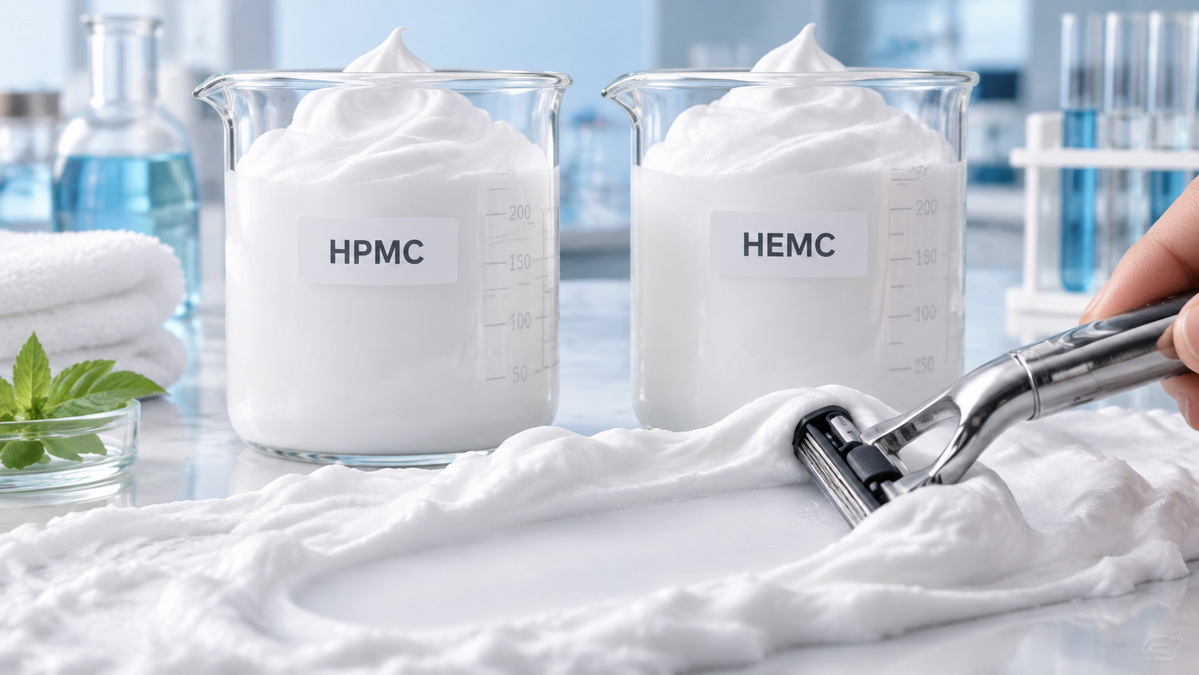
Hydroxypropyl Methyl Cellulose, commonly called HPMC, is a non-ionic cellulose ether containing methyl and hydroxypropyl groups. It is widely used in personal care, pharmaceuticals, food, coatings, and construction materials.
In shaving foam and shaving cream formulations, HPMC can function as:
- A thickener for creating body and creaminess
- A film-forming agent for a smooth protective layer on the skin
- A foam stabilizer for improving foam structure and reducing drainage
- A rheology modifier for improving flow during dispensing and application
- A lubricity enhancer for supporting smoother razor movement
- A texture improver for building a more premium skin-feel profile
HPMC is especially useful when a shaving formula needs a dense, rich texture while also maintaining a lubricious layer between the razor and the skin.
Hydroxyethyl Methyl Cellulose, commonly called HEMC, is another non-ionic cellulose ether. It contains methyl and hydroxyethyl substitution groups, which can influence hydration behavior, viscosity development, texture, and compatibility within a formula.
In shaving products, HEMC is commonly considered for:
- Efficient viscosity building
- Foam structure improvement
- Creamy and stable product texture
- Rheology control
- Reduced foam drainage
- Better stability during storage
- Smoother dispensing from pumps, tubes, or aerosol systems
HEMC can help formulators create products that remain thick and stable at rest while becoming easier to spread under pressure from the hand or razor.
The decision between HPMC and HEMC should not be based only on material name or viscosity grade. The final performance depends on the exact polymer grade, addition level, surfactant system, humectant content, pH, salt concentration, emulsifiers, oils, preservatives, fragrance components, packaging, and production process.
The table below provides a practical comparison for shaving foam development.
| Performance Factor | HPMC in Shaving Foams | HEMC in Shaving Foams | Formulation Consideration |
|---|---|---|---|
| Polymer structure | Methyl and hydroxypropyl substituted cellulose | Methyl and hydroxyethyl substituted cellulose | Chemical substitution influences hydration, viscosity and sensory behavior |
| Main function | Film formation, lubricity support, viscosity and foam stabilization | Viscosity development, foam stabilization and texture control | Both can function as multifunctional rheology modifiers |
| Razor glide | Often strong because of hydrated film formation | Supports glide through foam cushioning and viscosity control | Final glide depends on the full lubricant system |
| Foam density | Helps create rich, creamy and dense foam | Helps support stable and uniform foam structure | Test foam density together with drainage behavior |
| Viscosity control | Broad range of viscosity grades available | Can offer efficient thickening depending on grade | Compare equivalent grades under identical formula conditions |
| Skin feel | Often smooth, cushioned and lubricious | Often creamy, controlled and clean-feeling | Sensory testing is essential before final selection |
| Film-forming ability | Usually a major advantage | Can provide film contribution, but often selected more for rheology | Important for premium shaving cream and gel formats |
| Processing behavior | Requires proper dispersion and hydration | Also requires careful wetting and hydration control | Poor processing can cause lumps or unstable viscosity |
| Suitable product formats | Shaving gel, brushless cream, moisturizing foam | Aerosol foam, cream, gel and structured shaving products | Both can be used in multiple shaving formats |
| Blend potential | Can complement HEMC in mixed systems | Can complement HPMC in mixed systems | A blend may provide the best balance of glide and stability |
Razor glide describes how easily a razor blade moves over the skin during shaving. Good glide reduces the feeling of dragging and can help make shaving feel smoother and more comfortable.
A shaving product creates a temporary interface between the razor, hair, skin, water, surfactants, oils, and polymer ingredients. The quality of this interface determines whether the razor moves evenly or catches against the skin.
HPMC can improve razor glide by helping form a hydrated film on the skin surface. This film can act as a cushioning layer during shaving. Rather than relying only on foam volume, the formulation gains a more cohesive and lubricious shaving layer.
One of the most important benefits of HPMC is its film-forming ability. When fully hydrated in the formula, HPMC can help create a smooth layer that remains present during repeated razor strokes.
This can provide several advantages:
- Reduced blade drag
- Improved shaving comfort
- Better foam cohesion
- Longer-lasting lubricity
- More controlled product spreadability
- A softer post-shave feel
For premium shaving creams and moisturizing shaving gels, HPMC may help deliver a richer sensory profile. It can be especially useful when the product is designed for dry skin, coarse facial hair, frequent shaving, or users who want a more cushioned shave.
Foam alone does not guarantee a comfortable shave. Large, unstable bubbles may look impressive at first but collapse quickly and offer limited blade support.
HPMC can help strengthen the liquid film surrounding air bubbles. This may reduce drainage and improve foam density. A denser, creamier foam can remain more uniform during shaving and help maintain the lubricating layer beneath the razor.
The result is often a shaving experience that feels less airy and more protective.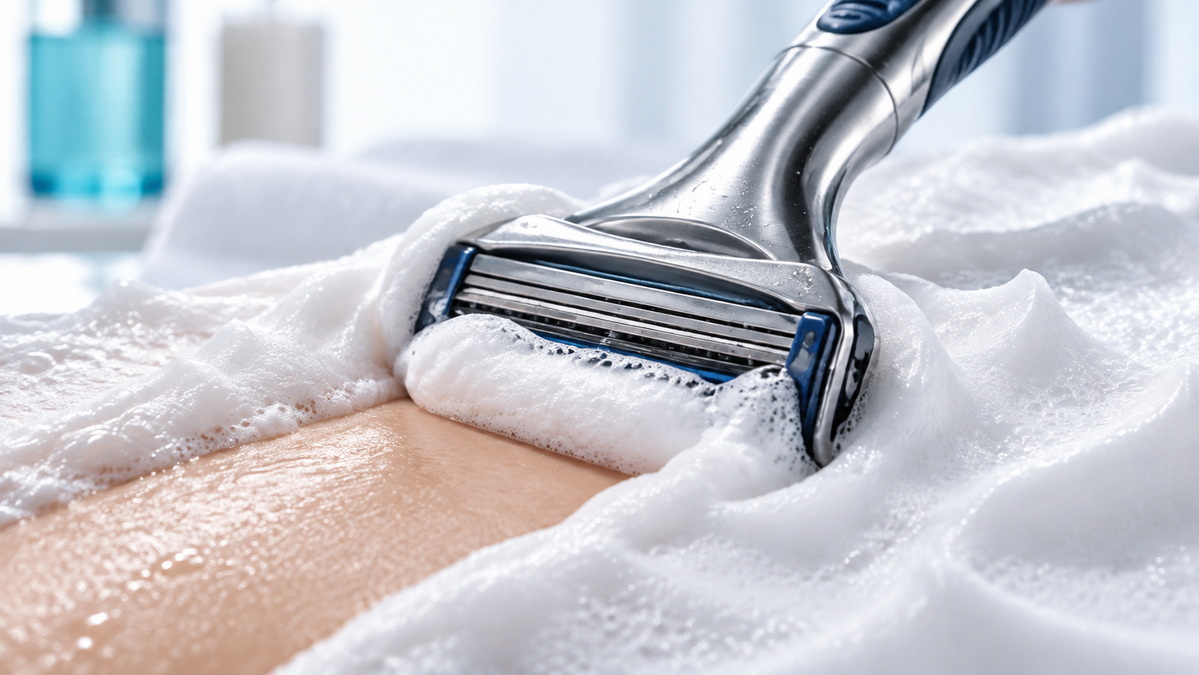
HEMC can be highly effective when formulators need to build stable, creamy shaving foam with controlled flow behavior. It can help create a product that remains structured inside the package while still spreading smoothly across the skin.
A shaving foam must have enough viscosity to maintain product integrity. If viscosity is too low, the product may become watery, drain quickly, collapse too fast, or fail to provide adequate cushioning.
HEMC can help create a structured rheology profile. At rest, the product can remain stable and creamy. During dispensing, rubbing, or shaving, the product can become easier to spread because the apparent viscosity decreases under shear.
This is useful for shaving products in several packaging formats:
- Aerosol cans
- Pump dispensers
- Tubes
- Jars
- Foaming pumps
- Pressurized shaving gel packages
Foam persistence refers to the ability of the foam to remain stable during the time between application and shaving. Consumers often apply foam, wait briefly for hair softening, and then shave over several minutes.
HEMC may help reduce liquid drainage from the foam structure. This can contribute to a more stable shaving layer, especially in products designed for longer shaving routines.
A stable foam can help:
- Keep the razor path visible
- Prevent the foam from running off the skin
- Improve the perception of creaminess
- Support even razor movement
- Reduce the need for repeated product application
For many shaving brands, visual texture influences consumer perception before the first shave. A shaving foam should look uniform, smooth, rich, and consistent.
HEMC can support a visually appealing foam or cream structure by improving bulk consistency and reducing rapid separation. This is particularly important for products marketed as premium, sensitive-skin, moisturizing, or professional-use shaving systems.
Lubricity is one of the most important performance targets in shaving products. It affects how the razor moves, how much pressure the user applies, and how comfortable the skin feels during and after shaving.
A high-quality shaving foam should create balance rather than maximize a single property.
For example:
- Excessively thin foam may spread quickly but provide weak cushioning.
- Excessively thick foam may feel rich but create drag or difficult rinse-off.
- Excessive film formation may improve glide but leave an unwanted residue.
- Insufficient structure may create a watery and unstable foam.
- Too much polymer may result in stringiness, tackiness, or poor dispensing.
The ideal shaving product provides enough structure to remain stable while keeping enough mobility to spread easily and support smooth razor movement.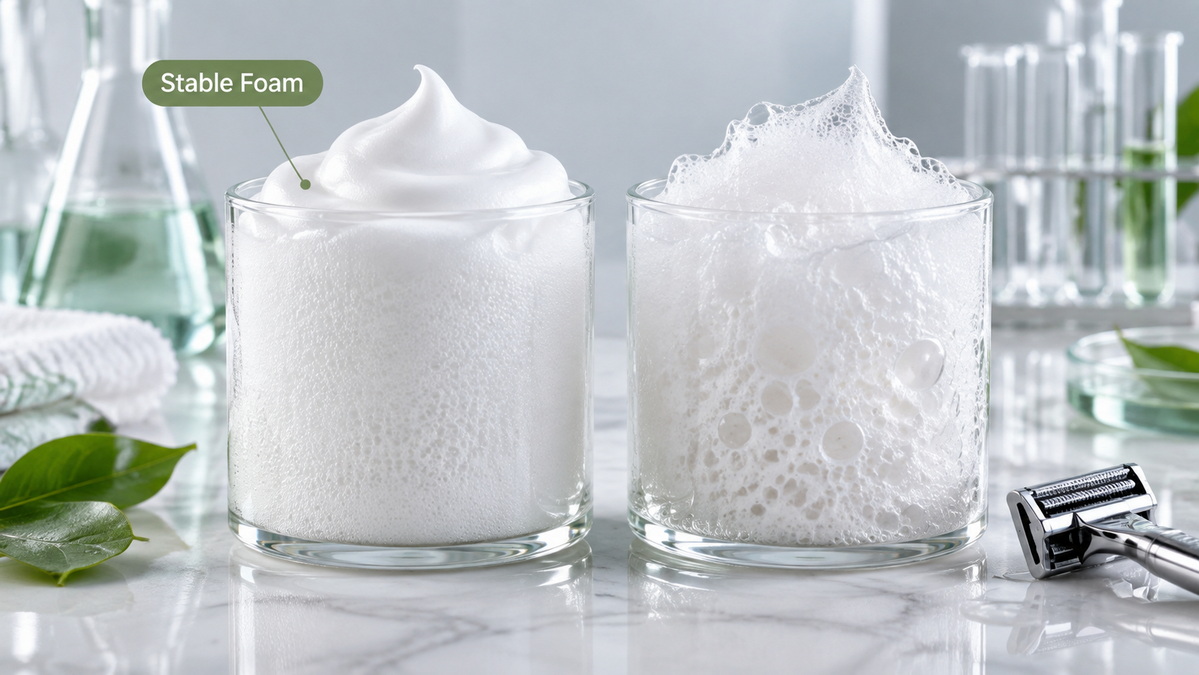
When comparing HPMC and HEMC, formulators should evaluate the following performance indicators:
| Testing Area | What to Evaluate | Why It Matters |
|---|---|---|
| Bulk viscosity | Viscosity after production and after 24 hours | Confirms hydration and formulation stability |
| Foam density | Weight-to-volume relationship of discharged foam | Indicates creaminess, richness and consumer perception |
| Foam expansion | Volume increase after aerosol or foaming-pump dispensing | Helps assess package and surfactant system performance |
| Foam drainage | Amount of liquid released from foam over time | Shows whether the foam remains stable on skin |
| Razor glide | Blade resistance and sensory assessment | Measures shaving comfort and lubrication |
| Spreadability | Ease of distributing product across wet skin | Affects consumer experience and product efficiency |
| Rinse-off | Residual film after water rinsing | Influences cleanliness and post-shave skin feel |
| Stability | Viscosity, appearance and odor after storage | Ensures consistent performance throughout shelf life |
| Package compatibility | Performance in can, tube, pump or jar | Prevents dispensing and filling problems |
The ideal cellulose ether depends on the type of shaving product being developed.
Brushless shaving creams are applied directly to the skin and do not rely on a shaving brush to create lather. These products often require a creamy texture, strong lubricity, emollient compatibility, and a premium after-feel.
HPMC can be a strong option for brushless shaving cream because it supports:
- A rich cream texture
- Hydrated film formation
- Smooth spreading
- Improved razor glide
- A cushioning shaving layer
- Moisturizing product positioning
A properly selected HPMC grade can help create a shaving cream that feels substantial but not heavy. The amount used should be carefully optimized because an overly thick product may become difficult to spread or rinse away.
Aerosol shaving foam requires a balance between package performance and consumer sensory expectations. The formula must perform consistently through the valve and actuator, expand into a stable foam, and maintain its structure long enough for shaving.
HEMC can be a useful option for aerosol shaving foam because it may support:
- Stable foam body
- Controlled viscosity
- Uniform foam texture
- Reduced drainage
- Good product structure during storage
- Improved process flexibility
Aerosol formulas should be evaluated at both laboratory and pilot scale because filling conditions, propellant selection, valve specifications, and storage temperatures can influence the final foam behavior.
Transparent shaving gels often need to provide a smooth, lubricious layer while maintaining acceptable clarity and dispensing performance.
HPMC can be useful in transparent or translucent shaving gels when the formulation target includes:
- Enhanced razor glide
- A smooth wet-shave feel
- Controlled gel body
- Film-forming support
- A premium, moisturizing sensory profile
The exact grade and concentration should be selected carefully to avoid haze, excessive stringiness, or an overly thick gel structure.
Some formulations need more than one rheology modifier. In these cases, using HPMC and HEMC together may offer a more balanced performance profile.
A blended approach may help achieve:
- Better razor glide from HPMC
- More structured foam from HEMC
- Improved viscosity balance
- Better foam persistence
- More flexible sensory adjustment
- Improved stability in complex surfactant systems
The blend ratio should always be optimized through structured laboratory screening rather than selected by assumption.
Selecting the right cellulose ether involves more than choosing a high-viscosity or low-viscosity grade. A practical development process helps minimize reformulation time and supports more reliable product performance.
Before selecting HPMC or HEMC, define the product target clearly.
Examples include:
- Dense shaving foam with visible creaminess
- Fast-spreading foam for daily shaving
- Rich shaving cream for coarse facial hair
- Clear shaving gel for precision shaving
- Moisturizing product for dry-feeling skin
- Stable aerosol foam with controlled expansion
- Brushless shaving cream with premium razor glide
A clear target helps determine whether the formula needs more film formation, more foam structure, better rinse-off, higher viscosity, or a specific consumer sensory profile.
When comparing HPMC and HEMC, use grades with similar viscosity categories where possible. Comparing a high-viscosity HPMC with a low-viscosity HEMC may lead to misleading conclusions.
A useful screening plan can include:
| Formula Version | Cellulose Ether System | Development Purpose |
|---|---|---|
| Formula A | HPMC only | Evaluate film formation, glide and smooth skin feel |
| Formula B | HEMC only | Evaluate thickening efficiency, foam stability and creaminess |
| Formula C | HPMC and HEMC blend | Evaluate whether combined performance improves the final product |
Each formula should be tested under identical conditions, including mixing speed, hydration time, surfactant level, storage temperature, package type, and application method.
The appropriate use level depends on the formulation format, cellulose ether grade, viscosity target, surfactant system, and desired consumer feel.
A lower level may be sufficient in formulas that already contain other thickening agents, emulsifiers, fatty alcohols, surfactants, or structure builders. A higher level may be considered for brushless creams, premium gels, or products requiring stronger foam support.
However, overuse can create problems such as:
- Excessive thickness
- Difficult mixing
- Poor dispensing
- Stringy texture
- Slow rinse-off
- Heavy skin feel
- Reduced foam expansion
- Increased production cost
The best approach is to begin with controlled screening trials and increase the cellulose ether level only when the formula requires additional structure or glide.
HPMC and HEMC need appropriate dispersion and hydration to reach their expected performance. Poor processing can cause lumps, fisheyes, incomplete hydration, inconsistent viscosity, and weak foam structure.
A reliable process generally includes the following stages:
1. Prepare the water phase according to the selected process temperature.
2. Introduce the cellulose ether slowly under adequate agitation.
3. Prevent powder from accumulating on the liquid surface.
4. Allow sufficient wetting and dispersion time.
5. Complete hydration according to the recommended method for the selected grade.
6. Add surfactants, humectants, preservatives, fragrances, and other ingredients in a validated sequence.
7. Check pH, viscosity, appearance, and foam performance after the batch has equilibrated.
8. Re-evaluate product properties after 24 hours, as viscosity may continue to develop.
The recommended process may vary according to grade. Technical support from the cellulose ether supplier is valuable during laboratory development and scale-up.
Viscosity is important, but it is not the only indicator of shaving performance. Two formulas can have similar viscosity but feel completely different during shaving.
One may have dense foam but weak lubricity. Another may feel slippery but collapse too quickly. A complete assessment should include foam density, drainage, razor glide, spreadability, rinse-off, and skin feel.
More cellulose ether does not always mean better shaving performance. Excessive polymer can create a heavy, sticky, stringy, or difficult-to-rinse formula.
The best shaving foam has balanced rheology. It remains stable in the package, spreads easily over the skin, supports smooth razor movement, and rinses cleanly after use.
A shaving foam that performs well immediately after production may change after storage. Viscosity, foam structure, fragrance, color, and dispensing behavior can all be affected by time and temperature.
A reliable development program should include:
- Room-temperature storage testing
- High-temperature stability testing
- Low-temperature stability testing
- Freeze-thaw testing where appropriate
- Package compatibility testing
- Aerosol valve and actuator testing
- Foam expansion evaluation
- Consumer-relevant shaving evaluation
HPMC and HEMC do not work in isolation. Their performance can be affected by surfactants, salts, alcohols, oils, glycols, humectants, preservatives, fragrances, and pH adjustment materials.
For this reason, a cellulose ether that performs well in a simple water solution may behave differently in the final shaving foam formula. Formula-specific testing is essential.
Selecting a reliable cellulose ether supplier is an important part of shaving product development. Consistent product quality can reduce formulation variability and help protect finished-product performance.
When evaluating HPMC and HEMC suppliers, consider requesting the following information:
- Product specification sheet
- Certificate of analysis
- Safety data sheet
- Recommended personal-care application guidance
- Viscosity test method
- Moisture specification
- Particle-size information
- Microbiological information where applicable
- Heavy-metal information where applicable
- Storage conditions
- Shelf-life details
- Batch traceability information
- Packaging options
- Technical support for formula development
- Stability and processing recommendations
Shandong Shengda New Material Co., Ltd. focuses on the research, development, production, and supply of cellulose ether products, including HPMC and HEMC. For shaving foam manufacturers, selecting the right personal-care-grade cellulose ether can help create a more stable formula, improve product texture, enhance foam quality, and support a smoother shaving experience.
The comparison between HPMC vs HEMC in shaving foams should focus on the desired end-user experience rather than on viscosity alone.
HPMC is often a strong choice for shaving products that require enhanced lubricity, smoother razor glide, dense foam cushioning, and a more premium film-forming skin feel. It can be particularly valuable in brushless shaving creams, moisturizing shaving gels, and comfort-focused shaving products.
HEMC is often highly effective for shaving foam systems that require controlled viscosity, stable foam structure, creamy texture, and reliable processing behavior. It can be a practical choice for aerosol shaving foams, structured shaving creams, and products requiring a stable rheology profile.
In some cases, the best solution may be a carefully optimized blend of HPMC and HEMC. Combining the two materials may help formulators balance film formation, foam stability, viscosity, spreadability, rinse-off, and razor glide.
Shandong Shengda New Material Co., Ltd. provides HPMC and HEMC cellulose ether solutions for global personal-care formulators seeking to develop stable, high-quality shaving foam, shaving cream, and shaving gel products with improved sensory performance.
HPMC is often preferred for its film-forming behavior and potential to support razor glide, cushioning, and a smooth skin feel. HEMC is often selected for controlled viscosity, foam stabilization, creamy texture, and rheology adjustment. The final performance depends on the specific grade and complete formula.
Yes. HPMC can create a hydrated film that helps improve the smoothness and cushioning of the shaving layer. This may reduce the sensation of blade drag and support a more comfortable shaving experience.
Yes. HEMC can be suitable for aerosol shaving foam when the selected grade is compatible with the surfactant system, propellant system, production process, and package design. Testing should include foam expansion, density, stability, dispensing, and storage performance.
Yes. HPMC and HEMC can be blended when a formula requires both enhanced lubricity and strong rheology control. A blend may help improve foam persistence, texture, viscosity balance, spreadability, and razor glide.
No. Higher viscosity can improve product structure, but excessive thickening may create poor spreadability, difficult dispensing, slow rinse-off, or a heavy skin feel. The target should be balanced viscosity and controlled shear-thinning behavior.
Important tests include viscosity, foam density, foam drainage, foam expansion, spreadability, razor glide, rinse-off, skin feel, storage stability, temperature stability, package compatibility, and consumer-use performance.
HPMC is often a strong starting option for brushless shaving cream because it can provide film formation, a rich cream texture, and enhanced razor glide. However, HEMC or a blend may also be suitable depending on the desired viscosity, sensory profile, and formula structure.
1. Vlad, R. A. et al. "Hydroxypropyl Methylcellulose—A Key Excipient in Dermatology and Cosmetic Applications." *PubMed Central*, 2025.
[https://pmc.ncbi.nlm.nih.gov/articles/PMC12196896/]
2. SpecialChem. "Toiletries: Shaving Gel."
[https://www.specialchem.com/cosmetics/formulation/toiletries-shaving-gel]
3. Dow. "CELLOSIZE™ Texture 40-0100 Hydroxypropyl Methylcellulose."
[https://www.dow.com/en-us/pdp.cellosize-texture-40-0100-hydroxypropyl-methylcellulose.509927z.html]
4. Lotioncrafter. "Hydroxypropyl Methylcellulose (HPMC) Cosmetic Thickener."
[https://lotioncrafter.com/products/hydroxypropyl-methylcellulose-hpmc]
5. U.S. Food and Drug Administration. "Modernization of Cosmetics Regulation Act of 2022."
6. Ashland. "Natrosol™ Hydroxyethylcellulose."
7. Ashland. "Natrosol™ Hydroxyethylcellulose: Polymer Properties."


