


close
Choose Your Site
Global
Social Media
Views: 245 Author: Shengda Publish Time: 2026-09-21 Origin: Site


Content Menu
● Why Pet Shampoo Texture Matters
>> Hydroxypropyl Methyl Cellulose for Pet Shampoo
>> Typical HPMC Benefits in Pet Shampoo
>> Hydroxyethyl Methyl Cellulose for Pet Shampoo
>> Typical HEMC Benefits in Pet Shampoo
● HPMC vs HEMC in Pet Shampoo Formulation
● Why High Purity Matters in Pet Shampoo Ingredients
>> High Purity Supports Better Formula Consistency
>> High Purity Does Not Replace Formula Design
● HPMC vs HEMC for Sensitive-Skin Pet Shampoos
>> The Most Important Question Is Not Only the Thickener
>> Rinseability Is a Critical Performance Factor
● Choosing HPMC or HEMC by Shampoo Type
>> Cat Shampoo
● Practical Formulation Steps for HPMC and HEMC
>> Step 1: Define the Product Target
>> Step 2: Compare HPMC and HEMC in the Same Base Formula
>> Step 3: Optimize the Dispersion Process
● Common Formulation Mistakes to Avoid
>> Selecting by Viscosity Alone
>> Ignoring Surfactant Compatibility
>> Making Unsupported Skin-Comfort Claims
● Quality Control Checklist for Pet Shampoo Manufacturers
● A Better Approach to HPMC and HEMC Selection
>> Is HPMC suitable for pet shampoo?
>> Is HEMC suitable for sensitive-skin dog shampoo?
>> Which is better for pet shampoo, HPMC or HEMC?
>> Can high-purity HPMC or HEMC reduce pet shampoo quality problems?
>> Can HPMC and HEMC be used in sulfate-free pet shampoo?
>> What should pet shampoo manufacturers test before production?
>> Why is rinseability important in pet shampoo?
Choosing between Hydroxypropyl Methyl Cellulose (HPMC) and Hydroxyethyl Methyl Cellulose (HEMC) can influence a pet shampoo's viscosity, stability, spreadability, foam appearance, rinseability, and overall user experience. This article compares HPMC and HEMC for dog and cat shampoo formulations, explains why high-purity cellulose ether matters, and outlines practical methods for creating stable, gentle, high-quality pet-care products.
For pet-shampoo formulators, the choice between HPMC and HEMC is not only about achieving a thicker product. It can influence product flow, suspension stability, foam quality, appearance, dispensing performance, rinsing behavior, and consumer perception.
For dog and cat shampoos, a well-designed texture matters. Pet owners want a product that pours easily, spreads through dense fur, produces a controlled lather, and rinses away without leaving a heavy or slippery residue. At the same time, manufacturers must consider the needs of pets with dry, delicate, or reactive skin.
Shandong Shengda New Material Co., Ltd. is a China-based manufacturer specializing in the research, development, production, and supply of cellulose ethers, including Hydroxypropyl Methyl Cellulose (HPMC) and Hydroxyethyl Methyl Cellulose (HEMC). We provide comprehensive cellulose ether solutions for global construction-grade and daily-chemical-grade product manufacturers.
In pet shampoo applications, HPMC and HEMC can both function as effective non-ionic thickeners and rheology modifiers. However, the most suitable option depends on the complete formula, including the surfactant system, salt content, active ingredients, preservative system, fragrance, pH, packaging, and desired sensory performance.
Pet shampoos differ from ordinary household cleaning products. They are applied directly to the skin and coat of dogs or cats, often repeatedly over the animal's lifetime. They must remove dirt, oil, loose hair, and unpleasant odors while remaining easy to distribute and rinse away.
A shampoo that is too thin may run through the fur too quickly. It may be difficult for users to control, especially on long-haired dogs, double-coated breeds, or animals that move during bathing. A shampoo that is too thick may be difficult to pump, dilute, spread, or rinse.
The ideal pet shampoo should have a balanced structure. It should remain stable in the bottle while becoming easy to spread when massaged into wet fur.
A carefully selected cellulose ether can help support this balance.
HPMC and HEMC may help pet shampoo manufacturers improve:
- Viscosity control
- Flow and dispensing performance
- Foam appearance
- Suspension of insoluble ingredients
- Storage stability
- Texture consistency
- Water retention
- Consumer perception of product quality
- Easy application through thick fur
- More controlled product usage
The objective is not simply to make a shampoo thicker. The objective is to create a stable, manageable, and pleasant product that helps pet owners wash their animals more effectively.
Hydroxypropyl Methyl Cellulose, commonly known as HPMC, is a non-ionic cellulose ether derived from cellulose. It is produced by modifying natural cellulose through controlled chemical processing.
HPMC contains methyl and hydroxypropyl groups attached to the cellulose backbone. These functional groups affect how the material hydrates, thickens water-based systems, interacts with other ingredients, and contributes to the final rheological profile of a shampoo.
In pet shampoos, HPMC can be used as a:
- Thickener
- Rheology modifier
- Stabilizer
- Water-retention aid
- Texture enhancer
- Film-forming support material
- Suspension-support ingredient
HPMC is particularly useful in formulations that require a smooth, gel-like texture. It can support controlled product flow from bottles, pumps, flip-top caps, or dispensing containers.
For example, a moisturizing dog shampoo intended for long-haired breeds may benefit from an HPMC grade that creates enough body to prevent excessive runoff while remaining easy to spread after water is added during bathing.
HPMC may help formulators achieve the following product characteristics:
- A smooth and uniform shampoo texture.
- Controlled viscosity in water-based systems.
- Improved product body without excessive salt thickening.
- Better stability during storage and transportation.
- More consistent dispensing from packaging.
- Improved appearance in translucent or opaque shampoo systems.
- Easier suspension of selected functional ingredients.
- A premium sensory profile for grooming products.
The final result depends on the specific HPMC grade, dosage level, hydration method, surfactant system, temperature, pH, and other ingredients in the formula.
Hydroxyethyl Methyl Cellulose, commonly known as HEMC, is another non-ionic cellulose ether. Like HPMC, it is derived from cellulose and is used to modify the viscosity, flow behavior, and stability of water-based products.
HEMC contains methyl and hydroxyethyl functional groups. This chemical structure gives HEMC its own hydration and rheological characteristics.
In pet-care formulations, HEMC may be selected when manufacturers need strong viscosity control, reliable suspension performance, and stable flow properties.
HEMC can be used in pet shampoos as a:
- Thickener
- Rheology modifier
- Stabilizer
- Suspension aid
- Water-retention material
- Consistency controller
- Processing support ingredient
A pet shampoo containing exfoliating particles, pearlescent materials, botanical powders, encapsulated fragrance, or insoluble functional additives may benefit from a formulation approach that includes HEMC for improved suspension stability.
HEMC can help support:
- Stable shampoo viscosity.
- Reduced settling of dispersed ingredients.
- Improved control over shampoo flow.
- Better storage stability.
- More uniform product texture.
- Reliable manufacturing consistency.
- Easier adjustment of rheological properties.
- Improved packaging performance.
- Enhanced product structure in high-water formulations.
As with HPMC, actual performance must be tested in the finished formula. A cellulose ether that performs well in one surfactant system may behave differently in another system.
Both HPMC and HEMC can be valuable ingredients for pet shampoo production. They are non-ionic cellulose ethers, but their chemical substitution patterns are different. These differences can affect viscosity development, hydration behavior, sensory performance, salt response, and compatibility with other ingredients.
| Feature | HPMC in Pet Shampoo | HEMC in Pet Shampoo |
|---|---|---|
| Full name | Hydroxypropyl Methyl Cellulose | Hydroxyethyl Methyl Cellulose |
| Main role | Thickening, stabilization, texture improvement | Thickening, stabilization, suspension support |
| Chemical structure | Methyl and hydroxypropyl substitution | Methyl and hydroxyethyl substitution |
| Product texture | Often supports smooth, gel-like texture | Often supports structured and stable viscosity |
| Flow behavior | Can provide controlled and elegant product flow | Can provide reliable viscosity and suspension performance |
| Water retention | Strong water-binding potential | Strong water-retention performance |
| Suspension support | Suitable for many systems | Often selected for systems requiring stronger suspension control |
| Packaging suitability | Bottles, pumps, flip-top caps, squeeze packaging | Bottles, pumps, pouches, structured shampoo formats |
| Best formulation direction | Smooth, premium, moisturizing or conditioning shampoos | Stable, suspension-focused, functional or structured shampoos |
| Testing requirement | Requires formula-specific compatibility testing | Requires formula-specific compatibility testing |
The table provides a general comparison. It should not replace laboratory evaluation.
The most suitable grade depends on the actual shampoo composition. A shampoo containing mild amphoteric surfactants, botanical extracts, moisturizing agents, fragrance, preservatives, and conditioning polymers may require a different cellulose ether grade than a medicated, deodorizing, whitening, or anti-odor pet shampoo.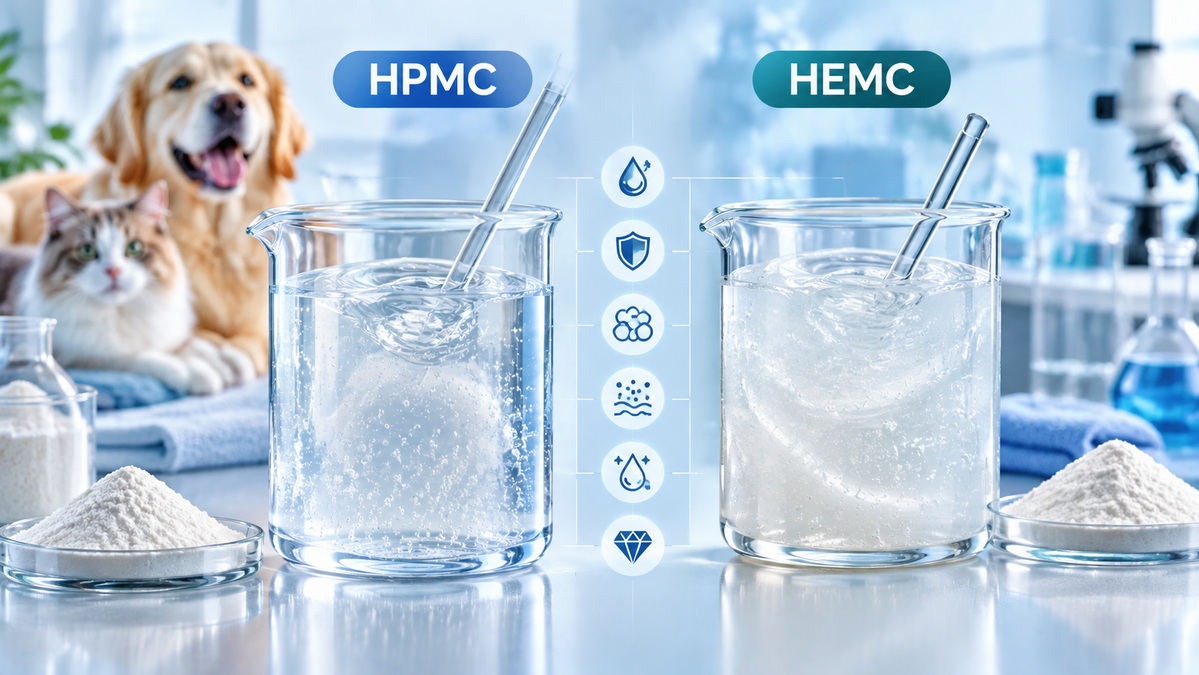
High purity is important because pet shampoo production requires predictable ingredient performance. When a cellulose ether has consistent quality, formulators can better control viscosity, product appearance, processing time, and finished-product stability.
For pet-care manufacturers, high-purity HPMC and HEMC can support more reliable production by helping reduce unwanted raw-material variability.
Important quality indicators may include:
- Appearance
- Color consistency
- Moisture content
- Viscosity range
- pH of aqueous solution
- Ash content
- Particle-size distribution
- Insoluble particle content
- Microbiological quality
- Heavy-metal control
- Batch traceability
- Storage stability
- Certificate of Analysis availability
A consistent cellulose ether grade helps manufacturers achieve repeatable viscosity from batch to batch. This is important because a pet shampoo that becomes too thin, too thick, cloudy, grainy, or unstable may create quality concerns for distributors, groomers, pet owners, and brand partners.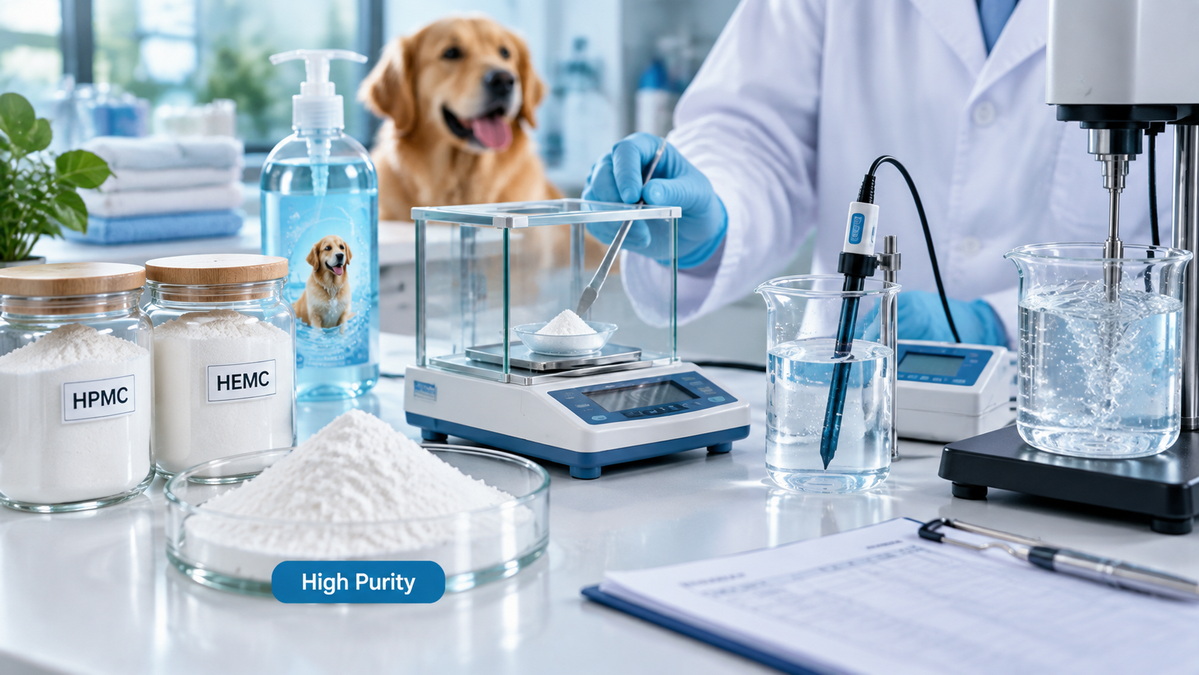
High-purity HPMC or HEMC can provide a stronger foundation for a pet shampoo formula. However, it cannot solve every product problem.
A pet shampoo may still be unsuitable for sensitive animals if the formula includes aggressive surfactants, excessive fragrance, poorly selected preservatives, unsuitable pH, unstable botanical extracts, or high levels of potentially irritating active ingredients.
A truly gentle pet shampoo should consider the full formulation system.
Key considerations include:
- Surfactant mildness.
- Rinseability.
- Fragrance concentration.
- Essential oil selection.
- Preservative compatibility.
- Final pH.
- Active ingredient concentration.
- Finished-product stability.
- Packaging compatibility.
- Clear consumer-use instructions.
The best approach is to select high-purity cellulose ether, build a balanced formula, and validate performance through stability, compatibility, microbiological, and tolerance evaluation.
For sensitive-skin dog shampoo or cat shampoo, brands often focus immediately on the thickening ingredient. This is understandable because viscosity and texture affect the consumer experience.
However, the most important question is broader:
How does the complete shampoo formula behave on the pet's skin and coat?
A high-purity HPMC or HEMC grade can help formulate a stable, controllable shampoo. But mildness requires attention to every major ingredient category.
For sensitive-skin formulations, consider:
- Mild surfactants.
- Low-fragrance or fragrance-free systems.
- Carefully selected botanical extracts.
- Gentle preservative strategies.
- Controlled pH.
- Easy rinsing.
- Low levels of unnecessary additives.
- Clear product-use instructions.
- Appropriate product testing.
Both HPMC and HEMC can be used in formulas positioned for gentle daily cleansing. The final selection should depend on the desired rheology, manufacturing process, and stability requirements.
Pet fur can make rinsing more difficult than washing human hair. Thick coats, undercoats, curls, mats, or long fur may hold shampoo longer than expected.
A shampoo must be thick enough for controlled application but not so heavy that it remains trapped in the coat.
This is where rheology becomes especially important.
A well-designed shampoo may show:
- Good bottle stability.
- Controlled flow during dispensing.
- Easy spreading on wet fur.
- Sufficient foam during washing.
- Fast dilution when water is added.
- Efficient rinsing.
- Limited residue after washing.
For this reason, the ideal viscosity should be evaluated under realistic conditions. Testing only the viscosity of a shampoo in a laboratory beaker is not enough. Manufacturers should also test how it performs after pumping, squeezing, applying to wet fur, massaging, diluting, and rinsing.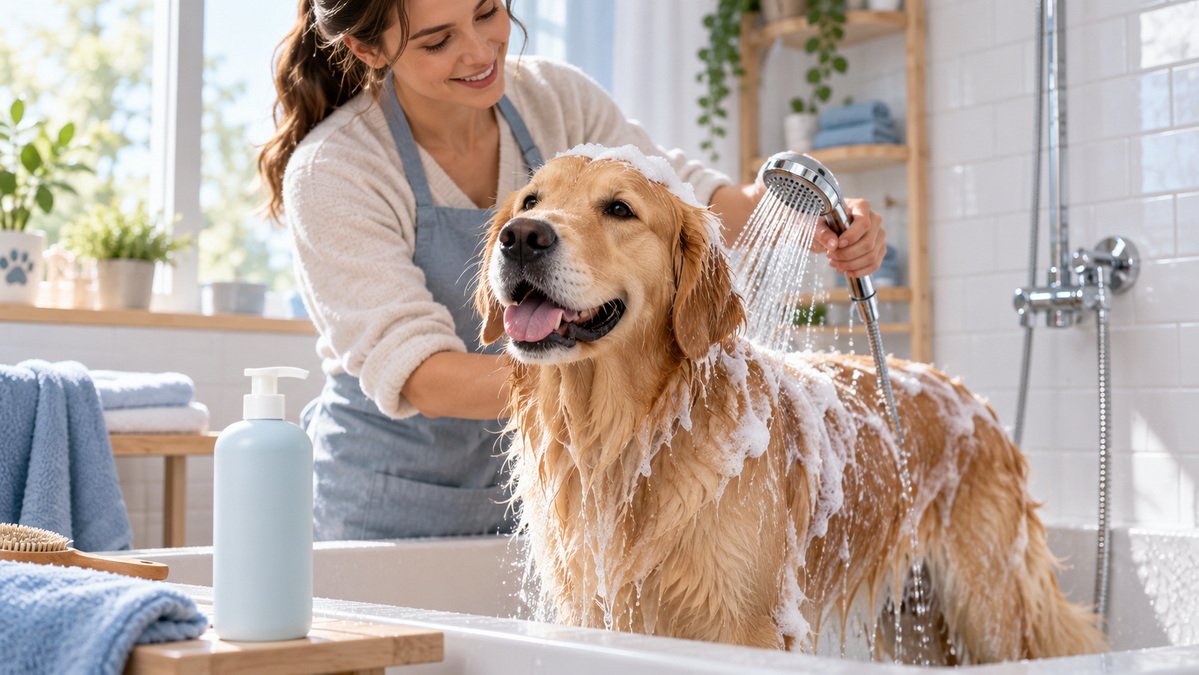
Daily dog shampoo usually requires balanced cleansing, stable foam, easy spreading, and simple rinsing. HPMC may be suitable when the brand wants a smooth, premium gel texture with controlled flow.
HEMC may be suitable when the formula requires enhanced structure, stable viscosity, or greater support for suspended ingredients.
Puppy shampoo often focuses on mild cleansing, low fragrance, and easy rinsing. The formula should avoid unnecessary complexity.
A low-to-medium viscosity profile may be preferred because it can spread easily across a small pet's coat without requiring excessive product use.
Both HPMC and HEMC can be evaluated, but the final decision should be based on gentle surfactant compatibility and easy rinse-off performance.
Cat shampoo requires additional caution because cats commonly groom themselves after bathing. Residual product may be licked from fur.
A cat shampoo should focus on mild surfactants, low residue, controlled fragrance strategy, and thorough rinseability. The cellulose ether should help create a manageable product texture without producing excessive heaviness.
Deodorizing shampoos may contain odor-control ingredients, fragrance, botanical extracts, or encapsulated materials. HEMC may be a useful candidate in systems that require stronger suspension support.
However, deodorizing performance should not depend only on fragrance. Excessive fragrance may create an unpleasant experience for sensitive pets or their owners.
Medicated pet shampoos often contain functional ingredients designed for specific coat or skin concerns. These formulas require more detailed compatibility testing because active ingredients may affect viscosity, pH, foam, stability, and sensory performance.
For medicated products, HPMC or HEMC selection should consider:
- Active ingredient compatibility.
- Suspension stability.
- Contact-time requirements.
- Rinse-off behavior.
- Viscosity after storage.
- Packaging compatibility.
- Manufacturing temperature.
- Product clarity or opacity.
- Finished-product safety review.
Before selecting HPMC or HEMC, define the technical and commercial direction of the product.
Key questions include:
- Is the product for dogs, cats, puppies, or multiple pet types?
- Is the shampoo for daily cleansing, deodorizing, moisturizing, whitening, or functional care?
- Is the formula sulfate-free?
- Is the target appearance clear, pearlescent, opaque, or translucent?
- Will the product use a bottle, pump, pouch, or foaming dispenser?
- What viscosity range is required?
- Will the product contain botanical extracts, conditioning agents, oils, or suspended particles?
- Is fragrance-free positioning required?
- What storage conditions must the product withstand?
A clear product brief reduces unnecessary formulation trials and helps the technical team identify the most suitable cellulose ether grade.
The best method is to test HPMC and HEMC in the same shampoo base.
Evaluate different grades and dosage levels under identical conditions. This makes the results more meaningful.
Important evaluation points include:
- Hydration time.
- Ease of dispersion.
- Mixing behavior.
- Initial viscosity.
- Viscosity after 24 hours.
- Viscosity after storage.
- Freeze-thaw stability.
- High-temperature stability.
- Foam volume.
- Foam quality.
- Product clarity.
- Product color.
- Odor stability.
- Particle suspension.
- Pumpability.
- Rinseability.
- Consumer sensory feedback.
Do not rely only on a single viscosity measurement. Pet shampoo experiences many types of movement during production and use. It is mixed in a tank, pumped into packaging, squeezed from a bottle, applied to wet fur, diluted with water, massaged into the coat, and rinsed away.
The most useful rheology evaluation reflects these real conditions.
Poor dispersion can create lumping, incomplete hydration, inconsistent viscosity, or visible gel particles. Correct processing is essential.
A practical processing approach may include:
1. Prepare the water phase according to the formula design.
2. Use sufficient agitation to create good circulation.
3. Add HPMC or HEMC gradually to avoid agglomeration.
4. Allow adequate wetting and hydration time.
5. Control the temperature according to the selected cellulose ether grade.
6. Add surfactants and other sensitive ingredients at the correct processing stage.
7. Adjust viscosity carefully after full hydration.
8. Allow the batch to stabilize before final measurement and filling.
The optimal addition method depends on the specific grade and formulation. Technical support from the cellulose ether supplier can help reduce trial-and-error during scale-up.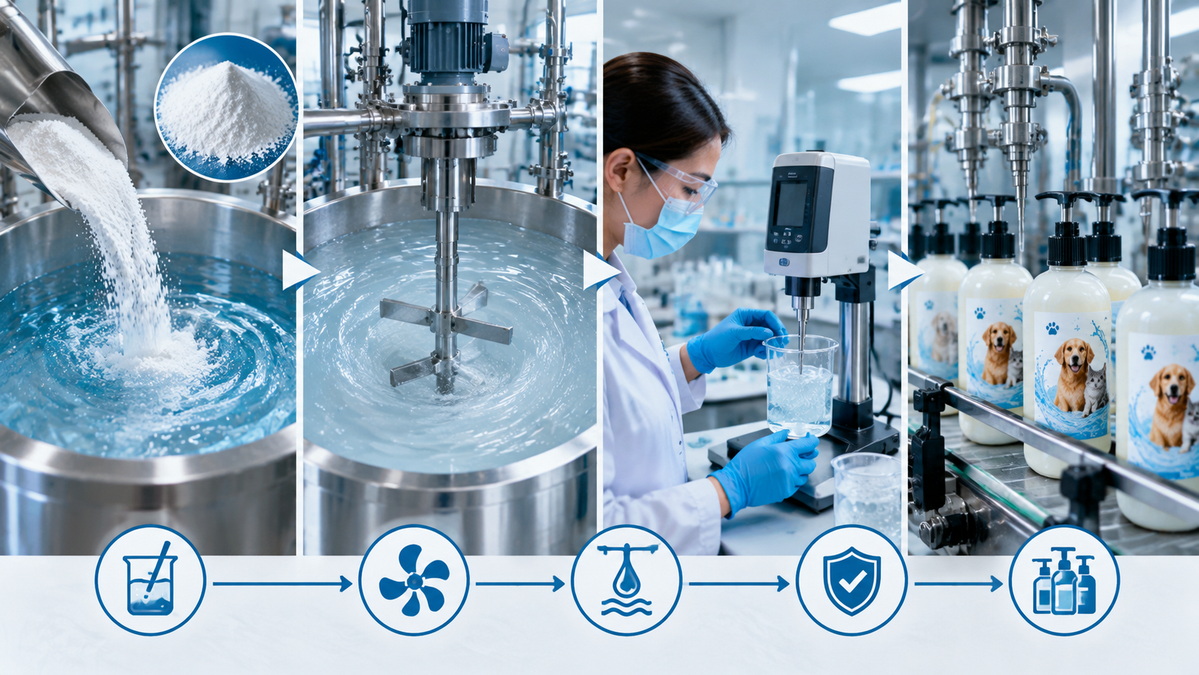
Two cellulose ether grades may have similar nominal viscosity values but behave differently in a shampoo formula. Their hydration rate, flow profile, clarity, salt response, and suspension performance may not be the same.
Always test the material in the final surfactant system.
Adding more thickener does not always improve product quality. Excessive cellulose ether may make a shampoo difficult to dispense, spread, dilute, or rinse.
The correct dosage should deliver the desired performance without creating unnecessary heaviness.
The surfactant system strongly affects viscosity and stability. A cellulose ether must be evaluated with the actual anionic, amphoteric, non-ionic, or mixed surfactant system planned for commercial production.
A pet shampoo may look stable immediately after production but change after several weeks of storage. Viscosity may decline, increase, separate, become cloudy, or develop instability under high or low temperatures.
Stability testing is essential before launch.
Words such as "hypoallergenic," "non-irritating," "sensitive skin," "dermatologist tested," or "veterinarian approved" should only be used when the product has appropriate evidence and documentation.
A responsible product description should accurately reflect the finished formula, testing status, intended use, and target market requirements.
Before moving from laboratory development to commercial production, review the following checklist.
| Quality Area | Key Review Point |
|---|---|
| Cellulose ether quality | Confirm grade specification, viscosity range, moisture, appearance, and batch consistency |
| Formula compatibility | Confirm HPMC or HEMC performance with surfactants, oils, extracts, preservatives, and fragrance |
| Stability | Test at room temperature, elevated temperature, low temperature, and freeze-thaw conditions |
| Appearance | Review color, clarity, opacity, pearlescent effect, and visible particles |
| Rheology | Evaluate viscosity, flow behavior, pumpability, and product recovery after shear |
| Foam | Check foam volume, foam stability, and rinsing behavior |
| Packaging | Confirm compatibility with bottles, pumps, caps, pouches, labels, and sealing systems |
| Microbiological quality | Verify preservation effectiveness and finished-product microbial quality |
| Consumer use | Confirm instructions for dilution, application, contact time, and complete rinsing |
| Claims | Ensure all product claims are supported, accurate, and suitable for the target market |
The most effective selection process begins with the desired user experience.
For example, a premium dog shampoo brand may want a product that looks elegant in a transparent bottle, creates a smooth lather, distributes easily through long fur, and rinses with minimal residue. In this case, the formulation team should compare HPMC and HEMC according to the real product target rather than simply choosing the lowest-cost thickener.
A functional shampoo containing suspended ingredients may require stronger structural support. A moisturizing shampoo may need a smoother gel profile. A puppy shampoo may require lower viscosity and rapid rinse-off. A cat shampoo may need especially careful control of fragrance and residue.
There is no universal answer.
The better material is the one that delivers the intended product performance with reliable processing, stable storage, appropriate quality control, and responsible finished-product evaluation.
HPMC and HEMC are both valuable cellulose ether options for pet shampoo formulation. Each material can contribute to viscosity control, stability, texture development, water retention, and improved product handling.
HPMC may be preferred for smooth, gel-like, premium shampoo textures and controlled flow. HEMC may be preferred when strong viscosity stability or suspension performance is especially important. However, neither product should be selected based on theory alone.
The final decision should be based on formula-specific testing.
A high-purity cellulose ether provides a more reliable starting point for pet shampoo development. It can help reduce raw-material variability, support stable production, and improve product consistency. Yet a gentle pet shampoo depends on the full formula: mild surfactants, balanced pH, thoughtful fragrance selection, reliable preservation, easy rinsability, suitable packaging, and careful product evaluation.
Shandong Shengda New Material Co., Ltd. provides HPMC and HEMC cellulose ether solutions for daily-chemical formulations. By combining consistent material quality with application-focused technical understanding, we help manufacturers develop stable, effective, and well-structured pet-care shampoo products for global markets.
HPMC can be suitable for pet shampoo as a non-ionic thickener and rheology modifier. It may help improve viscosity, texture, stability, and controlled flow. Its suitability should always be confirmed in the complete shampoo formula.
HEMC may be used in sensitive-skin dog shampoo formulations because it can provide viscosity control and stability. However, sensitive-skin suitability depends on the complete product formula, including surfactants, fragrance, preservatives, pH, and rinsing performance.
Neither is universally better. HPMC may be suitable for smooth gel textures and premium flow behavior, while HEMC may be suitable for structured viscosity and suspension-focused systems. The correct choice depends on the formula and performance target.
High-purity HPMC or HEMC can help reduce avoidable raw-material variability. Consistent quality can support more stable viscosity, cleaner product appearance, reliable processing, and better batch-to-batch performance.
Yes. HPMC and HEMC can be evaluated in sulfate-free pet shampoo systems. Their performance should be tested with the selected mild surfactants, conditioning ingredients, preservatives, botanical extracts, and fragrance system.
Manufacturers should test viscosity, flow behavior, foam, rinsability, product appearance, storage stability, freeze-thaw resistance, high-temperature stability, microbiological quality, preservation effectiveness, packaging compatibility, and overall formula consistency.
Rinseability is important because shampoo residue can remain in thick fur or close to the skin. A well-designed shampoo should spread easily during washing and rinse away efficiently after use.
1. [Shampoo Therapy in Veterinary Dermatology: Benefits and Practical Tips]
2. [Shampoo Therapy in Veterinary Dermatology — VIN]
3. [Tylose for Personal Care Product Information]
4. [Tylose Personal Care Brochure]
5. [Cosmetic Ingredient Review Quick Reference Table, October 2024]
6. [Cosmetic Ingredient Review Quick Reference Table]
7. [Reapplication of the Type IV Hypersensitivity Quantitative Risk Assessment in Dogs]


