


close
Choose Your Site
Global
Social Media
Views: 286 Author: Shengda Publish Time: 2026-10-27 Origin: Site


Content Menu
● What Does Bio-Stability Mean for Cellulose Ether Storage?
>> Resistance to Enzymatic Degradation
>> Resistance to Microbial Spoilage
>> Physical and Chemical Storage Stability
● HPMC vs HEMC: Chemistry and Storage Performance Compared
● Why Substitution Matters More Than the Polymer Name
>> Average Substitution Is Only Part of the Picture
>> Published Research Demonstrates Grade-Level Differences
>> Enzyme Type Also Changes the Result
● Dry Powder vs Aqueous Formulations: Two Different Storage Challenges
>> Storing HPMC and HEMC Powders
>> Storing Polymer Solutions and Finished Products
● Which Polymer Is Better for Your Application?
>> Dry-Mix Construction Materials
>> Ready-Mixed Construction Products
>> Household and Personal-Care Formulations
● A Practical Protocol for Comparing HPMC and HEMC Bio-Stability
>> 1. Define the Acceptance Criteria
>> 2. Prepare Two Types of Comparison
>> 3. Establish a Reliable Baseline
>> 4. Separate Biological and Nonbiological Testing
>> 5. Combine Real-Time and Accelerated Storage
● Expert Insight: Diagnose Thinning Before Replacing the Thickener
● What Evidence Should Buyers Request?
● Conclusion: Choose Proven Formulation Performance
>> 1. Is HEMC always more bio-stable than HPMC?
>> 2. Does enzyme-resistant HPMC eliminate the need for preservatives?
>> 3. Can HPMC and HEMC powders develop storage problems?
>> 4. Can retained viscosity prove that a product is microbiologically safe?
>> 5. Can accelerated aging establish a two-year shelf life?
>> 6. Should all cellulose ether formulations use the same challenge test?
HPMC vs HEMC bio-stability in storage has no universal winner. Hydroxypropyl Methyl Cellulose (HPMC) and Hydroxyethyl Methyl Cellulose (HEMC) can both support stable formulations, but neither polymer name guarantees resistance to microbial contamination or enzymatic viscosity loss. The better choice depends on the specific grade, substitution pattern, formulation, preservation system, and storage conditions.
For manufacturers of construction materials and household products, the practical question is therefore not simply, "Which polymer is more resistant?" It is, "Which grade maintains the required performance throughout our product's validated shelf life?"
Our selection principle is straightforward: prioritize validation over broad claims about polymer chemistry. Understanding how storage failures develop makes that decision more reliable—and helps avoid unnecessary reformulation.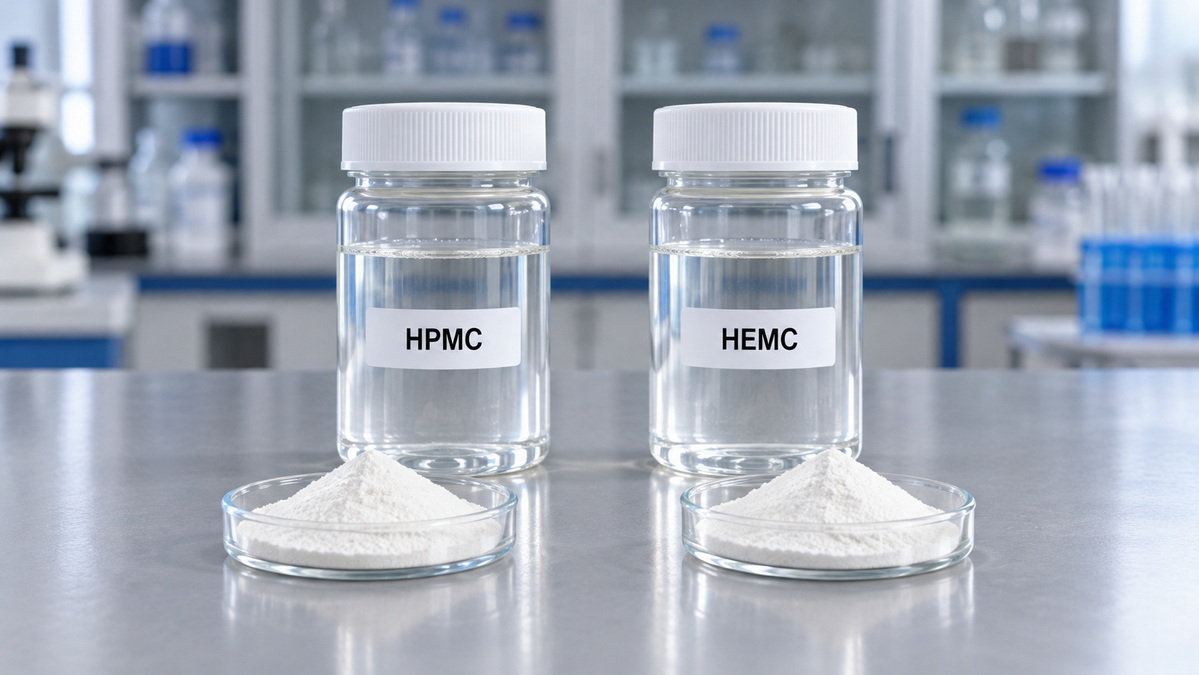
Bio-stability is often used loosely. For a meaningful HPMC vs HEMC comparison, separate three different performance questions.
Certain microorganisms produce cellulases: enzymes capable of breaking susceptible bonds in cellulose-based polymers.
If these enzymes degrade a cellulose ether, its molecular chains can become shorter. The formulation may lose viscosity, suspension performance, or application consistency.
Chemical substitution can restrict enzyme access to the cellulose backbone. However, resistance depends on how extensively—and where—the polymer has been modified.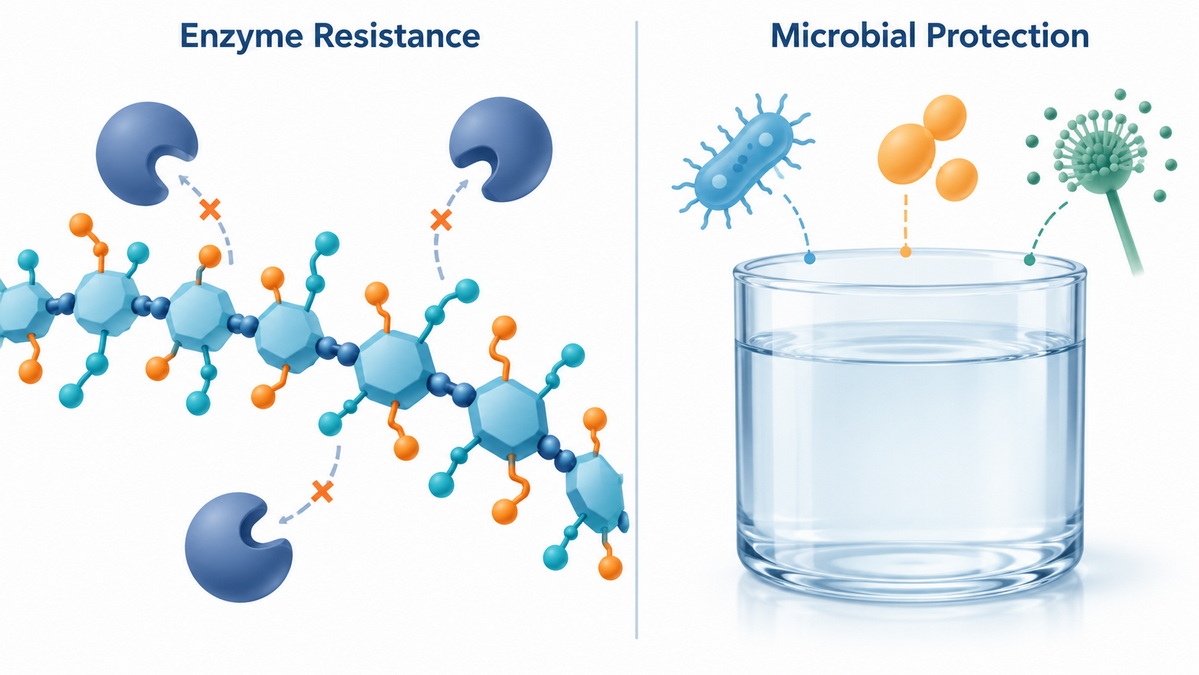
Microbial spoilage concerns the growth of bacteria, yeasts, or molds within a product.
An enzyme-resistant thickener is not necessarily antimicrobial. Microorganisms may grow using other ingredients even when the cellulose ether retains its thickening performance.
Consequently, a formulation can remain visibly thick while failing microbiological requirements.
Not every storage problem is biological.
Temperature changes, incomplete hydration, incompatible ingredients, oxidation, or changes in pH can also affect viscosity and appearance.
A useful investigation separates these mechanisms rather than treating every thin batch as evidence of poor cellulose ether bio-stability.
HPMC and HEMC are nonionic cellulose ethers derived from chemically modified cellulose.
HPMC contains methyl and hydroxypropyl substituents. HEMC contains methyl and hydroxyethyl substituents and is also commonly called methyl hydroxyethyl cellulose, or MHEC.
These structural differences influence formulation behavior. Nevertheless, they do not establish a universal ranking for biological storage resistance.
| Comparison factor | HPMC | HEMC | Practical implication |
|---|---|---|---|
| Chemical modification | Methyl and hydroxypropyl groups | Methyl and hydroxyethyl groups | Compare actual grades, not abbreviations alone |
| Main formulation functions | Thickening, water retention, binding, and rheology control | Thickening, water retention, binding, and rheology control | Both require application-specific screening |
| Enzyme resistance | Depends on substitution and enzyme exposure | Depends on substitution and enzyme exposure | Request comparative test evidence |
| Antimicrobial protection | Not inherently a preservative | Not inherently a preservative | Assess the finished product's protection system |
| Dry-storage priorities | Moisture exclusion and packaging integrity | Moisture exclusion and packaging integrity | Follow supplier storage instructions |
| Aqueous-storage priorities | Hygiene, preservation, compatibility, and viscosity retention | Hygiene, preservation, compatibility, and viscosity retention | Test the complete formulation |
| Guaranteed shelf life from polymer identity | Cannot be established | Cannot be established | Shelf-life claims require supporting data |
When comparing supplier recommendations, ask whether "better stability" means retained viscosity, lower microbial counts, better high-temperature workability, or reduced separation. These are different outcomes.
The degree of substitution describes the average number of cellulose hydroxyl groups replaced per repeating unit.
For hydroxyalkyl modifications, molar substitution provides additional information about the introduced groups.
These measurements help characterize a polymer. They do not, however, fully describe the distribution of substituents along its backbone.
Two grades with similar average chemistry may contain different arrangements of more-substituted and less-substituted regions. Those differences can influence enzyme accessibility.
A peer-reviewed investigation examined three HPMC batches with similar chemical properties. Their susceptibility to endoglucanase degradation differed, and the researchers associated those differences with substituent distribution.
The important purchasing lesson is not that one HPMC batch represents every commercial grade. It is that even closely related materials can behave differently under enzymatic exposure.
This study does not directly rank HPMC against HEMC. Instead, it explains why a blanket statement such as "HEMC always provides better bio-stability" requires stronger, application-specific evidence.
Different cellulases do not necessarily attack modified cellulose in the same way.
A favorable result against one enzyme preparation may not predict resistance to another enzyme source or to mixed contamination in a factory environment.
For that reason, an enzyme-resistance claim should identify the test conditions, not merely report "excellent resistance."
For unopened dry powders, moisture management is a primary concern.
Moisture ingress can cause caking, poor flow, and inconsistent dispersion. Dry powder should not be assumed sterile, but its storage assessment differs substantially from that of a water-rich finished product.
Recommended handling practices include:
- Retaining the original moisture-protective packaging.
- Keeping bags away from wet floors and leaking walls.
- Resealing partially used containers promptly.
- Using clean, dry transfer equipment.
- Following the grade-specific storage period and conditions.
- Investigating damaged packaging before releasing material.
Do not assign the same shelf life to every HPMC or HEMC grade without reviewing the supplier's documentation.
Once cellulose ethers enter an aqueous system, the assessment changes.
Water quality, contamination introduced during manufacture, other organic ingredients, and packaging exposure all become relevant.
A stable dry powder does not automatically produce a self-preserving solution. Likewise, a well-preserved formulation may still experience nonbiological viscosity drift.
Assess microbiological quality and functional stability separately.
For tile adhesives, cement-based renders, and gypsum products stored as dry blends, biological resistance is usually not the only—or most useful—selection criterion.
Evaluate:
- Water retention after mixing.
- Workability and consistency.
- Open time and application behavior.
- Compatibility with cement, gypsum, and other additives.
- Performance after representative dry-storage exposure.
Neither HPMC nor HEMC should be selected solely on a generalized claim about microbial resistance.
Water-containing fillers, adhesives, and similar products need a more explicit preservation strategy.
Compare the candidate grades within the same formulation, using equivalent manufacturing conditions. Measure both viscosity retention and microbial performance.
A grade that performs well in freshly prepared material may still behave differently after prolonged storage or repeated package opening.
Surfactants, salts, fragrance systems, pH adjustments, and preservatives can affect finished-product behavior.
Confirm that the selected grade is suitable for the intended application. Construction-grade acceptance does not automatically establish suitability for skin-contact products.
For cosmetics, a recognized preservation-efficacy framework can support evaluation of antimicrobial protection. Household cleaners and industrial construction products require methods appropriate to their own product categories and risks.
A useful comparison should reveal why a formulation succeeds or fails—not simply generate two final viscosity readings.
Specify the required shelf life, storage conditions, packaging, and application performance.
Set acceptance criteria before testing. These may include viscosity limits, separation, odor, appearance, microbiological quality, and functional performance.
There is no single viscosity-retention threshold suitable for every product.
First, compare grades at the same polymer concentration. This shows how they behave at equal dosage.
Second, compare formulations adjusted to similar initial application viscosity. This helps assess practical performance and cost at comparable starting consistency.
The two comparisons answer different questions and should not be treated as interchangeable.
Allow complete hydration before recording initial measurements.
Keep the following conditions consistent:
- Water quality and formulation composition.
- Mixing sequence and mixing intensity.
- Hydration time.
- Measurement temperature.
- Instrument, spindle, speed, and sample conditioning.
Otherwise, preparation differences can be mistaken for storage instability.
Include non-inoculated controls to track physical and chemical changes.
Use a qualified laboratory for microbiological challenge testing. If enzymatic resistance is a key concern, commission a separate, controlled enzyme-exposure study.
An enzyme test evaluates polymer vulnerability. A preservation challenge evaluates the formulation's antimicrobial protection. Neither replaces the other.
Real-time testing should reflect the intended storage environment.
Accelerated temperature exposure can help screen formulations for physical or chemical weakness. It does not automatically simulate microbial behavior or prove a longer ambient shelf life.
Choose conditions appropriate to the formulation and its thermal behavior.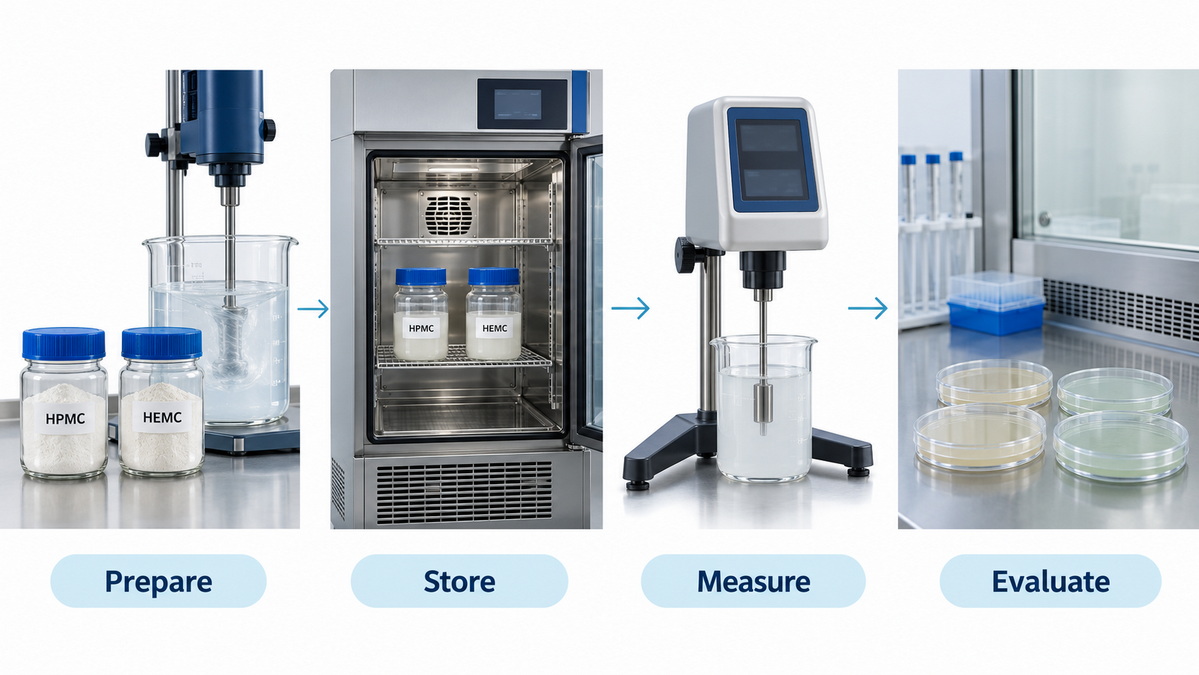
From a formulation-development perspective, replacing HPMC with HEMC—or the reverse—too early can conceal the real problem.
Use the failure pattern to guide investigation.
| Observation | Possible explanation | Recommended next check |
|---|---|---|
| Viscosity falls while microbial counts increase | Contamination may be contributing | Review preservation, water quality, and sanitation |
| Viscosity falls without detected microbial growth | Physical or chemical instability may be involved | Check pH, ingredients, temperature, and test sensitivity |
| Viscosity changes substantially during early hydration | Initial measurements may have been premature | Repeat after standardized hydration |
| Separation occurs while bulk viscosity remains acceptable | Suspension or interfacial stability may be inadequate | Review the broader formulation |
| Powder cakes before use | Moisture exposure or packaging failure | Inspect storage conditions and packaging |
| Only enzyme-exposed samples lose viscosity | Enzymatic chain degradation is implicated | Compare grade-specific enzyme resistance |
These observations guide troubleshooting; they are not definitive diagnoses.
Also avoid assuming that a low microbial count proves enzymes were never present. Investigations should consider manufacturing history and the limits of the analytical method.
A productive supplier discussion goes beyond nominal viscosity.
Request information on:
1. Grade identity and intended applications.
2. Viscosity specifications and measurement conditions.
3. Relevant substitution specifications.
4. Moisture limits and packaging requirements.
5. Available microbiological specifications.
6. Enzyme-resistance test methods and results, where applicable.
7. Recommended storage conditions and shelf life.
8. Batch consistency and change-notification practices.
For sustainability claims, distinguish cellulose-based origin from demonstrated environmental biodegradation. Storage bio-stability and end-of-life environmental behavior are separate questions requiring different evidence.
Neither HPMC nor HEMC offers universally superior bio-stability in storage. The strongest choice is the specific grade that delivers acceptable microbial protection, viscosity retention, and application performance in your complete formulation.
Shandong Shengda New Material Co., Ltd. focuses on the research, development, production, and sales of HPMC, HEMC, and related cellulose ethers for construction and daily chemical applications.
Contact our team with your product type, target viscosity, pH, manufacturing process, packaging, and intended storage conditions. Request application-relevant grade information and samples, then confirm performance through a controlled comparison before commercial approval.
No. Polymer identity alone does not establish superiority. Substitution, grade characteristics, enzyme exposure, formulation composition, and preservation all influence storage performance.
No. Enzyme resistance concerns degradation of the polymer. It does not establish that the finished formulation prevents bacteria, yeasts, or molds from growing.
Yes. Moisture exposure can cause caking and handling problems. Packaging damage or contamination also requires investigation. Follow the storage instructions for the specific grade.
No. A formulation can retain viscosity while containing unacceptable microbial contamination. Rheological testing and microbiological evaluation answer different questions.
Not by itself. Accelerated testing can support development, but shelf-life justification needs an appropriate relationship to real-time performance, packaging, and microbiological protection.
No. Select methods appropriate to the product category. Cosmetic preservation testing should not automatically be applied unchanged to household cleaners or construction products.
1. Schagerlöf, H., et al. (2006). "Substituent Distribution and Clouding Behavior of Hydroxypropyl Methyl Cellulose Analyzed Using Enzymatic Degradation." *Biomacromolecules*, 7(12), 3474–3481. Peer-reviewed evidence connecting HPMC substituent distribution with differences in enzymatic susceptibility; not a direct HPMC–HEMC ranking. [View publication]. [pubmed.ncbi.nlm.nih]
2. Dow. *METHOCEL Cellulose Ethers: Technical Handbook*. Sections on resistance to microorganisms, aqueous-solution preservation, hydration, and moisture sorption. Manufacturer guidance distinguishes resistance to microbial attack from antimicrobial activity; historical preservative examples should not be treated as current formulation recommendations. [Read technical handbook]. [talasonline]
3. Ashland. *Pharmaceutical Excipients Reference Guide*. General technical background on cellulose ether chemistry, degree of substitution, molar substitution, viscosity, and water retention. Used for chemistry principles, not to imply pharmaceutical suitability of construction or daily chemical grades. [Read reference guide]. [ashland]
4. SE Tylose. "Tylose® MHEC." Manufacturer description of methyl hydroxyethyl cellulose as a water-soluble, nonionic cellulose ether supplied in powder or granular form. [View product information]. [setylose]
5. International Organization for Standardization. *ISO 11930:2019—Cosmetics—Microbiology—Evaluation of the Antimicrobial Protection of a Cosmetic Product*. Establishes the cosmetic-product preservation-efficacy and antimicrobial-protection assessment framework. [View standard]. [iso]
6. International Organization for Standardization. *ISO 11930:2019/Amd 1:2022*. Amendment to the cosmetic antimicrobial-protection evaluation standard. [View amendment]. [iso]
7. Microchem Laboratory. "ISO 11930—Preservative Effectiveness Test." Practical explanation of cosmetic challenge testing, monitored microorganisms, and evaluation over a defined test period. [Read testing overview]. [microchemlab]


