


close
Choose Your Site
Global
Social Media
Views: 264 Author: Shengda Publish Time: 2026-10-25 Origin: Site


Content Menu
● HPMC vs HEMC: What Determines Dissolution Behavior?
● How Particle Size Affects Cellulose Ether Dissolution Rate
>> Separate Wetting, Dispersion, and Dissolution
>> Why Finer Particles Usually Dissolve Faster
>> Why Finer Powder Can Still Form Lumps
● What Published Research Actually Shows
>> A Quantitative Example—and Its Limitation
● HPMC vs HEMC Lumping: Why Surface Treatment Matters
>> Untreated Grades Need Effective Separation
>> Delayed-Hydration Grades Create a Mixing Window
● Choosing Particle Size for Construction and Daily Chemical Products
>> Dry-Mix Mortar, Tile Adhesive, and Wall Putty
>> Liquid Detergents and Other Daily Chemical Products
● A Practical Procedure to Reduce HPMC and HEMC Lumps
>> Step 1: Confirm the Grade Before Mixing
>> Step 2: Establish Controlled Starting Conditions
>> Step 3: Control Powder Addition
>> Step 4: Hydrate Using the Grade-Specific Method
● A Better HPMC vs HEMC Qualification Test
>> Use a Four-Sample Comparison
>> Measure Both Speed and Uniformity
● Troubleshooting Dissolution and Lumping Problems
● What Buyers Should Request from a Cellulose Ether Manufacturer
● Conclusion: Select the Grade That Fits Your Process
>> 1. Does HEMC dissolve faster than HPMC?
>> 2. Does finer HPMC always produce fewer lumps?
>> 3. Is there an ideal particle size for HEMC in mortar?
>> 4. Why does a surface-treated grade initially remain thin?
>> 5. Can more mixing eliminate every cellulose ether lump?
>> 6. Can HPMC and HEMC be exchanged at the same dosage?
HPMC vs HEMC comparisons often focus on viscosity and water retention. However, particle size can determine how quickly either cellulose ether develops useful performance—and whether it disperses smoothly or forms persistent lumps. For manufacturers of dry-mix mortar, wall putty, and daily chemical products, this difference directly affects mixing consistency and production efficiency.
The practical answer is straightforward: smaller particles generally dissolve faster when properly dispersed, but finer powder does not automatically mean fewer lumps. Surface treatment, addition sequence, water conditions, and mixing equipment can be equally important.
At Shandong Shengda New Material Co., Ltd., our formulation perspective starts with dispersion: select the grade that separates into individual particles before substantial hydration begins, then verify its performance under actual processing conditions.
Hydroxypropyl Methyl Cellulose, or HPMC, contains methoxy and hydroxypropyl groups attached to the cellulose backbone. Hydroxyethyl Methyl Cellulose, or HEMC, contains methoxy and hydroxyethyl groups. HEMC is also commonly called MHEC.
Both function as water-retaining agents and rheology modifiers. Nevertheless, neither chemical name alone establishes dissolution speed or resistance to lumping.
A meaningful comparison must consider several interacting variables:
| Comparison factor | HPMC | HEMC |
|---|---|---|
| Hydroxyalkyl substituent | Hydroxypropyl | Hydroxyethyl |
| Particle-size effect | Finer, separated particles generally hydrate faster | The same general principle applies |
| Lumping risk | Depends strongly on dispersion and grade treatment | Depends strongly on dispersion and grade treatment |
| Delayed-hydration options | Available in selected grades | Available in selected grades |
| Procurement priority | Match chemistry, viscosity, and physical form to processing | Apply the same grade-specific evaluation |
The important distinction is between comparing polymer families and comparing finished commercial grades. An untreated fine HPMC powder and a delayed-hydration HEMC powder differ in more than chemistry.
These stages are related but not interchangeable:
1. Wetting brings water into contact with powder surfaces.
2. Dispersion separates particles throughout the liquid or wet mixture.
3. Hydration and dissolution allow polymer chains to interact with water and develop solution properties.
A powder can disperse quickly while intentionally delaying viscosity development. Conversely, it can hydrate rapidly at its surface yet remain trapped inside lumps.
This explains why "instant soluble" and "fast dissolving" should not be accepted without a defined test method.
Smaller particles provide more surface area per unit mass and shorter distances for water penetration. When particles remain separated, these characteristics usually accelerate hydration and dissolution.
In dry-mix mortar, faster polymer availability can help establish water retention and consistency within a limited mixing period.
However, final solution viscosity and dissolution speed describe different properties. Two grades may reach similar fully hydrated viscosities but develop those viscosities at different rates.
When untreated cellulose ether enters water as a concentrated pile, the outside can hydrate before the particles separate.
A viscous gel layer then surrounds relatively dry material. These agglomerates are often called fish eyes.
Fine powder can be especially demanding when the dosing rate exceeds the mixer's ability to distribute it. The solution is not simply "use coarser material" or "increase mixing speed." The entire addition process needs examination.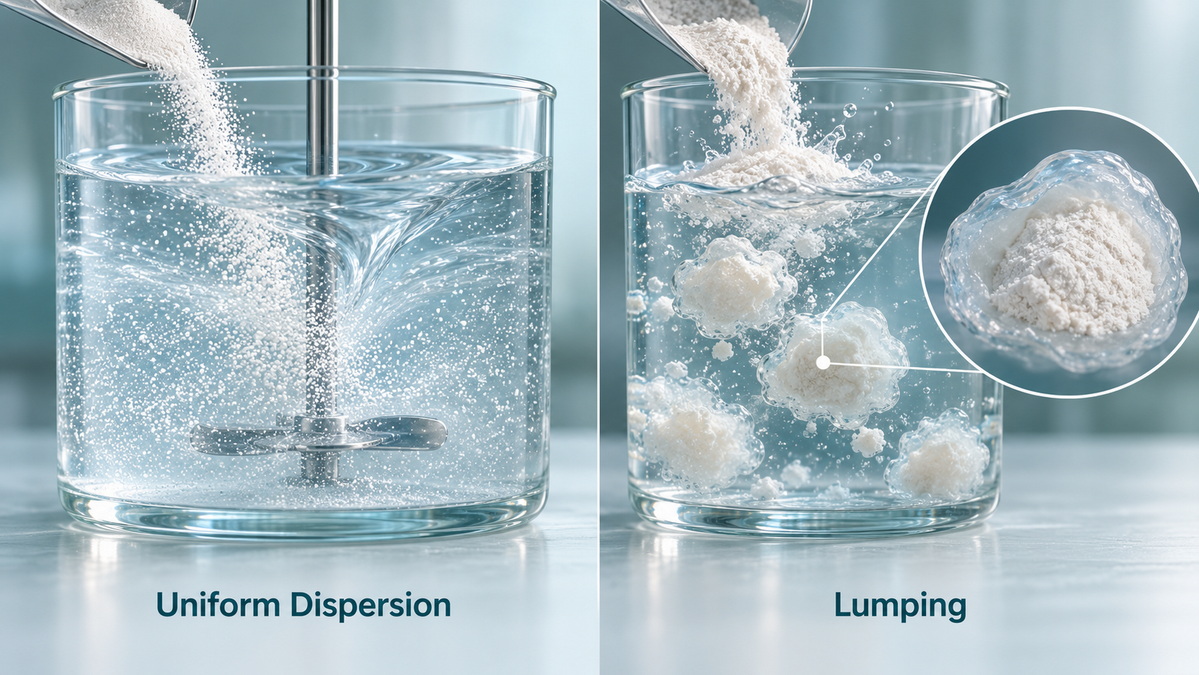
Research comparing ten cellulose ethers—including three HPMC and three HEMC samples—demonstrated that particle-size effects were not uniform across grades.
For one HPMC sample, smaller particles improved mortar water retention. For higher-molecular-weight HPMC samples, the effect became weaker or negligible under the tested conditions.
The HEMC results also varied. One sample showed no clear particle-size trend, while another delivered approximately constant water retention across the investigated fractions.
The practical lesson is important: finer particles can improve early polymer availability without producing a proportional improvement in every final performance measurement.
The same investigation measured dissolution of an HEC sample in saturated lime solution at 23°C:
| Particle-size fraction | Time to reach 90% dissolution |
|---|---|
| Below 100 µm | 11 minutes |
| 150–200 µm | 24 minutes |
These figures illustrate the potential influence of particle size. They are not HPMC or HEMC dissolution specifications and should not be presented as such.
For buyers, the defensible conclusion is that particle size matters, but numerical claims must remain attached to the tested polymer, liquid environment, concentration, and mixing conditions.
Untreated powders begin interacting with suitable water as soon as they become wetted.
They can work well in dry-blended construction products because mineral ingredients help distribute cellulose ether before water addition. Direct addition to liquid requires more deliberate control.
Typical safeguards include:
- Metering powder gradually.
- Maintaining effective liquid circulation.
- Avoiding accumulation on the liquid surface.
- Using an appropriate premixing or dispersion method.
Neither untreated HPMC nor untreated HEMC is inherently lump-proof.
Selected surface-treated grades temporarily delay hydration. This gives particles time to disperse before substantial thickening develops.
For relevant grades, alkaline adjustment can shorten that delay. However, the pH should be adjusted only after complete dispersion and according to the supplier's instructions.
Adding delayed-hydration powder directly into an already alkaline liquid can remove the intended dispersion window and encourage lump formation.
A longer initial delay is therefore not necessarily a disadvantage. It may produce faster overall preparation by preventing difficult agglomerates.
Construction formulations often require cellulose ether performance within relatively short mixing and maturation periods.
A suitable powder should distribute evenly through the dry blend and develop sufficient functionality during the specified preparation cycle.
Evaluate:
- Early consistency and subsequent viscosity development.
- Water retention under the selected test method.
- Troweling feel and visible agglomerates.
- Performance after the prescribed rest and remix.
- Application-specific properties such as slip resistance or open time.
Do not assume higher fineness automatically improves every property. Chemistry, dosage, molecular weight, and formulation composition remain important.
For liquid systems, the central challenge is often incorporating cellulose ether without local overconcentration.
A compatible delayed-hydration grade may provide a useful processing window. Alternatively, a separately prepared polymer solution may suit the manufacturing sequence.
Test the selected grade in the complete formulation. Surfactants, electrolytes, pH, and temperature can change behavior compared with a simple water test.
Construction-grade suitability does not establish suitability for personal-care or household products. Confirm the relevant purity, ingredient documentation, and application requirements separately.
The following framework should be adapted to the product's technical instructions.
Identify whether the material is untreated, delayed-hydration, powdered, or granulated.
Request the recommended preparation method. A procedure designed for one physical form may perform poorly with another.
Record water temperature, pH, quantity, and quality. Confirm that the mixer circulates the full batch rather than only the area around the impeller.
For delayed-hydration products, starting pH is particularly important.
Introduce powder at a rate the liquid can absorb and distribute.
Avoid dumping an entire bag into a small area. Increasing agitation after a gel-covered lump forms may be less effective than preventing the lump initially.
For suitable surface-treated grades, complete dispersion before any recommended pH adjustment.
For compatible untreated HPMC grades, a hot/cold preparation method may be appropriate: disperse in sufficiently hot water, then cool with the remaining water to enable hydration.
Do not interpret this as hot-water dissolution. Confirm temperatures and applicability with the supplier, especially before transferring the method to another grade.
Check for residual agglomerates and measure viscosity under consistent conditions.
A smooth-looking surface does not prove complete hydration. Conversely, entrained air should not be mistaken for undissolved powder.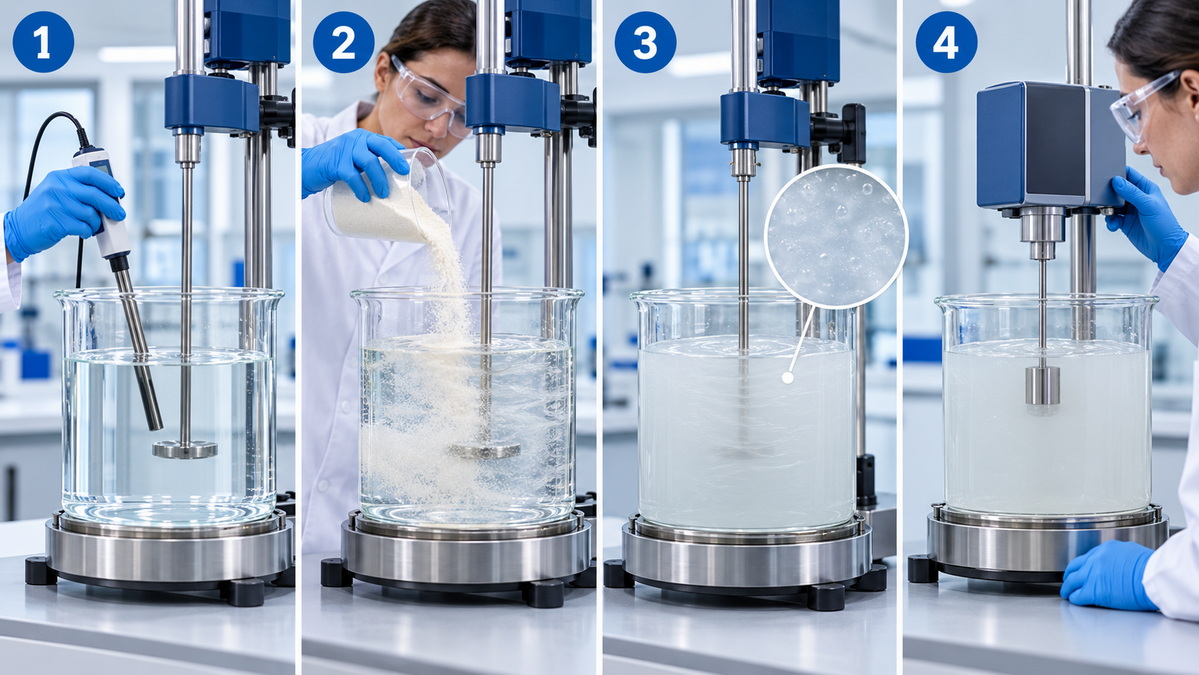
A controlled screening program can separate particle-size effects from chemistry and processing effects.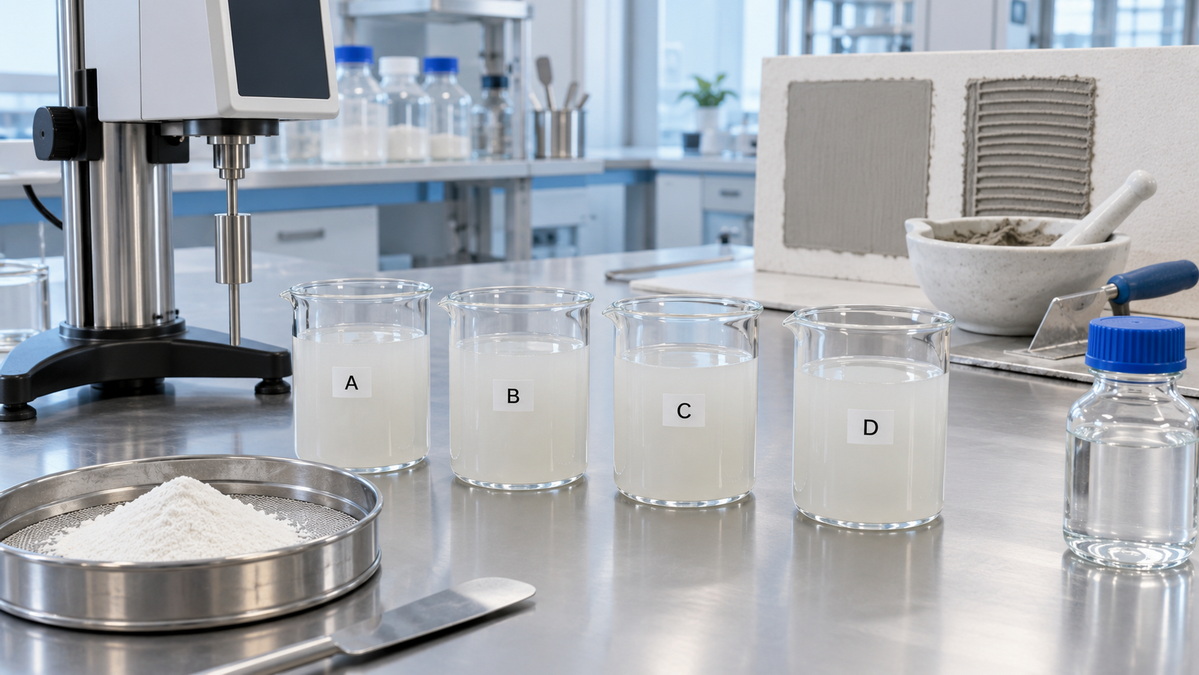
Where available, compare:
| Sample | Polymer | Physical specification |
|---|---|---|
| A | HPMC | Finer distribution |
| B | HPMC | Coarser distribution |
| C | HEMC | Finer distribution |
| D | HEMC | Coarser distribution |
Keep nominal viscosity, treatment status, and other grade characteristics as closely matched as practicable. Record remaining differences rather than treating them as irrelevant.
Use a fixed concentration, vessel, impeller, addition rate, and temperature.
Useful screening endpoints include:
- Time to uniform wetting.
- Time to a defined viscosity target.
- Viscosity at fixed intervals.
- Number or mass of retained agglomerates under a defined inspection procedure.
- Final application performance.
If viscosity is used as a hydration indicator, report it as viscosity development—not direct proof of the percentage dissolved. Polymer type and formulation structure can influence that relationship.
Repeat the screen in the actual mortar or liquid formulation before approving a replacement.
| Observation | Possible explanation | First investigation |
|---|---|---|
| Gel-coated lumps appear immediately | Local hydration outpaces dispersion | Reduce addition rate and inspect circulation |
| Delayed grade thickens during dosing | Starting conditions shorten the delay | Check initial pH and temperature |
| Few lumps, but slow viscosity development | Hydration remains incomplete or intentionally delayed | Verify grade instructions and measurement timing |
| Mortar changes strongly after resting | Polymer development continues after initial mixing | Standardize rest and remix procedures |
| Laboratory results do not scale up | Mixing and dosing conditions differ | Compare impeller arrangement, circulation, and feed location |
These observations are diagnostic starting points, not proof of a single cause.
Avoid changing particle size, dosage, mixer speed, and addition order simultaneously. Controlled changes make the underlying problem easier to identify.
A useful purchase specification goes beyond "fine powder" and a nominal viscosity value.
Ask for:
- Particle-size limits and the measurement method.
- Sieve aperture and percentage passing when sieve data are used.
- Viscosity concentration, temperature, instrument, and test conditions.
- Surface-treatment or delayed-hydration information.
- Moisture limits and recommended storage.
- Application-specific preparation guidance.
- Agreed batch acceptance criteria.
Mesh descriptions alone are insufficient without the applicable sieve standard and passing percentage. Likewise, viscosity numbers measured under different conditions may not be directly comparable.
From a manufacturing perspective, a reproducible specification is more valuable than an unsupported claim that one polymer family always dissolves faster.
HPMC and HEMC can both provide effective thickening and water retention. Particle size influences how quickly their functionality becomes available, but dispersion determines whether that potential is realized.
Choose the grade that reaches the required performance within your mixing cycle without unacceptable agglomeration. Validate the decision through controlled testing rather than polymer name, fineness, or viscosity alone.
Shandong Shengda New Material Co., Ltd. develops and manufactures HPMC, HEMC, and related cellulose ether solutions for construction and daily chemical applications. Share your formulation type, mixing equipment, water conditions, and current dissolution problem with our team to discuss suitable samples and a practical comparison plan.
Not universally. Particle distribution, substitution, molecular weight, surface treatment, and preparation conditions can outweigh the polymer-family distinction. Compare specified grades under identical conditions.
No. Finer particles can dissolve faster after separation, but rapid surface hydration can also trap dry powder inside agglomerates when dosing or mixing is inadequate.
There is no universal optimum. Select the distribution according to dry-blend uniformity, mixing time, viscosity development, and verified application performance.
Its hydration delay allows dispersion before substantial thickening. The duration depends on the grade and processing conditions, including pH and temperature.
Not reliably within a practical production cycle. Prevention through appropriate grade selection and controlled addition is preferable to relying on prolonged mixing after agglomeration.
Not without testing. Similar nominal viscosity does not guarantee equivalent hydration behavior, mortar workability, liquid texture, or final formulation performance.
1. Patural, L.; Govin, A.; Ruot, B.; Deves, O.; Grosseau, P. "Influence of Cellulose Ether Particle Size on Water Retention of Freshly-Mixed Mortars." Presented at the 9th CANMET/ACI International Conference on Superplasticizers and Other Chemical Admixtures in Concrete, Seville, 2009; archived in HAL in 2010. Primary evidence for grade-dependent particle-size effects and the explicitly identified HEC dissolution example. [hal]
2. The Dow Chemical Company. "METHOCEL Cellulose Ethers: Technical Handbook." Especially "How to Prepare Aqueous Solutions," printed pages 11–13, and the sections covering chemistry and physical forms. Technical basis for dispersion before hydration, surface-treated grades, and HPMC hot/cold preparation. Historical handbook; current grade instructions take precedence. [uolab.groups.et.byu]
3. SE Tylose GmbH & Co. KG. "Tylose for Building Materials." Edition 07/2025. Manufacturer documentation covering particle-size categories, HEMC/HPMC construction applications, delayed solubility, and the importance of dispersing before alkaline adjustment. Its product classifications are supplier-specific, not universal specifications. [setylose]
4. SE Tylose GmbH & Co. KG. "Tylose for Home Care." Manufacturer guidance on physical forms, delayed-solubility grades, and pH-dependent preparation in household formulations. [setylose]
5. SE Tylose GmbH & Co. KG. "Tylose for Personal Care." Manufacturer documentation supporting the distinction between particle form, delayed hydration, and application-specific grade selection. [setylose]


