


close
Choose Your Site
Global
Social Media
Views: 254 Author: Shengda Publish Time: 2026-10-24 Origin: Site


Content Menu
● What Does Shear-Thinning Mean for HEMC and HPMC?
● HEMC vs HPMC: Chemical Structure and Practical Differences
● What Controls Cellulose Ether Shear-Thinning Behavior?
>> Molecular Weight and Polymer Concentration
● Why Matching Viscosity Numbers Can Be Misleading
● An Evidence-Based Insight: Grades Within One Family Behave Differently
● Choosing HEMC or HPMC for Different Applications
>> Tile Adhesives and Vertical Mortars
>> Renders, Plasters, and Wall Putties
>> Household and Daily-Chemical Products
● A Six-Step Protocol for Comparing HEMC and HPMC
>> 1. Define the Application Problem
>> 2. Control Preparation Conditions
>> 3. Run Two Comparison Tracks
>> 5. Measure Recovery Separately
>> 6. Validate Application and Storage
● Troubleshooting Example: Easy Spreading but Poor Tile Stability
● Procurement: Compare Cost per Acceptable Result
● Conclusion: Select the Grade That Matches the Application
>> Is HEMC More Shear-Thinning Than HPMC?
>> Can HPMC Replace HEMC at the Same Dosage?
>> Does Higher Viscosity Mean Better Anti-Sag Performance?
>> Are Shear-Thinning and Thixotropy the Same?
>> Can Water-Solution Testing Predict Mortar Performance?
>> What Should Buyers Request Before Comparing Grades?
HEMC vs HPMC is not simply a choice between two cellulose ethers. It is a decision about how a formulation flows during mixing, pumping, spreading, and application. Hydroxyethyl Methyl Cellulose (HEMC) and Hydroxypropyl Methyl Cellulose (HPMC) can both produce shear-thinning behavior, but their performance depends on the specific grade and the complete formulation.
For manufacturers of tile adhesives, renders, wall putties, and household products, the practical question is straightforward: which grade provides easy application without sacrificing stability?
My starting point for this comparison is rheology—not the viscosity number printed on a specification sheet. Understanding the full flow profile provides a stronger basis for choosing between HEMC and HPMC.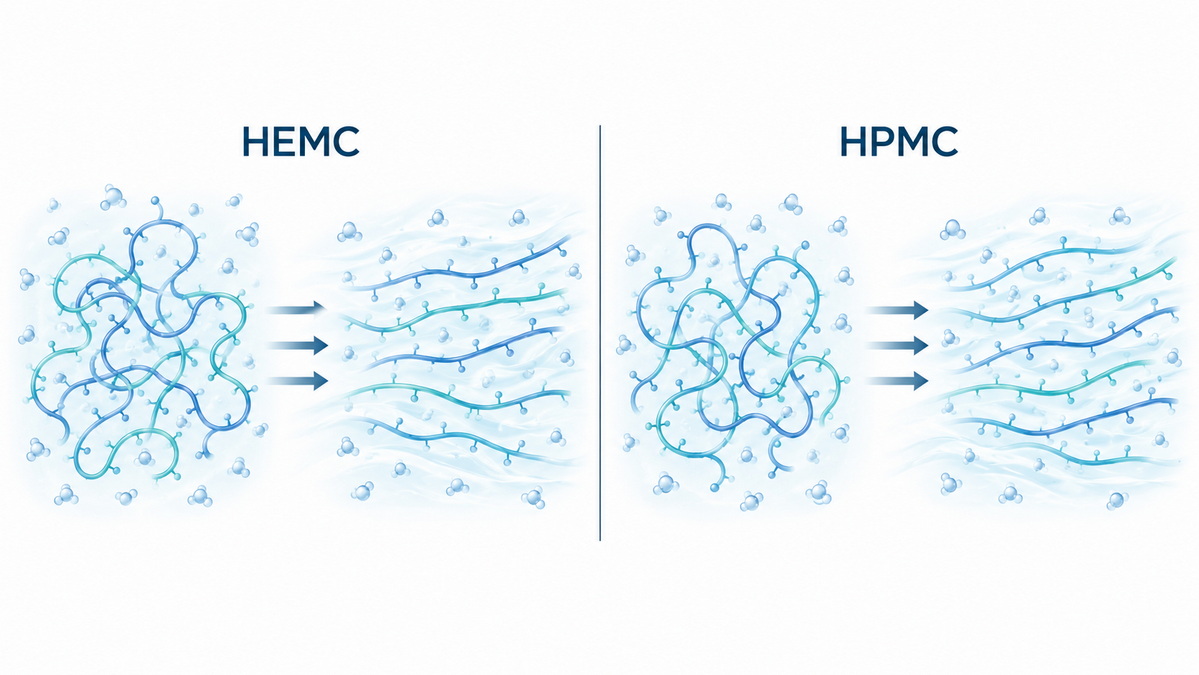
Shear-thinning describes a decrease in apparent viscosity as shear rate increases.
A formulation may feel thick when undisturbed but move more easily when mixed, pumped, or spread with a trowel. In cellulose ether solutions, this behavior reflects changes in polymer-chain orientation and interactions under flow.
However, three properties must remain separate:
- Shear-thinning describes how viscosity changes with shear rate.
- Yield stress describes the stress needed to initiate substantial flow.
- Thixotropy describes time-dependent structural breakdown and recovery.
These distinctions matter. A mortar that spreads easily does not automatically resist tile slip. Similarly, a detergent that becomes thinner during pouring does not necessarily recover its original structure quickly afterward.
A useful HEMC vs HPMC comparison therefore examines flow, resistance to movement, and recovery separately.
HEMC contains methyl and hydroxyethyl substituents on the cellulose backbone. HPMC contains methyl and hydroxypropyl substituents.
HEMC is also commonly called MHEC, while HPMC may appear as MHPC in technical literature.
These chemical differences influence hydration, polymer interactions, and temperature response. However, the product name alone does not establish which material will exhibit stronger shear-thinning.
| Comparison factor | HEMC | HPMC | Practical implication |
|---|---|---|---|
| Substituent groups | Methyl and hydroxyethyl | Methyl and hydroxypropyl | Chemistry influences hydration and interactions |
| Shear-thinning potential | Grade-dependent | Grade-dependent | Compare measured flow curves |
| Molecular weight | Varies by grade | Varies by grade | Strongly affects solution consistency |
| Temperature response | Depends on substitution and formulation | Depends on substitution and formulation | Test under intended operating conditions |
| Construction applications | Used in mortars, renders, and tile adhesives | Used in mortars, putties, and tile adhesives | Neither family guarantees superior application |
| Selection basis | Full formulation performance | Full formulation performance | Choose a grade, not merely an abbreviation |
The most defensible conclusion is that there is no universal winner. A particular HEMC grade may outperform one HPMC grade while performing differently against another.
Molecular weight influences chain entanglement and solution viscosity. Concentration determines how frequently polymer chains overlap and interact.
Consequently, changing either variable can alter application resistance, low-shear consistency, and sensitivity to shear.
This explains why increasing dosage does not simply make a formulation "the same, but thicker." It can change the shape of the flow curve and disturb the balance between workability and stability.
The amount and distribution of substituent groups influence cellulose ether behavior in water.
Hydration conditions also matter. Incomplete dissolution can produce lumps, inconsistent viscosity, and misleading measurements.
Before comparing HEMC and HPMC, establish a repeatable preparation procedure. Otherwise, apparent differences may reflect unequal hydration rather than genuine material performance.
Mortar is not a cellulose ether solution with sand added. Cement, fillers, water, entrained air, and other additives collectively determine its flow.
Similarly, household formulations contain surfactants, salts, fragrances, and other ingredients that can change thickening behavior.
Solution testing is useful for screening. Final selection requires testing the actual product.
Two products labeled with the same nominal viscosity may behave differently during application.
A viscosity value is meaningful only when its measurement conditions are known:
- Polymer concentration and concentration basis.
- Temperature.
- Instrument and measuring geometry.
- Spindle speed or shear rate.
- Hydration time and sample preparation.
Even when these conditions match, a single-point measurement cannot describe the entire flow curve.
One material may provide greater resistance at low shear but lower resistance during spreading. Another may show less contrast between those conditions.
For purchasing decisions, request comparable measurement methods before treating two viscosity specifications as equivalent.
A published mortar study examined three HEMC grades with reported molecular weights of approximately 600,000, 680,000, and 1,000,000.
The formulations contained 0.19–0.31% HEMC by dry-mixture weight, with water maintained at 19% relative to the dry mixture.
All tested mortars showed shear-thinning at low shear rates. At higher shear rates, their responses diverged: some remained shear-thinning, while others approached Bingham-like behavior under particular conditions.
The important lesson is not that these values define an ideal formulation. They do not.
Instead, the study demonstrates that substantial rheological differences exist within HEMC itself. It cannot establish a universal HEMC-over-HPMC ranking because it was not a matched comparison between both families.
For product development, within-family variation deserves as much attention as the HEMC vs HPMC distinction.
Tile adhesives require manageable trowel resistance alongside resistance to unwanted movement.
Evaluate:
- Mixing and spreading effort.
- Ridge formation and stability.
- Tile slip.
- Wetting and transfer.
- Open time and adhesion.
Shear-thinning can support easier spreading, but it does not independently prove anti-slip performance or bond strength.
Avoid increasing viscosity as the automatic response to every application problem. The resulting adhesive may become harder to spread without solving the underlying issue.

For these applications, the desired balance often involves easy spreading, stable wet-layer thickness, and an acceptable finish.
A strongly structured formulation may hold well but feel resistant under the tool. A more mobile formulation may spread comfortably but require better control of sagging.
Assess both the fresh application and the finished surface rather than relying exclusively on a laboratory viscosity result.
For household liquids, shear-thinning can help reconcile storage consistency with easier dispensing.
However, construction-grade performance cannot establish suitability for a household formulation. Evaluate the intended grade with the actual surfactant system, salt level, temperature range, and packaging.
Clarity, compatibility, storage stability, and dispensing behavior should accompany rheological testing.
The following is a proposed development workflow, not a universal standardized method.
Specify the failure you need to correct: difficult spreading, excessive slip, poor dispensing, or unstable consistency.
Set acceptance criteria before evaluating samples.
Use identical water quality, temperature, addition sequence, mixing energy, and hydration time.
For mortar, also control raw-material lots and elapsed time after mixing.
First, compare HEMC and HPMC at equal dosage and water content.
Then, optimize each candidate separately to meet the same application target.
The first track isolates substitution effects more clearly. The second provides a more commercially relevant comparison between workable formulations.
Record viscosity or shear stress across a relevant shear-rate range.
Use geometry suitable for the sample. Mortars require particular attention to particle size, wall slip, and sample disturbance.
A three-interval thixotropy test applies low shear, high shear, and then low shear again.
This helps assess how the formulation responds after an application-like disturbance.
Interpret mortar recovery cautiously because hydration and aging continue during measurement.
Combine instrument data with spreading, slip, wetting, dispensing, and storage tests as appropriate.
Repeat important measurements to establish whether differences are reproducible.
Consider a hypothetical tile adhesive that spreads comfortably but allows excessive tile movement.
This example is illustrative, not a reported Shandong Shengda customer trial.
The initial temptation may be to replace HPMC with HEMC immediately. A more informative sequence is:
1. Confirm water dosage and mixing consistency.
2. Measure yield behavior and structural recovery.
3. Check entrained air and interactions with other additives.
4. Compare alternative grades under controlled conditions.
5. Recheck slip, wetting, and adhesion together.
If a candidate improves stability but noticeably worsens transfer, the problem is not fully solved.
The objective is a balanced application window, not an isolated improvement in one rheological parameter.
For buyers, price per kilogram is only one part of the decision.
A useful commercial comparison considers the dosage required to achieve acceptable performance, batch consistency, mixing requirements, and the risk of application-related rejection.
Likewise, sustainability claims should remain specific. Potential reductions in additive consumption or rework require supporting trial data. Cellulose-derived chemistry alone does not establish the environmental footprint of a finished formulation.
Request grade-specific specifications, comparable test methods, and documented application results before approving a substitution.
HEMC and HPMC can both deliver useful shear-thinning behavior. Their practical differences emerge through molecular weight, substitution, concentration, preparation, and formulation interactions.
My recommendation is to replace the question "Which cellulose ether is better?" with "Which grade produces the required flow, stability, and recovery in this formulation?"
Shandong Shengda New Material Co., Ltd. focuses on developing, manufacturing, and supplying construction-grade and daily-chemical-grade cellulose ethers.
Contact Shandong Shengda with your formulation type, current dosage, viscosity test method, application temperature, and main performance challenge. Request suitable HEMC and HPMC samples, then validate the candidates through a controlled comparison before scaling production.
Not universally. Molecular weight, substitution, dosage, and formulation conditions can change the ranking. Compare specific grades using the same measurement procedure.
It may be a useful starting trial, but equal dosage does not guarantee equivalent performance. Recheck flow, water retention, stability, and application results.
Not necessarily. Anti-sag behavior also involves yield stress, structural recovery, and formulation interactions. A single viscosity value cannot describe all these properties.
No. Shear-thinning concerns viscosity changes with shear rate. Thixotropy concerns time-dependent breakdown and recovery under a defined shear history.
It can support screening and quality control, but it cannot replace mortar testing. Mineral particles, air, hydration, and additives alter the response.
Request the viscosity method, concentration, temperature, preparation procedure, and relevant application data. Where available, add flow curves and recovery measurements.
1. Feng, K., Ma, K., Yang, H., Long, G., Xie, Y., Zeng, X., Tang, Z., and Usman, I. U. "Influence of Cellulose Ethers on Rheological Properties of Cementitious Materials: A Review." *Journal of Building Engineering*, 2024, volume 95, article 110347. Supports the discussion of formulation effects, rheological models, and testing limitations. [sciencedirect]
2. Phan Van Tien, Nguyen Huu Cuong, Phan Dinh Quoc, and Le Ngoc Hung. "High Molecular Weight Cellulose Ethers Influence on the Rheological Properties of Fresh Mortars." *Scholars Journal of Engineering and Technology*, 2016, 4(8), pp. 338–343. Source of the HEMC molecular weights, dosage range, and grade-dependent mortar behavior discussed above. [saspublishers]
3. Anton Paar. "Basics of Thixotropy." Technical knowledge resource explaining shear-thinning, time-dependent recovery, and three-interval testing. Supports the distinctions between flow behavior and structural recovery. [wiki.anton-paar]
4. Anton Paar. "3iTT Test." Technical guidance describing low-shear, high-shear, and recovery intervals for evaluating application-related structural changes. Supports the proposed recovery-testing workflow. [wiki.anton-paar]
5. Bayer, R. "Thermal Precipitation or Gelling Behaviour of Dissolved Methylcellulose (MC) Derivatives—Behaviour in Water and Influence on the Extrusion of Ceramic Pastes. Part 1: Fundamentals of MC-Derivatives." *Journal of the European Ceramic Society*, 2012. Supports the importance of substitution, concentration, and temperature when comparing cellulose ether behavior. [sciencedirect]


