


close
Choose Your Site
Global
Social Media
Views: 233 Author: Shengda Publish Time: 2026-07-03 Origin: Site


As a cellulose ether manufacturer, we are often asked a practical question: what is the difference between HPMC and HEMC and which one performs better in real formulations? The answer depends on chemistry, application conditions, temperature, cost, and the performance balance you need in construction or daily chemical products. [wotaichem]
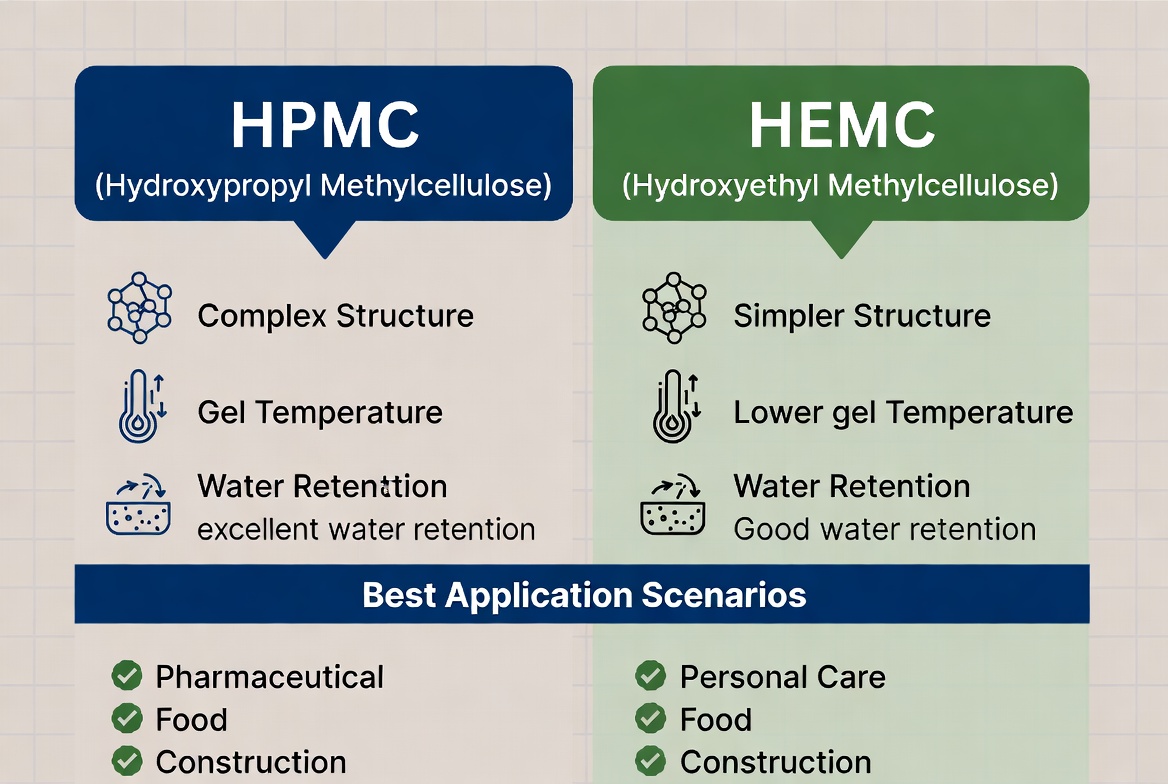
HPMC stands for hydroxypropyl methyl cellulose, while HEMC stands for hydroxyethyl methyl cellulose. Both are non-ionic cellulose ethers made from natural cellulose through etherification, and both are widely used in building materials, coatings, adhesives, and some daily chemical formulations. [kimachemical]
From an application engineer's perspective, these two products are often selected for similar jobs, but they do not behave exactly the same under heat, mixing, and long open-time conditions. That is why choosing the right cellulose ether can directly affect workability, water retention, sag resistance, and final product stability. [tenessy]
The core difference lies in the side groups attached to the cellulose backbone. HPMC contains hydroxypropyl and methyl groups, while HEMC contains hydroxyethyl and methyl groups. This small molecular difference creates meaningful changes in solubility, rheology, thermal behavior, and formulation tolerance. [celotech]
In practical terms, HEMC is often considered more hydrophilic, while HPMC usually offers broader formulation flexibility in some systems. That is why these two materials may look interchangeable on paper, but deliver different results in the bucket, on the wall, or during storage. [cemotech]
The most important comparison points are water retention, gel temperature, thermal stability, dispersibility, and cost. In construction applications, these are not abstract lab terms; they determine whether mortar stays workable long enough, whether tile adhesive resists sagging, and whether coatings level smoothly under real jobsite conditions. [kimachemical]
| Property | HPMC | HEMC |
|---|---|---|
| Main substituent | Hydroxypropyl | Hydroxyethyl |
| Gel temperature | Typically lower | Typically higher |
| High-temperature stability | Good | Better |
| Water retention | Good | Often slightly better |
| Workability | Stable and versatile | Smoother in hot conditions |
| Cost | Usually more economical | Often higher |
| Best-fit use | Broad construction and daily chemical uses | Hot-climate construction and high water-retention systems |
The table above reflects the most commonly reported industry differences, especially in hot-weather construction and cement-based formulations. [wotaichem]
Gel temperature is one of the most useful indicators when comparing HPMC and HEMC. HPMC typically gels at a lower temperature than HEMC, while HEMC generally maintains performance better in hotter environments. [youtube]
In real project conditions, that means HEMC may hold water and preserve workability better during summer installation, especially in regions with high ambient temperatures or fast-drying substrates. HPMC can still perform very well, but formulators often need to fine-tune dosage or the rest of the system more carefully when the climate is hot. [youtube]
Both HPMC and HEMC are widely used in tile adhesives, wall putty, plaster, render, gypsum products, and dry-mix mortars. In these systems, they act as thickener, water retention agent, workability improver, and anti-sag additive. [tenessy]
In day-to-day manufacturing, the choice often follows the environment and performance target:
- Choose HPMC when you need broad usability, reliable water retention, and a cost-effective solution.
- Choose HEMC when the project is exposed to higher temperatures, needs stronger water retention, or requires a smoother rheology profile under harsh site conditions.
- For premium mortars, some formulators test both grades side by side to optimize open time, slip resistance, and finishing feel. [cemotech]

Although construction is the main market, both materials can also appear in certain daily chemical formulations where thickening, stabilization, and texture control are important. Their non-ionic nature helps them work in systems that need good compatibility and balanced viscosity development. [kimachemical]
For personal care or household products, the final selection should consider clarity, salt tolerance, sensory feel, and temperature behavior. In these cases, the decision is not simply "which one is stronger," but rather which one fits the full formulation goal. [tenessy]
A practical selection method is better than a theoretical comparison. Based on industry use patterns, procurement teams and formulation engineers can decide in three steps:
1. Define the climate and substrate temperature.
2. Check whether water retention or open time is the top priority.
3. Verify compatibility with cement, gypsum, sand, pigments, preservatives, and redispersible polymer powders. [cemotech]
This matters because the same cellulose ether can behave differently when the rest of the system changes. In other words, the best product is not always the one with the highest viscosity; it is the one that delivers the most stable field performance. [kimachemical]
For a manufacturer like Shandong Shengda New Material Co., Ltd., the strongest value proposition is not just "we supply HPMC and HEMC." The real message should be consistent quality, tailored grade selection, and application support across construction and daily chemical markets. This positions the company as a solution provider rather than a commodity seller. [tenessy]
A strong content strategy should therefore highlight raw material control, production consistency, application testing, and technical service. These are exactly the trust signals that support E-E-A-T and help convert informed buyers. [kimachemical]
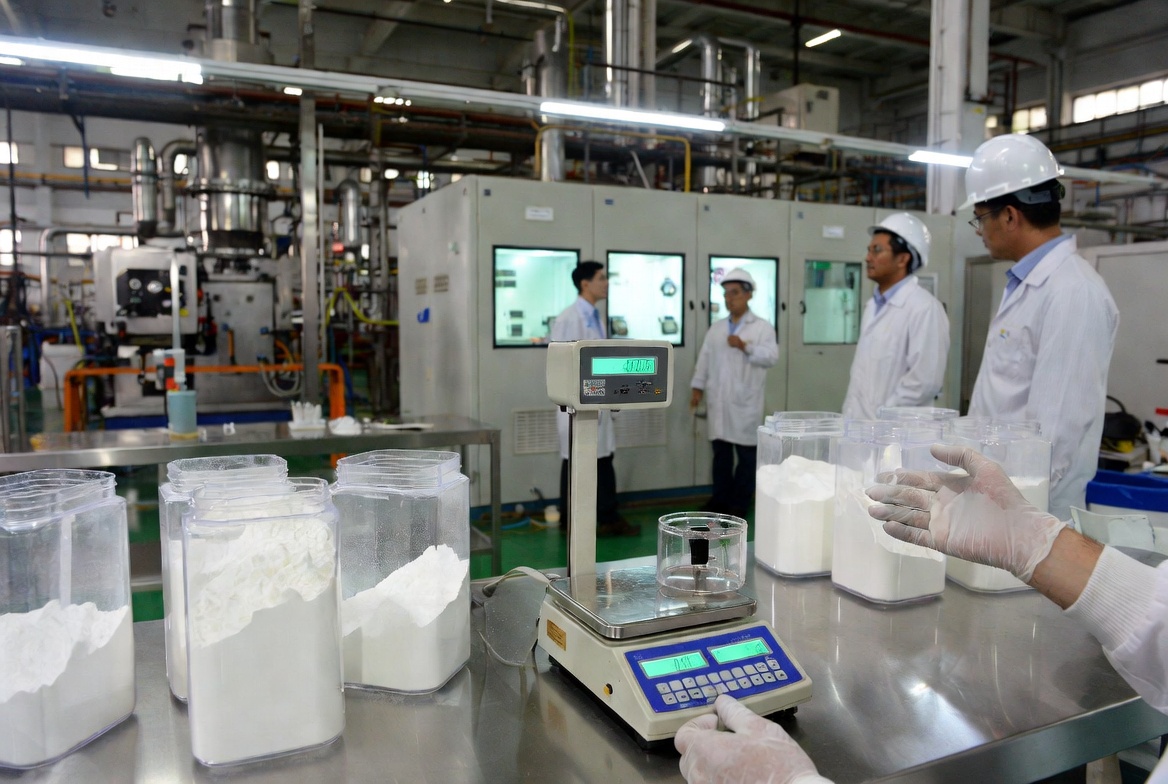
If your project needs the right cellulose ether for tile adhesive, plaster, mortar, coatings, or daily chemical formulations, choose a supplier that can do more than ship powder. Ask for grade guidance, sample testing, and application support so you can match the right product to the right environment. [kimachemical]
For manufacturers and buyers looking for stable, customized cellulose ether solutions, this is the point where technical service becomes as important as product price. [tenessy]
Not always. HEMC is often better in hot-weather construction and water-retention-sensitive systems, while HPMC is widely valued for versatility and cost efficiency. [cemotech]
HEMC generally has a higher gel temperature than HPMC, which helps it perform more stably in high-temperature environments. [celotech]
Both are used in tile adhesive, but HEMC is often preferred when hot-climate performance and water retention are especially important. [tenessy]
Because HPMC offers reliable thickening, water retention, and broad application flexibility across many construction and daily chemical products. [hpmc]
Sometimes, but not blindly. A lab trial is recommended because temperature, viscosity, dosage, and the full formula all affect final performance. [cemotech]
1. WOTAIchem, "7 Key Differences of HPMC and HEMC | Best Tips for Selection" — https://wotaichem.com/difference-between-hpmc-and-hemc/ [wotaichem]
2. HPMC.com, "What is the difference between HPMC and HEMC?" — https://www.hpmc.com/company-news/what-is-the-difference-between-hpmc-and-hemc.html [hpmc]
3. WOTAIchem YouTube video, "The difference between HPMC and HEMC" — https://www.youtube.com/watch?v=rkrN0JCpNdk [youtube]
4. Kima Chemical, "Comparison between HEMC and HPMC in the field of coatings" — https://www.kimachemical.com/news/comparison-between-hemc-and-hpmc-in-the-field-of-coatings/ [kimachemical]
5. Celotech, "The difference of physical and chemical properties and application of HPMC and HEMC" — https://www.celotech.com/technology/the-difference-of-physical-and-chemical-properties-and-application-of-hpmc-and-hemc-in-the-c ... [celotech]
6. Tenessy, "HPMC vs HEMC: Which is Better for Your Project?" — https://tenessy.com/hpmc-vs-hemc-which-is-better-for-your-project/ [tenessy]
7. Cemotech, "The Difference Between HPMC & HEMC" — https://www.cemotech.com/blog/the-difference-between-hpmc-hemc [cemotech]


