


close
Choose Your Site
Global
Social Media
Views: 238 Author: Shengda Publish Time: 2026-10-18 Origin: Site


Content Menu
● What Does Enzyme Resistance Mean for HPMC and HEMC?
>> Enzyme Resistance Is Not Antimicrobial Protection
● HPMC vs HEMC: Structural Differences That Matter
>> Degree of Substitution and Molar Substitution
>> Why Substitution Uniformity Matters
● Which Has Better Enzyme Resistance: HPMC or HEMC?
>> What Published Evidence Actually Establishes
>> Why Matching Initial Viscosity Is Not Enough
● How Application Conditions Change the HPMC vs HEMC Decision
>> Water-Based Paints and Coatings
>> Ready-Mixed Construction Products
>> Household Cleaners and Daily Chemical Products
● A Practical Protocol for Comparing HPMC and HEMC Enzyme Resistance
>> Step 1: Define the Commercial Failure
>> Step 2: Use Two Comparison Designs
>> Step 3: Fully Hydrate Each Grade
>> Step 4: Include Controls and Replicates
>> Step 5: Measure Viscosity Retention
>> Step 6: Validate the Finished Product
● Expert Insight: Diagnose Thinning Before Replacing the Thickener
● How to Evaluate Supplier Claims and Long-Term Value
● Discuss Your HPMC or HEMC Requirements with Shandong Shengda
● FAQs
>> Is HEMC always more enzyme-resistant than HPMC?
>> Can HPMC or HEMC replace preservatives?
>> Does higher viscosity mean better enzyme resistance?
>> Can HEMC replace HPMC at the same dosage?
>> Which test should manufacturers use?
>> Why can viscosity fall without obvious microbial growth?
HPMC vs HEMC enzyme resistance is not a comparison with one universal winner. Both Hydroxypropyl Methyl Cellulose (HPMC) and Hydroxyethyl Methyl Cellulose (HEMC) can help maintain viscosity in water-based formulations, but their resistance to enzymatic degradation depends on the specific grade, substitution chemistry, and formulation environment.
For manufacturers of coatings, ready-mixed construction products, and household cleaners, that distinction matters. A thickener that performs well immediately after production may behave differently after storage or exposure to cellulose-degrading enzymes.
Our formulation perspective is straightforward: prioritize validation over polymer labels. Select HPMC or HEMC using documented performance under relevant conditions, rather than assuming that one chemical name guarantees longer shelf life.
This guide explains the chemistry, practical differences, and testing approach needed to make that decision.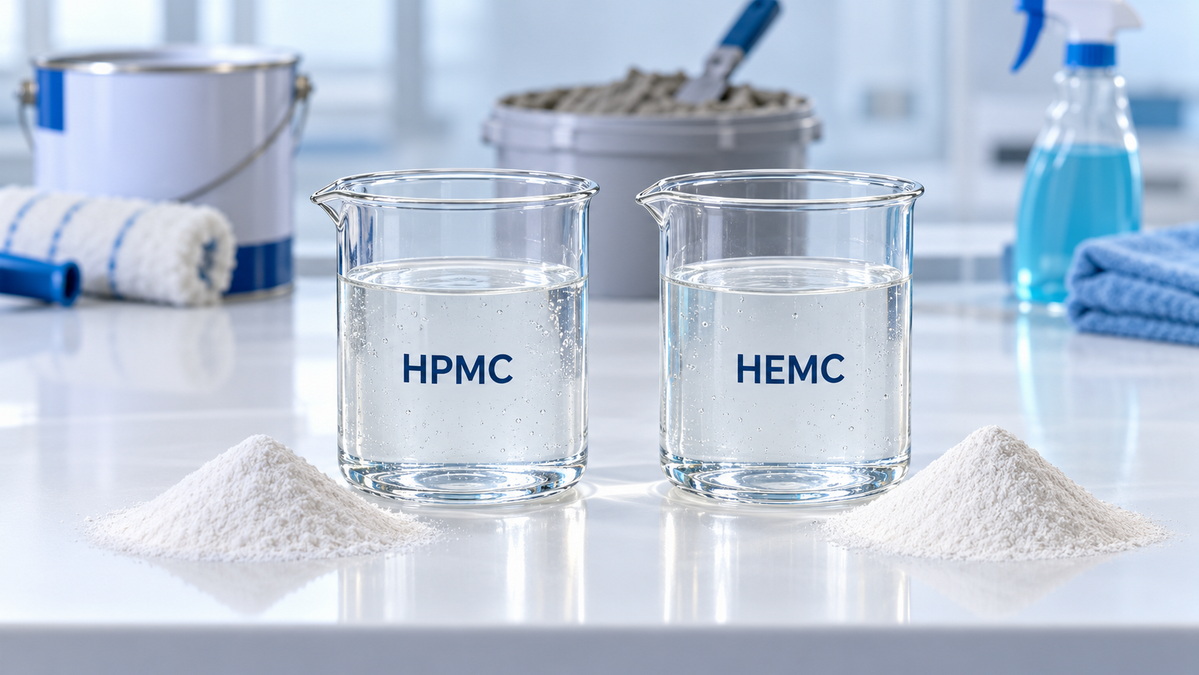
Enzyme resistance describes a cellulose ether's ability to retain its molecular integrity and thickening performance when exposed to enzymes capable of degrading its cellulose backbone.
Cellulases are particularly relevant. These enzymes can break susceptible bonds in cellulose-based polymers, shortening their chains and reducing solution viscosity.
In a finished formulation, this may contribute to:
- Loss of body and application consistency.
- Reduced suspension of pigments or fillers.
- Changes in flow, leveling, or dispensing.
- Separation and unacceptable storage performance.
However, viscosity loss alone does not prove enzymatic degradation. Temperature changes, incomplete hydration, formulation incompatibility, and other chemical or physical effects can produce similar symptoms.
A cellulose ether can resist enzymatic attack without preventing bacteria or fungi from growing.
That distinction separates two formulation questions:
1. Will the thickener retain viscosity when enzymes are present?
2. Will the finished product adequately control microbial contamination?
An enzyme-resistant HPMC or HEMC grade addresses the first question. It does not automatically answer the second.
Preservatives, manufacturing hygiene, packaging, and appropriate microbial testing remain separate requirements. Nor should an enzyme-resistant designation be interpreted as permission to reduce preservative dosage without supporting evidence.
Both materials are nonionic cellulose ethers. Their cellulose backbones carry methyl groups together with a second type of substituent.
HPMC contains hydroxypropyl groups. HEMC contains hydroxyethyl groups.
These modifications affect hydration, solution behavior, thermal response, and accessibility to enzymes. Yet the substituent name alone does not describe how thoroughly or uniformly the cellulose chain is protected.
| Comparison point | HPMC | HEMC |
|---|---|---|
| Full name | Hydroxypropyl Methyl Cellulose | Hydroxyethyl Methyl Cellulose |
| Main substituents | Methyl and hydroxypropyl | Methyl and hydroxyethyl |
| Ionic character | Nonionic | Nonionic |
| Enzyme-resistant grades possible? | Yes | Yes |
| Main resistance considerations | Substitution level, distribution, and grade design | Substitution level, distribution, and grade design |
| Does the chemical name guarantee superiority? | No | No |
| Practical selection basis | Relevant challenge testing and finished-product performance | Relevant challenge testing and finished-product performance |
Degree of Substitution and Molar Substitution
Degree of substitution, or DS, describes the average number of original cellulose hydroxyl positions that have been substituted per repeating glucose unit.
Molar substitution, or MS, describes the average number of hydroxyalkyl units introduced per repeating glucose unit. Because hydroxyalkyl side chains can extend, MS and DS are not interchangeable.
For buyers, the practical lesson is important: a higher hydroxyethyl or hydroxypropyl content does not, by itself, establish superior enzyme resistance.
Ask how the grade performs, not simply how much substituent it contains.
Average substitution figures can conceal uneven protection.
Two cellulose ethers with similar average substitution may contain different distributions of substituted and relatively exposed segments. Those accessible regions can influence susceptibility to enzyme attack.
This explains why a general statement such as "HEMC always has better enzyme resistance than HPMC" is technically unreliable. Manufacturing control and individual grade chemistry can be more informative than the polymer family.
Neither HPMC nor HEMC should receive an automatic first-place ranking.
Technical literature documents enzyme-resistant HPMC products. Historical experimental work also demonstrates that carefully designed HEMC products can combine enzymatic stability with useful latex-paint performance.
Together, these findings support a grade-specific conclusion—not a universal hierarchy.
Historical HEMC development work linked improved enzyme resistance with controlled substitution. It also described HPMC products developed for increased enzymatic resistance.
Importantly, the same work included HEMC samples with different resistance outcomes. That variation within one polymer family illustrates why broad comparisons can mislead.
These findings are useful for understanding mechanisms. They are not current qualification data for every commercially available HPMC or HEMC grade, and they do not establish performance for Shandong Shengda products.
Two grades can deliver the same starting viscosity but retain different proportions after an enzyme challenge.
Initial viscosity also depends on concentration, molecular weight, temperature, and measurement conditions.
A credible comparison therefore needs:
- Clearly identified product grades.
- A defined enzyme preparation and activity.
- Controlled polymer concentration, pH, and temperature.
- Consistent hydration and measurement procedures.
- Viscosity results across multiple time points.
- Appropriate unchallenged controls.
Without these details, a claim of "better stability" is difficult to interpret or reproduce.
For stored paints, enzyme resistance matters alongside pigment compatibility, suspension, application feel, and preservation.
A candidate that retains solution viscosity may still change color development or flow in a complete coating. Conversely, a well-performing coating thickener should not be rejected solely because another polymer family carries a stronger general reputation.
Evaluate both simplified polymer solutions and the actual paint.
For microbial deterioration of emulsion paints in their containers, ASTM D2574 provides an established evaluation framework. It is a finished-paint microbial resistance test, not a direct ranking method for isolated HPMC and HEMC enzyme resistance.
Ready-mixed joint compounds, pastes, and similar water-containing products require attention to storage stability.
Their selection criteria may include:
- Viscosity retention.
- Water separation.
- Spreadability and sag resistance.
- Compatibility with fillers and binders.
- Preservation performance.
Dry-mix mortars present a different exposure pattern because prolonged aqueous storage is normally absent before use. For these products, water retention, workability, open time, and temperature-dependent behavior may deserve greater selection weight.
Results from a stored latex paint should not be transferred directly to a cementitious system.
Household formulations introduce surfactants, salts, fragrances, and sometimes intentionally added enzymes.
Compatibility must therefore be verified in the complete formula. Resistance to one cellulase preparation does not establish compatibility with every commercial enzyme package.
For an enzyme-containing cleaner, include both viscosity retention and intended cleaning performance in the evaluation. The formulation needs a functioning enzyme system as well as an acceptable rheology profile.
The following is a proposed screening workflow, not a standardized test method. A qualified laboratory should define safe procedures and suitable challenge conditions.
Start with a measurable problem: unacceptable thinning, settling, separation, or inconsistent dispensing after storage.
Record the formulation, packaging, storage conditions, and timing. A precise failure description makes the investigation more useful than a general request for "higher enzyme resistance."
Run an equal-concentration comparison to understand polymer behavior at the same dry-solids loading.
Then run an equal-initial-viscosity comparison to assess practical formulation alternatives.
These designs answer different questions. Using both avoids confusing inherent resistance with the effect of adding more polymer.
Follow the supplier's recommended dispersion and hydration procedure.
Confirm stable baseline viscosity before introducing the challenge. Otherwise, continuing hydration can conceal degradation or distort apparent retention.
Record the viscometer, spindle or geometry, speed, temperature, and conditioning procedure.
Prepare challenged and unchallenged samples of each candidate.
Where appropriate, include a reference material with known susceptibility to confirm that the enzyme challenge is functioning.
Replicates help distinguish a meaningful difference from preparation or measurement variability.
Define whether the initial reading is taken before or immediately after challenge addition. This matters because adding an enzyme solution can dilute the sample.
Compare challenged results with the corresponding controls, rather than interpreting retention in isolation.
Advance promising grades into the complete formulation.
Assess viscosity, separation, application properties, and appropriate microbial resistance. Accelerated storage can support screening, but it should not automatically be converted into a guaranteed commercial shelf life.
Replacing HPMC with HEMC—or the reverse—may not solve a problem whose cause has been misidentified.
Use the pattern of results to guide the next investigation.
| Observation | Possible explanation | Useful next check |
|---|---|---|
| Challenged samples thin while controls remain stable | Enzymatic degradation may be involved | Confirm enzyme activity and repeatability |
| Challenged and control samples both thin | Nonenzymatic instability may contribute | Review hydration, temperature, pH, and compatibility |
| Odor, gas, or pH changes accompany thinning | Microbial spoilage may be involved | Arrange qualified microbiological testing |
| Simple solutions remain stable but finished products fail | Formulation interactions may dominate | Investigate the complete ingredient system |
These are diagnostic clues, not definitive conclusions. Multiple mechanisms can occur together.
From a formulation standpoint, the most useful question is not simply "Which cellulose ether is stronger?" It is "Which failure mechanism must this grade withstand?"
An enzyme-resistant designation becomes commercially useful when its supporting conditions are clear.
Before qualifying a grade, request:
1. The exact product identity and recommended applications.
2. The viscosity specification and measurement method.
3. Available enzyme-challenge conditions and results.
4. Relevant finished-formulation stability evidence.
5. Batch traceability and change-control information.
6. Appropriate technical and safety documentation.
Compare cost at the dosage needed to achieve acceptable finished-product performance—not only price per kilogram.
A more stable formulation may reduce rejected batches, rework, and disposal. Those benefits should be measured rather than assumed. Cellulose origin alone does not establish that one grade has a lower environmental footprint than another.
Shandong Shengda New Material Co., Ltd. focuses on the research, development, production, and sale of cellulose ethers for construction and daily chemical applications.
Send your formulation type, target viscosity, pH, processing conditions, storage requirements, and observed stability problem to discuss suitable HPMC and HEMC candidates.
Request relevant technical documentation and samples for side-by-side evaluation. The objective is a grade that satisfies your formulation's measured requirements—not a decision based on the acronym alone.
No. Both families include grades with useful enzyme resistance. Substitution chemistry, manufacturing control, and test conditions determine the meaningful comparison.
No. Enzyme resistance does not make a cellulose ether antimicrobial. Finished-product preservation must be evaluated separately.
No. Higher starting viscosity is not proof of stronger resistance. Compare percentage retention, controls, and performance under equivalent conditions.
Not automatically. Equal dosage may produce different hydration, rheology, thermal behavior, and application results. Laboratory reformulation trials are necessary.
Use a defined enzyme challenge for thickener susceptibility and an appropriate microbial test for finished-product preservation. ASTM D2574 addresses microbial deterioration of emulsion paints in containers.
Active enzymes can degrade susceptible polymers without visible growth. Physical or chemical instability can also cause thinning, so visual inspection alone is insufficient.
- The Dow Chemical Company. *METHOCEL Cellulose Ethers: Technical Handbook*. See "General Properties," "Chemistry of METHOCEL Cellulose Ethers," and "Resistance to Microorganisms" for substitution chemistry, enzyme resistance, and the distinction between resistance and antimicrobial action. [uolab.groups.et.byu]
- *US3709876A: Water Soluble Hydroxyethyl Methyl Cellulose Ether Thickener for Latex Paint*. Published January 9, 1973. Historical experimental evidence concerning HEMC substitution, enzymatic stability, and coating compatibility. This is not current product qualification evidence. [patents.google]
- ASTM International. *ASTM D2574-16(2020)e1: Standard Test Method for Resistance of Emulsion Paints in the Container to Attack by Microorganisms*. Scope, significance, and limitations of finished-paint microbial resistance testing. [astm]
- Industrial Cellulosics. *METHOCEL™ Cellulose Ethers for Cleaning Solutions*. Application information on HPMC-based rheology modifiers and the availability of enzyme-resistant grades for cleaning formulations. [industrialcellulosics]


