


close
Choose Your Site
Global
Social Media
Views: 222 Author: Shengda Publish Time: 2026-05-09 Origin: Site


Hydroxypropyl methylcellulose (HPMC) and hydroxyethyl cellulose (HEC) can both build viscosity in shampoos, but they deliver subtly different "pseudo‑plastic" flow, clarity, and sensorial profiles in high‑viscosity systems. For premium personal‑care shampoos above ~5000 mPa·s, HEC usually gives stronger thickening and very smooth shear‑thinning flow, while HPMC offers better film‑forming, clarity, and salt/pH robustness when correctly formulated with surfactants. [wotaichem]

High‑viscosity shampoos must feel rich in the bottle yet spread and rinse easily under finger shear and water dilution. This is the classic "pseudo‑plastic" or shear‑thinning profile: high viscosity at rest, lower viscosity under shear. [scribd]
From an end‑user standpoint, that means:
- Thick, stable appearance in the bottle
- Easy pour and quick spreading on wet hair
- Dense but non‑stringy foam
- No "globs" left in the palm or on the scalp
In modern sulfate or sulfate‑free shampoos, cellulose ethers like HEC and HPMC are widely used as rheology modifiers, co‑thickeners, and sensorial enhancers because they give controllable viscosity and shear‑thinning without harshness. [maissen-hpmc]
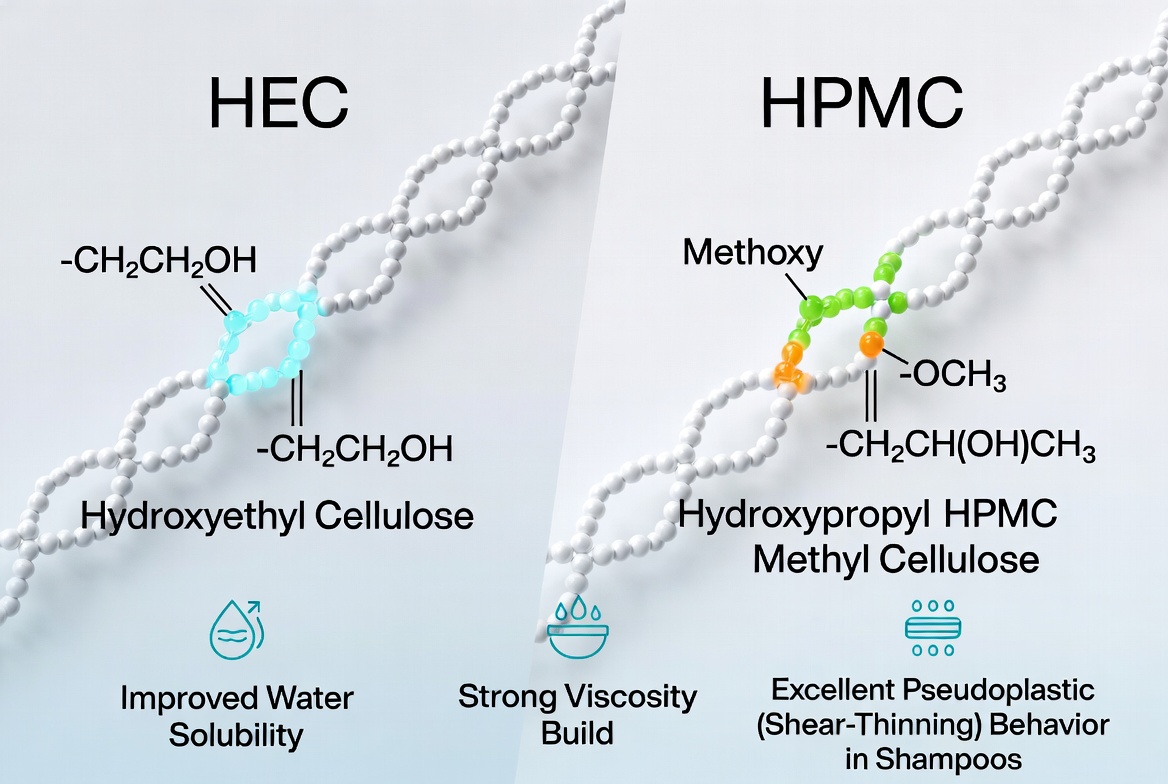
Both HPMC and HEC are non‑ionic cellulose ethers produced by etherifying purified cellulose, but they carry different substituent groups and thus behave differently in surfactant systems. [hpmcfactory]
- HEC (Hydroxyethyl Cellulose)
- Substituent: hydroxyethyl groups from ethylene oxide. [kemoxcellulose]
- Very high water affinity and good solubility in cold and hot water. [kdochem]
- Widely used in shampoos, body washes, lotions, and other personal‑care products as a mild, transparent thickener. [tenessy]
- HPMC (Hydroxypropyl Methyl Cellulose)
- Substituents: methoxy and hydroxypropyl groups from methyl chloride and propylene oxide. [echemi]
- Shows thermal gelation, film‑forming, and good clarity at suitable grades. [hpmcfactory]
- Used across construction, pharmaceuticals, food, and cosmetics; in shampoos, it works as a viscosity and texture modifier and can interact with surfactants for tailored rheology. [blog.rheosense]
- HEC
- Soluble in both hot and cold water. [kdochem]
- Operates stably over a wider pH range, which helps in systems with pH 5–8 or where pH may drift slightly over shelf life. [kdochem]
- HPMC
- Shows better solubility in cold water; hydration usually follows a "wetting then dissolution" path. [echemi]
- Performs very well in slightly acidic conditions, matching typical shampoo pH around 4.5–6.0. [blog.rheosense]
For daily shampoos, both polymers fit the pH window, but HEC's broad pH tolerance and strong water solubility make it slightly more forgiving in complex formulas. [maissen-hpmc]
Independent technical sources consistently note that HEC delivers higher viscosity than HPMC at low to moderate concentrations, which is advantageous for high‑viscosity shampoos that must still pour smoothly. [wotaichem]
- HEC
- Strong thickening even at relatively low dosage. [wotaichem]
- Ideal where a rich, "gel‑like" shampoo is desired without over‑loading the formulation. [tenessy]
- HPMC
- Generally lower viscosity than HEC at the same solid content. [maissen-hpmc]
- Better suited for medium‑viscosity shampoos or where flowability and clarity are prioritized over extreme thickness. [echemi]
Pseudo‑plastic behavior is evaluated by how viscosity changes with shear rate. In surfactant solutions, polymers such as HPMC substantially increase viscosity, and their interaction with surfactants (e.g., sodium dodecyl sulfate) shapes the final shear and extensional viscosity profile. [scribd]
From industry measurement data:
- HPMC–surfactant systems show strong shear‑thinning: viscosity decreases under combing or rubbing, then recovers at rest, giving good "thickness" in the bottle yet easy spreading. [scribd]
- HEC creates highly entangled polymer networks in water, also leading to smooth shear‑thinning and pleasant slip, especially in transparent or pearlescent shampoos. [tenessy]
In practical UX terms for high‑viscosity shampoos:
- HEC:
- Creamy, cushiony feel in the palm
- Good control of product "stringiness" and "ropey" flow
- Often perceived as more "gel‑like" and luxurious
- HPMC:
- Slightly more "elastic" feel depending on grade and surfactant ratio
- Excellent for controlled flow from pump bottles and for maintaining viscosity under mild temperature changes. [hpmcfactory]
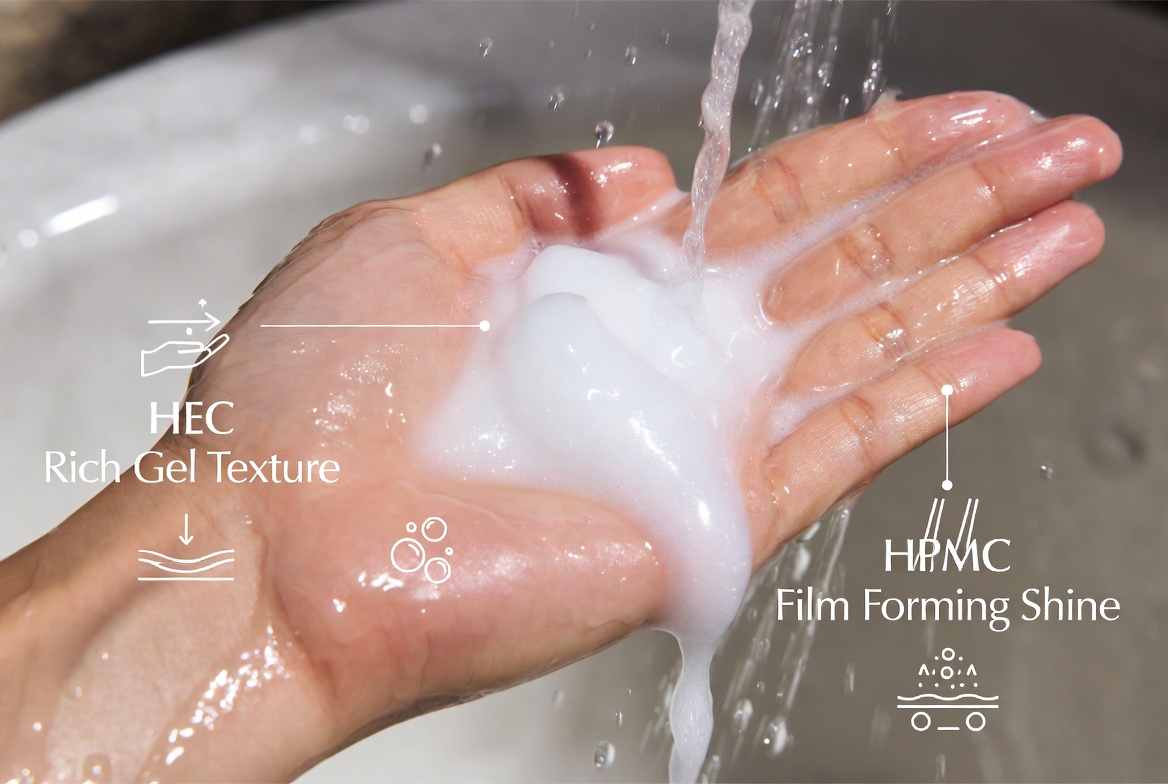
For premium transparent shampoos, formulation aesthetics matter as much as rheology.
- HEC
- Frequently chosen for transparent and pearlescent systems because it can achieve high viscosity with excellent clarity when properly dispersed. [maissen-hpmc]
- HPMC
- Also capable of high clarity at suitable substitution levels and molecular weights, and can form clear, non‑ionic films that support a glossy appearance on hair. [hpmcfactory]
In practice, both can support visually clear systems, but HEC is more commonly associated with very clear, "water‑gel" style washes, while HPMC adds more film‑formation benefit on hair fibers. [echemi]
Shampoo foam structure is largely governed by surfactant type and level, yet polymeric thickeners influence foam stability and bubble size distribution. [blog.rheosense]
- With HEC, formulators often report:
- Stable, dense foam
- Good combability and slip due to its hydrated network and mild, non‑ionic nature [tenessy]
- With HPMC, studies in model surfactant systems show that polymer addition changes both shear and extensional viscosity, which can enhance foam stability and "elasticity" under washing conditions. [blog.rheosense]
Both polymers are considered mild, non‑ionic, and suitable even for sensitive‑skin shampoos when properly formulated. [maissen-hpmc]
HEC solutions maintain viscosity quite consistently over a broad temperature range, which is helpful for shampoos distributed globally. [kdochem]
HPMC, in contrast, shows thermosensitive behavior and thermal gelation: its viscosity changes with temperature and can increase near a characteristic "gel point." [hpmcfactory]
- For high‑viscosity shampoos stored and used across diverse climates, HEC generally offers more predictable viscosity stability across temperature swings. [wotaichem]
- HPMC's thermogelling can be leveraged in niche concepts (e.g., "heat‑activated" or in‑shower treatments) when carefully designed. [echemi]
Electrolytes (NaCl, organic salts, actives) strongly influence shampoo rheology. In systems thickened with acrylic rheology modifiers, hydrophobically modified polymers are often chosen for better electrolyte tolerance and pH range. [scribd]
Compared with such acrylics:
- HEC
- Shows good tolerance in typical anionic/amphoteric surfactant systems but can lose viscosity at very high salt or strong electrolyte loads. [kdochem]
- HPMC
- Interacts with surfactants and salts in more complex ways; data show HPMC–SDS systems respond significantly to NaCl addition, allowing fine‑tuning of viscosity but requiring tighter process control. [blog.rheosense]
For mainstream shampoos, both are workable, but HEC often gives a broader "processing window" for salt‑curve adjustment, particularly in high‑viscosity designs. [kdochem]
Industry sources indicate that HPMC is often more widely available and cost‑effective in large industrial segments such as construction and pharmaceuticals, because its production is highly optimized and scaled. [meskajoinway]
However, in personal care:
- HEC tends to be positioned as a specialized cosmetic‑grade thickener, with slightly higher cost but strong performance in high‑viscosity, mild formulations. [meskajoinway]
- Pricing for both is affected by region, order volume, and quality grade (viscosity level, purity, DS/Ms values). [meskajoinway]
From a brand perspective, choosing HEC for high‑viscosity flagship shampoos and HPMC for volume or mid‑viscosity ranges can be a balanced portfolio strategy. [meskajoinway]
HPMC and HEC are both cellulose‑based, non‑ionic, and derived from renewable biomass, which supports sustainability narratives compared with purely petrochemical rheology modifiers. [kdochem]
Brands increasingly highlight:
- "Cellulose‑derived polymer" instead of "synthetic thickener"
- Biodegradability and mildness compared with some older, more irritating thickeners [scribd]
For eco‑positioned high‑viscosity shampoos, either polymer fits, but HEC's long association with "mild, skin‑friendly" formulations is a strong marketing advantage. [tenessy]
From an industry formulator's lens, the choice is driven by target rheology, user feel, and line‑up strategy:
1. Target viscosity and flow
- For very high viscosity with pronounced pseudo‑plastic flow (thick in bottle, smooth under shear), HEC usually gives more viscosity headroom and very forgiving processing. [wotaichem]
- For medium–high viscosity with clear, slightly more elastic flow, HPMC works very well, especially when combined with surfactant–salt thickening. [wotaichem]
2. Appearance and sensorial
- Choose HEC if you want a classic clear or pearlescent shampoo with a gel‑like look and cushiony slip. [maissen-hpmc]
- Choose HPMC if film‑forming on hair, combability, and shine are key benefits alongside viscosity. [hpmcfactory]
3. Stability and process window
- HEC: more stable over broad pH and temperature; easier to maintain viscosity across markets. [kdochem]
- HPMC: more sensitive but allows finer tuning via temperature and salt; useful for differentiated, technical claims. [echemi]
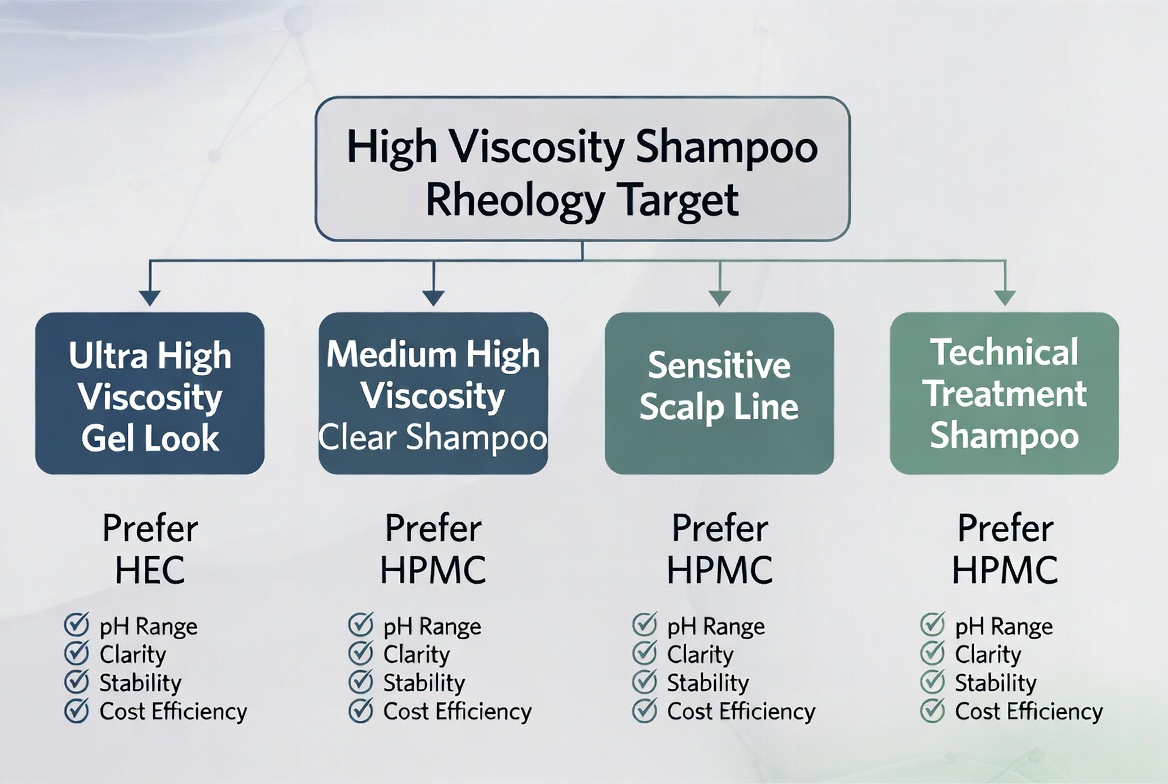
| Scenario | Preferred polymer | Key rationale |
|---|---|---|
| Ultra‑viscous, transparent flagship shampoo (pH 5–6) | HEC | Strong thickening at low dose, wide pH, excellent clarity, mild sensorial feel (wotaichem) |
| Mass‑market family shampoo, mid–high viscosity | HPMC | Good cost‑effectiveness, clear films, robust performance in acidic conditions (hpmcfactory) |
| Sensitive‑scalp or baby shampoo, sulfate‑free | HEC | Mild, non‑ionic, transparent, good slip without heavy build‑up (maissen-hpmc) |
| "Technical" or treatment shampoo (heat‑assisted, salon‑style) | HPMC | Thermosensitive behavior, film‑forming, tunable rheology with surfactants and salts (hpmcfactory) |
| Eco‑positioned hair‑care line emphasizing plant‑derived polymers | HEC or HPMC | Both cellulose‑based; HEC often perceived as extra gentle; HPMC offers cross‑industry proof (hpmcfactory) |
Industry case reports show that personal‑care formulators often switch from salt‑only thickening or acrylic rheology modifiers to cellulose ethers to improve mildness and control. When HEC replaced pure salt thickening in a high‑viscosity shampoo, brands typically reported better low‑temperature stability, more consistent viscosity, and a creamier foam feel. [scribd]
On the other hand, studies of HPMC in surfactant systems (e.g., SDS) reveal that by adjusting HPMC and salt levels, formulators can closely design shear and extensional viscosity, directly influencing perceived thickness, foamability, and storage stability. [blog.rheosense]
These findings align with day‑to‑day lab experience:
- HEC is the "safe choice" when you want a high‑viscosity, user‑friendly shampoo quickly.
- HPMC is the "engineering choice" when you want to fine‑tune rheology and hair feel with more knobs to turn.
As a Chinese manufacturer specialized in building‑grade and personal‑care‑grade cellulose ethers (HPMC, HEC), Shandong Shengda New Material Co., Ltd. can support shampoo brands from concept to scale‑up with:
- Rheology‑targeted HEC grades for ultra‑viscous, pseudo‑plastic shampoos
- Hair‑care‑optimized HPMC grades balancing viscosity, film‑forming, and clarity
- Lab support for salt curves, surfactant compatibility, and stability testing tailored to your market conditions
By co‑designing formulations with your R&D team, we help you achieve the exact pseudo‑plastic profile your consumers expect, while controlling cost and ensuring global‑market stability.
In pure rheology terms, HEC is often the first choice for very high‑viscosity shampoos requiring strong pseudo‑plastic flow, broad pH tolerance, and a mild, gel‑like sensorial profile. [tenessy]
However, HPMC is extremely attractive when you want a balance of good viscosity, film‑forming on hair, clarity, and robust performance in acidic systems—and especially when you leverage its interaction with surfactants and salts. [hpmcfactory]
For many brand portfolios, the best answer is not "HPMC vs. HEC" but "HPMC and HEC," using HEC for ultra‑rich hero products and HPMC for scalable, cost‑effective lines with strong technical storytelling. [meskajoinway]
Both HEC and HPMC are non‑ionic, cellulose‑derived, and regarded as mild when used at normal cosmetic levels; HEC is especially popular in gentle, transparent personal‑care products. [maissen-hpmc]
Yes, combining them can synergize viscosity, clarity, and hair feel, allowing very fine tuning of pseudo‑plastic behavior in complex surfactant systems. [echemi]
Both work, but HEC is frequently chosen for sulfate‑free systems due to its strong thickening and mild, transparent profile, particularly in high‑viscosity designs. [kdochem]
Salt strongly affects viscosity and flow; HEC has a relatively broad processing window, while HPMC–surfactant systems allow precise rheology tuning but demand tighter control of salt levels. [scribd]
Specify viscosity grade, substitution pattern, purity, and cosmetic‑grade compliance, and request rheology data in your target surfactant system from your supplier. [meskajoinway]
1. HEC vs. HPMC: Key Differences, Applications, and How to Choose – [hpmcfactory.com] [hpmcfactory]
2. HEC vs HPMC: Picking the Perfect Cellulose for Success – [wotaichem.com] [wotaichem]
3. What Is the Difference Between HPMC and HEC? – [maissen-hpmc.com] [maissen-hpmc]
4. Differences Between HPMC and HEC – [kdochem.com] [kdochem]
5. HPMC 与 MC、HEC、CMC 的比较 – [kemoxcellulose.com] [kemoxcellulose]
6. Pharmaceutical Differences Between HPMC & HEC – [meskajoinway.com] [meskajoinway]
7. Why Do CMC, HEC, and HPMC Perform Differently in Daily Chemical and Cleaning Products? – [tenessy.com] [tenessy]
8. Difference Between Hydroxypropyl Methylcellulose and Hydroxyethyl Cellulose – [kdochem.com] [kdochem]
9. Shampoo and Surfactant Solutions—Shear and Extensional Viscosity – [rheosense.com] [blog.rheosense]
10. Introduction to Shampoo Thickening (polymeric thickeners overview) – [Scribd] [scribd]


