


close
Choose Your Site
Global
Social Media
Views: 266 Author: Shengda Publish Time: 2026-07-10 Origin: Site


HPMC grades are typically differentiated by viscosity, degree of substitution, and particle size. These parameters affect how fast the product hydrates, how it thickens water, how it behaves during mixing, and how it performs after application. [landu-china]
In practical terms, formulators usually evaluate HPMC by:
- Viscosity level.
- Hydration speed.
- Water retention.
- Film-forming ability.
- Rheology control.
- Compatibility with other ingredients.
For construction and daily chemical users, the grade is often more important than the chemical name itself, because the grade determines processing behavior and final user experience. [shengdahpmc]
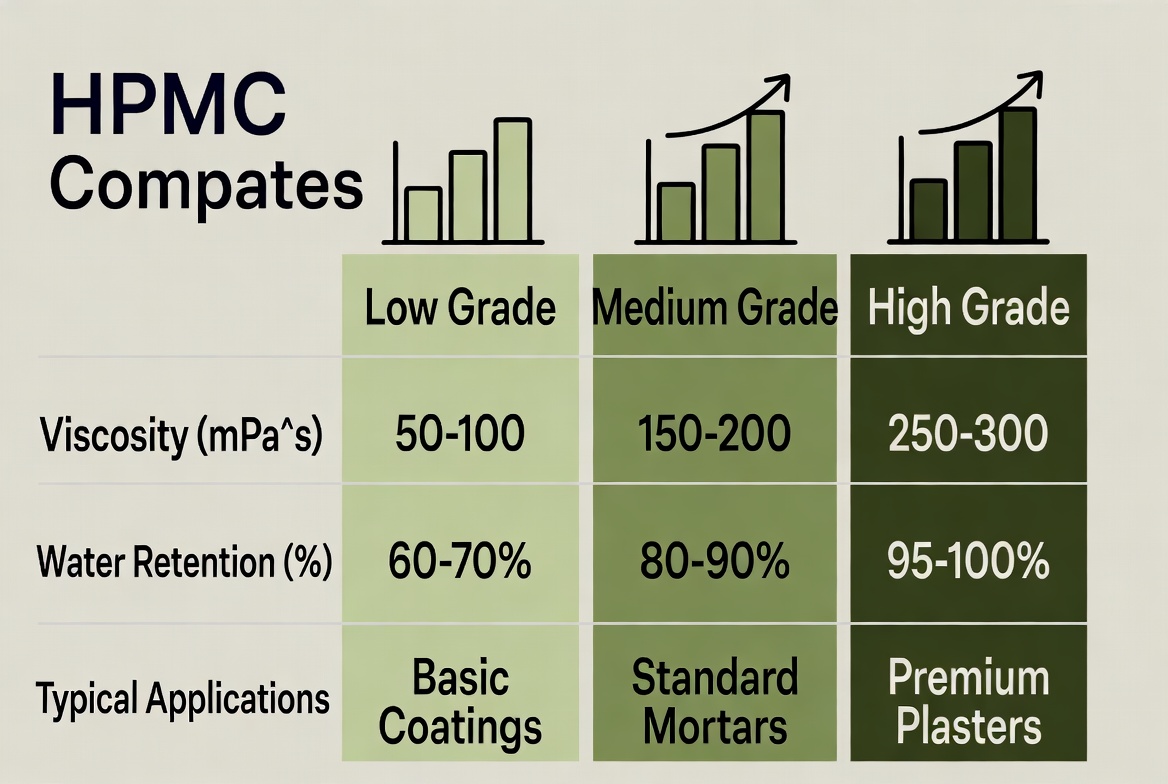
Choosing the wrong HPMC grade can create avoidable problems. A low-viscosity product may not provide enough body or water retention, while an overly thick grade may reduce workability, slow mixing, or make coating and application difficult. [meskajoinway]
In other words, the best grade is the one that gives you the right balance of performance, processability, and cost. That balance is especially important in competitive markets where product consistency and application efficiency directly affect customer satisfaction.
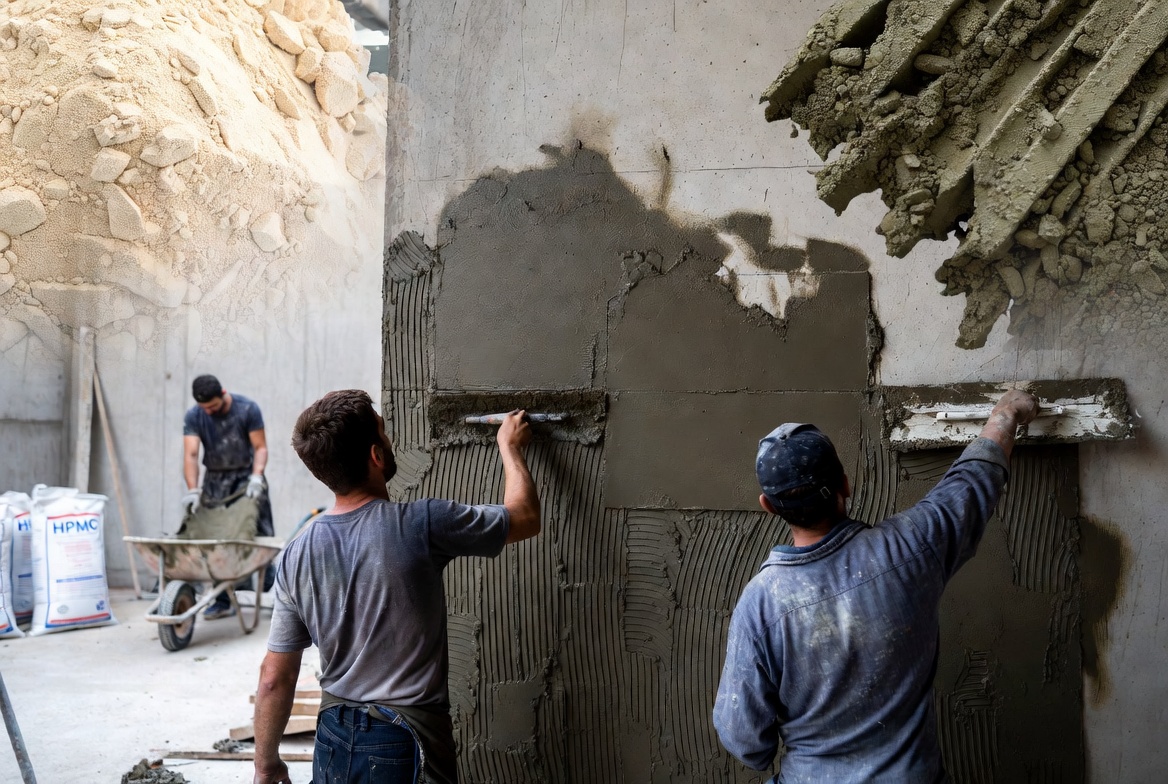
Low-viscosity HPMC grades are commonly used where fast hydration, easier dispersion, and lighter thickening are needed. In pharmaceutical and coating systems, low-viscosity grades such as E3 or E5 are often chosen for film coating and immediate-release systems because they spread smoothly and dissolve efficiently. [youtube]
In non-pharma applications, low-viscosity grades can also support:
- Light thickening.
- Easy sprayability.
- Improved leveling.
- Better surface finish.
Medium-viscosity HPMC grades are often seen as the most versatile option. They provide a stronger balance between water retention, thickening, and workability, which is why they are widely used in general-purpose formulations. [youtube]
In practice, this grade range is valuable when you need:
- Stable body without over-thickening.
- Good open time.
- Better sag resistance.
- Reliable film formation.
High-viscosity HPMC grades are selected when stronger water retention, higher thickening power, and slower release behavior are needed. In controlled-release or matrix systems, high-viscosity grades are often used to form gel layers that regulate performance. [youtube]
These grades are especially useful in:
- Tile adhesives.
- Wall putty.
- Cement-based mortars.
- Sustained-release systems.
- Thick gel-type formulations.
Construction is one of the most important application areas for HPMC. In tile adhesives, wall putty, plaster, skim coat, and mortar, HPMC improves water retention, extends open time, enhances workability, and helps maintain consistency during application. [sdshengda.en.made-in-china]
A practical way to think about it is this: the higher the performance expectations for adhesion, water retention, and anti-sag behavior, the more carefully the grade must be selected.
Common construction uses include:
- Tile adhesive.
- Wall putty.
- Cement plaster.
- Render and skim coat.
- Self-leveling systems.
- Dry-mix mortar.
Typical performance goals include:
- Better hydration of cement.
- Reduced water loss.
- Improved smoothness.
- Easier spreading.
- Stronger resistance to slump.
In daily chemical formulations, HPMC is used for thickening, stabilizing, suspending, and improving texture in products such as personal care and household cleaning systems. The exact grade influences the final feel, clarity, flow, and stability of the formula.
For these products, formulators often care about:
- Sensory feel.
- Spreadability.
- Clarity.
- Pumpability.
- Long-term stability.
A small viscosity adjustment can noticeably change the user experience, which is why HPMC grade selection is a critical formulation step.
Although your company focus is construction and daily chemical grades, pharmaceutical applications are useful as a reference because they show how strongly grade selection shapes performance. HPMC is widely used in tablet binding, film coating, controlled release, and capsule shells. [meskajoinway]
This is a valuable benchmark for other industries because it demonstrates one key point: one polymer family can serve very different functions when the grade changes.
Here is a practical selection framework that can be used in product development.
| Application Need | Recommended HPMC Type | Why It Works |
|---|---|---|
| Fast dispersion and light thickening | Low-viscosity | Easier hydration and smoother processing. |
| General-purpose thickening | Medium-viscosity | Balanced performance and flexibility. |
| Strong water retention and anti-sag | High-viscosity | Better body and stability. |
| Tile adhesive / mortar | Medium to high-viscosity | Improves workability and open time. |
| Wall putty / plaster | Medium to high-viscosity | Helps with consistency and application feel. |
| Film coating / immediate release | Low-viscosity | Forms uniform films more easily. |
| Sustained release / matrix systems | High-viscosity | Supports gel formation and release control. |
This table is useful for buyers, R&D teams, and procurement managers because it simplifies the first-stage selection process before lab testing.
From an R&D perspective, HPMC should never be selected in isolation. The best results usually come from evaluating the full system, including fillers, binders, surfactants, salts, pH, and mixing method. Even a technically correct grade can perform poorly if the formula or process is not optimized.
In my experience, three questions matter most:
1. What is the real function of the HPMC?
2. What processing constraints exist during manufacturing?
3. What user experience must the final product deliver?
Once those are clear, grade selection becomes much more accurate and much less expensive.

A tile adhesive manufacturer may initially choose a low-viscosity HPMC because it mixes easily. However, after field testing, the product may show poor water retention and short open time in hot or dry climates. Switching to a medium- or high-viscosity grade can improve workability, reduce water loss, and give installers more usable time on the jobsite. [tradeindia]
This is a common pattern in building materials: the best grade is not always the one that looks easiest in the lab. It is the one that performs best under real construction conditions.
Recent public product and manufacturer references show that HPMC demand remains strongly linked to building materials and daily chemical applications, with construction-grade products often supplied in viscosity ranges from roughly 30,000 to 200,000 mPa·s depending on the application need. [sdshengda.en.made-in-china]
For manufacturers and buyers, this means the market continues to reward suppliers who can provide:
- Stable quality.
- Consistent batch performance.
- Application-specific grade support.
- Technical guidance for formulation optimization.
In today's market, technical service is not a luxury. It is part of the product itself.
Before final approval, formulators should validate HPMC with a structured test plan.
1. Define the target performance, such as water retention, thickening, or film formation.
2. Select 2 to 4 candidate grades across nearby viscosity levels.
3. Run small-scale lab trials under realistic mixing conditions.
4. Measure workability, hydration speed, stability, and end-use behavior.
5. Confirm performance in pilot batches and field tests.
6. Choose the grade that gives the best overall balance, not just the highest viscosity.
This method reduces trial-and-error and improves launch reliability.
For global buyers, the supplier should be more than a factory. A strong HPMC partner should provide grade consistency, technical guidance, application support, and scalable supply capability. Shandong Shengda New Material Co., Ltd. presents itself as a professional cellulose ether manufacturer with a focus on research, development, production, and sales of cellulose ether products, including HPMC, HEMC, and HEC. [shengdahpmc]
That background matters because cellulose ether selection is often an engineering decision, not just a purchasing decision.
If you are developing construction-grade or daily chemical HPMC formulations, work with a supplier that can help you match the right grade to the right application. A well-selected HPMC grade can improve product performance, reduce formulation risk, and strengthen customer satisfaction.
Contact Shandong Shengda New Material Co., Ltd. to discuss the most suitable HPMC grade for your project, request samples, or receive technical support for formulation optimization.
The main differences are viscosity, substitution degree, and particle size, which affect hydration speed, thickening behavior, and final application performance. [landu-china]
There is no single best grade. Medium- to high-viscosity grades are commonly used in tile adhesives, mortar, plaster, and wall putty because they improve water retention and workability. [tradeindia]
Low-viscosity grades are chosen when easy dispersion, faster hydration, and lighter thickening are needed, especially in coating and fast-processing systems. [meskajoinway]
No. Different formulas require different performance profiles. A grade that works well in one system may underperform in another because viscosity and hydration behavior are not the same. [landu-china]
Start with the target function, test nearby viscosity grades in the real formula, and compare workability, stability, open time, and end-use performance before finalizing. [sdshengda.en.made-in-china]
1. Landu China, "Different HPMC Grades and Their Corresponding Applications"
https://landu-china.com/en/different-hpmc-grades-and-their-corresponding-applications/ [landu-china]
2. Shandong Shengda New Material Co., Ltd., "About Us"
https://www.shengdahpmc.com/aboutus.html [shengdahpmc]
3. Shengda HPMC product listing and company overview
https://sdshengda.en.made-in-china.com/product/SvsmwJGHJntL/China-Hot-Cellulose-Ether-HPMC-Chemical-Manufacture-for-Construction-Materials-Tile-Adhesives-Wall-Putty-Plaster.html [sdshengda.en.made-in-china]
4. Shengda HPMC trade product page
https://www.tradeindia.com/products/hydroxypropyl-methyl-cellulose-powder-6416665.html [tradeindia]
5. Kima Chemical, "Discover the Different Grades Of HPMC"
https://www.kimacellulose.com/different-grades-of-hpmc.html [kimacellulose]
6. Kemox Cellulose, "Understanding the Different HPMC Grades and Their Applications"
https://www.kemoxcellulose.com/hpmc-grades-and-their-applications/ [kemoxcellulose]
7. MESKA, "HPMC E3 vs. E5 vs. E6 for Film Coating Applications"
https://www.meskajoinway.com/technical-blogs/hpmc-e3-vs-e5-vs-e6/ [meskajoinway]


