


close
Choose Your Site
Global
Social Media
Views: 242 Author: Shengda Publish Time: 2026-07-09 Origin: Site


Hydroxypropyl Methyl Cellulose (HPMC) is one of the most widely used cellulose ethers in modern formulation science. For manufacturers, contractors, and product developers, understanding different HPMC grades and their corresponding applications is essential for selecting the right balance of viscosity, water retention, workability, film formation, and stability.
HPMC is not a one-size-fits-all material. Different grades are designed to perform differently in construction materials, daily chemical products, and other industrial systems. The right grade can improve mortar sag resistance, enhance open time, stabilize emulsions, or deliver a smoother feel in personal care products.
From an industry perspective, grade selection often decides whether a formula works well in production and performs reliably in the field. For this reason, formulators should evaluate HPMC not only by price, but also by viscosity profile, substitution pattern, particle size, dissolution behavior, and end-use function.
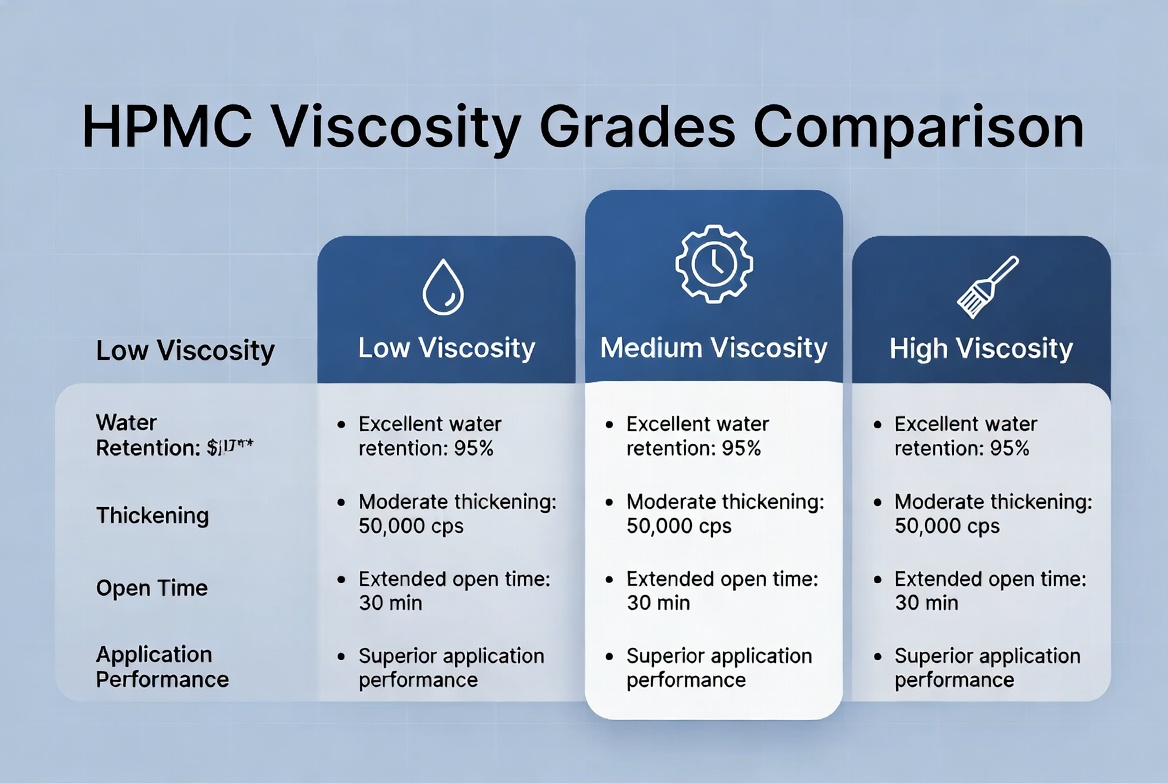
HPMC grades are usually classified according to several technical factors:
- Viscosity, which affects thickening, water retention, and film strength.
- Degree of substitution, which influences solubility, thermal gelation, and compatibility.
- Particle size, which affects dispersibility and hydration speed.
- Application-specific performance, such as construction-grade or daily chemical-grade use.
In practice, a low-viscosity grade may hydrate faster and be easier to disperse, while a higher-viscosity grade usually provides stronger water retention and thicker consistency. That is why understanding the grade system is the first step toward better formulation design.
The table below helps readers quickly compare common grade tendencies and their typical usage.
| HPMC Grade Type | Main Performance | Typical Applications |
|---|---|---|
| Low viscosity grades | Fast dispersion, easier processing, lighter thickening | Tile adhesive, wall putty, detergents, some coatings |
| Medium viscosity grades | Balanced thickening and workability | General construction mortars, daily chemical products |
| High viscosity grades | Strong water retention, thickening, suspension stability | Tile adhesive, plaster, self-leveling systems, premium formulations |
Low, medium, and high viscosity grades are all useful, but each serves a different formulation goal. The best choice depends on whether the product needs faster wetting, longer open time, stronger anti-sagging behavior, or improved suspension.
In construction, HPMC is valued mainly for water retention, thickening, workability, adhesion, and anti-sag performance. These functions are especially important in dry-mix mortars, tile adhesives, wall putty, plasters, EIFS, and repair mortars.
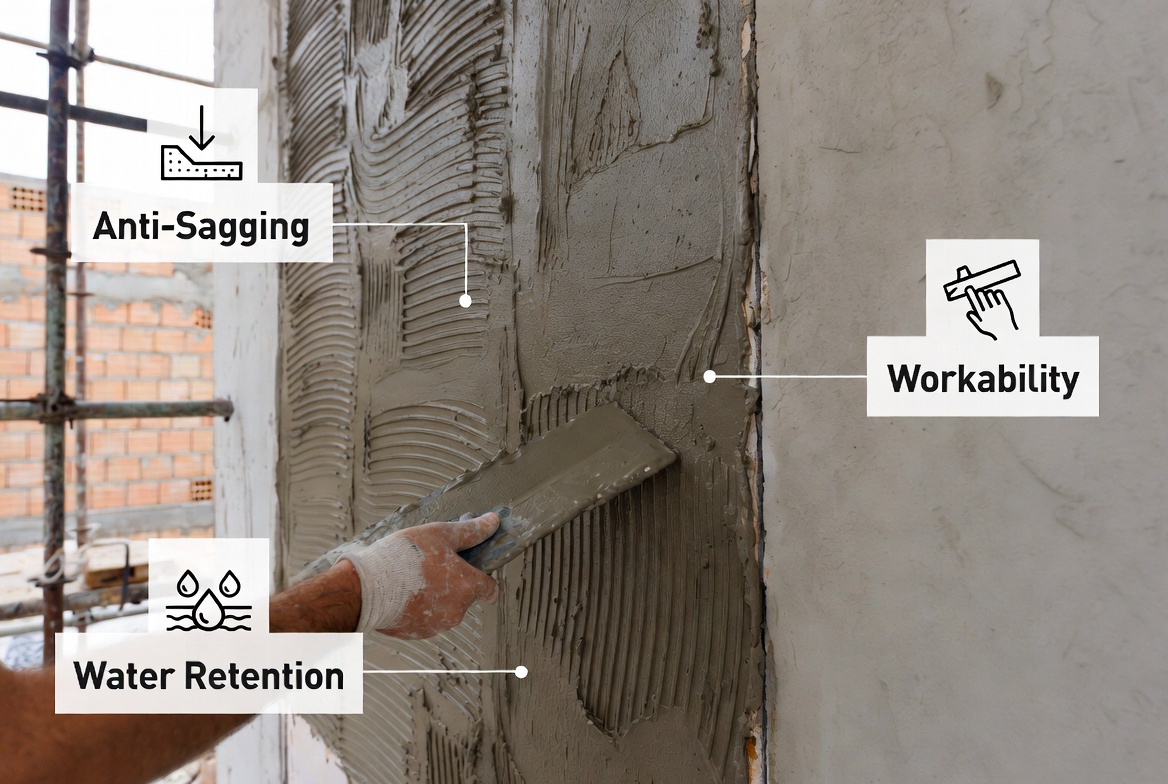
Tile adhesive systems often require HPMC grades that support open time, slip resistance, and consistent application. A properly selected grade helps keep the adhesive workable long enough for installation while preventing tiles from sliding after placement.
For tile adhesives, formulators usually look for:
- Good water retention.
- Stable viscosity.
- Strong anti-sag behavior.
- Smooth troweling and application consistency.
In humid or hot environments, the wrong HPMC grade can shorten open time and reduce bonding performance. This is why grade selection must consider both climate and substrate conditions.
In wall putty, HPMC improves scrape feel, water retention, and crack resistance. It also helps the product spread evenly and maintain a more stable consistency during application.
Higher performance is especially important when the substrate absorbs water quickly. In such cases, HPMC helps delay water loss so the cement or other binders can hydrate properly.
Plaster formulations benefit from HPMC because it improves smoothness, adhesion, and workability. It also helps reduce sticking and supports better surface finish.
For render systems, HPMC can improve open time and reduce application defects. This is particularly useful in large-area work where workers need longer material handling time.
HPMC is also used in daily chemical products, where it serves as a thickener, stabilizer, film former, and texture enhancer. In this segment, grade choice depends on clarity, viscosity, rheology, and compatibility with surfactants and salts.
In shampoos, body washes, lotions, and creams, HPMC can improve texture, flow behavior, and visual appeal. It helps create a smooth and pleasant consumer experience.
Typical benefits include:
- Better thickening.
- Improved suspension of particles.
- More stable formula viscosity.
- Enhanced sensory feel.
For personal care formulators, the goal is not only stability but also elegance. The product should look clean, pour well, and feel comfortable on the skin or hair.

HPMC is useful in toothpaste because it helps with body, dispersion, and consistency control. It supports a uniform paste structure and can improve product stability during storage.
In oral care formulas, the selected grade should be compatible with abrasives, humectants, and flavor systems. A poor match may cause separation, weak structure, or undesirable texture.
Choosing the right HPMC grade should follow a practical decision process rather than trial and error alone. The following step-by-step method can help formulators make better decisions.
1. Define the end-use requirement.
Decide whether the priority is water retention, thickening, film formation, suspension, or workability.
2. Check the application environment.
Consider temperature, humidity, substrate absorption, and processing speed.
3. Match viscosity with formulation goals.
Low viscosity is better for faster dissolution and easier processing, while high viscosity offers stronger thickening and water retention.
4. Test compatibility with other raw materials.
Evaluate cement, surfactants, salts, pigments, fillers, and preservatives.
5. Run pilot trials before scale-up.
Lab success does not always guarantee production stability, so field testing is essential.
This selection method reduces formulation risk and improves cost efficiency.
One of the most common mistakes in HPMC sourcing is focusing only on viscosity number. That number is important, but it does not tell the full story. Two products with similar viscosity can behave very differently in hydration speed, particle wetting, or final application performance.
Buyers should also evaluate:
- Consistency between batches.
- Dissolution behavior in real production conditions.
- Water retention under hot or dry environments.
- Compatibility with the rest of the formulation.
- Technical support from the supplier.
This is where a manufacturer with R&D and application knowledge can provide real value. A good supplier should not only sell HPMC, but also help customers choose the most suitable grade for their target performance.
The market is moving toward higher-efficiency and more sustainable formulation systems. In construction, this means products that improve workability while reducing material waste and rework. In daily chemicals, it means cleaner sensory profiles, better stability, and more efficient processing.
Sustainability also matters at the sourcing stage. Buyers increasingly prefer suppliers that can provide stable quality, responsible production, and technical data support. For manufacturers, this creates an opportunity to position HPMC as both a functional ingredient and a value-added solution.
A specialized cellulose ether manufacturer can provide more than product supply. It can support customers with grade recommendation, sample testing, formulation advice, and consistent quality control.
For global buyers, this matters because different markets often need different performance profiles. Construction systems in hot climates, for example, may require stronger water retention than systems in moderate weather. Daily chemical products may require better clarity or a smoother rheological profile.
As a manufacturer focused on HPMC and cellulose ether solutions, Shandong Shengda New Material Co., Ltd. can position itself as a technical partner rather than just a raw material vendor.
If you are developing construction-grade HPMC or daily chemical HPMC products, choose a supplier that can support both technical performance and stable supply. Contact Shandong Shengda New Material Co., Ltd. to request samples, compare grades, and get application guidance for your target formula.
The main difference is viscosity, which affects thickening, water retention, and processing behavior. Grade differences may also include particle size and substitution pattern.
There is no single best grade for every formula, but tile adhesive usually needs a grade with strong water retention, open time, and anti-sag performance.
Sometimes yes, but it is usually better to use an application-specific grade. Construction and daily chemical systems have different performance requirements.
Water retention helps cement or binder systems hydrate properly, improves workability, and reduces defects such as cracking or weak bonding.
Buyers should evaluate product consistency, technical support, application knowledge, and the supplier's ability to recommend the right grade for the final use.
1- Landu China, "Different HPMC Grades and Their Corresponding Applications," [https://landu-china.com/en/different-hpmc-grades-and-their-corresponding-applications/]
2- Kima Chemical, "Understanding the Different HPMC Grades and Their Applications," [https://www.kemoxcellulose.com/hpmc-grades-and-their-applications/]
3- Kima Chemical, "Application of HPMC in construction and personal care products," [https://www.kimacellulose.com/application-of-hpmc-in-construction-and-personal-care-products.html]
4- MESKA, "HPMC E3 vs. E5 vs. E6 for Film Coating Applications," [https://www.meskajoinway.com/technical-blogs/hpmc-e3-vs-e5-vs-e6/]
5- Shandong Shengda New Material Co., Ltd. product information pages and company materials, including HPMC construction and daily-use applications.


