


close
Choose Your Site
Global
Social Media
Views: 224 Author: Shengda Publish Time: 2026-07-08 Origin: Site


When buyers search for an HPMC factory or premium hydroxypropyl methyl cellulose, they usually want more than a product list. They want stable quality, reliable supply, technical guidance, and a supplier who understands real application challenges in construction, daily chemicals, and industrial processing.
As a cellulose ether manufacturer serving global customers, Shandong Shengda New Material Co., Ltd. can position this page as both a product education hub and a commercial trust page. The strongest approach is to explain what HPMC is, how premium grades differ, where performance matters most, and how a professional factory helps customers reduce cost, improve consistency, and speed up formulation success.
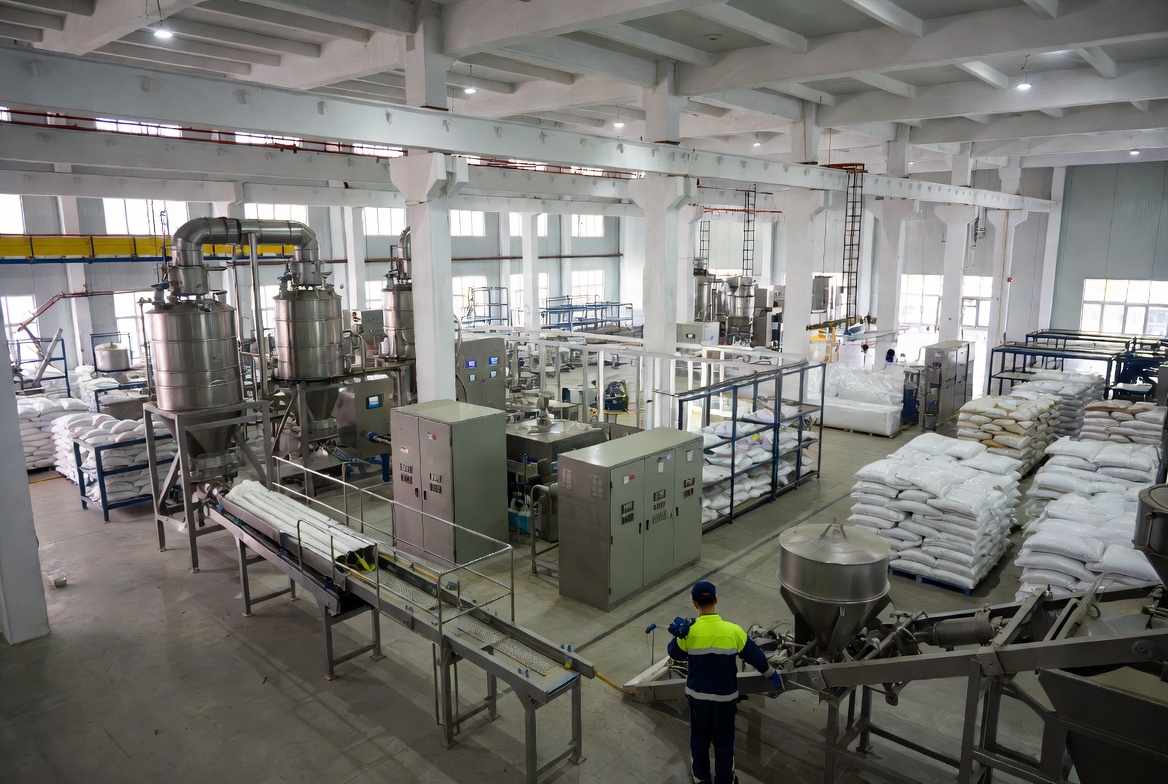
Hydroxypropyl Methyl Cellulose (HPMC) is a non-ionic cellulose ether derived from natural cellulose. It is widely used as a thickener, water-retention agent, film former, binder, and stabilizer.
In practical terms, HPMC helps formulas behave more predictably. In construction, it improves water retention, workability, and open time. In daily chemical products, it helps control viscosity, texture, suspension, and stability. That is why premium HPMC is valued not only for chemistry, but for repeatable end-use performance.
- Water retention.
- Thickening and viscosity control.
- Improved workability and smoothing.
- Better adhesion and film formation.
- Suspension and stabilization.
- Tile adhesives and dry-mix mortars.
- Wall putty and skim coat.
- Cement-based and gypsum-based systems.
- Detergents, cleaners, and personal care products.
- Pharmaceutical and specialty formulations.
The phrase HPMC factory focuses on the source of supply. It signals manufacturing capability, production control, technical support, and export readiness. Premium hydroxypropyl methyl cellulose focuses on the product level, emphasizing purity, performance consistency, and fit for demanding applications.
In search intent terms, these are related but not identical. A buyer looking for an HPMC factory wants to know whether the manufacturer can deliver scale, quality assurance, and customization. A buyer looking for premium HPMC wants to know whether the grade will perform better in a specific formula.
| Aspect | HPMC Factory | Premium HPMC |
|---|---|---|
| Main focus | Manufacturer capability | Product performance |
| Buyer concern | Supply reliability | Formula consistency |
| Key proof points | Production lines, QC, certification, export support | Viscosity stability, water retention, purity, batch uniformity |
| Best use | Supplier evaluation | Product selection |
| SEO intent | Commercial and trust-driven | Technical and performance-driven |
The best content strategy is to connect both ideas in one page. That means showing that the factory is not just a seller, but a technical partner capable of producing premium HPMC for different market needs.
Premium HPMC is not just a label. In real applications, small differences in molecular structure, substitution level, particle behavior, and batch control can change the final user experience.
For construction customers, premium quality often means:
- More stable water retention.
- Better open time.
- Easier trowelability.
- Stronger anti-sag behavior.
- Improved workability in hot or dry weather.
For daily chemical customers, premium quality often means:
- Smoother thickening response.
- Better clarity or appearance, depending on the system.
- More stable viscosity.
- Reliable suspension and texture.
- Better performance consistency across batches.
The commercial benefit is simple: better consistency reduces rework, customer complaints, and formulation downtime.
A strong factory page should prove process discipline, not just claim it. Buyers want to know how the product is controlled from raw materials to finished bags.
1. Raw material selection
Quality begins with cellulose source control and chemical input purity.
2. Reaction and substitution control
This affects performance, solubility, and viscosity behavior.
3. Viscosity testing
Batch-to-batch stability is one of the most important commercial indicators.
4. Moisture control and particle consistency
These affect storage stability, dispersibility, and end-use handling.
5. Application testing
Construction and daily chemical systems should be tested in realistic conditions.
6. Packaging and logistics control
Moisture protection, labeling, and export handling matter for global customers.
A trustworthy HPMC factory should explain these controls clearly and show that quality is managed as a system, not as a one-time inspection.

Different buyers care about different performance outcomes. The page should separate applications so readers can quickly identify relevance.
HPMC is especially valuable in:
- Tile adhesive.
- Wall putty.
- Gypsum plaster.
- Cement render.
- EIFS and insulation mortars.
In these systems, HPMC helps with water retention, open time, bond strength support, and application smoothness.
HPMC can also be used in:
- Detergents.
- Hand wash systems.
- Cleaning gels.
- Thickened liquid products.
- Personal care formulations.
In daily chemicals, the focus is usually on texture, suspension, flow control, and user experience.
Some grades may also be used in more controlled applications where precise consistency, film-forming behavior, or binding performance is required. This should only be stated where the specific grade and compliance scope support it.
Not all HPMC grades are suitable for the same formula. The right selection depends on application goals, process conditions, and customer requirements.
- Viscosity range required by the formula.
- Water retention needs.
- Open time or working time requirements.
- Dispersibility and mixing behavior.
- Temperature sensitivity of the application.
- End-use standard for construction or daily chemical systems.
If the customer is unsure, the factory should recommend:
- A grade shortlist.
- Sample testing.
- Formula adjustment guidance.
- Technical comparison between grades.
This is one of the most valuable conversion points on the page, because it moves the visitor from interest to inquiry.
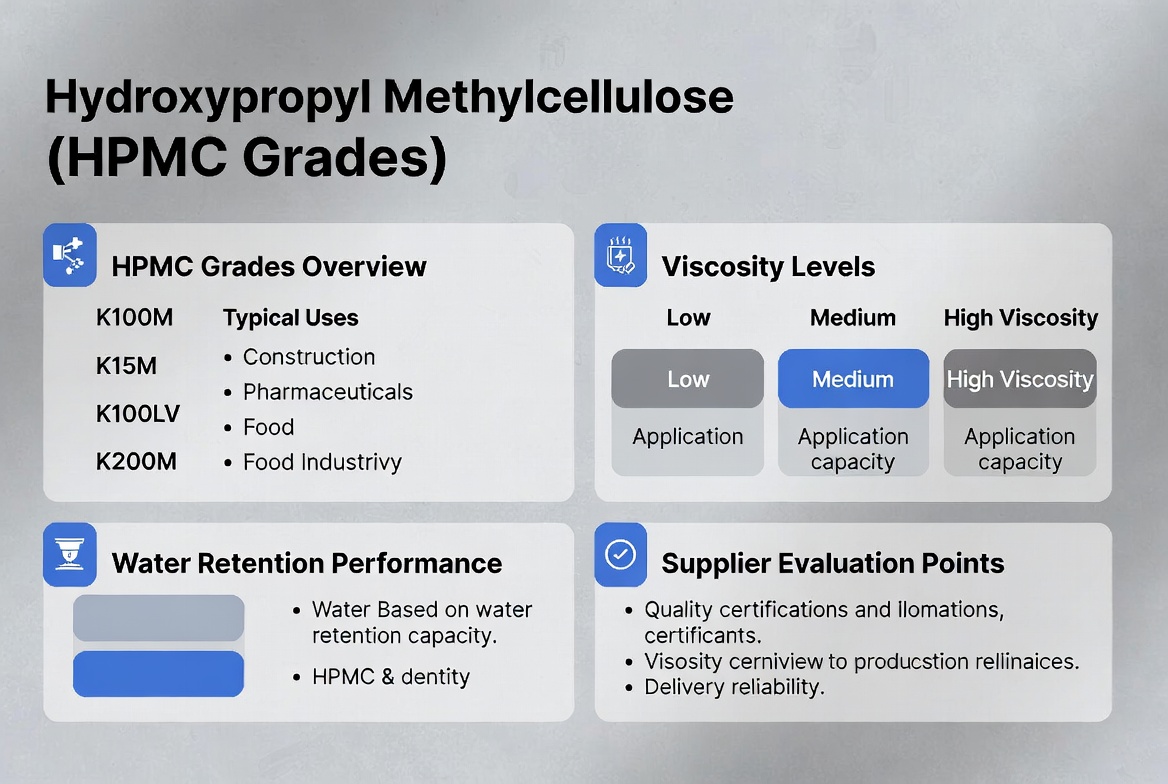
One of the strongest ways to improve page depth is to add a market-facing insight section. Buyers do not only compare products; they compare supplier risk.
Today, customers increasingly prefer manufacturers that can provide:
- Stable supply chains.
- Technical documents.
- Transparent testing data.
- Fast sample response.
- Custom grade support.
- Export experience.
This reflects a broader B2B trend: industrial buyers are searching less for generic product claims and more for proof of capability. That makes a manufacturer page stronger when it explains how the company reduces risk, improves consistency, and supports formulation success across regions.
When choosing an HPMC supplier, ask the right questions. This helps buyers avoid low-quality or inconsistent material.
- Can the factory explain grade differences clearly?
- Are technical data sheets available?
- Is batch consistency documented?
- Can the supplier support custom viscosity needs?
- Does the manufacturer serve export markets?
- Are packaging and logistics suitable for long-distance shipping?
- Is there application support after purchase?
A professional HPMC factory should answer these questions with confidence and evidence. That is how trust is built in a competitive market.
If you are looking for a reliable HPMC factory that can supply premium hydroxypropyl methyl cellulose for construction or daily chemical applications, choose a manufacturer that can prove both technical strength and production consistency. Shandong Shengda New Material Co., Ltd. can present itself as a partner that supports product selection, sample testing, and long-term supply stability.
Request a sample, technical data sheet, or customized recommendation today to find the right HPMC grade for your formula.
An HPMC factory refers to the manufacturer and its production capability, while premium HPMC refers to the product quality, consistency, and performance level.
HPMC is widely used in construction materials, daily chemicals, detergents, personal care products, and some specialty formulations.
Viscosity affects thickening, workability, water retention, and final product behavior. The right viscosity helps match the application needs.
Check technical documentation, batch consistency, application support, export experience, and whether the factory can explain grade differences clearly.
Yes. Many manufacturers offer different viscosity grades and application-specific recommendations for construction, daily chemical, and other systems.
1. Article page provided by your company: [HPMC Factory Premium Hydroxypropyl Methyl Cellulose]
2. General manufacturer SEO guidance: [SEO for Manufacturers: Strategies to Dominate Search] [robertsiegers]
3. E-E-A-T product-page guidance: [E-E-A-T for Product Pages] [visively]
4. Manufacturer SEO best-practice overview: [SEO for Manufacturers] [sana-commerce]
5. Comparative cellulose ether context: [HEMC vs. HPMC: A Comparative Analysis of Two Key Cellulose Ethers] [kdochem]
6. HPMC application background: [The application of biomedical polymer material hydroxypropyl methylcellulose (HPMC) in pharmaceutical formulations] [jocpr]


