


close
Choose Your Site
Global
Social Media
Views: 254 Author: Shengda Publish Time: 2026-07-05 Origin: Site


Hydroxypropyl Methyl Cellulose (HPMC) is one of the most versatile cellulose ethers used today. In construction, it improves water retention, workability, and open time; in personal care and daily chemical products, it helps control viscosity, stabilize formulas, and create a smoother user experience.
For manufacturers, distributors, and formulators, understanding the properties of HPMC is just as important as understanding its applications. The right grade can directly affect product performance, production efficiency, and final customer satisfaction.
HPMC, or Hydroxypropyl Methyl Cellulose, is a non-ionic cellulose ether derived from natural cellulose. It is modified through etherification to create a polymer that is water-soluble, functional, and highly adaptable across multiple industries.
From an industry perspective, HPMC stands out because it combines thickening, water retention, film formation, suspension stability, and binding in one material. That is why it has become a core ingredient in construction materials, pharmaceuticals, food systems, and daily chemical formulations.

The performance of HPMC depends on its molecular structure, substitution level, viscosity range, and particle characteristics. These factors determine how it behaves in different systems.
HPMC helps formulations hold moisture for longer periods. In cement-based products, this supports hydration and improves curing consistency.
HPMC increases viscosity and helps control flow. This is especially useful in tile adhesives, wall putty, plaster, shampoos, creams, and detergents.
HPMC can form transparent, flexible films. This property is valuable in coatings, personal care, and certain pharmaceutical applications.
Depending on the grade, HPMC can exhibit thermal gelation behavior. This makes it useful in specialized systems that require temperature-responsive performance.
As a non-ionic polymer, HPMC is generally compatible with a wide range of ingredients and ionic environments. This makes it a practical choice for complex formulations.
Construction remains one of the largest application areas for HPMC. In dry-mix mortar systems, HPMC is widely used because it supports better workability, stronger adhesion, longer open time, and improved anti-sag performance.
- Tile adhesives.
- Wall putty.
- Cement renders and plasters.
- Self-leveling compounds.
- EIFS and dry-mix mortar systems.
In practical terms, HPMC helps workers apply materials more smoothly and gives the mortar more time to bond properly before drying. This reduces application defects and improves site efficiency.
From a formulation standpoint, the "best" HPMC grade is not the one with the highest viscosity. It is the grade that matches the water demand, application thickness, substrate type, and construction climate.
HPMC is also important in daily chemical and personal care products because it helps improve texture, suspension, and stability without making the formula overly harsh or sticky.
- Shampoo and conditioner systems.
- Facial cleansers.
- Body wash.
- Toothpaste.
- Hand sanitizer gels.
- Creams and lotions.
- Creates a smoother texture.
- Improves product body and spreadability.
- Helps stabilize suspended ingredients.
- Supports a more premium sensory feel.
For consumers, this means a product that feels better during use. For manufacturers, it means better batch consistency and easier formula control.

The same raw material family can serve very different purposes depending on grade selection. This is why HPMC should be treated as a functional platform, not just a single additive.
| Aspect | Construction Grade HPMC | Daily Chemical Grade HPMC |
|---|---|---|
| Primary role | Water retention, workability, adhesion | Thickening, stabilizing, texture improvement |
| Main systems | Tile adhesive, putty, plaster, mortar | Shampoo, cleanser, cream, toothpaste |
| Performance focus | Open time, sag resistance, smooth application | Viscosity, sensory feel, stability |
| Key selection factors | Viscosity, water demand, thermal behavior | Clarity, smoothness, compatibility |
| User benefit | Better application and durability | Better product feel and shelf performance |
This comparison shows why suppliers must understand both application needs and end-user expectations before recommending a grade.
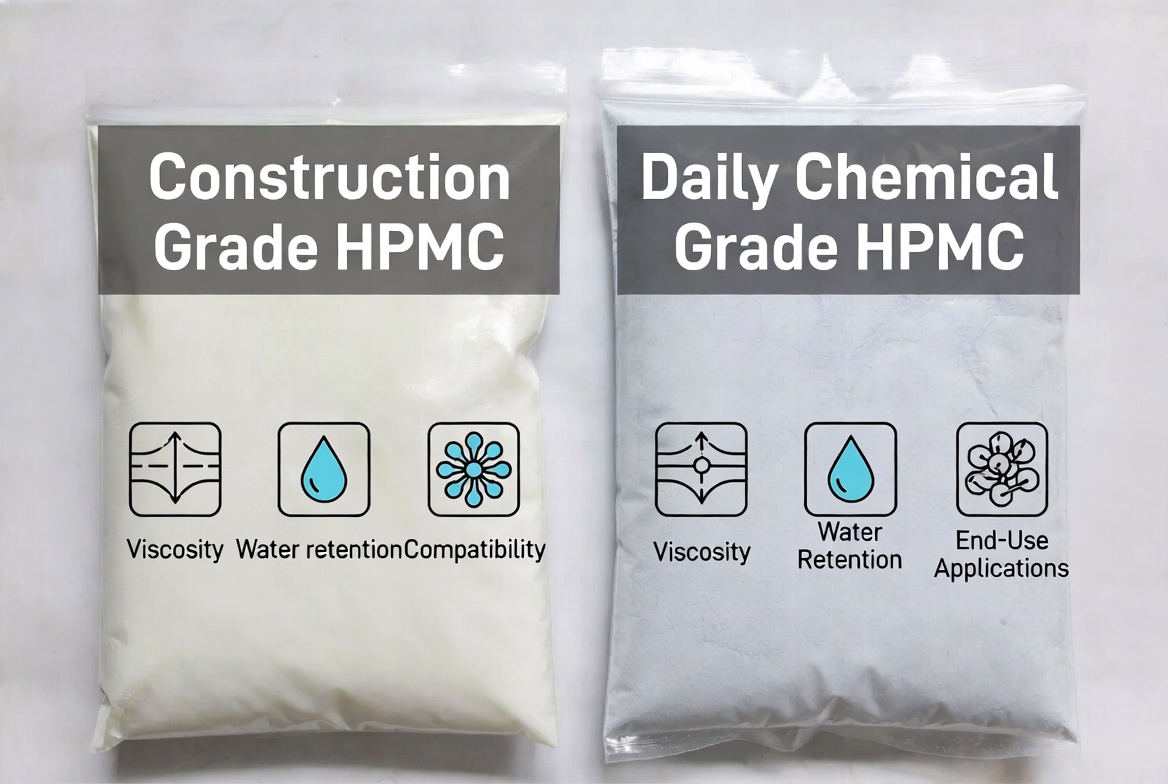
In real-world production, HPMC performance is influenced by more than viscosity alone. Particle size, dissolution behavior, surface treatment, mixing sequence, and temperature can all affect the final result.
1. Dispersibility affects how quickly the powder wets and dissolves.
2. Mixing order can change the smoothness of the final product.
3. Water temperature can influence hydration speed.
4. Raw material compatibility affects stability and consistency.
5. Dosage level determines whether the formula is under-thickened or over-thickened.
A good formulation strategy starts with the end use, not the ingredient sheet. That is the difference between a technically acceptable product and a commercially successful one.
The global HPMC market continues to grow as demand rises in construction, personal care, and pharmaceuticals. According to a 2026 market report, the industry is expected to expand further in the coming years, supported by urbanization, renovation demand, and functional ingredient adoption in consumer products. This confirms that HPMC is not a niche material; it is a core industrial polymer with long-term relevance. [giiresearch]
At the same time, buyers are asking for more than basic performance. They now care about supply stability, technical support, sustainability, and consistent batch quality. That is why manufacturers with real production control and R&D capability are gaining more trust in global procurement.
For buyers, HPMC is not just about choosing a product name. It is about choosing a supplier who understands formulation, production consistency, and end-use performance.
As a manufacturer focused on cellulose ethers, Shandong Shengda New Material Co., Ltd. emphasizes research, development, production, and sales of water-soluble polymer compounds. Company materials show that the business has a production base in Jinan, advanced equipment, a 36,000-square-meter factory, and products used in construction and other industries. [sdshengda.en.made-in-china]
That kind of manufacturing background matters because HPMC quality is sensitive to process control. A reliable supplier should be able to support grade selection, technical adjustment, and consistent delivery.
If you are sourcing HPMC for construction or daily chemical use, the following steps can help narrow the right option.
1. Define the application clearly.
2. Identify the target viscosity range.
3. Check water retention or thickening needs.
4. Review dissolution and dispersion performance.
5. Test compatibility with your full formula.
6. Compare batch stability and supply consistency.
7. Ask for technical support, not just a quotation.
For B2B buyers, this is where product quality and supplier expertise meet. A well-chosen HPMC grade can reduce rework, improve customer satisfaction, and lower formula risk.
HPMC is a high-value cellulose ether that bridges two major markets: construction and daily chemicals. Its real value comes from how well its properties match the target application, not from the ingredient name alone.
For formulators and buyers, the best results come from combining technical understanding with a reliable manufacturing partner. If you need HPMC for tile adhesives, wall putty, plaster, shampoo, or skincare formulations, selecting the right grade early will save time, cost, and production risk.
CTA: Contact Shandong Shengda New Material Co., Ltd. for technical guidance, grade selection support, and customized cellulose ether solutions for your target market.
HPMC mainly works as a thickener, water retention agent, binder, and stabilizer depending on the formulation and application.
It improves water retention, open time, workability, and adhesion, which makes application easier and more reliable.
Yes. It is widely used in shampoo, cleanser, lotion, toothpaste, and gel systems to improve viscosity and stability.
No. Different grades vary in viscosity, dispersibility, substitution level, and performance, so selection should match the end use.
Start with the application, then test viscosity, water retention, dissolution, and formula compatibility before finalizing the grade.
1. [HPMC Selection Guide: Matching Key Properties to Application Needs]
2. [Hydroxypropyl methylcellulose - an overview]
3. [Hydroxypropyl Methylcellulose—A Key Excipient in Modern Formulation Science]
4. [Characteristics and applications of hydroxypropyl methylcellulose]
5. [Hydroxypropyl Methylcellulose Global Market Report 2026]
6. [Shandong Shengda New Material Co., Ltd. company profile]


