


close
Choose Your Site
Global
Social Media
Views: 211 Author: Shengda Publish Time: 2026-08-22 Origin: Site


Content Menu
>> What Is CMC?
● The Main Difference Between HPMC and CMC
>> Water Retention Performance
>> Viscosity and Rheology Control
>> Compatibility With Cement and Additives
● HPMC vs. CMC for Construction Materials
>> Gypsum Plaster and Joint Compound
>> Waterproofing and Repair Mortar
● HPMC vs. CMC for Daily Chemical Products
>> Detergents and Household Cleaning Products
>> Personal Care and Cosmetic Formulations
>> Coatings, Paper and Textile Processing
● How to Select the Right Cellulose Ether Grade
>> Step 1: Define the Application
>> Step 2: Set Performance Targets
>> Step 3: Compare Several Grades
>> Step 4: Check Raw-Material Compatibility
>> Step 5: Confirm Production-Scale Performance
● Common Mistakes When Choosing HPMC or CMC
>> Replacing HPMC With CMC at the Same Dosage
>> Ignoring Climate and Jobsite Conditions
● FAQ
>> Can CMC replace HPMC in tile adhesive?
>> Is HPMC better than CMC for cement mortar?
>> Can CMC be used in gypsum plaster?
>> Does a higher HPMC viscosity mean better performance?
>> What is the difference between HPMC and HEMC?
>> Which cellulose ether is suitable for liquid detergent?
>> How should HPMC and CMC be tested before purchase?
HPMC and CMC are water-soluble cellulose derivatives produced by chemically modifying natural cellulose. Both materials are supplied as white or off-white powders and can be used to control viscosity, stabilize formulations, improve suspension, and support processing performance.
Despite their shared cellulose origin, they behave differently in water, cementitious materials, gypsum systems, coatings, detergents, and other industrial products.
The right choice depends on the application target, raw-material compatibility, processing conditions, dosage range, and required finished-product performance.
Hydroxypropyl Methyl Cellulose, commonly known as HPMC, is a non-ionic cellulose ether. It contains methoxy and hydroxypropyl groups, which give it a valuable balance of water retention, thickening, binding, film-forming, and rheology-control properties.
HPMC is widely used in drymix mortar, tile adhesive, skim coat, wall putty, gypsum plaster, waterproofing mortar, repair mortar, coatings, adhesives, detergents, and pharmaceutical formulations.
In construction applications, HPMC is valued for its ability to retain water in the mixture. This helps maintain mortar workability, reduces rapid moisture loss, and supports more stable cement hydration.
Key functional benefits of HPMC include:
- Water retention in cement- and gypsum-based systems
- Thickening and viscosity control
- Improved trowelability and spreading performance
- Better open time in tile adhesive and mortar
- Improved anti-sag behavior on vertical surfaces
- Film-forming and binding properties
- Suspension and stabilization support
- Improved consistency during mixing and application
Many HPMC grades also show thermal gelation behavior. Their aqueous solutions can form a gel when heated above a specific temperature range and return to a liquid state after cooling.
Carboxymethyl Cellulose, commonly known as CMC or cellulose gum, is an anionic cellulose derivative. It contains carboxymethyl groups that make it highly effective in many water-based thickening and stabilizing applications.
CMC is widely used in detergents, paper coating, textile processing, ceramic applications, food formulations, water-based industrial systems, and selected construction or gypsum products.
Compared with HPMC, CMC is often chosen for its efficient thickening performance and cost advantages in compatible aqueous formulations.
Key functional benefits of CMC include:
- Fast aqueous thickening
- Suspension and stabilization support
- Moisture-control properties
- Improved flow behavior
- Better particle dispersion
- Reduced settling in liquid systems
- Binding support in selected industrial formulations
- Cost-effective rheology modification
CMC can perform very well in the right system. However, because it is anionic, its compatibility with cement, salts, multivalent ions, cationic additives, and other raw materials should always be tested carefully.
| Property | HPMC | CMC |
|---|---|---|
| Full name | Hydroxypropyl Methyl Cellulose | Carboxymethyl Cellulose |
| Ionic character | Non-ionic | Anionic |
| Main function | Water retention, thickening, binding, film formation | Thickening, stabilization, suspension |
| Cement mortar suitability | Highly suitable for many systems | Suitable only for selected systems |
| Tile adhesive suitability | Commonly preferred | Usually limited |
| Gypsum product suitability | Suitable for standard and premium formulations | Often suitable for economical formulations |
| Water solubility | Soluble with correct dispersion and hydration procedures | Readily soluble in water |
| Thermal gelation | Present in many grades | Not a typical feature |
| Electrolyte sensitivity | Generally broader compatibility | Can be more sensitive |
| Cost position | Often higher | Often lower |
| Typical selection focus | Performance-driven formulations | Cost-efficient thickening and stabilization |
The most important difference between HPMC and CMC is their chemical structure.
HPMC is non-ionic. This gives it strong compatibility across many cement-based, gypsum-based, and industrial systems. It is often selected when a formulation needs water retention, workable consistency, controlled rheology, and stable performance across changing application conditions.
CMC is anionic. Its charged molecular structure can provide excellent thickening, suspension, and stabilization in many water-based formulations. However, the same ionic character can create compatibility challenges in systems containing certain salts, minerals, cationic additives, or high electrolyte levels.
For formulators, this means the selection should not be based only on viscosity or product price. It should be based on complete application performance.
Water retention is especially important in cement-based mortar, tile adhesive, skim coat, and plaster products.
When mortar loses water too quickly, several problems may occur:
- Reduced workability
- Shorter open time
- Difficult spreading
- Incomplete cement hydration
- Lower bonding consistency
- Surface defects
- Increased risk of premature drying
HPMC is widely used in drymix mortar because it helps hold water inside the fresh mixture. This supports consistent handling, smoother application, and more reliable hydration performance.
CMC can also provide water retention in some formulations. However, it is usually less preferred for demanding cement-based mortar systems where high and stable water retention is required.
Both HPMC and CMC can increase viscosity, but they influence flow behavior differently.
HPMC can provide a balanced rheology profile that supports spreading, anti-sag performance, water retention, and workable consistency. This is particularly valuable in wall applications, tile adhesive, repair mortar, and gypsum plaster.
CMC is highly effective for aqueous thickening. It can be an efficient choice for detergent liquids, textile formulations, paper coatings, ceramics, and other water-based products where stable viscosity and suspension are key priorities.
A higher viscosity grade is not always better. Excessive viscosity may lead to difficult mixing, poor flow, unwanted stickiness, reduced pumpability, or poor user experience during application.
Cement-based formulations are complex systems. They can contain cement, graded sand, calcium carbonate, redispersible polymer powder, starch ether, retarders, accelerators, defoamers, pigments, hydrophobic additives, and many other ingredients.
HPMC is generally more suitable for these formulations because its non-ionic character provides broad compatibility.
CMC requires more careful evaluation. The presence of calcium ions, salts, alkaline materials, and other additives may affect its performance. In some systems, CMC may still be useful, but it should be tested under actual formulation conditions.
Tile adhesive requires reliable workability, water retention, open time, anti-slip performance, and bonding consistency.
For cement-based tile adhesive, HPMC is generally the preferred cellulose ether. It helps retain water, improve trowelability, and maintain workable consistency during application.
This is particularly important for:
- Large-format tile installation
- Porcelain tile adhesive
- Vertical wall installation
- High-temperature working conditions
- Dry or highly absorbent substrates
- Extended open-time requirements
CMC may be considered for low-cost or low-performance formulas. However, it should not be regarded as a direct replacement for HPMC at the same dosage.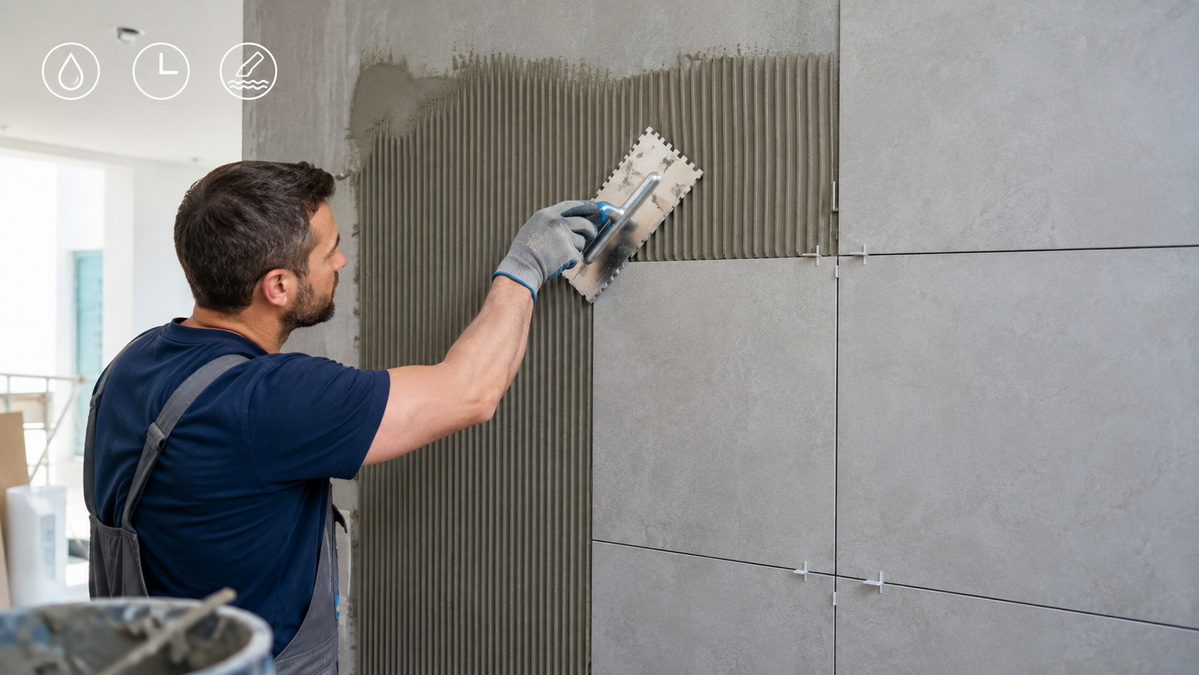
Skim coat and wall putty formulations need smooth application, good water retention, stable consistency, and a refined finished surface.
HPMC helps support:
- Smooth troweling
- Reduced rapid moisture loss
- Better application time
- More uniform spreadability
- Improved surface finishing
- Better control of fresh-material consistency
For premium wall putty and skim coat formulations, HPMC is often selected because it can help create a more consistent application experience.
Cement plaster and render need workability, water retention, sag resistance, and stable behavior under changing site conditions.
HPMC can improve the fresh properties of plaster and render by helping retain water and manage rheology. This can make the material easier to spread and finish, especially on porous walls or in dry climates.
The final performance will also depend on cement quality, filler ratio, sand grading, polymer content, water demand, mixing procedure, and curing conditions.
Both HPMC and CMC can be used in gypsum-based products.
CMC may be suitable when cost-effective thickening and basic workability are the main targets. HPMC may be preferred when the product requires stronger water-management performance, smoother application, higher sag resistance, or more refined handling properties.
The best choice depends on the balance between setting time, water demand, consistency, application feel, surface quality, and production cost.
Waterproofing mortar and repair mortar often require a more carefully balanced rheology profile. These products may need good adhesion, stable mixing, controlled flow, anti-sag behavior, and compatibility with polymer modifiers.
HPMC is usually a stronger starting point for these performance-driven systems. Its water-retention and rheology-control properties can support consistent application and improve formulation stability.
CMC is widely used in liquid detergents, laundry products, and household cleaning formulations. It can help control viscosity, suspend particles, and improve product stability.
In certain detergent applications, CMC can also help reduce the redeposition of soil onto fabric during washing.
HPMC may also be used in selected household and personal-care formulations where thickening, film formation, or sensory properties are required. However, CMC is often a more common choice for basic detergent thickening and suspension needs.
HPMC can be used in creams, gels, lotions, shampoos, and other personal-care products where smooth texture, film formation, and viscosity control are needed.
CMC can also be used as a thickener and stabilizer in compatible cosmetic or personal-care formulations. The selection should consider pH, electrolyte content, surfactant system, clarity requirements, and desired product texture.
CMC is commonly used in paper coating, textile sizing, printing, and industrial coatings because of its thickening, binding, and suspension properties.
HPMC may be selected in certain coatings and adhesive systems where water retention, film formation, or specific flow behavior is needed.
The best material depends on the binder system, pigment load, solid content, coating method, drying conditions, and final-product requirements.
The correct cellulose ether is selected through testing, not assumptions.
A material that performs well in one formulation may produce completely different results when used with another cement source, gypsum type, filler, water quality, polymer powder, or climate condition.
Use the following approach when selecting an HPMC or CMC grade.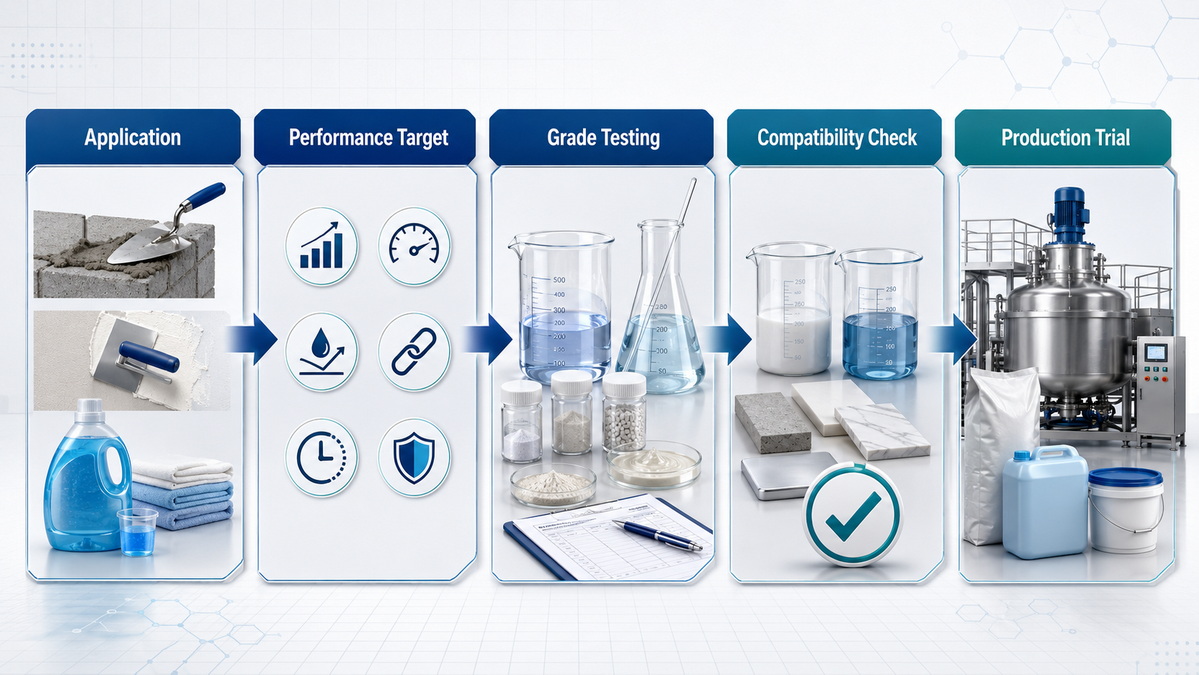
Start by identifying the exact product category.
Examples include:
- C1 or C2 tile adhesive
- Cement skim coat
- Wall putty
- EIFS base coat
- Gypsum plaster
- Joint compound
- Waterproofing mortar
- Repair mortar
- Liquid detergent
- Paper coating
- Textile sizing
Each application has different functional requirements.
Define the performance requirements before selecting a grade.
For construction materials, test:
- Water retention
- Open time
- Slip resistance
- Tensile adhesion
- Workability
- Sag resistance
- Setting behavior
- Compressive strength
- Surface finish
For daily chemical products, test:
- Viscosity
- Stability
- Suspension
- Clarity
- Foam behavior
- pH stability
- Storage stability
- Compatibility with surfactants and salts
Test at least two or three suitable grades instead of selecting only one material based on a brochure value.
Compare products based on total performance, including dosage efficiency, mixing time, storage stability, user experience, and finished-product consistency.
Do not compare HPMC and CMC only at the same addition level. Compare them at the dosage required to achieve the same target performance.
Cellulose ether performance can change significantly depending on the formulation.
Always evaluate compatibility with:
- Cement
- Gypsum
- Calcium carbonate
- Sand
- Redispersible polymer powder
- Starch ether
- Retarders
- Accelerators
- Defoamers
- Hydrophobic agents
- Pigments
- Surfactants
- Process water
This step is especially important when replacing an existing cellulose ether supplier or reformulating for cost control.
Laboratory results are essential, but production trials are equally important.
Before full-scale adoption, evaluate:
- Powder feeding behavior
- Mixing time
- Lump formation
- Batch consistency
- Packaging performance
- Moisture sensitivity
- Storage conditions
- Seasonal performance variation
- Operator handling experience
A successful product should perform consistently not only in the laboratory, but also in factory production and final application conditions.
The lowest price per kilogram does not always create the lowest finished-product cost.
A lower-cost material may require higher dosage, longer mixing time, additional additives, or more customer-service support if it creates inconsistency in the final product.
The more useful comparison is total formulation cost per ton of stable, market-ready product.
Viscosity is important, but it is only one part of performance.
Two products with similar viscosity can behave differently because of substitution level, particle size, dissolution speed, moisture content, purity, and application-specific design.
HPMC and CMC do not provide identical performance. A direct one-to-one substitution may reduce open time, change water retention, affect consistency, or create compatibility issues.
Any replacement should be validated through controlled laboratory trials and production testing.
Hot, dry, windy, or highly absorbent conditions can change mortar behavior significantly.
A formulation that performs well in a controlled environment may dry too quickly in real construction conditions. Water retention and open time should therefore be tested under conditions that reflect the target market.
HPMC and CMC are both important cellulose ethers, but they serve different formulation priorities.
HPMC is generally the better option for demanding construction applications that require strong water retention, stable workability, open time, anti-sag properties, and broad compatibility with cementitious materials.
CMC is often an effective and economical option for aqueous thickening, stabilization, detergent products, paper processing, textile applications, and selected gypsum or low-demand construction systems.
The most reliable choice is based on application testing, not assumptions. A carefully selected cellulose ether can improve product consistency, reduce formulation risk, enhance application performance, and support long-term customer satisfaction.
For formulation guidance, product sampling, and cellulose ether selection support, Shandong Shengda New Material Co., Ltd. is ready to help identify suitable HPMC, HEMC, HEC, and related cellulose ether solutions for your product requirements.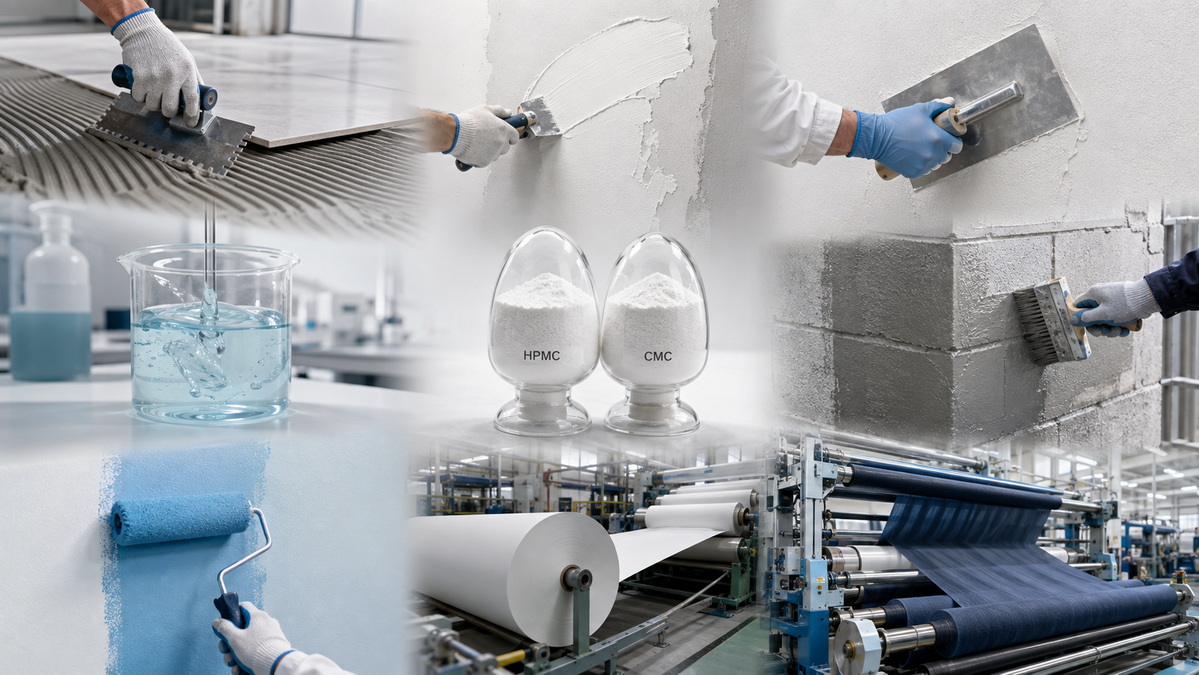
CMC may be used in certain cost-sensitive tile adhesive formulations, but it is usually not a direct replacement for HPMC. HPMC is generally preferred when water retention, open time, anti-slip behavior, and application consistency are important.
For many cement-based mortars, HPMC is the more suitable choice because it provides strong water retention and supports workability. The final selection should always be confirmed through formulation testing.
Yes. CMC can be suitable for gypsum plaster and some joint-compound formulations, especially where economical thickening and basic workability are required. HPMC may be selected when higher water retention or premium handling properties are needed.
Not always. Higher viscosity can improve thickening and water retention, but excessive viscosity may make a formulation too sticky, difficult to mix, or harder to apply. The right grade depends on the complete formulation target.
HPMC contains hydroxypropyl and methyl groups, while HEMC contains hydroxyethyl and methyl groups. Both are non-ionic cellulose ethers used in construction and industrial applications, but they may provide different hydration, rheology, and temperature-response characteristics.
CMC is commonly used in liquid detergent because it can provide efficient thickening, suspension, and stability. The most suitable grade depends on the surfactant system, salt level, target viscosity, pH, and storage conditions.
Evaluate multiple grades in the actual formula. For drymix mortar, test water retention, open time, slip resistance, workability, setting behavior, and adhesion. For liquid products, test viscosity, stability, pH compatibility, clarity, suspension, and long-term storage behavior.
1. Celotech. "[HPMC vs CMC: Ultimate Guides for Your Application]."
2. U.S. Food and Drug Administration. "[Carboxymethyl Cellulose: Food Substances Database]."
3. Zhang, et al. "[Water Retention Mechanism of HPMC in Cement Mortar]." *Materials*, 2020.
4. Costa, E. M., et al. "[Carboxymethyl Cellulose as a Food Emulsifier]." *Foods*, 2023.
5. ChemPoint. "[METHOCEL™ HPMC and MC: What It Is, Uses, and How to Select]."
6. Roquette Industrial Cellulosics. "[METHOCEL™ Cellulose Ethers]."


