


close
Choose Your Site
Global
Social Media
Views: 288 Author: Shengda Publish Time: 2026-08-21 Origin: Site


Content Menu
● What Determines an HPMC Grade?
>> Why Substitution Level Matters
● HPMC Grades for Construction Applications
>> HPMC for Wall Putty and Skim Coat
>> HPMC for Cement Render and Plaster
>> HPMC for Self-Leveling Mortar
● HPMC Grades for Personal Care and Daily Chemical Products
>> HPMC for Shampoo and Body Wash
>> HPMC for Household Cleaning Products
● How to Select the Right HPMC Grade
>> Step 1: Define the Application
>> Step 2: Review the Complete Formula
>> Step 3: Test More Than One Grade
>> Step 4: Confirm Process Compatibility
● Common HPMC Selection Mistakes
>> Selecting Only by Viscosity
>> Ignoring Local Climate Conditions
>> Changing Multiple Variables at Once
>> Comparing Products Without Consistent Test Methods
● FAQ
>> What is the difference between low-viscosity and high-viscosity HPMC?
>> Does higher HPMC viscosity always provide better water retention?
>> Which HPMC grade is suitable for tile adhesive?
>> Why does HPMC form lumps during mixing?
>> Can the same HPMC grade be used for wall putty and self-leveling mortar?
>> What information is needed for HPMC grade evaluation?
An HPMC grade is defined by several physical and chemical characteristics. Viscosity is important, but it is only one part of the full performance profile.
Key characteristics include:
- Viscosity
- Methoxy and hydroxypropoxy substitution level
- Particle-size distribution
- Surface treatment
- Moisture content
- Ash content
- Gel temperatur
- Dissolution behavior
- Bulk density
- Test method and test conditions
Two HPMC products may have a similar nominal viscosity but still perform differently in a finished formulation. Differences in substitution, particle size, production control, or viscosity measurement conditions can influence hydration speed, consistency development, water retention, and final application behavior.
For this reason, an HPMC specification should not state only a viscosity value. It should also identify the solution concentration, testing temperature, viscosity measurement method, and acceptable performance range.
Viscosity refers to a liquid's resistance to flow. In HPMC applications, viscosity is commonly used as an indicator of thickening ability and molecular-weight range.
In general, a higher-viscosity HPMC grade can provide stronger thickening, improved cohesion, better water retention, and enhanced anti-sag performance. However, a product with excessively high viscosity may also reduce flow, increase mixing resistance, create a sticky application feel, or negatively affect setting behavior.
Lower-viscosity HPMC grades can improve flow and processability. They may be suitable for fluid formulations, self-leveling products, and applications where excessive thickening is undesirable.
| Viscosity Direction | Typical Effect | Suitable Application Focus |
|---|---|---|
| Lower viscosity | Supports flow, easier mixing, lower thickening | Self-leveling mortar, fluid grout, some coatings |
| Medium viscosity | Balances workability, water retention, and body | Tile adhesive, skim coat, render, shampoo |
| Higher viscosity | Builds stronger structure, cohesion, and anti-sag properties | Wall putty, EIFS mortar, thick creams, heavy-duty adhesive systems |
The correct viscosity range depends on the entire formula. Cement type, filler particle size, polymer powder, starch ether, surfactants, water ratio, temperature, and mixing process can all change the final result.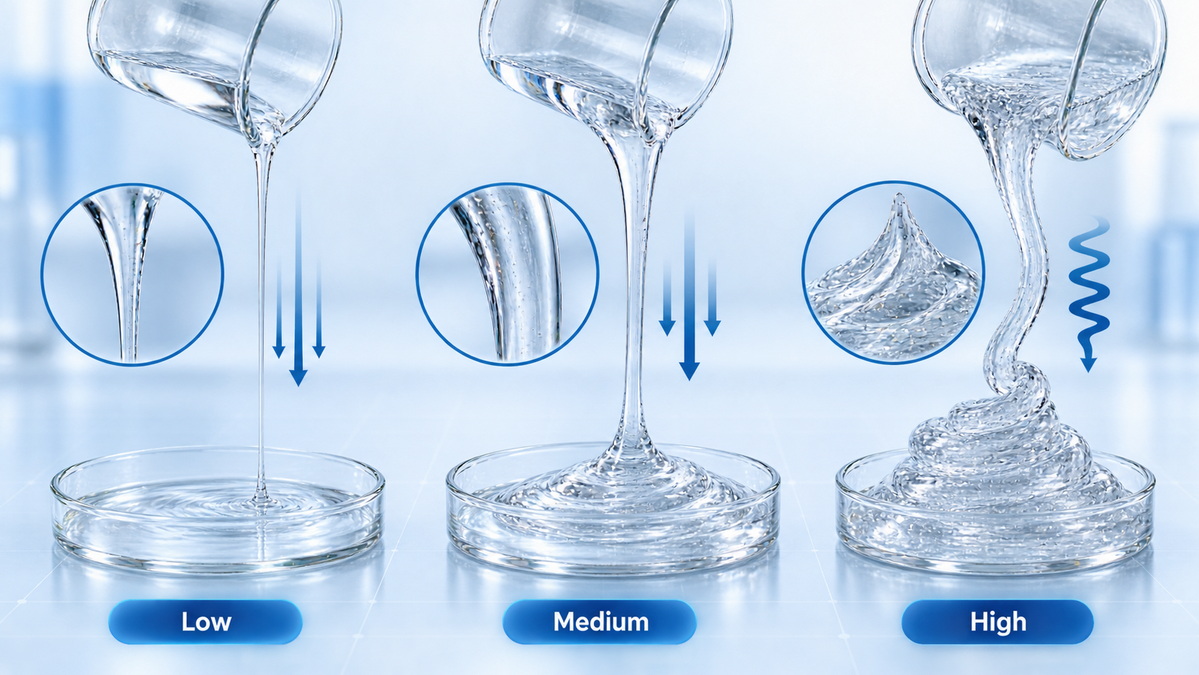
HPMC is produced by chemically modifying cellulose with methoxy and hydroxypropoxy groups. The type and level of substitution influence how the polymer hydrates, dissolves, thickens, forms films, and responds to temperature.
In construction applications, substitution can influence:
- Water retention
- Workability
- Open time
- Adhesion development
- Mortar consistency
- Cement hydration behavior
- Thermal gelation behavior
In personal care applications, substitution can influence:
- Clarity
- Thickening efficiency
- Film formation
- Skin feel
- Compatibility with surfactants
- Product stability
A well-selected HPMC grade should support the desired end-use performance without disrupting the balance of the formulation.
Particle size affects how quickly HPMC disperses and hydrates in water. Fine HPMC powders often hydrate quickly because of their larger surface area. This can help speed up viscosity development, especially in controlled mixing systems.
However, fast hydration can also increase the risk of lump formation if the powder is added incorrectly. When HPMC particles hydrate rapidly on the surface, they can form a gel layer that prevents water from reaching the inner powder core. These undissolved particles are often called "fish eyes."
Coarser or surface-treated grades may offer slower, more controlled dissolution. This can be beneficial for dry-mix mortar production, automated batching systems, and large-scale industrial mixing.
The ideal particle size depends on the process. A product that works well in a laboratory beaker may not perform the same way in a high-speed factory mixer.
Construction-grade HPMC is commonly used in dry-mix mortar, tile adhesive, wall putty, skim coat, render, gypsum products, EIFS mortar, self-leveling compounds, and cement-based repair materials.
Its primary functions include improving water retention, workability, cohesion, open time, sag resistance, and application smoothness.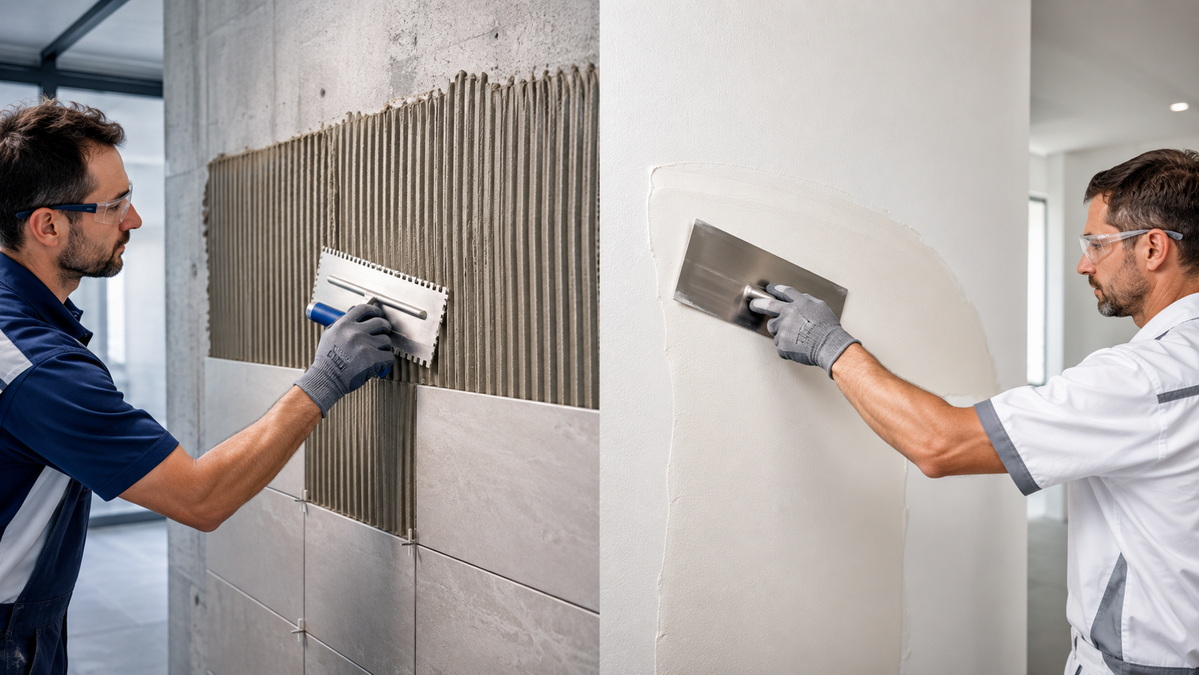
Tile adhesive requires a carefully balanced combination of water retention, open time, workability, and slip resistance.
During installation, cement-based tile adhesive can lose water quickly to porous substrates, tiles, or the surrounding environment. If too much water is lost too early, cement hydration may be incomplete and adhesion performance may be affected.
HPMC helps manage water movement within the mortar. It supports a more stable fresh-state consistency and can help maintain workable application time.
Important performance indicators for tile adhesive include:
- Water retention
- Open time
- Tensile adhesion strength
- Slip resistance
- Workability
- Spreadability
- Trowel feel
- Setting time
- Compatibility with redispersible polymer powder
Medium- to high-viscosity HPMC grades are commonly evaluated for tile adhesives. However, the highest-viscosity product is not always the best option. A grade that is too thick may make adhesive difficult to spread or reduce wetting ability between the tile and substrate.
Wall putty and skim coat formulations require smooth application, good knife feel, sufficient water retention, and a uniform finished surface.
The goal is to create a material that spreads easily without tearing, rolling, dragging, or drying too quickly. HPMC contributes to mortar consistency and helps maintain workable moisture during application.
For wall putty and skim coat, formulators should evaluate:
- Smoothness during application
- Water retention
- Workability after mixing
- Surface finish
- Sanding behavior
- Consistency stability
- Resistance to cracking
- Compatibility with fillers and binders
High-viscosity grades may provide stronger body and water retention, but they should be balanced with the desired spreading performance. If the mortar feels too heavy or sticky, a lower viscosity grade or adjusted dosage may offer a better result.
Cement render and plaster applications often require good workability, water retention, adhesion, and resistance to sagging.
The HPMC grade should help maintain moisture while the mortar is being applied and finished. It should also support cohesive behavior, particularly for vertical application.
For machine-applied render systems, the product must also be compatible with pumping and spraying equipment. Excessive viscosity can create processing difficulties, while insufficient viscosity may reduce mortar stability.
Key evaluation points include:
- Pumpability
- Sprayability
- Application thickness
- Sag resistance
- Water retention
- Workability time
- Surface finishing
- Adhesion to the substrate
Self-leveling mortar requires a different balance from wall putty or tile adhesive. The formulation must flow and level effectively while maintaining enough water control to support proper curing.
An HPMC grade suitable for wall putty may be too thick for a self-leveling system. Excessive thickening can reduce flow spread and prevent the material from leveling properly.
For self-leveling mortar, formulators should monitor:
- Initial flow spread
- Flow retention over time
- Segregation resistance
- Bleeding behavior
- Surface smoothness
- Setting time
- Strength development
- Compatibility with defoamers and superplasticizers
Lower-viscosity HPMC grades are often considered for these applications because they can support water control without creating excessive yield stress.
> The best HPMC grade for self-leveling mortar is the one that provides sufficient stability while preserving the product's ability to flow and level.
HPMC is also used in personal care and household formulations. Depending on the grade and system, it can act as a thickener, rheology modifier, stabilizer, film former, or texture enhancer.
Common applications include:
- Shampoo
- Body wash
- Facial cleanser
- Lotion
- Cream
- Hair styling products
- Hand sanitizer gel
- Household cleaning products
- Dishwashing liquids
In surfactant-based products such as shampoo and body wash, HPMC can help modify viscosity and improve product texture.
The selected grade should be evaluated for compatibility with surfactants, salts, fragrances, preservatives, and other additives. It is important to test the final system because an HPMC grade may behave differently depending on the surfactant blend and pH level.
Relevant performance factors include:
- Dissolution speed
- Product appearance
- Viscosity stability
- Foam compatibility
- Salt tolerance
- Freeze-thaw stability
- Elevated-temperature stability
- Rinsing behavior
For clear formulations, clarity and haze should be assessed throughout the product development process.
In lotions and creams, HPMC can contribute to viscosity, suspension stability, spreadability, and film-forming performance.
A suitable grade should help create the intended texture without producing an overly stringy, sticky, or heavy feel. The desired sensory profile may vary significantly depending on the target market and product positioning.
For example, a lightweight body lotion may require easy spreadability and fast absorption. A richer cream may require stronger structure and a more substantial feel.
Laboratory evaluation should include:
- Viscosity development
- Emulsion stability
- Texture
- Spreadability
- Skin feel
- Freeze-thaw stability
- Heat stability
- Packaging compatibility
HPMC can also be used in selected household cleaning formulations where viscosity control, suspension, and rheology modification are required.
The grade must be compatible with the surfactant system, pH level, electrolyte content, and active ingredients. A stable formula should be assessed under real storage conditions, including low temperature, high temperature, and repeated temperature cycling.
A successful HPMC selection process begins with the application requirement rather than the viscosity number.
Before selecting a grade, define the finished product's key performance targets. These may include water retention, flow, workability, thickening, anti-sag behavior, open time, stability, texture, or sensory performance.
Identify the specific product category.
Examples include:
- C1 or C2 tile adhesive
- Wall putty
- Skim coat
- Cement render
- Gypsum plaster
- Self-leveling mortar
- Shampoo
- Lotion
- Cream
- Household cleaner
Different applications require different rheological behavior. A grade selected for tile adhesive should not automatically be used for self-leveling mortar or personal care products.
The HPMC grade must be evaluated with the complete formula.
For construction products, review:
- Cement type
- Calcium carbonate or silica filler
- Sand grading
- Redispersible polymer powder
- Starch ether
- Superplasticizer
- Defoamer
- Water ratio
For daily chemical products, review:
- Surfactants
- Oils
- Emulsifiers
- Electrolytes
- Preservatives
- Fragrance
- pH adjusters
- Active ingredients
HPMC performance can change significantly when any of these components are modified.
A practical development approach is to test at least two or three suitable grades under controlled conditions.
Keep the formulation stable during the first screening. Change one main variable at a time so that the result can be interpreted accurately.
For example:
1. Test several viscosity grades at the same dosage.
2. Compare water retention, consistency, and application behavior.
3. Select the most suitable viscosity range.
4. Adjust dosage in small increments.
5. Confirm the result with repeat testing.
6. Validate performance at production scale.
This approach reduces unnecessary trial-and-error work.
A grade should not be selected only because it performs well in a small laboratory trial.
The material should also be evaluated for:
- Mixing time
- Powder feeding behavior
- Dust generation
- Dispersion
- Lump formation
- Storage stability
- Batch-to-batch consistency
- Production-scale repeatability
The selected product must work reliably within the actual manufacturing process.
Viscosity is important, but it does not provide a complete picture of performance. Two HPMC materials with similar viscosity may differ in dissolution speed, water retention, particle size, or application behavior.
Increasing dosage may improve water retention or thickening, but excessive dosage can create stickiness, reduce flow, delay setting, or increase formulation cost.
The objective is to identify the lowest effective dosage that meets the required performance standard.
Temperature and humidity can influence mortar workability, water evaporation, open time, and application behavior.
A formulation that performs well in one climate may require adjustment in another region. Hot, dry, cold, or humid environments should be considered during application testing.
When viscosity, dosage, cement type, polymer powder, and water ratio are changed at the same time, it becomes difficult to identify the real cause of the performance result.
Use a structured testing plan. Adjust one main variable at a time whenever possible.
A viscosity value is meaningful only when the measurement method is clear. Solution concentration, temperature, spindle type, and testing equipment can influence the reported result.
Always compare products under equivalent testing conditions.
The right HPMC grade can improve the consistency, workability, water retention, stability, and practical performance of construction and daily chemical formulations. However, successful selection requires more than choosing a product based on viscosity.
Formulators should consider viscosity, substitution, particle size, dissolution behavior, dosage, production process, and compatibility with the complete formula. The most reliable approach is to combine laboratory testing with realistic production and application evaluation.
Shandong Shengda New Material Co., Ltd. provides HPMC, HEMC, and HEC solutions for construction-grade and daily-chemical-grade applications. By evaluating each product against specific formulation requirements, manufacturers can develop more stable products, improve production consistency, and support long-term quality control.
Low-viscosity HPMC generally supports better flow and easier processing. High-viscosity HPMC usually provides stronger thickening, higher cohesion, improved water retention, and better anti-sag performance. The most appropriate grade depends on the complete formulation.
No. Higher viscosity can improve water retention, but it may also make the formulation too thick or sticky. Excessive viscosity can reduce flow, affect workability, and influence setting behavior.
Tile adhesives usually require construction-grade HPMC with good water retention, workability, open time, and slip resistance. The final grade should be selected through testing with the full cement, filler, and polymer system.
Lumps may occur when HPMC hydrates too quickly on the powder surface. Incorrect addition sequence, insufficient mixing, unsuitable water temperature, or incompatible processing conditions can all contribute to lump formation.
Not always. Wall putty often requires more body and water retention, while self-leveling mortar requires better flow and leveling behavior. Different HPMC grades may be needed to achieve the desired result.
Useful information includes the application type, formula structure, target consistency, current dosage, mixing method, temperature conditions, production process, and the specific performance issue that needs improvement.
1. Chen, N., Wang, P., Zhao, L., & Zhang, G. (2020). [Water Retention Mechanism of HPMC in Cement Mortar]. *Materials*, 13(13), 2918. [pmc.ncbi.nlm.nih]
2. Wan, S. et al. (2021). [Application of Multivariate Methods to Evaluate Differential Material Attributes of HPMC from Different Sources]. *ACS Omega*, 6(43), 28598–28610. [pubs.acs]
3. European Commission. (2025). [Commission Regulation (EU) 2025/666: Specifications for Cellulose Food Additives, Including E 464]. [eur-lex.europa]
4. European Food Safety Authority. (2018). [Re-evaluation of celluloses as food additives]. *EFSA Journal*, 16(1), 5047.
5. LANDU. [Different HPMC Grades and Their Corresponding Applications]. Original topic reference. [landu-china]


