


close
Choose Your Site
Global
Social Media
Views: 222 Author: Shengda Publish Time: 2026-05-18 Origin: Site


HEMC and HPMC are both essential cellulose ethers for modern self-leveling underlayments, but they influence layer separation, flow, and long-term performance in different ways that contractors must understand to avoid costly failures in the field. As a Chinese HEMC/HPMC manufacturer working directly with flooring applicators worldwide, Shandong Shengda New Material Co., Ltd. has seen how the right cellulose ether strategy can dramatically reduce delamination and ensure durable, flat substrates. [linkedin]

Self-leveling underlayments (SLUs) are cement-based, pumpable, highly flowable compounds used to create smooth, flat substrates before installing floor coverings such as vinyl, tile, wood, or carpet. They typically contain cement, graded fillers, redispersible polymer powder (RDP), defoamers, and cellulose ether to control water retention and rheology. [kemoxcellulose]
Because SLUs are applied in thin layers, any weakness between layers or between SLU and substrate can result in layer separation, hollow spots, and ultimately flooring failure. Cellulose ethers like HEMC and HPMC play a critical role in controlling water migration, flow, and cohesion, all of which directly influence separation risk. [kimachemical]
Hydroxyethyl Methyl Cellulose (HEMC) is a non-ionic cellulose ether modified with hydroxyethyl and methyl groups, giving it high hydrophilicity and strong water retention. In aqueous systems, HEMC solutions often show high transparency and pronounced pseudoplastic behavior, which helps control sagging and maintain a stable layer thickness. [efful]
In cementitious systems like self-leveling underlayments, HEMC's excellent water retention slows water loss into porous substrates, reducing the risk of early shrinkage, microcracking, and poor layer cohesion. This makes HEMC especially attractive in dry climates, highly absorbent substrates, or thin-layer applications where premature water loss is a major concern. [kimachemical]
Hydroxypropyl Methyl Cellulose (HPMC) is another non-ionic cellulose ether where hydroxypropyl and methyl groups are introduced, improving solubility in water and some organic systems and enhancing hydrophobicity slightly compared with HEMC. HPMC solutions typically offer broad viscosity ranges and stable rheology, which is valuable in systems requiring precise flow control, such as self-leveling compounds. [hpmcmanufacturer]
In construction mortars, HPMC is well-known for improved temperature stability and better resistance to enzymatic degradation, supporting storage stability and consistent performance under varying jobsite conditions. This combination of stable rheology and durability is a key reason why HPMC is widely used in high-performance self-leveling flooring systems. [kemoxcellulose]
The following table summarizes the most relevant differences between HEMC and HPMC for self-leveling underlayments:
| Aspect | HEMC | HPMC |
|---|---|---|
| Main substituents | Hydroxyethyl + methyl (1) | Hydroxypropyl + methyl (1) |
| Water retention | Very high, strong hydrophilicity (1) | High, but slightly lower than HEMC (1) |
| Rheology | Highly pseudoplastic, strong anti-sag behavior (1) | Wide viscosity range, highly stable rheology (1) |
| Transparency of solution | Typically higher transparency in water (1) | Slightly lower transparency, focus on stability (1) |
| Enzymatic resistance | More sensitive to enzymatic hydrolysis (1) | Better resistance, improved storage stability (1) |
| Temperature stability | High, but less robust than HPMC at extremes (1) | Very good, suitable for broad temperature ranges (1) |
| Cost positioning | Generally more economical for cost-sensitive systems (1) | Often used in mid-to-high-end systems (1) |
| Typical use in coatings/FLOORS | Dry powder coatings, putty, adhesive systems (1) | Latex paints, self-leveling coatings, advanced mortars (1) |
These fundamental differences shape how each cellulose ether impacts flow, cohesion, and layer separation in self-leveling underlayments. [kimachemical]

Layer separation in SLUs typically appears as delamination between:
- The SLU layer and concrete substrate
- Two successive SLU pours (cold joints)
- SLU and subsequent adhesive or flooring layer
Common drivers include excessive water, poor water retention, uneven flow, substrate contamination, and improper curing. When water migrates too quickly into the substrate or evaporates from the surface, the top portion can form a dense, weakly bonded film while the lower region remains under-hydrated, leading to interlayer weakness. [riverwoodsflooring]
Cellulose ethers are designed to slow water loss, maintain viscosity during setting, and hold the matrix together until cement hydration builds sufficient internal cohesion, thereby minimizing separation risk. [kemoxcellulose]
From a mortar technologist's perspective, HEMC offers several mechanisms that directly reduce layer separation:
1. Enhanced water retention
HEMC's high hydrophilicity keeps water in the matrix longer, preventing differential drying between the top and bottom of the layer. This uniform curing reduces internal stresses and improves interlayer bonding. [kimachemical]
2. Improved anti-sag and build
Thanks to its pseudoplastic behavior, HEMC can thicken the mixture at rest while allowing flow under shear, helping maintain consistent layer thickness even on uneven substrates. This stability reduces localized thin spots where separation often starts. [kimachemical]
3. Strong film formation and cohesion
In many cementitious systems, optimized HEMC grades support continuous polymer-like films within the matrix, contributing to cohesion between particles and between layers. [kemoxcellulose]
4. Cost-effective performance
For cost-sensitive projects, HEMC allows manufacturers to deliver reliable anti-separation performance without moving the system into a premium price band, which is important in highly competitive markets. [kimachemical]
For contractors working in hot, dry environments or on highly absorbent substrates, a HEMC-rich formulation can significantly reduce the risk of top-layer crusting and interlayer weakness. [kemoxcellulose]
Industry experience and published data show that HPMC brings another set of advantages for layer integrity:
1. Stable rheology and flow control
HPMC's wide viscosity range and stable rheology enable precise flow adjustment, ensuring SLUs are fluid enough to self-level but not so thin that they segregate or bleed. This controlled flow minimizes segregation and density differences between layers, a common precursor to separation. [hpmcmanufacturer]
2. Temperature and storage stability
HPMC's enhanced resistance to enzymatic degradation and high temperatures supports consistent viscosity over storage and application, so the product behaves predictably even in warm or bioactive environments. Consistency from batch to batch is critical to avoiding unexpected separation issues. [kimachemical]
3. Compatibility with high-performance systems
HPMC is widely used in high-spec self-leveling and polymer-modified systems, where stringent requirements for smooth surfaces and strong adhesion must be met. In such systems, HPMC's stability helps lock in optimized layer cohesion. [kemoxcellulose]
4. Synergy with RDP and other additives
In SLUs containing RDP, defoamers, and other admixtures, HPMC's balanced hydrophobic/hydrophilic character often provides better synergy, resulting in stronger, more flexible interlayer bonds. [kemoxcellulose]
For fast-track commercial projects where performance and reliability outweigh raw-material cost, an HPMC-centered design is often preferred to ensure long-term layer stability. [kimachemical]
From an R&D and field-support perspective, the choice between HEMC and HPMC rarely comes down to a simple "better/worse" answer. Instead, technical teams typically evaluate:
- Substrate type and absorbency
- Climate (temperature and humidity)
- Application thickness and method (pump vs. hand pour)
- Required open time and walk-on time
- Cost targets and performance guarantees
Typical strategies include:
- HEMC-dominant systems for cost-sensitive, dry climates where water retention is critical and temperature conditions are moderate. [kemoxcellulose]
- HPMC-dominant systems for high-performance SLUs that must tolerate variable climates, longer storage, and more demanding mechanical performance. [kimachemical]
- Hybrid HEMC/HPMC systems that balance water retention (from HEMC) with rheology and stability (from HPMC) to fine-tune flow and anti-separation performance.
At Shandong Shengda New Material Co., Ltd., technical teams often work with customers to run side-by-side slab tests, comparing crack patterns, bond strength, and delamination behavior between different HEMC/HPMC blends under real-world conditions. This application-driven approach ensures formulations are validated not just in the lab but on the jobsite. [linkedin]
In one typical scenario observed by industry technicians, a contractor reported widespread debonding and hollow sounds in a large open-plan office after installing a pump-applied self-leveling underlayment. Investigation revealed:
- Highly absorbent concrete substrate with limited priming
- High ambient temperature and low humidity
- SLU with insufficient water retention and uncontrolled bleed
Under these conditions, free water migrated quickly into the substrate and evaporated from the surface, creating a dense, weakly bonded skin and a more porous underlying layer. When subjected to traffic and adhesive stresses, the top layer separated. [riverwoodsflooring]
After reformulating the SLU with higher water-retention cellulose ether (HEMC) and refined HPMC-based rheology control, the product maintained a more uniform moisture profile and cohesive structure, greatly reducing debonding in subsequent test pours. This case underscores how proper selection and balancing of HEMC and HPMC are crucial to preventing layer separation. [kemoxcellulose]
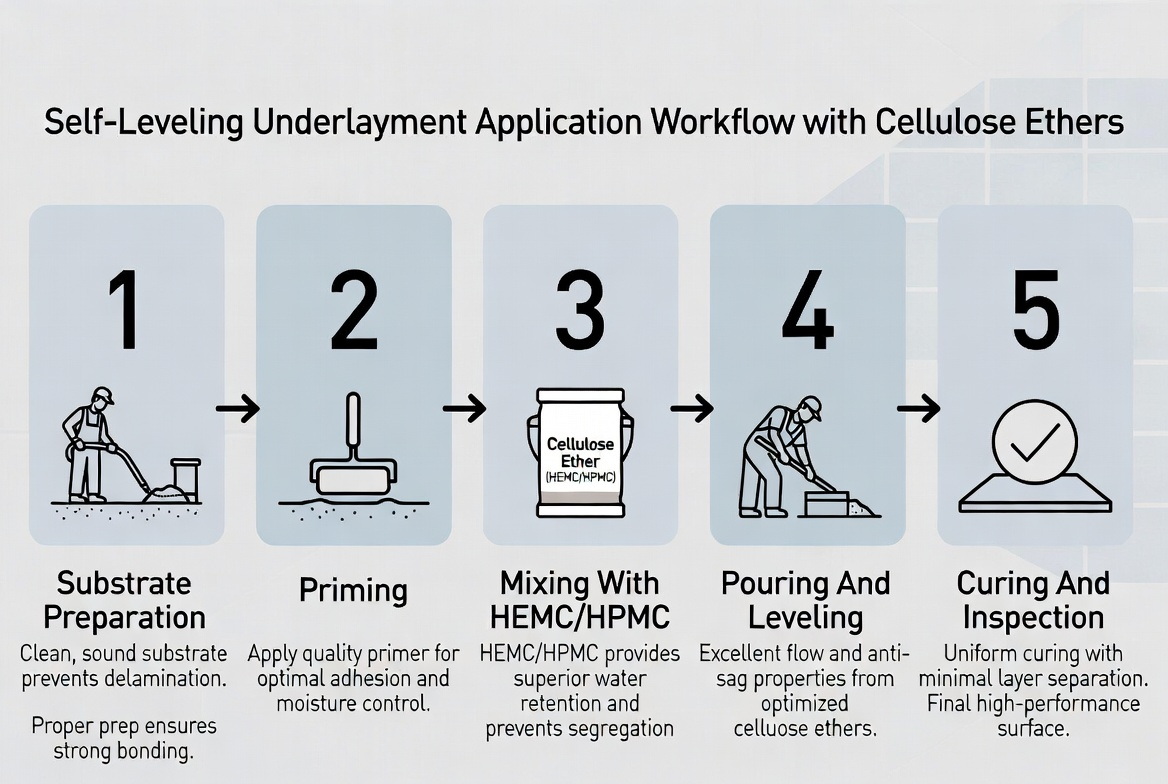
From a field-application standpoint, contractors can combine proper cellulose ether formulation with best practice application:
1. Assess and prepare the substrate
- Test absorbency and moisture content
- Mechanically clean and profile the surface
- Use compatible primers as specified
2. Select the right cellulose ether system
- For dry, absorbent substrates: favor higher HEMC content for water retention
- For variable climates and high-performance floors: use HPMC-rich or hybrid systems
3. Control water content and mixing
- Follow manufacturer's water recommendations strictly
- Avoid over-watering, which leads to bleed and segregation
4. Ensure uniform placement
- Pour continuously to avoid cold joints
- Maintain consistent layer thickness across the slab
5. Protect during early curing
- Avoid strong drafts and direct sunlight
- Respect walk-on and overlay times recommended by the manufacturer
By combining optimized HEMC/HPMC formulations with disciplined jobsite practices, contractors can significantly reduce layer separation and warranty claims on self-leveling projects. [kimachemical]
Global construction is moving towards low-CO₂, longer-lasting flooring systems, and cellulose ethers are part of that evolution. Because HEMC and HPMC enhance durability, reduce rework, and extend service life, they help lower the overall environmental footprint of flooring installations. [kemoxcellulose]
Manufacturers like Shandong Shengda New Material Co., Ltd. are increasingly focusing on:
- Optimized dosage to achieve performance with minimal material use
- Product consistency to reduce rejects and on-site adjustments
- Technical support and training that helps contractors implement best practices and avoid failures that would otherwise require demolition and re-pouring. [linkedin]
From an expert's perspective, a practical decision framework is:
- Choose HEMC-focused systems if:
- Projects are in hot, dry regions
- Substrates are highly absorbent
- Cost constraints are strict, but baseline performance is non-negotiable
- Choose HPMC-focused systems if:
- Project specifications demand high-level performance and durability
- Storage conditions and climate vary significantly
- SLUs must interface with complex adhesive/floor-covering systems
- Choose HEMC/HPMC blends if:
- You require balanced water retention, flow, and stability
- You want to fine-tune rheology and anti-separation performance without over-relying on a single ether type
Working with a dedicated cellulose ether supplier like Shandong Shengda New Material Co., Ltd. allows formulators and contractors to co-develop SLU systems tailored to specific markets, climates, and building codes. [linkedin]
If you are an SLU manufacturer, flooring contractor, or project specifier facing layer separation, debonding, or inconsistent flow, you should not treat HEMC vs. HPMC as a theoretical choice. Instead, treat it as a strategic lever.
Contact Shandong Shengda New Material Co., Ltd. to:
- Evaluate your current self-leveling formulations
- Compare HEMC-, HPMC-, and hybrid-based designs in lab and field tests
- Optimize cost–performance balance for your target markets
- Train your technical team on best practices for preventing layer separation
By partnering with an experienced cellulose ether producer, you can convert SLU layer stability from a risk into a competitive advantage. [linkedin]
A: Neither is universally "better"—HEMC excels in high water retention and anti-sag behavior, which helps in dry climates and absorbent substrates, while HPMC offers more stable rheology and better temperature and enzymatic stability, which is ideal for high-performance and variable-condition projects. The best solution is often a carefully balanced combination tuned to your specific application. [kemoxcellulose]
A: Not necessarily; while HPMC may improve rheology stability, delamination is usually multifactorial, involving substrate preparation, water content, curing, and overall formulation design. A holistic review of primers, mix design, and jobsite practices is often required. [riverwoodsflooring]
A: Too low a dosage may result in poor water retention and unstable flow, increasing separation risk, while excessive dosage can over-thicken the mix and trap air, affecting density and adhesion. Optimized dosage, verified through lab and field trials, is essential. [kimachemical]
A: Yes; both HEMC and HPMC are widely used in polymer-modified cementitious systems, including SLUs containing redispersible polymer powder. The right combination can enhance flexibility, adhesion, and cohesive strength, further reducing separation. [kemoxcellulose]
A: Common methods include bond strength tests, pull-off tests, and core sampling after curing under realistic site conditions. Comparing different HEMC/HPMC formulations on test slabs provides direct evidence of which system offers better layer stability. [kimachemical]
1. Kimachemical – "Comparison between HEMC and HPMC in the field of coatings" (2023).
https://www.kimachemical.com/news/comparison-between-hemc-and-hpmc-in-the-field-of-coatings/ [kimachemical]
2. Kemox – "Application of cellulose ether in self-leveling."
https://www.kemoxcellulose.com/self-leveling-application/ [kemoxcellulose]
3. HPMCmanufacturer – "HEMC vs HPMC Viscosity: Which One Is Best for Self-Leveling Compounds?"
https://www.hpmcmanufacturer.com/hemc-vs-hpmc-viscosity-which-one-is-best-for-self-leveling-compounds/ [hpmcmanufacturer]
4. Shandong Shengda New Material Co., Ltd. – Company profile.
https://www.linkedin.com/company/shandongshengda [linkedin]
5. Efful – "聊聊纤维素醚的类型该如何选择?-一夫科技股份有限公司."
https://efful.com/newsinfo/8555291.html [efful]
6. Riverwoods Flooring – "Simple Solutions for Laminate Floor Separation."
https://riverwoodsflooring.com/blogs/news/why-laminate-floor-separation-is-a-common-problem-and-how-to-avoid-it [riverwoodsflooring]


