


close
Choose Your Site
Global
Social Media
Views: 222 Author: Shengda Publish Time: 2026-05-29 Origin: Site


Lightweight mortar lives or dies by one thing: consistency. In practice, that means stable density, smooth application, predictable air content, and enough water retention to keep the mix workable from batch to batch. For manufacturers and formulators, the choice between HEMC and HPMC directly affects how well the mortar holds its structure during mixing, pumping, and placement. [sciencedirect]
From a cellulose-ether perspective, both products are powerful rheology modifiers, but they are not identical. HPMC is widely valued for water retention and workability, while HEMC is often preferred where thermal stability and performance in hot conditions matter more. In lightweight mortar, that difference becomes especially important because low-density systems are more sensitive to segregation, slump, and air-bubble instability. [tenessy]

Density consistency is the ability of the mortar to keep a uniform bulk density throughout production and application. If density drifts, the final material may become too heavy, too porous, or uneven in strength. In lightweight mortar, even small shifts can cause visible problems such as surface irregularity, weak bonding, pumping difficulty, or cracking after curing. [bisley]
This is why cellulose ether selection is not just a formulation detail. It is a control lever for water retention, viscosity, cohesion, and anti-sag behavior, all of which influence how stable the mix remains before setting. When the mortar stays stable, the density stays more predictable, and that improves both product quality and jobsite performance. [tenessy]
Both HEMC and HPMC are non-ionic cellulose ethers used in construction materials, but their molecular structure gives them different behavior in mortar systems. HPMC is known for strong water retention and broad application flexibility, while HEMC generally offers better stability at higher temperatures and can maintain performance when site conditions become more demanding. [celotech]
The most practical difference for formulators is the gel temperature. Several industry sources note that HPMC typically gels at a lower temperature range, while HEMC has a higher gel temperature and therefore keeps its functional viscosity longer in hot conditions. That makes HEMC a strong candidate for summer construction, tropical climates, or fast-drying environments where consistency loss is a real risk. [cemotech]
| Factor | HEMC | HPMC |
|---|---|---|
| Water retention | Strong, especially in hot conditions | Strong in standard conditions |
| Thermal stability | Higher | Lower than HEMC |
| Gel temperature | Generally higher | Generally lower |
| Workability | Smooth and stable | Very good and widely used |
| Density consistency in lightweight mortar | Better when heat control is critical | Good when temperature is moderate |
| Best-fit use case | Hot-weather or stability-sensitive lightweight mortars | General-purpose lightweight mortars |
The table above reflects how formulators usually evaluate the two polymers in dry-mix systems. The final choice still depends on viscosity grade, dosage, raw materials, and the rest of the mortar recipe. [celotech]
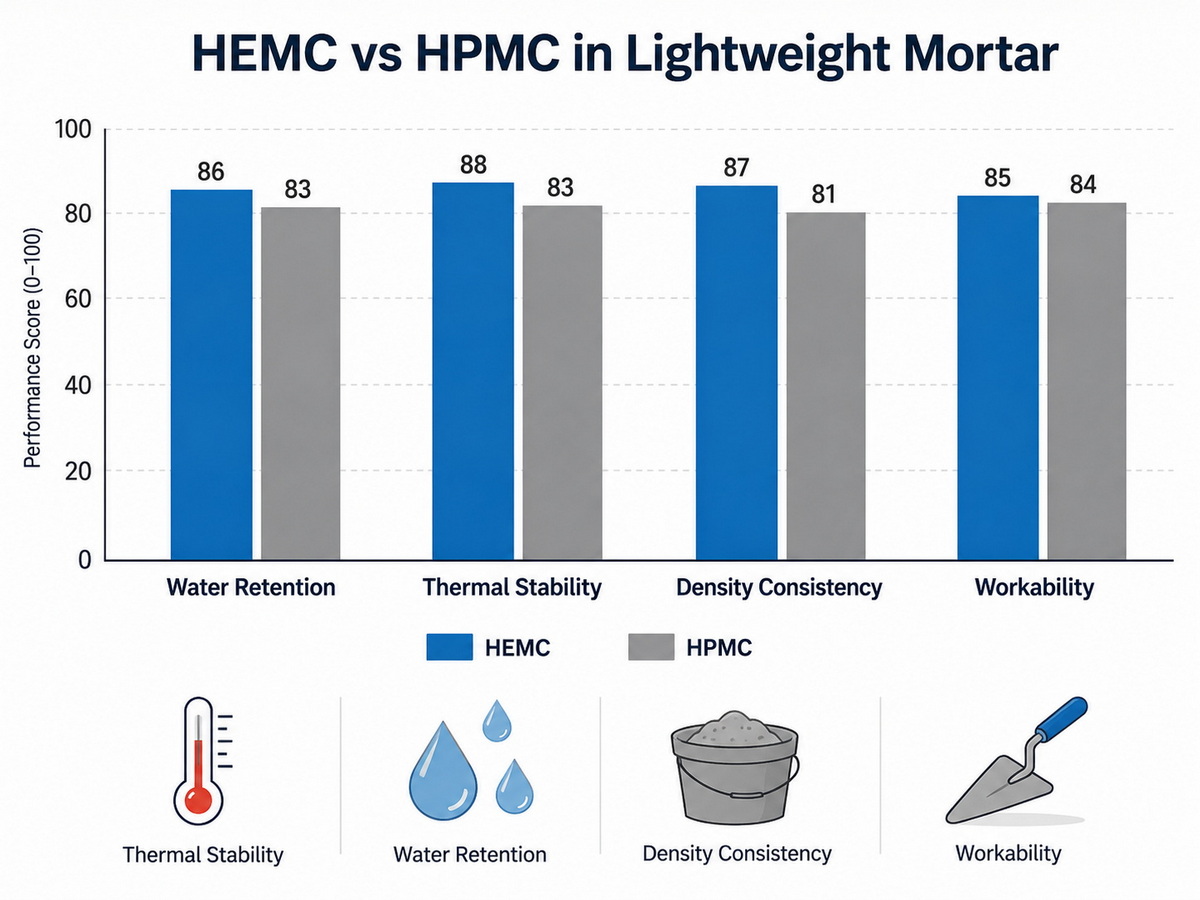
Density consistency in lightweight mortar is shaped by how well the additive controls water, air, and internal structure. HPMC improves cohesion and water retention, which helps reduce rapid water loss and gives the mortar a more workable, uniform feel. This is valuable when the mix needs stable pumping and even spreading. [hpmc]
HEMC can offer an edge when temperature or application speed would otherwise destabilize the mix. Because it retains functional performance better at elevated temperatures, it can help limit premature thickening and protect the internal structure of the mortar. In lightweight systems, that matters because unstable rheology can trap too much air in one batch and too little in the next, causing density fluctuation. [meskajoinway]
A useful way to think about it is simple: HPMC helps you hold water well; HEMC helps you hold performance better under heat. If your lightweight mortar is produced or used in warm climates, HEMC often gives more reliable density control. If the environment is moderate and the formulation needs broad usability, HPMC remains a proven option. [tenessy]
Lightweight mortar differs from conventional mortar because it often contains lower-density aggregates, more entrained air, or modified fillers. That means the system has less tolerance for water imbalance and poor dispersion. Even a small formulation drift can change flow, bulk density, open time, and final compressive performance. [data.epo]
Cellulose ethers help stabilize this delicate structure by improving water retention and reducing segregation. They also support a more homogeneous mix, which is essential when the goal is to keep density consistent from the plant to the jobsite. This is why lightweight mortar formulations often need more careful selection of viscosity grade and dosage than standard cement mortars. [tenessy]
In manufacturing, we often see a recurring pattern: a mortar that performs well in the lab may lose consistency at scale if temperature, mixing energy, or raw-material moisture changes. That is where the HEMC vs. HPMC decision becomes operational, not theoretical. A good cellulose ether is not just about initial viscosity; it is about how well the product protects the formulation against daily production variation. [cemotech]
For this reason, many manufacturers test both options under real plant conditions rather than relying only on datasheet numbers. In my experience as a formulation strategy perspective, the best results come from evaluating bulk density, open time, sag resistance, pumpability, and surface finish together. Density consistency should never be treated in isolation, because one additive choice can improve one metric while weakening another. [bisley]
Use the following decision logic when choosing between HEMC and HPMC for lightweight mortar:
1. Choose HEMC if your project faces hot weather, long transport time, or temperature-sensitive consistency loss. [meskajoinway]
2. Choose HPMC if you need a proven general-purpose additive with strong water retention and reliable workability. [hpmc]
3. Test both if the mortar is ultra-light, air-structured, or highly sensitive to segregation. [sciencedirect]
4. Confirm performance under actual production temperature, not only room-temperature lab testing. [tenessy]
5. Verify density, pumping behavior, and curing results on the full formulation, not just on the cellulose ether sample. [bisley]
A simple pilot test can save a lot of rework. For example, running the same lightweight mortar recipe with HEMC and HPMC at the same dosage, then comparing wet density, 30-minute stability, and surface workability, often reveals which additive is truly better for that line. [sciencedirect]
One of the biggest mistakes in cellulose-ether selection is assuming the product name alone determines performance. In reality, viscosity grade, substitution pattern, dosage, and formulation balance matter just as much as the HEMC or HPMC label. A well-matched lower-viscosity grade may outperform a higher-viscosity grade if the rest of the mortar is already highly cohesive. [celotech]
This is especially true in lightweight mortar, where air management and density stability are tightly linked. If the formulation already contains a strong thickener or stabilizer, the cellulose ether may need to focus more on water retention and thermal stability than on raw thickening power. That is why experienced manufacturers often optimize the whole system rather than chasing one "best" raw material. [sidleychem]
HEMC is often a better fit when the mortar will be applied in hot climates, summer construction, or fast-paced production environments. In those conditions, maintaining viscosity and water retention is harder, so the higher thermal stability of HEMC can protect density consistency more effectively. [cemotech]
HPMC is often preferred in standard lightweight mortar formulations where the priority is good workability, water retention, and broad compatibility. It remains one of the most common cellulose ethers in construction dry mixes, especially when environmental conditions are stable and the system does not face extreme heat. [hpmc]
For Shandong Shengda New Material Co., Ltd., this is a strong product-story angle: you are not simply selling cellulose ether, but offering tailored construction-grade solutions for different climates, mix designs, and jobsite realities. That positioning strengthens both credibility and commercial relevance. [alldatabases]
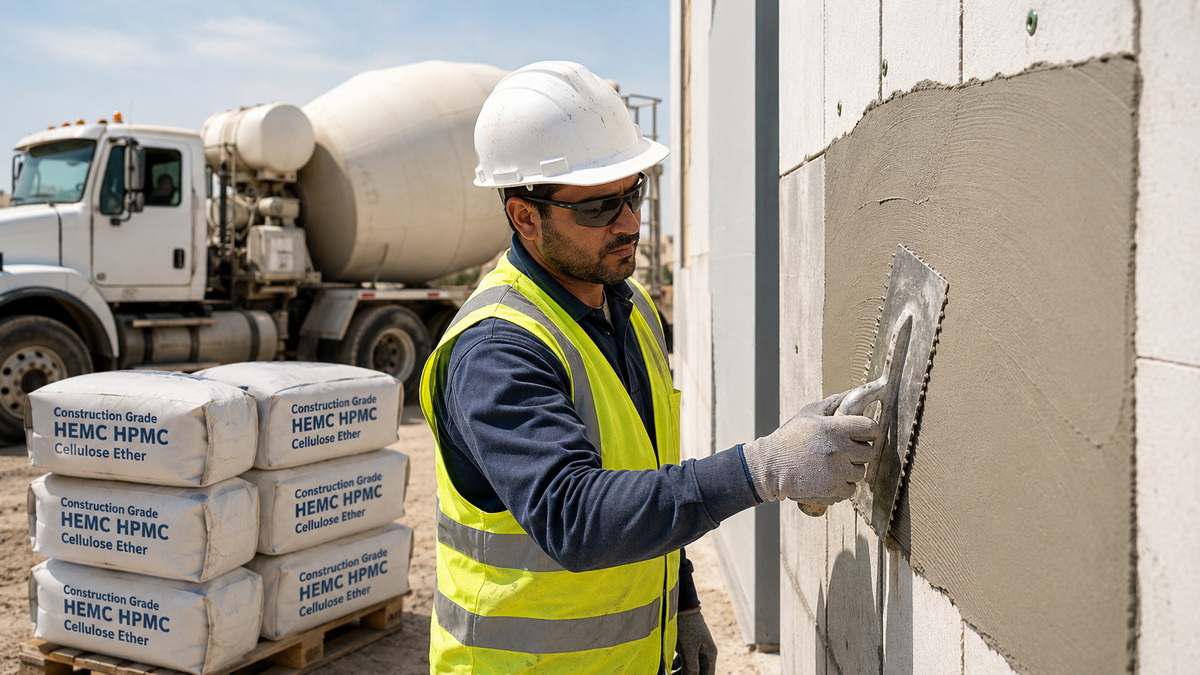
If your lightweight mortar must stay stable in hot or variable conditions, HEMC is usually the more protective choice for density consistency. If your formulation needs a proven all-round performer for standard conditions, HPMC remains a strong and practical option. The best answer is not "which is better overall," but "which is better for your exact formulation, climate, and production process." [celotech]
For manufacturers and buyers, the smartest next step is to test both under real production conditions and select the grade that delivers the most stable wet density, workable open time, and reliable curing results. That is where Shandong Shengda New Material Co., Ltd. can support global customers with construction-grade cellulose ether solutions designed for performance consistency. [sdshengda.en.made-in-china]
CTA: Request a formulation consultation, sample evaluation, or technical recommendation to match the right HEMC or HPMC grade to your lightweight mortar system. [alldatabases]
Not always. HEMC is often better in hot conditions because it maintains performance more reliably, while HPMC is a strong general-purpose choice for standard environments. [celotech]
Because inconsistent density can lead to uneven strength, poor workability, segregation, and visible surface defects. Stable density improves both quality and application performance. [bisley]
Yes. HPMC is commonly used in mortar systems and can perform very well when water retention and workability are the main goals. [celotech]
Its main advantage is higher thermal stability, which helps it perform better in hot-weather construction and other temperature-sensitive environments. [meskajoinway]
Test wet density, pumpability, open time, sag resistance, segregation resistance, and final curing strength under your actual production conditions. [sciencedirect]
1. Tennessy. "HPMC vs HEMC: Which is Better for Your Project?" https://tenessy.com/hpmc-vs-hemc-which-is-better-for-your-project/ [tenessy]
2. Celotech. "The difference of physical and chemical properties and application of HPMC and HEMC…" https://www.celotech.com/technology/the-difference-of-physical-and-chemical-properties-and-application-of-hpmc-and-hemc-in-the-c... [celotech]
3. Shandong Shengda New Material Co., Ltd. profile on Made-in-China. https://sdshengda.en.made-in-china.com [sdshengda.en.made-in-china]
4. Bisley Australia. "Cellulose Ethers & Their Main Uses in Construction." https://bisley.biz/news/what-are-cellulose-ethers-and-their-main-uses-in-construction/ [bisley]
5. HPMC.com. "HPMC for Mortar." https://www.hpmc.com/uses-of-hpmc/hpmc-for-mortar.html [hpmc]
6. Cemotech. "The Difference Between HPMC & HEMC." http://www.cemotech.com/blog/the-difference-between-hpmc-hemc [cemotech]
7. ScienceDirect. "Cellulose ethers influence on water retention and consistency in cement-based mortars." https://www.sciencedirect.com/science/article/abs/pii/S0008884610002085 [sciencedirect]
8. Celotech. "Construction Grade HPMC: Benefits in Tile Adhesives & Dry-Mix…" https://www.celotech.com/news/advantages-of-hpmc-in-building-materials-and-tile-adhesives/ [celotech]
9. MESKA Joinway. "How HEMC Improves Water Retention in Cement Mortar." https://www.meskajoinway.com/technical-blogs/how-hemc-improves-water-retention-in-cement-mortar/ [meskajoinway]
10. HPMC Producer. "HEMC/MHEC Applications in Lightweight Mortars." https://www.hpmcproducer.com/uncategorized/hemc-mhec-applications-in-lightweight-mortars/ [hpmcproducer]


