


close
Choose Your Site
Global
Social Media
Views: 270 Author: Shengda Publish Time: 2026-07-11 Origin: Site


Content Menu
● HPMC vs HEMC for Underwater Concrete: Preventing Washout in High-Flow Areas
● What Is HPMC and Why It Matters Underwater
● What Is HEMC and Its Role in Wet Environments
● Core Technical Comparison: HPMC vs HEMC in High-Flow Underwater Conditions
● Personal Expert Perspective: How I Would Choose on a Real Project
● Mix Design Considerations for Washout Prevention
● Field Case Insight (Conceptual Example)
● Practical Selection Guide for Engineers and Contractors
● Sustainability and Durability Considerations
● Partner with a Specialized Cellulose Ether Manufacturer
● FAQs
HPMC and HEMC are both highly effective cellulose ethers for underwater concrete, but they behave differently in high‑flow environments and should be selected based on mix design, placement method, and performance targets. [kemoxcellulose]
Underwater concrete in rivers, ports, hydropower projects, and offshore foundations faces one critical challenge: cement paste washout in moving water. To control this, contractors increasingly rely on Hydroxypropyl Methyl Cellulose (HPMC) and Hydroxyethyl Methyl Cellulose (HEMC) as key rheology modifiers. From my experience working with global project teams and manufacturers like Shandong Shengda New Material Co., Ltd., choosing between HPMC and HEMC often determines whether an underwater pour is clean and stable—or a costly repair job. [kmxhpmc]
As a content strategist and industry observer, I see a recurring pattern: projects that treat HPMC and HEMC as interchangeable additives often struggle with inconsistent slump, bleed water, and poor cohesion under flow. In contrast, teams that make a deliberate choice based on water velocity, placement method, and environmental constraints achieve significantly better durability and sustainability outcomes. [dycellulose]
Hydroxypropyl Methyl Cellulose (HPMC) is a non‑ionic cellulose ether widely used in construction as a thickener, water‑retention agent, and workability enhancer. In underwater concrete, HPMC is valued for its ability to improve cohesion and reduce segregation, especially in high‑cement, high‑fines mixes. [zhiweichem]
Key technical roles of HPMC in underwater concrete: [kemoxcellulose]
- Water retention: Helps keep mixing water in the paste, reducing bleed and washout.
- Viscosity control: Increases plastic viscosity, so paste resists flow and erosion.
- Lubrication: Supports pumpability and placement stability in tremie and pump systems.
From an expert standpoint, HPMC is often preferred when you need maximum washout resistance without heavily modifying the base mix design. For contractors working in tidal zones or fast river currents, this balance between viscosity and workable slump is one of the strongest arguments for HPMC. [dycellulose]
Hydroxyethyl Methyl Cellulose (HEMC) is another non‑ionic cellulose ether, designed to provide excellent water retention with slightly different rheological behavior than HPMC. In many building applications, HEMC is used to improve open time and sag resistance in mortars and tile adhesives. [kmxhpmc]
In underwater concrete contexts, HEMC offers: [kmxhpmc]
- Strong water retention that limits bleed water in moderate‑flow environments.
- Smoother workability, often perceived as a bit more forgiving during placement.
- Temperature robustness, helping maintain performance under varying site conditions.
While less commonly highlighted specifically for underwater concrete in public literature, HEMC can be highly effective when mixes need good cohesion, but the environment is more controlled—such as cofferdams or low‑flow basins where extreme viscosity is not necessary. [dycellulose]
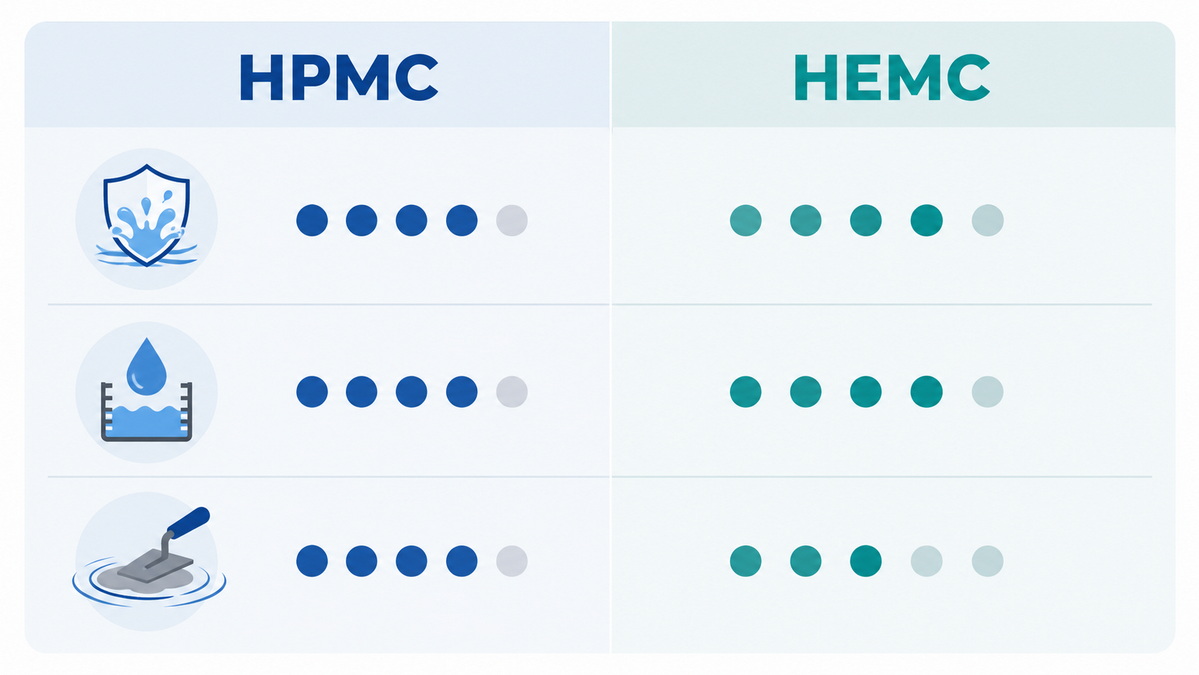
Below is a practical comparison table summarizing how HPMC and HEMC typically perform in underwater concrete exposed to flowing water, based on published cellulose ether characteristics and industry practice. [zhiweichem]
| Performance Aspect | HPMC in Underwater Concrete | HEMC in Underwater Concrete |
|---|---|---|
| Washout resistance in high‑flow water | Generally stronger due to higher plastic viscosity and cohesive paste. (kemoxcellulose) | Good in moderate flow, may need higher dosage or mix adjustments for extreme currents. (kmxhpmc) |
| Water retention | Very high, reduces bleed and helps preserve cement paste around aggregates. (kemoxcellulose) | High, suitable for most underwater pours with controlled placement. (kmxhpmc) |
| Workability and finishing | Slightly "stickier" feel; excellent cohesion but needs careful slump control. (kemoxcellulose) | Smoother handling, longer working time; attractive for crews prioritizing ease of placement. (kmxhpmc) |
| Pumpability and tremie flow | Good pumpability when viscosity grade and dosage are optimized. (kemoxcellulose) | Very good in many structural mixes; more forgiving in typical site operations. (kmxhpmc) |
| Sensitivity to dosage | Requires accurate dosing; overdosing can lead to too high viscosity. (kemoxcellulose) | Also sensitive, but often perceived as slightly more tolerant in general building mixes. (kmxhpmc) |
| Typical use focus | High‑performance mortars, self‑leveling, building and concrete applications needing strong washout control. (kemoxcellulose) | Mortars, tile adhesives, building products; underwater concrete mainly where flow risk is moderate. (kmxhpmc) |
For fast rivers, open channels, or tidal zones, expert practice usually favors an HPMC‑dominant strategy to maximize washout resistance. In low‑flow cofferdams, sheltered basins, or submerged slabs in controlled environments, HEMC can deliver excellent performance with better placement comfort for the crew. [kemoxcellulose]
Assuming I am advising a contractor on a deep foundation project with strong currents, my practical recommendation would follow three steps:
1. Quantify the hydraulic risk
I would ask for water velocity, turbulence level, and placement duration. In high‑flow areas above typical tremie design assumptions, I treat washout as a severe risk requiring maximum rheology control. [zhiweichem]
2. Start with an HPMC‑focused design
For those conditions, I would specify a high‑quality construction‑grade HPMC with an appropriate viscosity grade, then optimize dosage through lab trials to balance cohesion, slump, and pumpability. HPMC gives me a more aggressive tool to fight washout. [kemoxcellulose]
3. Use HEMC as a complementary or alternative option in controlled zones
In parts of the project where water movement is reduced—such as inside well‑sealed cofferdams—I would consider HEMC either as a partial replacement or for mixes where crews demand longer open time and smoother placement behavior. [kmxhpmc]
This combined approach aligns well with the product portfolio of comprehensive cellulose ether manufacturers in China, where both building‑grade HPMC and HEMC are produced and tailored for different structural applications. [cn.hpmc]
Choosing HPMC or HEMC is only part of the solution. Concrete technologists must align the additive with the overall mix design.
Critical mix design points: [zhiweichem]
- Cement and fines content: Higher fines plus appropriate cellulose ether help fill voids and lock paste around aggregates.
- Water‑to‑cement ratio: Lower ratios improve durability but must remain workable; cellulose ethers support workable low W/C.
- Use of anti‑washout admixtures: In many underwater concretes, dedicated anti‑washout agents are paired with HPMC or HEMC for best results.
From an expert viewpoint, HPMC is often preferred when the mix already uses a high‑fines, anti‑washout formulation, and the goal is to further stabilize paste in high‑energy hydraulic environments. HEMC fits better when engineers seek balanced rheology with good open time and the hydraulic risk is moderate. [dycellulose]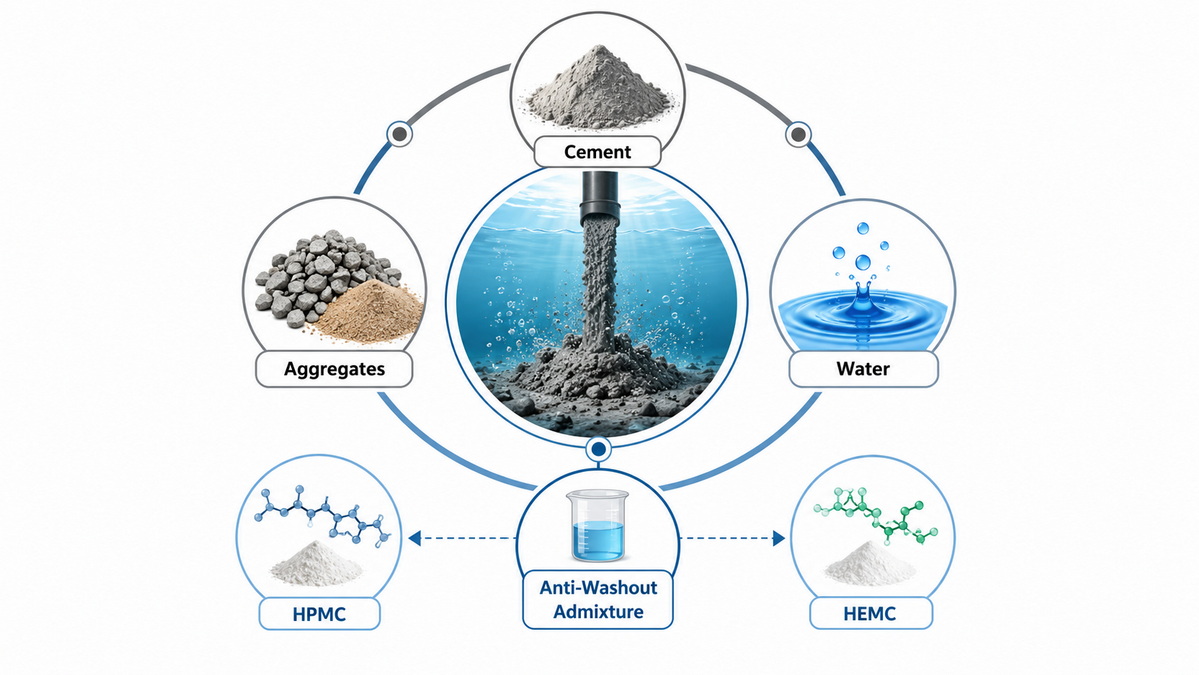
Consider a conceptual case based on typical hydropower intake construction practice: [zhiweichem]
- Scenario A: Fast river intake, >1 m/s flow near the placement zone
The concrete team selects a high‑performance underwater mix with anti‑washout admixture and HPMC as the primary cellulose ether. They conduct pre‑pour trials in a flume to confirm that washout is minimal even under simulated current conditions. [kemoxcellulose]
- Scenario B: Protected stilling basin with local low‑flow conditions
Here, designers choose HEMC to enhance water retention and workability, prioritizing ease of placement and extended handling time. The mix still meets washout criteria due to the reduced hydraulic stresses. [kmxhpmc]
These two scenarios illustrate that the question is not "HPMC or HEMC?" in isolation, but "How do we match rheology to the hydraulic environment?"—a nuance that experienced engineers and manufacturers emphasize during specification. [dycellulose]
To support real‑world decision‑making, here is a concise selection guide:
- Choose HPMC‑dominant formulations when:
- Water velocity or turbulence at the pour location is high. [zhiweichem]
- Washout risk is a primary concern in structural integrity.
- You are using tremie placement or pumping over long distances. [kemoxcellulose]
- Choose HEMC‑enhanced formulations when:
- The underwater environment is more controlled (cofferdams, low‑flow basins).
- Workability, open time, and crew comfort are key priorities.
- You want strong water retention with smoother handling characteristics. [kmxhpmc]
In both cases, partnering with a specialized cellulose ether manufacturer that can adjust viscosity grades, substitution levels, and product consistency is crucial for repeatable performance. [landercoll]
Modern underwater projects increasingly focus on sustainability, not just initial placement quality. By optimizing washout, HPMC and HEMC help reduce cement loss into water bodies, decrease rework, and extend structural service life. [static.cninfo.com]
Key sustainability benefits: [static.cninfo.com]
- Reduced material waste through better paste retention around aggregates.
- Lower environmental impact due to minimized leaching of fines and cement into rivers or marine environments.
- Extended durability that reduces maintenance interventions over the structure's lifecycle.
From an industry perspective, manufacturers that invest in research, development, and tailored cellulose ether solutions contribute significantly to sustainable underwater infrastructure, aligning performance with environmental responsibility. [cn.hpmc]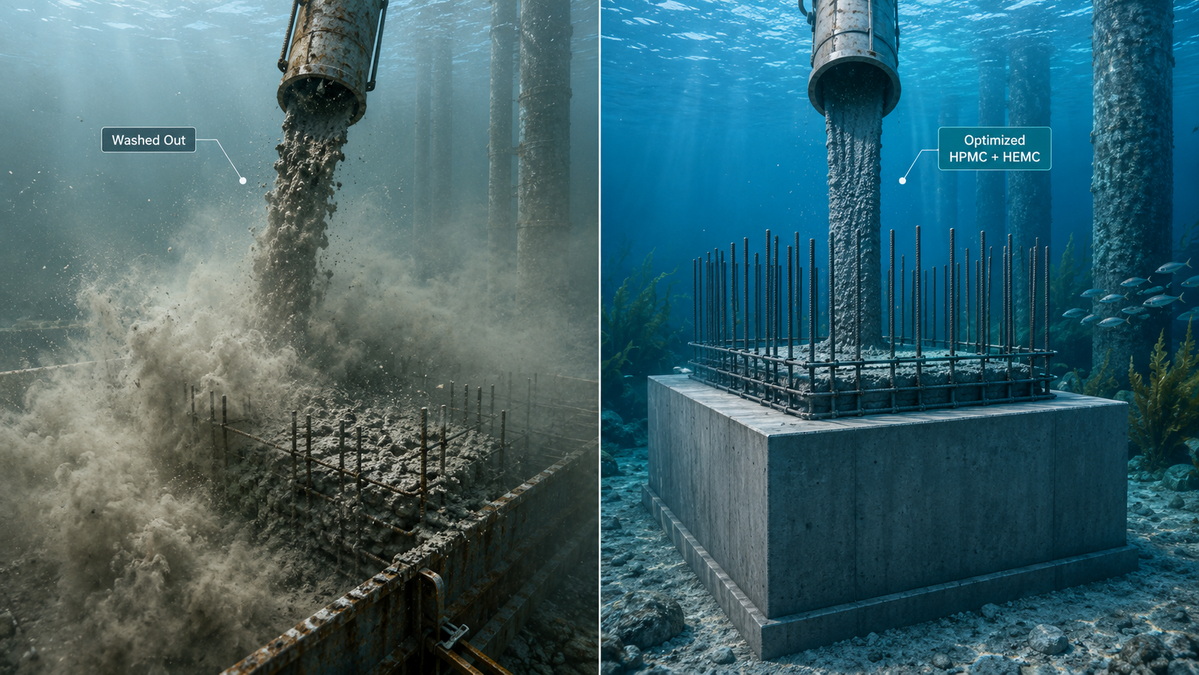
For underwater concrete projects in high‑flow environments, the difference between success and failure often lies in how you manage washout and rheology. If you are designing or executing underwater works, now is the time to review your current mix designs and evaluate whether HPMC, HEMC, or a tailored combination is truly optimized for your hydraulic conditions. [dycellulose]
Consider collaborating directly with an experienced cellulose ether manufacturer that offers construction‑grade HPMC and HEMC, along with technical support for underwater applications. This partnership can help you run lab trials, simulate washout behavior, and finalize specifications that are robust, sustainable, and cost‑effective across the full project lifecycle. [landercoll]
Q1: Can HPMC and HEMC be used together in one underwater mix?
Yes, in practice they can be combined, with HPMC often providing higher viscosity and HEMC contributing to smooth workability and water retention. [kemoxcellulose]
Q2: Does HPMC always give better washout resistance than HEMC?
Not always, but HPMC typically offers stronger rheology control in high‑energy hydraulic environments when dosage and mix are properly optimized. [dycellulose]
Q3: Is cellulose ether enough to prevent washout without other admixtures?
Usually, best practice is to combine cellulose ethers with dedicated anti‑washout admixtures and carefully designed mix proportions. [zhiweichem]
Q4: How do I decide the right dosage for HPMC or HEMC?
Dosage should be determined through lab trials that simulate actual placement conditions, balancing viscosity, slump, pumpability, and strength development. [kemoxcellulose]
Q5: Are HPMC and HEMC environmentally safe for use in underwater concrete?
Non‑ionic cellulose ethers are widely used in construction and, when properly applied, help reduce cement loss into water and support more sustainable underwater structures. [static.cninfo.com]
1. Kemox – Cellulose ether manufacturer, HPMC and HEMC application notes in building materials. https://www.kemoxcellulose.com/zh/
2. DyCellulose – HPMC manufacturer guidance on direct‑from‑factory quality and product range including HEMC. https://www.dycellulose.com/zh/hpmc-manufacturer-factory-direct/
3. ZhiweiChem – HPMC technical guide (properties, production, applications). https://zhiweichem.com/zh/%E4%BA%A7%E5%93%81/%E4%BB%80%E4%B9%88%E6%98%AF%E7%BE%9F%E4%B8%99%E5%9F%BA%E7%94%B2%E5%9F%BA%E7%BA%A4%E7%BB%B4%E7%B4%A0-hpmc/
4. KMX HPMC profile – Product families including HPMC and HEMC for construction uses. http://www.kmxhpmc.com/profile.html
5. Matecel – Chinese cellulose ether factory offering comprehensive solutions (HPMC, HEC, CMC). https://cn.hpmc.com/about-us/
6. Shandong Hedda Group – Annual report highlighting cellulose ether business and sustainability focus. http://static.cninfo.com.cn/finalpage/2026-04-27/1225189879.PDF
7. Landercoll (Shandong Landu New Material) – Company background for cellulose ether manufacturing, global supply focus. https://landercoll.com/en/company/


