


close
Choose Your Site
Global
Social Media
Views: 255 Author: Shengda Publish Time: 2026-07-16 Origin: Site


Content Menu
● What Makes HPMC Grades Different?
● Core Dimensions Of HPMC Grades
>> Viscosity Ranges (LV, MV, HV)
● Major Application‑Specific HPMC Grades
>> Construction‑Grade HPMC (Mortars, Tile Adhesives, EIFS)
>> Pharmaceutical‑Grade HPMC (E, K Series)
>> Food‑Grade HPMC (Texture And Stability)
>> Detergent‑Grade And PVC‑Grade HPMC
● How To Choose The Right HPMC Grade (Expert Workflow)
● Industry Trends And Expert Insights On HPMC Grades
● Practical Handling Tips For HPMC In Production
● Why Partner With A Professional HPMC Manufacturer
● FAQs
Hydroxypropyl methylcellulose (HPMC) is not just a generic thickener; different grades deliver very different performance in tile adhesives, gypsum plasters, detergents, shampoos, and food systems, so choosing the right grade is critical for formulators and buyers. [wotaichem]
As a cellulose ether manufacturer working with global construction and daily‑chemical brands, I have seen how a small change in HPMC grade can turn a borderline formulation into a stable, easy‑to‑apply, premium product. HPMC grades are primarily differentiated by viscosity, molecular weight, and substitution pattern (E, K, F series), which together control water retention, workability, film‑forming, and release behavior. [kimacellulose]
In cold water, HPMC disperses to form clear or slightly cloudy solutions or gels, acting as a non‑ionic, plant‑derived thickener, stabilizer, binder, and film‑forming polymer across construction, pharmaceuticals, food, detergents, and personal care. Because it is generally regarded as safe and compatible with cement, gypsum, surfactants, and many active ingredients, HPMC has become a backbone additive for high‑performance building materials and daily‑chemical products. [unilongindustry]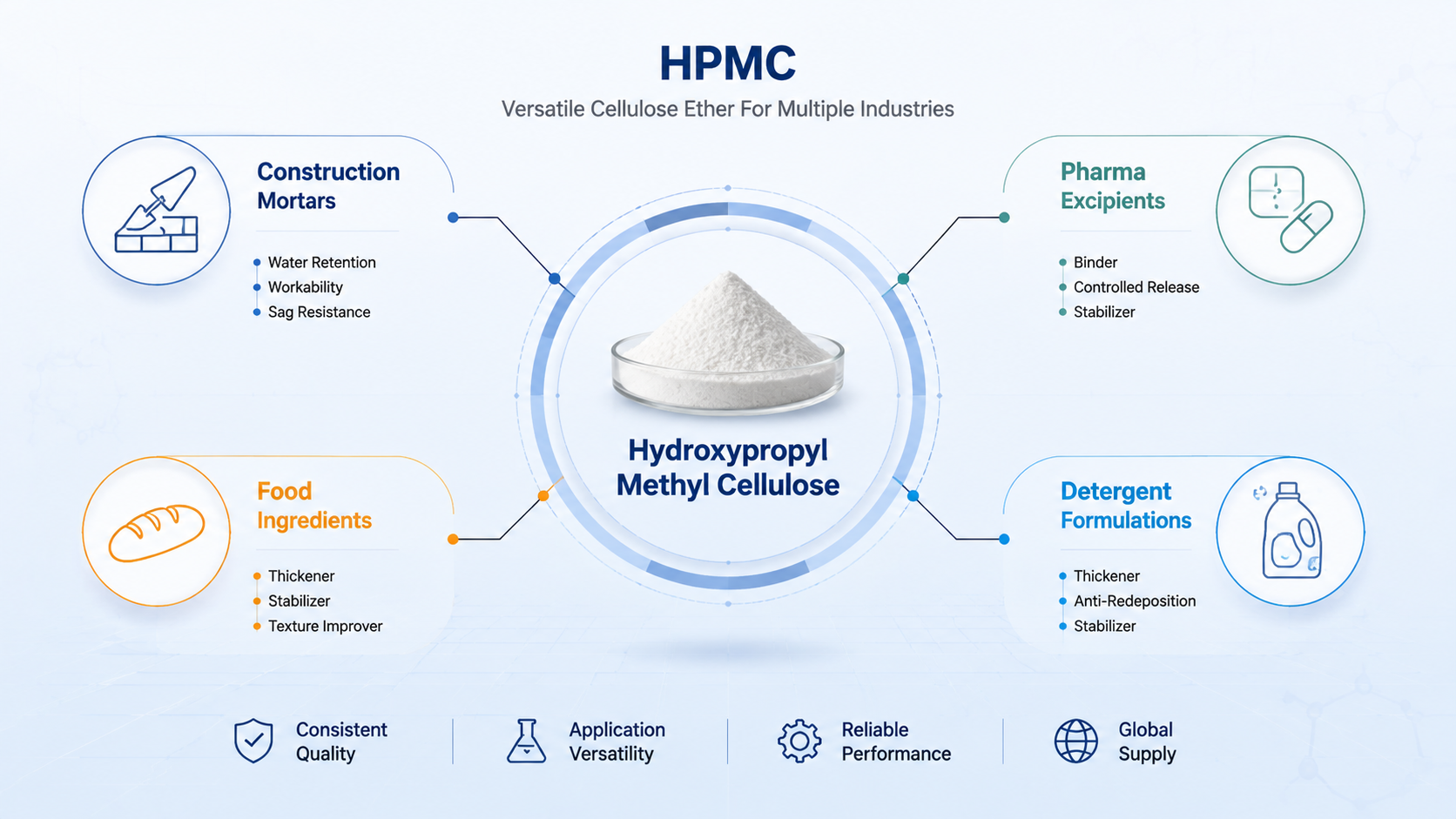
In practice, formulators classify HPMC into low, medium, and high viscosity ranges, typically measured in mPa·s for a standard solution. [wotaichem]
- Low viscosity (LV): about 5–100 mPa·s, with fast dissolution and low thickening, ideal for sprayable systems and tablet coatings. [youtube]
- Medium viscosity (MV): about 400–5,000 mPa·s, balancing thickening and flow, common in many mortars and adhesives. [wotaichem]
- High viscosity (HV): roughly 20,000–200,000 mPa·s, delivering strong water retention and gel strength for tile adhesives, plasters, and controlled‑release tablets. [kimacellulose]
These ranges are reflected in commercial construction grades such as MP400, MP60M, MP100M, MP150M, MP200M, which step up viscosity and water‑retention for increasingly demanding cement‑based systems. [kimacellulose]
Construction is one of the largest consumers of HPMC, especially in cement and gypsum dry‑mix products. Typical construction grades are designed in the viscosity window of roughly 400–200,000 mPa·s to tune open time, water retention, and troweling feel. [wotaichem]
Representative construction grades and viscosity (2% solution): [kimacellulose]
| Grade (Construction) | NDJ viscosity (mPa·s, 2%) | Brookfield viscosity (mPa·s, 2%) | Typical use focus |
|---|---|---|---|
| HPMC MP400 | 320–480 (kimacellulose) | 320–480 (kimacellulose) | Entry‑level mortars, basic water retention |
| HPMC MP60M | 48,000–72,000 (kimacellulose) | 24,000–36,000 (kimacellulose) | Tile adhesives, improved open time |
| HPMC MP100M | 80,000–120,000 (kimacellulose) | 40,000–55,000 (kimacellulose) | High‑performance tile adhesives, putty |
| HPMC MP150M | 120,000–180,000 (kimacellulose) | 55,000–65,000 (kimacellulose) | EIFS base coats, vertical mortars |
| HPMC MP200M | 180,000–240,000 (kimacellulose) | 70,000–80,000 (kimacellulose) | Heavy‑duty plasters in hot, dry climates |
Key performance contributions in construction: [wotaichem]
- Water retention in cement and gypsum systems to ensure proper hydration and avoid early drying.
- Enhanced workability and rheology, making mortars easier to mix, spread, and trowel.
- Stronger adhesion and sag resistance, especially in vertical tile installations.
- Improved crack resistance and durability through better cohesion and flexible filling of pores.
Modern formulators often match viscosity to product type—for example, 20,000–60,000 mPa·s for C1/C2 tile adhesives, 20,000–40,000 mPa·s for wall putty, and 60,000–150,000 mPa·s for EIFS adhesives where high thixotropy is required. [wotaichem]
Pharmaceutical‑grade HPMC is standardized under hypromellose codes and used as a binder, film‑former, and controlled‑release matrix in oral solid dosage forms and liquid suspensions. [kimacellulose]
Representative pharma grades and viscosity: [pubmed.ncbi.nlm.nih]
| Grade (Pharma) | Viscosity (cps / mPa·s) | Substitution type | Main functions |
|---|---|---|---|
| HPMC E5 | 4.0–6.0 (kimacellulose) | Hypromellose 2910 | Low‑viscosity film coating, solutions |
| HPMC E6 | 4.8–7.2 (kimacellulose) | Hypromellose 2910 | Similar to E5, slightly higher viscosity |
| HPMC E15 | 12.0–18.0 (kimacellulose) | Hypromellose 2910 | Matrix tablets with moderate viscosity |
| HPMC E4M | 3,200–4,800 (kimacellulose) | Hypromellose 2910 | Higher‑viscosity film former, gel matrices |
| HPMC F50 | 40–60 (kimacellulose) | Hypromellose 2906 | Film‑forming for coatings and adhesives |
| HPMC K100 | 80–120 (kimacellulose) | Hypromellose 2208 | Viscosity builder, binder |
| HPMC K4M | 3,200–4,800 (kimacellulose) | Hypromellose 2208 | Controlled‑release matrix, strong gel (wotaichem) |
| HPMC K100M | 80,000–120,000 (kimacellulose) | Hypromellose 2208 | Very slow‑release tablets, high gel strength (wotaichem) |
In controlled‑release tablet coating systems, higher‑viscosity grades like K4M, K15M, K100M build dense hydrophilic matrices that extend lag time and drug release, while lower grades such as E5, E6 support immediate‑release coatings. [meskajoinway]
Food‑grade HPMC, often labeled E464, is used as a thickener, stabilizer, emulsifier, and film‑former in processed foods and beverages. [unilongindustry]
Typical food grades and viscosity: [kimacellulose]
| Grade (Food) | Viscosity (cps) | Label remark |
|---|---|---|
| HPMC E5 FG | 4.0–6.0 | Hypromellose E464 (kimacellulose) |
| HPMC E6 FG | 4.8–7.2 | Hypromellose E464 (kimacellulose) |
| HPMC E15 FG | 12.0–18.0 | Hypromellose E464 (kimacellulose) |
| HPMC E4M FG | 3,200–4,800 | Hypromellose E464 (kimacellulose) |
| HPMC F50 FG | 40–60 | Hypromellose E464 (kimacellulose) |
| HPMC K100 FG | 80–120 | Hypromellose E464 (kimacellulose) |
| HPMC K4M FG | 3,200–4,800 | Hypromellose E464 (kimacellulose) |
| HPMC K100M FG | 80,000–120,000 | Hypromellose E464 (kimacellulose) |
Food formulators use these grades to: [unilongindustry]
- Build viscosity and mouthfeel in sauces, dressings, and dairy analogues.
- Act as fat replacers, delivering creamy texture in low‑fat products.
- Enhance water retention in bakery items and gluten‑free doughs to reduce dryness.
- Form protective surface films that support shelf life and appearance.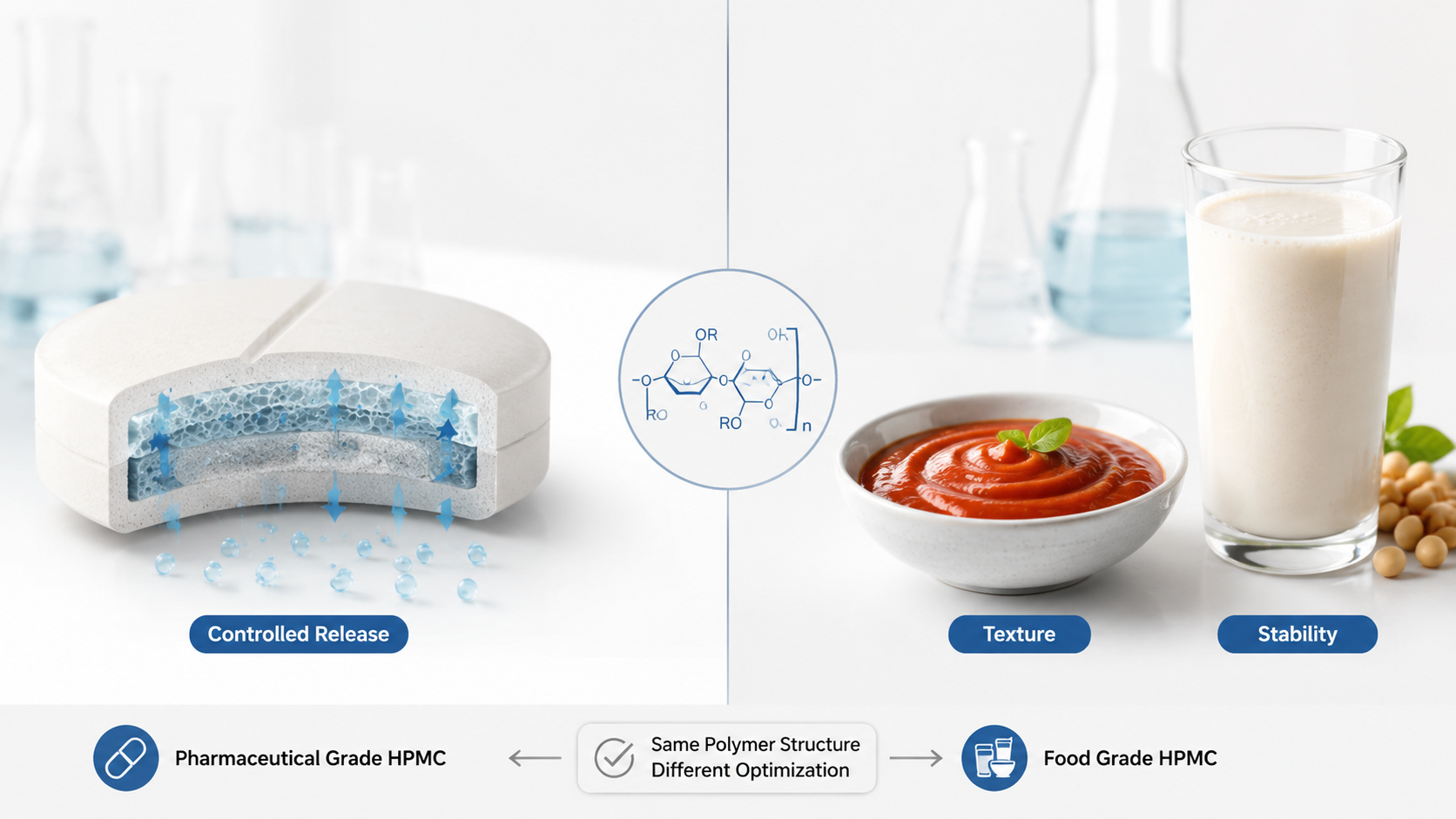
Detergent‑grade HPMC is tailored for laundry and cleaning products, where it stabilizes formulations and suspends particles. [kimacellulose]
Detergent grades: [kimacellulose]
| Grade (Detergent) | NDJ viscosity (mPa·s, 2%) | Brookfield viscosity (mPa·s, 2%) | Use focus |
|---|---|---|---|
| HPMC MP100MS | 80,000–120,000 | 40,000–55,000 (kimacellulose) | Thickening, suspension, stability |
| HPMC MP150MS | 120,000–180,000 | 55,000–65,000 (kimacellulose) | High‑viscosity liquid detergents |
| HPMC MP200MS | 180,000–240,000 | 70,000–80,000 (kimacellulose) | Heavy‑duty detergents, controlled flow |
These grades improve viscosity, phase stability, particle suspension, and flow properties of both liquid and powdered detergents, and are compatible with common surfactants and builders. [unilongindustry]
PVC‑grade HPMC (Hydrocel HPMC) functions as a processing aid and stabilizer in PVC compounds, improving melt flow, impact resistance, and thermal/UV stability. Representative grades include E50, F50, K100 with viscosity around 40–120 cps in typical PVC applications. [kimacellulose]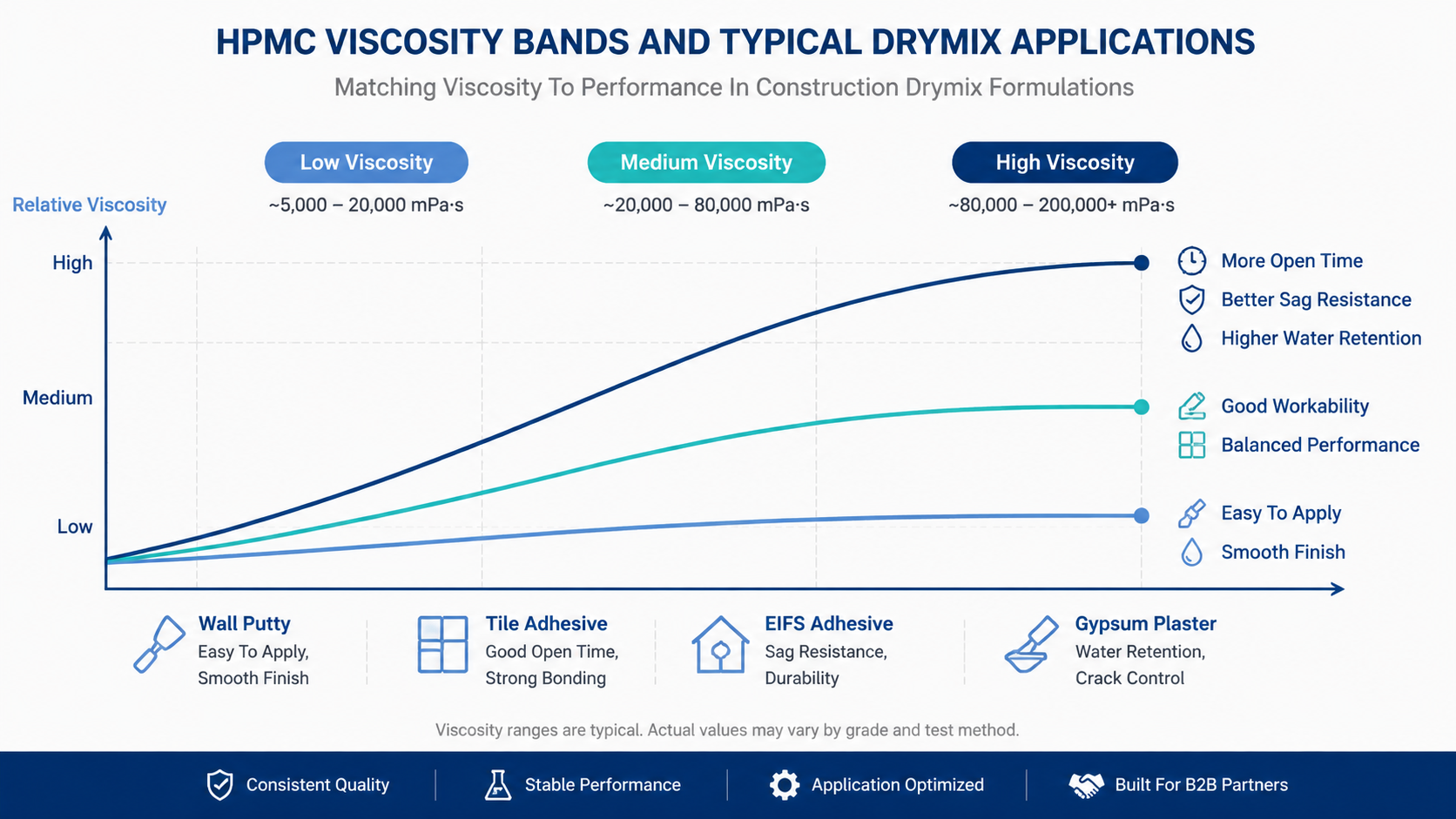
From a practical formulator's perspective, choosing an HPMC grade should follow a structured six‑step selection workflow, rather than focusing only on price or familiarity. [wotaichem]
1. Define application and performance targets.
Construction: open time, slip resistance, workability, strength. [wotaichem]
Pharmaceuticals: release profile, tablet hardness, coating quality. [pubmed.ncbi.nlm.nih]
Food/detergent/personal care: texture, clarity, stability, and processing. [unilongindustry]
2. Select a viscosity band (LV, MV, HV).
Start from typical viscosity intervals used in your product category, then adjust after trial batches. [wotaichem]
3. Choose substitution series (E, K, F).
Use K‑series for stronger gel matrices and sustained release, E‑series for balanced film‑forming and matrix building, and F‑series for high‑performance coating and film applications. [kimacellulose]
4. Align grade with climate and equipment.
Hot, dry environments often require higher viscosity to retain water in mortars; cooler or more humid conditions can benefit from slightly lower viscosity to avoid over‑thickening. Check your mixing speed, water temperature, and pH to avoid lumping and viscosity loss. [wotaichem]
5. Run lab and field trials.
Evaluate viscosity, flow, sag resistance, adhesion, and crack behavior in construction; dissolution, release profile, and film quality in pharma; texture and stability in food and detergents. [pubmed.ncbi.nlm.nih]
6. Optimize dosage and blend with co‑additives.
Combine HPMC with starch ethers, redispersible powders, air‑entraining agents, plasticizers, or surfactants to fine‑tune performance and cost. [unilongindustry]
As a manufacturer, Shandong Shengda New Material Co., Ltd. supports this process with application‑specific technical guidance, tailored viscosity profiles, and stable long‑term supply across construction, personal care, and other industries. [wotaichem]
Recent market analyses show steady growth in global HPMC demand, driven by infrastructure and real estate development, sustained‑release pharmaceuticals, and plant‑based personal care products. At the same time, formulators are moving toward specialty HPMC grades with fine‑tuned viscosity and substitution profiles for advanced tile adhesives, self‑leveling compounds, and EIFS systems. [unilongindustry]
As someone working closely with R&D teams, I see three practical trends shaping grade selection:
- Green building and durability: High‑viscosity construction grades that improve water retention and crack resistance are increasingly favored in sustainable mortar systems. [wotaichem]
- Cleaner‑label excipients: Pharmaceutical and personal‑care brands rely on HPMC as a non‑ionic, cellulose‑derived polymer that fits clean‑label and plant‑based positioning. [pharcos.co]
- Customized rheology: OEM/ODM partnerships often demand custom HPMC blends that match specific pumping, spraying, and finishing behaviors rather than generic viscosity ranges. [wotaichem]
For buyers and formulators, partnering with a specialized cellulose ether manufacturer who can provide both standard and customized grades is now a competitive advantage, not just a sourcing preference. [kimacellulose]
Correct handling is essential to unlock the full performance of your chosen HPMC grade. [wotaichem]
- Disperse before dissolving. Add powder slowly into vigorously stirred cold water to avoid lump formation and ensure uniform hydration. [wotaichem]
- Control water temperature: starting with cold water improves dispersion; very warm water can create surface gel prematurely. [wotaichem]
- Monitor pH and salt content, which can influence viscosity and clarity, particularly in detergents and oral suspensions. [wotaichem]
- In construction systems, blend HPMC with starch ethers, RDPs, and air‑entraining agents to adjust open time and workability without over‑increasing viscosity. [wotaichem]
These operational details are often the difference between a specification‑compliant product on paper and a formulation that actually performs well on site or in the end‑user's hands. [wotaichem]
Choosing the right HPMC grade is a technical decision that affects performance, cost‑effectiveness, and customer satisfaction across construction and daily‑chemical products. A professional cellulose ether manufacturer like Shandong Shengda New Material Co., Ltd. offers: [wotaichem]
- A full portfolio of construction‑grade, daily‑chemical‑grade, and other HPMC grades covering low, medium, and high viscosity ranges. [wotaichem]
- Technical support to match viscosity and substitution profiles to specific mortars, tile adhesives, detergents, or personal care products. [wotaichem]
- Stable quality and supply, enabling long‑term product consistency and easier regulatory compliance in sensitive applications. [wotaichem]
If you are upgrading your tile adhesives, wall putties, gypsum plasters, cleaning products, or personal‑care formulations, working with a grade‑focused HPMC producer can significantly shorten development cycles and reduce trial‑and‑error costs. [kimacellulose]
Q1: What is the main difference between low and high viscosity HPMC in construction mortars?
Low‑viscosity HPMC offers faster dissolution and lighter thickening, while high‑viscosity grades provide stronger water retention, higher gel strength, and better sag resistance for tile adhesives and plasters. [kimacellulose]
Q2: Can I use one HPMC grade across construction, food, and pharmaceutical applications?
In theory, the same polymer could appear in different applications, but food and pharmaceutical uses require dedicated grades that comply with strict regulatory and pharmacopeial standards, so it is safer to use industry‑specific HPMC grades. [kimacellulose]
Q3: How does climate affect my choice of construction HPMC grade?
Hot, dry, or windy climates typically need higher‑viscosity HPMC to maintain open time and prevent early drying, while cooler or humid conditions may perform better with slightly lower viscosity to avoid overly stiff mortars. [wotaichem]
Q4: Why do K4M, E4M, and F4M behave differently if they have similar viscosity?
Although they share nominal viscosity around 4,000 mPa·s, their methoxy/hydroxypropyl substitution patterns differ, which changes hydration rate, gel structure, thermal gelation, and compatibility with other ingredients. [wotaichem]
Q5: What is the best starting point when selecting HPMC for a new tile adhesive?
Define performance targets (open time, slip resistance, climate), select a medium‑to‑high viscosity range, choose an appropriate series (often E or F for construction), then run lab and field trials with two to three nearby grades to fine‑tune rheology and adhesion. [kimacellulose]
1. Shandong Shengda New Material Co., Ltd. – "HPMC Grades Explained: Viscosity, Applications And Selection Guide for Formulators." [wotaichem]
2. Kima Chemical – "Discover the Different Grades Of HPMC." [kimacellulose]
3. Kima Chemical – "What Are the Different Grades of HPMC?" [kimachemical]
4. Unilong Industry – "What is Hydroxypropyl Methylcellulose used for?" [unilongindustry]
5. Strategic Market Research – "Hydroxypropyl Methylcellulose Market." [unilongindustry]
6. PubMed – "Different HPMC viscosity grades as coating agents for an oral pulsatile drug delivery system." [pubmed.ncbi.nlm.nih]
7. Pharcos – "HPMC Grades and Viscosity Levels in Pharmaceuticals: Full Guide." [pharcos.co]
8. MESKA – "HPMC E3 vs E5 vs E6 for Film Coating Applications." [meskajoinway]
9. Wotai Chemical – "The Ultimate HPMC Grades Breakdown." [wotaichem]
10. YouTube – "Hydroxypropyl Methylcellulose HPMC Grades and Applications." [youtube]


