


close
Choose Your Site
Global
Social Media
Views: 234 Author: Shengda Publish Time: 2026-09-26 Origin: Site


Content Menu
● Why Micronutrient Compatibility Matters in Liquid Fertilizers
● Common Causes of Micronutrient Instability
● HEC vs HEMC in Liquid Fertilizers
>> When HEC Is Usually the Better Starting Choice
>> When HEMC May Be the Better Choice
● HEC vs HEMC for Chelated Micronutrients
>> Zinc, Manganese, and Copper Compatibility
>> Boron and Molybdenum Compatibility
● The Role of pH in HEC and HEMC Formulations
● Why Water Quality Must Be Tested
● Correct Mixing Order for Liquid Fertilizers
● How to Hydrate HEC and HEMC Correctly
>> Recommended HEC or HEMC Hydration Process
● Compatibility Jar Testing: A Practical Quality-Control Method
● High-Temperature and Freeze–Thaw Testing
● Viscosity Is Not the Same as Stability
>> Important Performance Indicators
● A Practical Development Strategy
>> 3. Control pH and Water Quality
>> 4. Screen HEC and HEMC Grades
>> 5. Test the Final Salt Concentration
>> 6. Evaluate Storage Conditions
>> 8. Confirm Production Performance
● FAQ
>> 1. Is HEC compatible with micronutrients in liquid fertilizer?
>> 2. Is HEMC better than HEC for fertilizer suspensions?
>> 3. Can HEC prevent micronutrient precipitation?
>> 4. Why does a micronutrient fertilizer become cloudy after mixing?
>> 5. Can HEC be used in foliar fertilizers?
>> 6. What should be tested before producing a liquid micronutrient fertilizer?
>> 7. Why should calcium and phosphate fertilizers be separated?
>> 8. How can a manufacturer choose between HEC and HEMC?
Liquid fertilizer manufacturers need more than a thickening agent. They need a formulation component that supports micronutrient stability, controlled viscosity, reliable suspension, easy pumping, clean dilution, and consistent field performance.
When comparing HEC vs HEMC in liquid fertilizers, both Hydroxyethyl Cellulose (HEC) and Hydroxyethyl Methyl Cellulose (HEMC) can improve rheology and suspension behavior. However, they perform differently in systems containing iron, zinc, manganese, copper, boron, molybdenum, phosphates, sulfates, calcium, magnesium, chelating agents, and high levels of dissolved salts.
For many water-based micronutrient fertilizer formulations, HEC is often the preferred starting point because it is nonionic, water-soluble, and well suited to broad aqueous rheology-control applications. HEMC can also be valuable, especially when a formulation needs more specialized flow behavior or stronger structure at rest. The right choice depends on the full formulation—not only on the polymer type.
Liquid fertilizers can contain a complex combination of nutrients, water, acids, chelating agents, humectants, surfactants, preservatives, and rheology modifiers. A successful product must remain stable from production through shipping, storage, dilution, and field application.
Micronutrients are especially important because they are required in relatively small quantities but can strongly affect plant growth, chlorophyll formation, enzyme activity, flowering, fruit development, and overall crop quality.
The most common micronutrients in liquid fertilizer formulations include:
- Iron (Fe)
- Zinc (Zn)
- Manganese (Mn)
- Copper (Cu)
- Boron (B)
- Molybdenum (Mo)
These nutrients do not always remain stable in solution. They may react with other fertilizer components, process water minerals, or alkaline conditions. When this happens, the liquid fertilizer may become cloudy, form sediment, lose viscosity, separate into layers, or block filters and spray equipment.
A cellulose ether can improve physical stability, but it cannot solve every chemical compatibility problem. The formulation must first control nutrient chemistry, water quality, pH, and mixing order.
Several factors can cause a liquid fertilizer containing micronutrients to lose stability.
| Stability Factor | Why It Matters | Possible Result |
|---|---|---|
| pH | Influences metal solubility and chelate performance | Precipitation, color change, nutrient loss |
| Water hardness | Calcium, magnesium, and bicarbonate may react with fertilizer salts | Sediment, cloudiness, filter blockage |
| Salt concentration | High ionic strength may affect polymer hydration and viscosity | Viscosity reduction or separation |
| Nutrient source | Sulfates, oxides, nitrates, and chelates behave differently | Variable solubility and stability |
| Mixing order | Local over-concentration can trigger a reaction | Flocculation, gel particles, sediment |
| Temperature | Heat, cold, and freeze–thaw cycles affect the full formulation | Viscosity drift and phase separation |
| Particle size | Larger particles settle faster in suspension fertilizers | Bottom sediment and poor redispersion |
In practical production, a formula may look stable immediately after mixing but develop problems after several days or weeks. For this reason, initial appearance alone is not enough. Manufacturers should evaluate stability over time and under different storage conditions.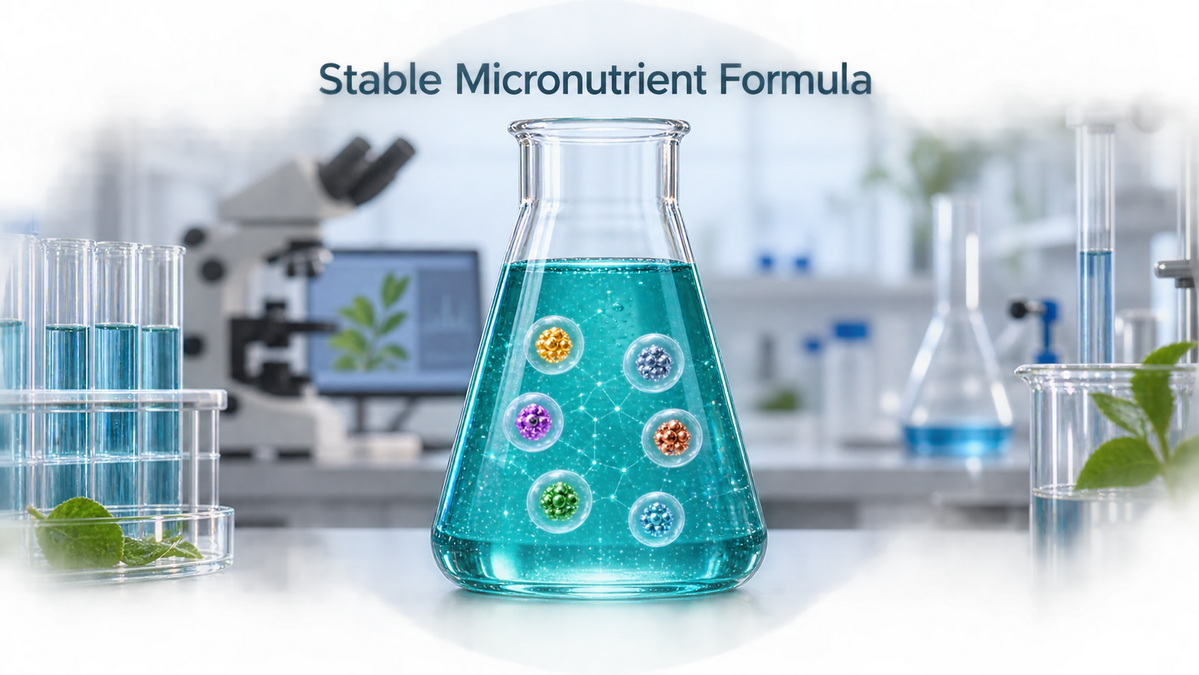
Hydroxyethyl Cellulose, commonly called HEC, is a nonionic cellulose ether made from natural cellulose. It is widely used as a thickener, suspension aid, rheology modifier, protective colloid, and stabilizer in water-based systems.
HEC is available in different viscosity grades. A low-viscosity grade may be selected for easier pumping and faster mixing, while a higher-viscosity grade may be used to improve suspension and reduce particle settling.
In liquid fertilizers, HEC can help create:
- Smooth, controlled viscosity
- Better suspension of fine mineral particles
- Reduced settling during storage
- Improved product uniformity
- More consistent dispensing and dosing
- Better visual appearance
- Easier redispersion after storage
- Improved handling during filling and transportation
Because HEC is nonionic, it generally avoids some of the direct charge interactions that can occur with ionic thickeners. This makes it a practical candidate for many liquid fertilizer systems containing dissolved salts and micronutrients.
However, performance still depends on the grade selected, polymer dosage, electrolyte content, nutrient concentration, temperature, and hydration process.
Hydroxyethyl Methyl Cellulose, commonly called HEMC or MHEC, is also a nonionic cellulose ether. It contains both hydroxyethyl and methyl groups, which give it different hydration, thickening, and temperature-response characteristics compared with HEC.
HEMC is widely used in construction materials, coatings, adhesives, and other water-based industrial products. In agricultural formulations, it can be used as a rheology modifier when a product requires a more structured flow profile.
HEMC may offer advantages in formulas requiring:
- Stronger body at rest
- More controlled shear-thinning behavior
- Improved anti-settling structure
- A more gel-like texture
- Better cling in selected foliar formulations
- Customized rheology for premium specialty products
However, HEMC should always be evaluated in the final fertilizer system. Its behavior can change depending on the level of dissolved fertilizer salts, the type of micronutrients, the pH range, the storage temperature, and the overall solids concentration.
Both HEC and HEMC can improve liquid fertilizer performance. The difference is not simply "good versus bad." The best option depends on what the formula needs to achieve.
| Performance Area | HEC | HEMC | Practical Meaning |
|---|---|---|---|
| Ionic character | Nonionic | Nonionic | Both are less likely to create direct ionic polymer interactions |
| Water solubility | Readily soluble in water when properly dispersed | Usually dissolves in cold water with suitable mixing | Both require a controlled hydration process |
| Thickening behavior | Broad viscosity range and smooth aqueous thickening | Can provide stronger body and tailored rheology | Choose based on target flow profile |
| Electrolyte tolerance | Often suitable for many water-based salt systems | Can perform well but requires salt-level testing | Final formula testing is essential |
| Solution clarity | Can support clear or visually clean solutions | May vary according to grade and formula | Important for premium liquid concentrates |
| Suspension support | Effective for fine particle suspension | Can provide structured anti-settling behavior | Particle size still matters |
| Temperature response | Often more predictable in broad aqueous conditions | May show more temperature-sensitive behavior | Important during hot storage and transport |
| Best starting use | Chelated micronutrient liquids and moderate-salt systems | Specialty suspensions and structured formulations | Select based on product positioning |
HEC is often the first material to evaluate for liquid fertilizer products that need stable, practical, and easy-to-process rheology.
It is especially suitable for:
- Chelated micronutrient fertilizer liquids
- Clear or slightly colored nutrient concentrates
- Foliar fertilizer products
- Water-based trace-element solutions
- Low-to-medium salt liquid fertilizers
- Products requiring consistent pumpability
- Formulations that must dilute easily in field water
- Systems needing improved suspension without excessive gel structure
HEC can provide a good balance between viscosity control and ease of handling. It is particularly useful when the finished product must remain pourable, fill smoothly into packaging, and flow through dosing equipment.
HEMC can be useful when a fertilizer manufacturer needs more specialized rheology. It may be selected for products that need higher body at rest or stronger anti-settling performance.
HEMC may be considered for:
- Dense suspension concentrates
- High-solids mineral fertilizer systems
- Specialty nutrient gels
- Products requiring stronger apparent viscosity at low shear
- Formulas needing more pronounced shear-thinning flow
- Certain foliar formulations where improved surface cling is desirable
- Premium agricultural inputs with a structured texture
A more structured formula is not always better. If viscosity becomes too high, the product may be difficult to pump, filter, fill, dilute, or apply. Therefore, HEMC dosage should be carefully optimized.
In high-quality micronutrient liquid fertilizers, the most important technical decision is often the selection of the micronutrient source and chelate system.
The selection process should begin with questions such as:
- Is the product designed for foliar application or fertigation?
- What is the target pH?
- Is the product intended for acidic, neutral, or alkaline water?
- Does the formula contain phosphate, sulfate, calcium, or magnesium?
- Is the micronutrient supplied as a sulfate, nitrate, oxide, carbonate, or chelate?
- What is the expected storage temperature?
- Will the product be diluted in hard water?
Only after these questions are answered should the formulator finalize the HEC or HEMC choice.
Iron is often the most challenging micronutrient to keep stable. It can become unavailable or form insoluble compounds when pH is too high or when it reacts with incompatible materials.
Iron is commonly supplied in several forms:
- Fe-EDTA
- Fe-DTPA
- Fe-EDDHA
- Ferrous sulfate
- Ferric sulfate
- Iron oxide
- Iron amino acid complexes
Chelated iron is generally preferred for stable liquid products because the chelate protects iron from undesirable reactions. However, each chelate has a preferred pH range.
For example:
- Fe-EDTA is commonly used in acidic to near-neutral conditions.
- Fe-DTPA is generally suitable for a wider pH range than Fe-EDTA.
- Fe-EDDHA is often selected for alkaline conditions because of its wider stability range.
HEC is frequently a good starting choice for chelated iron liquids because it can provide smooth viscosity and a clean appearance. HEMC may also work, but it should be evaluated carefully where the formula will experience high storage temperatures or high salt loading.
Zinc, manganese, and copper are commonly used in foliar fertilizers, fertigation products, seed treatments, and specialty crop nutrition programs.
These micronutrients may be supplied as:
- Sulfates
- Nitrates
- Chlorides
- Oxides
- Carbonates
- EDTA chelates
- Organic complexes
- Amino acid complexes
Metal sulfates can be economical, but they may increase ionic strength and create compatibility challenges in concentrated products. They can also react with phosphate, carbonate, calcium, or alkaline water.
For zinc, manganese, and copper products, HEC can be useful for maintaining consistent viscosity and supporting uniform suspension. HEMC can be useful when the formula contains fine insoluble solids and requires stronger structure at rest.
In both cases, the polymer should be tested with the exact micronutrient source. A polymer that works well with zinc sulfate may not perform the same way with copper chelate, manganese carbonate, or iron phosphate.
Boron and molybdenum usually create different formulation challenges compared with iron, zinc, manganese, and copper.
Boron may be supplied as boric acid, sodium borate, ethanolamine borate, or other boron-containing materials. Molybdenum may be supplied as sodium molybdate or ammonium molybdate.
Although they may not require the same chelation strategy as transition metals, they still influence the final salt load, pH, conductivity, and storage stability of the formula.
When boron and molybdenum are included in a multi-micronutrient blend, the total formulation must be assessed as one system. A stable single-nutrient product does not guarantee a stable multi-nutrient product.
pH is one of the most important control points in liquid micronutrient fertilizers.
A change in pH can affect:
- Micronutrient solubility
- Chelate stability
- Polymer hydration
- Product color
- Odor development
- Corrosion risk
- Storage stability
- Crop safety after dilution
A formula may have the right HEC or HEMC grade but still fail if its pH is not controlled.
In general, lower pH can help keep some metal ions more soluble. However, extremely low pH may damage certain chelate structures, increase corrosion risk, or create handling concerns. Higher pH can increase the risk of metal hydroxide, carbonate, or phosphate precipitation.
The ideal pH should be selected according to the nutrient chemistry of the product. It should also account for the pH of the water used by growers during dilution.
Water is not simply an inactive carrier. It is a formulation ingredient.
Hard water may contain calcium, magnesium, bicarbonate, iron, manganese, chloride, sulfate, and other dissolved minerals. These components can react with fertilizer ingredients and influence viscosity, clarity, and micronutrient stability.
Water-quality testing should include:
- pH
- Conductivity
- Total hardness
- Calcium concentration
- Magnesium concentration
- Bicarbonate concentration
- Iron contamination
- Manganese contamination
- Chloride concentration
- Sulfate concentration
Hard water can create precipitation problems in micronutrient fertilizers. Calcium and magnesium can react with phosphates and sulfates. High bicarbonate levels can raise alkalinity and make some micronutrients less stable.
When possible, use clean process water with controlled hardness. If field dilution water varies by region, carry out compatibility testing with several representative water samples.
Mixing order is often underestimated. Many stability failures occur because materials are added too quickly or in the wrong sequence.
A recommended process for many liquid micronutrient fertilizer systems is:
1. Charge clean water into the mixing vessel.
2. Begin moderate agitation.
3. Adjust the initial pH if required.
4. Add fully soluble base fertilizer materials gradually.
5. Dissolve chelating agents or use pre-chelated micronutrient materials.
6. Add micronutrient sources one at a time.
7. Allow each component to dissolve before adding the next one.
8. Hydrate HEC or HEMC using a validated dispersion procedure.
9. Adjust final viscosity.
10. Adjust final pH.
11. Add preservatives, antifoams, colorants, or surfactants if required.
12. Run final filtration and quality checks.
Some formulations may require the cellulose ether to be hydrated before the salt concentration becomes too high. Others may use pre-dispersed polymer systems. The correct sequence depends on the cellulose ether grade and the total fertilizer chemistry.
A small laboratory trial should always be completed before commercial-scale production.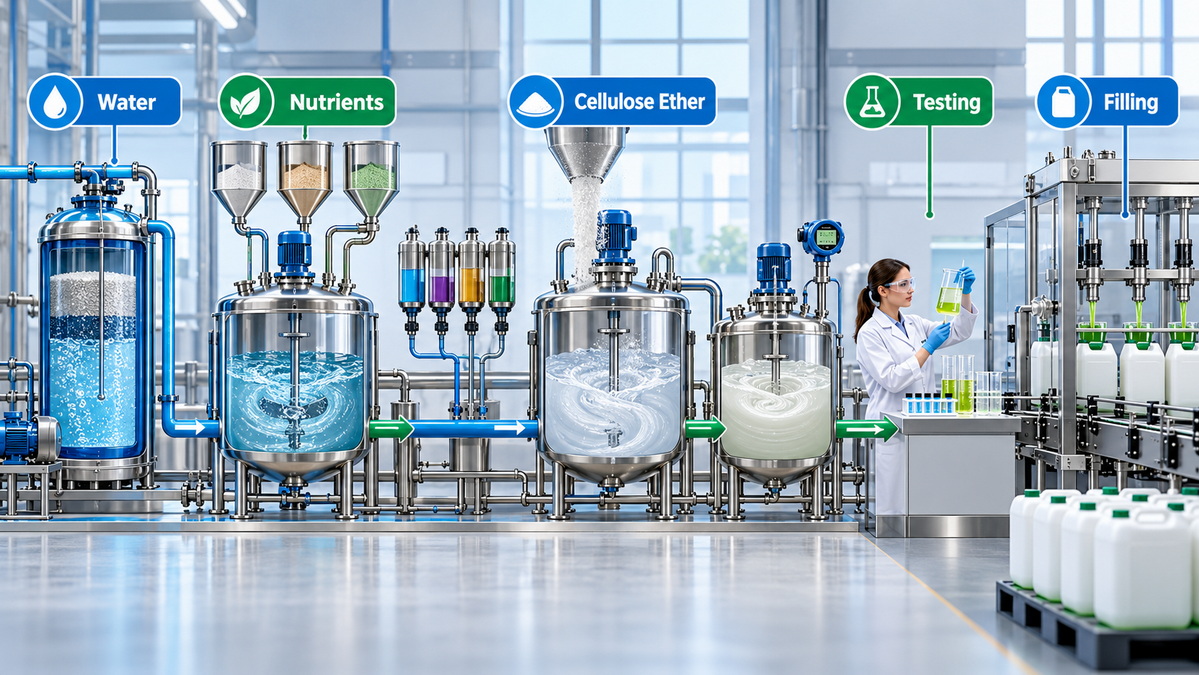
Incorrect hydration can cause undissolved polymer lumps, incomplete viscosity development, long mixing times, and poor batch consistency.
- Use clean water where possible.
- Start with moderate agitation.
- Create a stable vortex without introducing excessive air.
- Slowly sift the cellulose ether powder into the vortex.
- Avoid adding the powder in one large portion.
- Allow sufficient hydration time before adjusting viscosity.
- Add concentrated salts gradually after hydration unless the grade-specific process requires another method.
- Avoid excessive shear that may introduce foam or reduce process efficiency.
- Record batch temperature, mixing time, agitation speed, and addition sequence.
The most reliable procedure is not necessarily the fastest one. A consistent hydration method helps prevent batch-to-batch variation.
A compatibility jar test is a fast and cost-effective method for screening a liquid fertilizer formulation before scale-up.
The goal is to identify cloudiness, sediment, gas formation, flocculation, viscosity loss, or phase separation before the product reaches production equipment or customers.
1. Prepare the fertilizer formula using the intended process water.
2. Produce a small-scale batch at the same nutrient concentration planned for commercial production.
3. Prepare several jars with different HEC or HEMC dosages.
4. Record initial pH, conductivity, viscosity, color, and clarity.
5. Store samples at room temperature.
6. Place additional samples in elevated-temperature storage.
7. Run freeze–thaw cycles if the product may be shipped in cold conditions.
8. Observe samples after 1 hour, 24 hours, 7 days, 14 days, and 30 days.
9. Check for sediment, hard packing, color changes, odor, gas formation, and redispersibility.
10. Dilute the product in representative irrigation water and inspect for precipitation.
A product should not be considered stable simply because it looks good on the first day. Long-term behavior is more important.
Transportation and storage conditions can strongly affect liquid fertilizers.
High temperatures may accelerate chemical reactions, increase viscosity drift, reduce chelate stability, or change polymer structure. Low temperatures can lead to crystallization, freeze damage, separation, or incomplete redispersion.
A practical stability program should include:
- Ambient storage
- Elevated-temperature storage
- Low-temperature storage
- Freeze–thaw cycling
- Centrifuge testing
- Dilution testing
- Filtration testing
- Pumpability testing
- Redispersion testing
HEMC requires particular attention in high-temperature storage because methyl-containing cellulose ethers can show more temperature-sensitive behavior than HEC. The final formula should therefore be tested at realistic transport and warehouse temperatures.
A thick fertilizer is not automatically a stable fertilizer.
Increasing HEC or HEMC dosage may slow down particle settling, but excessive viscosity can create new problems:
- Difficult pumping
- Slow mixing
- Poor container filling
- Higher energy use
- Reduced filterability
- Incomplete emptying of containers
- Slow field dilution
- Uneven nutrient delivery
- Poor spray pattern
- Fertigation equipment blockage
The ideal product has enough structure to control settling but remains easy to manufacture, transfer, dilute, and apply.
A complete liquid fertilizer evaluation should include:
- Low-shear viscosity
- High-shear viscosity
- Yield stress
- Sedimentation rate
- Redispersibility
- Particle-size distribution
- pH stability
- Conductivity stability
- Filtration performance
- Pumpability
- Sprayability
- Dilution clarity
- Nutrient retention
- Storage stability
For suspension fertilizers, redispersibility is especially important. Soft sediment that redistributes after gentle shaking is generally more acceptable than hard-packed sediment that remains at the bottom of the container.
The following guide can help formulators make an initial HEC vs HEMC decision.
| Formulation Type | Preferred Starting Material | Main Reason |
|---|---|---|
| Clear chelated micronutrient fertilizer | HEC | Smooth viscosity and broad aqueous formulation flexibility |
| Foliar micronutrient concentrate | HEC | Easy handling, good dilution behavior, controlled viscosity |
| Moderate-salt trace-element liquid | HEC | Practical electrolyte tolerance and suspension support |
| High-solids mineral suspension | HEMC or HEC/HEMC comparison trial | May require stronger structure at rest |
| Gel-like specialty nutrient product | HEMC | Can provide more structured rheology |
| Fertigation stock solution | HEC | Often easier to pump, filter, and dilute |
| Calcium-containing product | Formula-specific testing | Compatibility depends mainly on nutrient chemistry |
| Phosphate-rich micronutrient liquid | Formula-specific testing | Must control precipitation risk before polymer selection |
A strong product-development process should follow a clear order.
Determine whether the product is designed for foliar application, fertigation, soil application, seed treatment, or another specialty use.
Choose micronutrient materials based on solubility, plant availability, target pH, crop requirements, and compatibility with other fertilizer ingredients.
Test process water and adjust the formula to minimize precipitation risk.
Evaluate several grades at realistic dosage levels. Do not compare only one HEC grade with one HEMC grade.
A polymer should be tested in the complete formula, not only in water or a simplified laboratory solution.
Run ambient, heat, cold, freeze–thaw, centrifuge, and redispersion tests.
Dilute the product in representative water samples. Check for cloudiness, precipitate, foam, and filter blockage.
Verify mixing time, filtration, pumping, filling, packaging compatibility, and batch consistency before scale-up.
HEC and HEMC can both play valuable roles in liquid fertilizer formulations containing micronutrients.
HEC is often the stronger starting choice for water-based micronutrient liquids because it provides effective viscosity control, practical suspension support, broad aqueous compatibility, and manageable processing behavior. It is especially suitable for clear chelated micronutrient products, foliar fertilizers, and moderate-salt liquid concentrates.
HEMC can be valuable for more specialized formulations requiring stronger structure, higher apparent body at rest, or tailored shear-thinning behavior. It may be particularly useful for dense mineral suspensions and premium gel-like agricultural products.
Neither HEC nor HEMC can replace sound fertilizer chemistry. The final product must be designed around compatible nutrient sources, stable chelates, appropriate pH, clean water, correct mixing order, and realistic storage testing.
The best cellulose ether choice is the one that delivers stable micronutrients, controlled flow, reliable redispersion, easy handling, and consistent performance under real production and field conditions.
Shandong Shengda New Material Co., Ltd. supports global fertilizer formulators with cellulose ether solutions for agricultural liquid systems. By selecting the appropriate HEC or HEMC grade and validating it in the final fertilizer formula, manufacturers can develop more stable, efficient, and commercially reliable micronutrient products.
HEC can be compatible with many micronutrient liquid fertilizer systems because it is nonionic and water-soluble. However, compatibility depends on the full formula, including pH, water hardness, salt concentration, nutrient source, chelate type, temperature, and mixing order.
HEMC is not always better. It may provide stronger structure at rest in some suspension systems, but HEC is often easier to process and is a strong starting point for many liquid fertilizers. The best option depends on particle size, solids loading, required viscosity, storage temperature, and application method.
No. HEC can improve suspension and physical stability, but it cannot prevent chemical precipitation caused by incompatible fertilizer ingredients, high pH, hard water, or unsuitable micronutrient sources.
Cloudiness may be caused by nutrient precipitation, poor chelate stability, unsuitable pH, hard water, excessive salts, incorrect mixing order, or incompatible combinations such as calcium with phosphate or sulfate.
Yes. HEC can be used in water-based foliar fertilizer formulations to help control viscosity, improve product uniformity, and support more consistent application. The final formula should still be tested for sprayability, dilution behavior, crop safety, and nozzle performance.
Important tests include pH, viscosity, conductivity, sedimentation, redispersibility, freeze–thaw stability, high-temperature storage, dilution stability, filtration, pumpability, nutrient retention, and package compatibility.
Calcium may react with phosphate to form insoluble materials. This can produce sediment, cloudiness, and blocked equipment. Separate tanks or carefully designed formulas are often used to reduce this risk.
Start by defining the product type, nutrient sources, pH range, salt concentration, water quality, target viscosity, storage conditions, and application method. Then compare several HEC and HEMC grades in small-scale trials using the complete formula.
1. University of Florida IFAS Extension. "Implementing the Five Rs of Nutrient Stewardship in Commercial Tomato Production."
[https://ask.ifas.ufl.edu/publication/HS1386]
2. Haifa Group. "How to Prepare Fertilizer Solutions in a Two-Tank System."
[https://www.haifa-group.com/how-prepare-fertilizer-solutions-two-tank-system]
3. Haifa Group. "Interaction Among Fertilizers (Compatibility)."
[https://www.haifa-group.com/haifa-blog/interaction-among-fertilizers-compatibility]
4. Haifa Group. "Haifa Micro™ Micronutrients Fertilizer for Plants."
[https://www.haifa-group.com/micronutrients-fertilizer-haifa-micro%E2%84%A2]
5. Haifa Group. "Fertigation: A Tool for Efficient Fertilizer and Water Management."
[https://www.haifa-group.com/sites/default/files/ifa_fertigation-Kafkafi-511.pdf]
6. Dow. "CELLOSIZE™ Hydroxyethyl Cellulose QP-15000-H."
[https://www.dow.com/en-us/pdp.cellosize-hydroxyethyl-cellulose-qp-15000-h-europe-pcg.129119z.html]
7. Ashland. "Natrosol™ 250 Hydroxyethylcellulose."
8. Kima Chemical. "Hydroxyethyl Methylcellulose (MHEC) Is a Nonionic Cellulose Ether."
[https://www.kdochem.com/news/properties-of-hydroxyethyl-methylcellulose-mhec-hemc.html]
9. SIEBTECHNIK TEMA. "Cellulose Ether."
[https://www.siebtechnik-tema.com/application/cellulose-ether/]
10. Shandong Shengda New Material Co., Ltd. "Cellulose Ether Types Explained: HPMC, HEMC, and HEC."


